Tag: Philadelphia Orchestra

  • Previn, Carol, and a General’s Musical Mishap

    Previn, Carol, and a General’s Musical Mishap

    Last week, when writing my memorial to Norman Carol – longtime concertmaster of the Philadelphia Orchestra, who died on April 28 – I recollected reading an anecdote André Previn shared in his book “No Minor Chords” (Doubleday, 1991), an amusing memoir, largely about Previn’s experiences in Hollywood, where seemingly no one in charge knew anything about music (hence the mocking title, taken from a memo handed down by producer Irving Thalberg, “No music in an MGM film is to contain a minor chord”).

    Previn was hired by Metro-Goldwyn-Mayer in 1946 while still in high school. MGM was “looking for somebody who was talented, fast, and cheap and, because I was a kid, I was all three,” he mused. He worked as a session musician, arranger, and composer, cutting his teeth supplying cues for Lassie movies. He would go on to write music for 50 films, was nominated for 11 Academy Awards, and won four. In 1960, he received three nominations in a single year! But Previn never took the movie biz too seriously and eventually he left it all behind to pursue a career in classical music.

    He was drafted into the military during the Korean War, and beginning in 1951, while stationed with the Sixth Army Band in San Francisco, he began conducting lessons with Pierre Monteux, then music director of the San Francisco Symphony. The particular passage I was thinking of is about the time he and Carol served together at the Presidio. I’ve been wanting to look it up, so this morning I finally took the book down from the shelf, and of course there’s no index. Thankfully, it’s a lean and entertaining 148 pages, so it didn’t take long for me to find what I was looking for.

    Sobering to think that both these gentlemen are gone now.

    Beginning on page 47:

    I made friends with Norman Carol, another musician stationed at the Presidio. He was even then a most remarkable violinist. Shortly after his discharge from the army he became concertmaster of the Philadelphia Orchestra, a distinguished position he has now held for thirty-odd years. But back in 1951, neither one of us could have laid claim to the adjective “distinguished” by the wildest stretch of the imagination. Whenever it was possible, we would commandeer a piano and play sonatas for our own pleasure, and I remember quite a few evenings at officers’ clubs, trying to make some Viennese bonbons audible over the hubbub.

    Norman and I were summoned to appear at the office of the reigning two-star general one day. We absolutely could not figure out why. Our small transgressions of the rules were definitely not worthy of generals, and neither of us could come up with a reason to receive a medal. So we shined our boots, pressed our wrinkled ties, and polished our belt buckles, hoping that our smart appearance might lessen whatever blow was to be aimed at us. The general was feeling chatty. “I’m told you two can play the fiddle and the piano pretty good,” he said. “Well, in two weeks’ time there’s going to be a huge meeting of heads of state here in Frisco; Truman is coming, and so are the Russians, the English, the French, and everybody else. After the meetings are over, there’s gonna be a big blowout at the Palace Hotel, and I want you to play for a half hour or so. Understood?”

    We nodded rapidly. Yes, we understood. We thank the general, sir. We’ll do our best, sir, yes indeed. We saluted and backed away from the desk, treading on each other’s feet and bumping into a map case. When we got to the door, the general said rather sharply, “Oh, there’s one thing I forgot. You mustn’t play anything recognizably national. Nothing American or Russian or French or English. Understood?”

    We looked at one another. Obviously this request was both loony and impossible to fulfill. My misplaced compulsion for jokes surfaced. “If the general agrees,” I said winningly, “we could play a long Swiss medley.”

    Not a blink, not a smile was forthcoming. That’ll be fine. See to it,” and the general turned away from us. Silently we went outside. Once we were on the street, Norman turned on me. “You moron,” he started, “you asshole, what are we going to do now? A Swiss medley, you jerk! Name me some Swiss composers except Bloch and Frank Martin! We’ll be court-martialed!”

    I calmed him down. “Nobody’ll be listening, Norman,” I said with confidence, “and if by chance anyone does listen, what makes you think they’ll recognize the music? As it turned out, I was right. The ballroom of the Palace Hotel was live with bunting and flags, the guests were representative of the world’s power, and they were not interested in the two GIs on a small corner platform, assaying Brahms, Debussy, and Prokofiev. We ate a lot of very good food, drank a glass or two of wine, and ogled the great and powerful. Our general passed, retinue in tow. This was one night when he was outranked, but he was very scary to us. He gave us the briefest of glances and smiled a smile which never reached his eyes.

    “Well done, boys,” he said. “Carry on.”


    My post about Norman Carol here:

    https://www.facebook.com/photo/?fbid=1297416914510702&set=a.883855802533484
  • Remembering Norman Carol Philly Legend

    Remembering Norman Carol Philly Legend

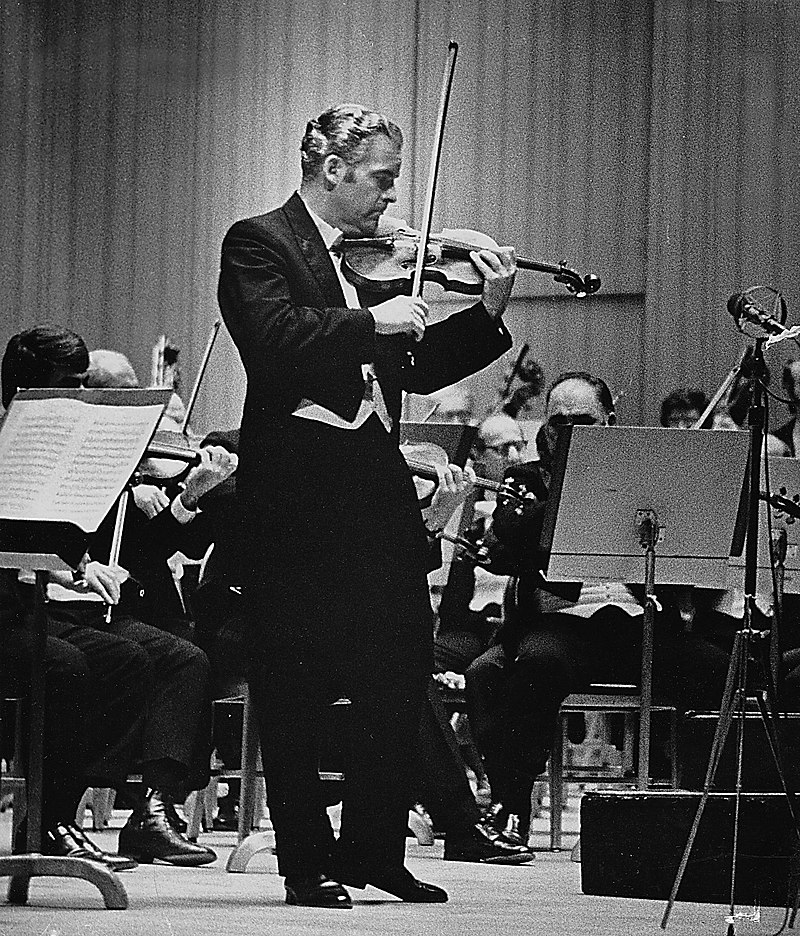
    Even though I continue to attend the occasional Philadelphia Orchestra concert (most recently on April 11 to hear Mahler 7 and, coming up, Sibelius 5), for me the glory days of my attendance were from the mid-‘80s to the mid-‘90s, when I was there nearly every week, often standing in line for a couple of hours on a Friday or Saturday evening, with a cup of coffee and a friend or a book, in order to score a $2.00 seat in the amphitheater at the old Academy of Music. (The price was later raised to $2.50.) Norman Carol, therefore, will always be the Philadelphia Orchestra concertmaster closest to my heart.

    Carol joined the orchestra, at the invitation of Eugene Ormandy, in 1966. He served as concertmaster (succeeding Anshel Brusilow) under Ormandy, Riccardo Muti, and Wolfgang Sawallisch. His retirement in 1994, I remember, came ahead of his scheduled performance as soloist in Samuel Barber’s Violin Concerto, the piece with which he had made his Philadelphia solo debut decades earlier. As I recall, he had been playing through excruciating shoulder pain and he just couldn’t do it anymore.

    In the years of my attendance, I was fortunate to hear Carol step up from his position as leader of the orchestra to solo in many concertos. One of the most memorable, for me, was that of Benjamin Britten, which, at the time, I had never heard before.

    Prior to his position in Philadelphia, Carol had played in the Boston Symphony Orchestra under Serge Koussevitzky (who extended the invitation to join when Carol was 17) and Charles Munch. He was concertmaster with the orchestra, when, under Leonard Bernstein, it gave the U.S. premiere of Britten’s “Peter Grimes” at Tanglewood in 1946.

    Following service in the Korean War (André Previn relates playing with Carol and Chet Baker at the Presidio in his book “No Minor Chords”), he became concertmaster of the New Orleans Symphony and then the Minneapolis Symphony, under Antal Doráti and Stanislaw Skrowaczewski. Decades later, Carol would give the premiere of Skrowaczewski’s Violin Concerto in Philadelphia, as Skrowaczewski guest conducted.

    As a student at the Curtis Institute, Carol was groomed for a solo career. He went on to record an early recital for RCA. Later, of course, he played solo violin passages on all the Philadelphia Orchestra recordings from the time he joined the group, including Ormandy’s later recordings of “Ein Heldenleben” and “Scheherazade.”

    After his retirement, he continued to perform and record with the Philadelphia Piano Quartet. He also taught orchestral repertoire at Curtis. (He was on the Curtis faculty for some 40 years.) His violin, a 1743 Guarneri “del Gesù,” formerly belonged to Albert Spalding. Spalding gave the first public performances of Barber’s Violin Concerto in Philadelphia in 1941.

    Carol was old school, tuning the orchestra in evening dress, his wavy hair impeccably Brylled, seemingly unflappable in his reserve. But when he played, he played like the principal of one of the greatest orchestras in the land. I knew him neither as a man nor behind the scenes, but only from my vantage in the appreciative audience. He embodied the traditions of a fabled era. His like will not come again.

    Carol, who was born in Philadelphia, died on Sunday at the age of 95. R.I.P.


    Carol plays the Nielsen Violin Concerto

    Big band Telemann

    1958 recorded recital with Julius Levine

    Vaughan Williams’ “Fantasia on a Theme by Thomas Tallis,” featuring solos by Carol, violist Joseph De Pasquale, and cellist Samuel Mayes

    Two-part interview with Ovation Press:

    Part 1

    Interview with Norman Carol, Part 1

    Part 2

    Interview with Norman Carol, Part 2

  • Mahler 7 Philadelphia Orchestra Review

    Mahler 7 Philadelphia Orchestra Review

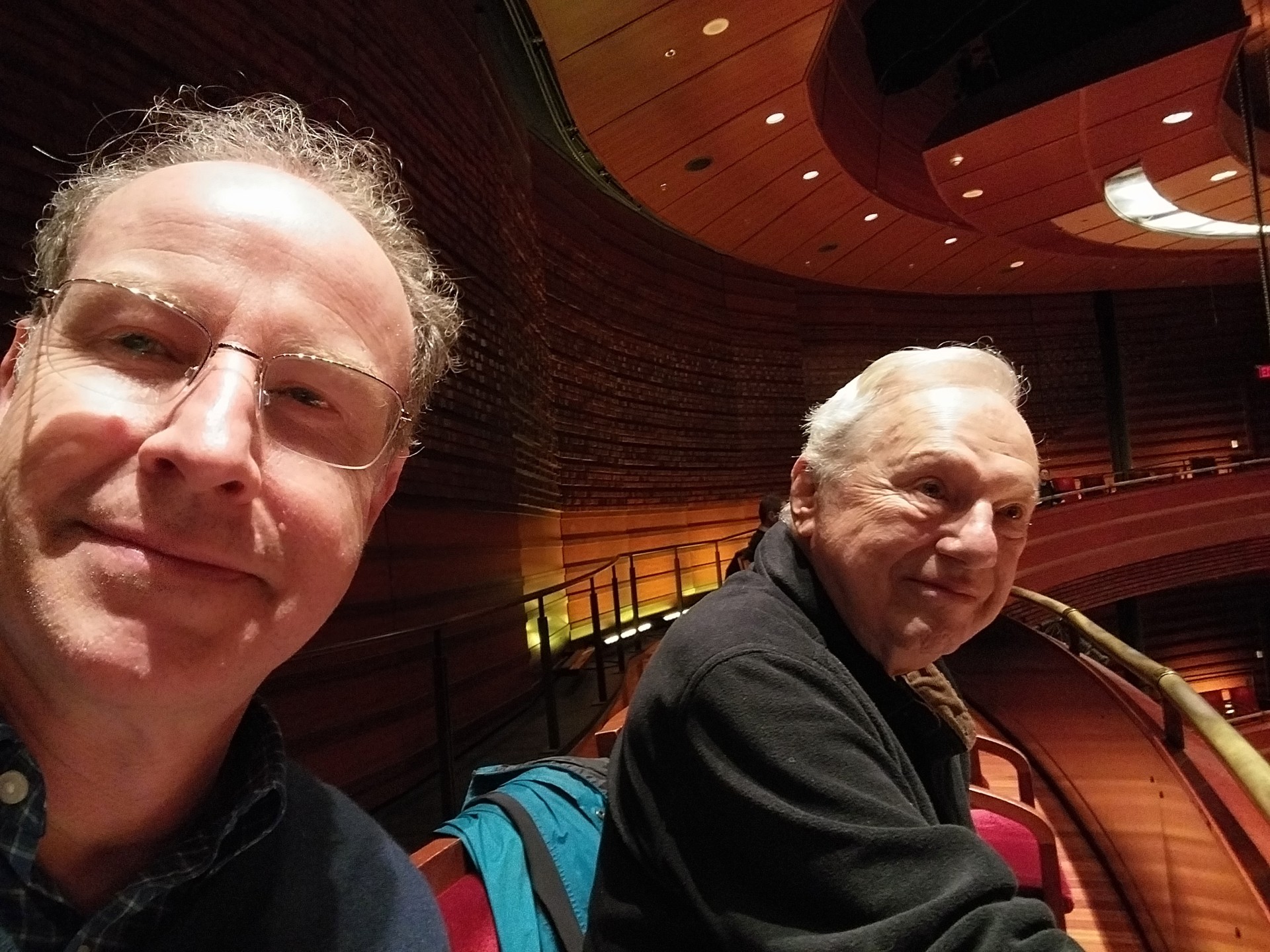
    With Robert Moran last night for Mahler 7 with The Philadelphia Orchestra, at the recently-rechristened Marian Anderson Hall at the Kimmel Center for the Performing Arts. Bob likes to get there early and, last night anyway, sit close, so here we are, all alone, in our “box” in the third tier, like Statler and Waldorf, overlooking the stage and waiting for the auditorium to fill. The vantage is not my preference, but it is within my price range, and – pleasant surprise – the sound did not suffer at all for it. The orchestra performed magnificently under its music director, Yannick Nézet-Séguin, but the brass players, in particular, must have had their super-serum. Everything was so immediate, which in my experience has not always been the case in this hall. Of course, Mahler, he does write big.

    The 7th has fun, outlandish touches in the orchestration, including parts for acoustic guitar, mandolin, and cowbells, for the pastoral “Nachtmusik” movements (there are two of them framing a central scherzo in a five-movement structure, which is why you will sometimes hear the work referred to as “Song of the Night”), and enormous, pendulous chimes for the rousing finale.

    The crowd, which included many young people, a number of whom looked like they were bused in together as part of a sizeable group, roared its approval, and a smiling Yannick, who looked all the world like a diminutive angel on the podium, as I gazed down on his blond hair, went from section to section to genuflect before all the principals. Percussionist Don Liuzzi was clearly an audience favorite for his thrilling mastery of the timpani.

    The orchestra will take its act to Carnegie Hall tonight at 8:00, but will return to Philly for two more performances, Saturday at 8:00 and Sunday at 2:00. You may not think that the 7th is anyone’s favorite Mahler, but if the orchestra plays with the energy and commitment it did last night, you could change your mind.

    Tickets and information here:

    https://www.philorch.org/performances/our-season/events-and-tickets/

    Don Liuzzi timpani teaser

    Look closely at the bird’s-eye, and you’ll see the guitar and mandolin on the left, next to the harps

  • Marin Alsop Joins Philly Orchestra

    Marin Alsop has been appointed principal guest conductor of the Philadelphia Orchestra, beginning in the 2024-25 season. Details at the link.

  • Frank Kaderabek Obituary Philadelphia Orchestra

    Frank Kaderabek Obituary Philadelphia Orchestra

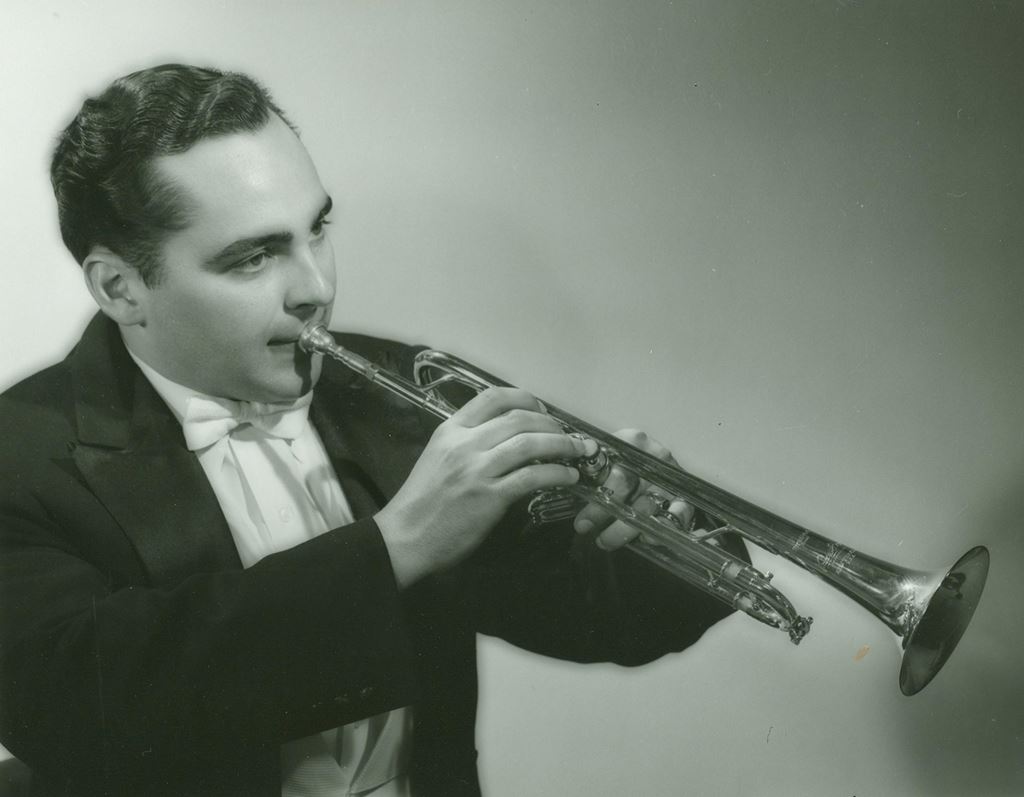
    I’m a little late to the table for this one, but I just learned that Frank Kaderabek has died. For me, Kaderabek was a familiar presence from his twenty years as principal trumpet of the Philadelphia Orchestra. But it turns out it was but the crown on an estimable career as an orchestra musician. No doubt he was burnished in the raging fiery furnace of Fritz Reiner’s Chicago Symphony, with its legendary brass section, but he also held positions with the Dallas and Detroit Symphony Orchestras. This may be old news to some, but it’s all new to me. All I know is that Kaderabek was one of the Philly all-stars who played under Ormandy and who made my weekly sojourns to the Academy of Music in the 1980s and ‘90s so rewarding.

    Kaderabek died on December 28 at the age of 94. His recordings will live on.


    A very informative and satisfying obituary at the link. It really gives a sense of a life well lived.

    https://www.legacy.com/us/obituaries/inquirer/name/frank-john-kaderabek-obituary?id=53976009

    In Scriabin’s “The Poem of Ecstasy”

    Opening Mahler’s Symphony No. 5

    And Mussorgsky’s “Pictures at an Exhibition”

    I may be wrong about this, and please correct me if I am, but I believe he’s playing shoulder-to-shoulder here with some legendary brass players of Reiner’s Chicago Symphony – under guest conductor Paul Hindemith!

    R.I.P.

Tag Cloud

Aaron Copland (92) Beethoven (94) Composer (114) Film Music (116) Film Score (143) Film Scores (255) Halloween (94) John Williams (185) KWAX (228) Leonard Bernstein (99) Marlboro Music Festival (125) Movie Music (131) Opera (197) Philadelphia Orchestra (86) Picture Perfect (174) Princeton Symphony Orchestra (106) Radio (86) Ralph Vaughan Williams (85) Ross Amico (244) Roy's Tie-Dye Sci-Fi Corner (290) The Classical Network (101) The Lost Chord (268) Vaughan Williams (99) WPRB (396) WWFM (881)

DON’T MISS A BEAT

Receive a weekly digest every Sunday at noon by signing up here


RECENT POSTS