Tag: Philadelphia Orchestra

  • Ormandy’s Lost American Legacy Rediscovered

    Ormandy’s Lost American Legacy Rediscovered

    Eugene Ormandy was born Jenő Blau in Budapest in 1899. In 1927, he became a naturalized American citizen and wound up directing the Philadelphia Orchestra for 44 years.

    In that capacity, he championed much contemporary music and works by his adopted countrymen – a fact eclipsed by his reputation as a superb interpreter of the 19th century classics.

    In fact, for many years, much of his American legacy dropped out of print. In the late 1990s, Albany Records attempted to rectify the situation by reissuing some of Ormandy’s recordings of lesser-heard American music. The series only made it to three volumes, but each one of them is a treasure.

    This week on “The Lost Chord,” we’ll hear two selections from these invaluable anthologies. Both are by Pulitzer Prize winners whose music has sadly fallen out of fashion.

    William Schuman was the very first recipient of the Pulitzer Prize for Music, in 1943, for his “Cantata No. 2, A Free Song.” At the height of his fame, he was also President of Lincoln Center. He was considered such an important figure in American culture, he was even brought on to “What’s My Line?” (Those were the days.)

    We’ll hear Schuman’s “Credendum – Article of Faith,” composed in 1955. The work was written in response to the first ever commission by the U.S. government for a symphonic work.

    Two years later, the Pulitzer was awarded to Norman Dello Joio, for his “Meditations on Ecclesiastes.” His symphonic suite “Air Power” was adapted from 22 individual scores composed for the CBS television series about the history of aviation. The series ran from November 1956 through the spring of 1957. (Dello Joio would collect his prize in April.) The individual sections were used to underscore segments on the early days of flight, with their barnstormers and daredevils, air battles and war scenes.

    I hope you’ll join me for these rarely-heard recordings of American music. Ormandy flies American, on “All-American Ormandy,” on “The Lost Chord,” now in syndication on KWAX, the radio station of the University of Oregon!


    Remember, KWAX is on the West Coast, so there’s a three-hour difference for the Trenton-Princeton area. Here are the respective air-times of my recorded shows (with East Coast conversions in parentheses):

    PICTURE PERFECT, the movie music show – Friday on KWAX at 5:00 PACIFIC TIME (8:00 PM EST)

    THE LOST CHORD, unusual and neglected rep – Saturday on KWAX at 4:00 PACIFIC TIME (7:00 PM EST)

    Stream them here!

    https://kwax.uoregon.edu/


    William Schuman on “What’s My Line?” (1962):

    https://www.youtube.com/watch?time_continue=10…

    “Air Power,” narrated by Walter Cronkite (1956):

    https://www.youtube.com/watch?v=gKXKTh50USM


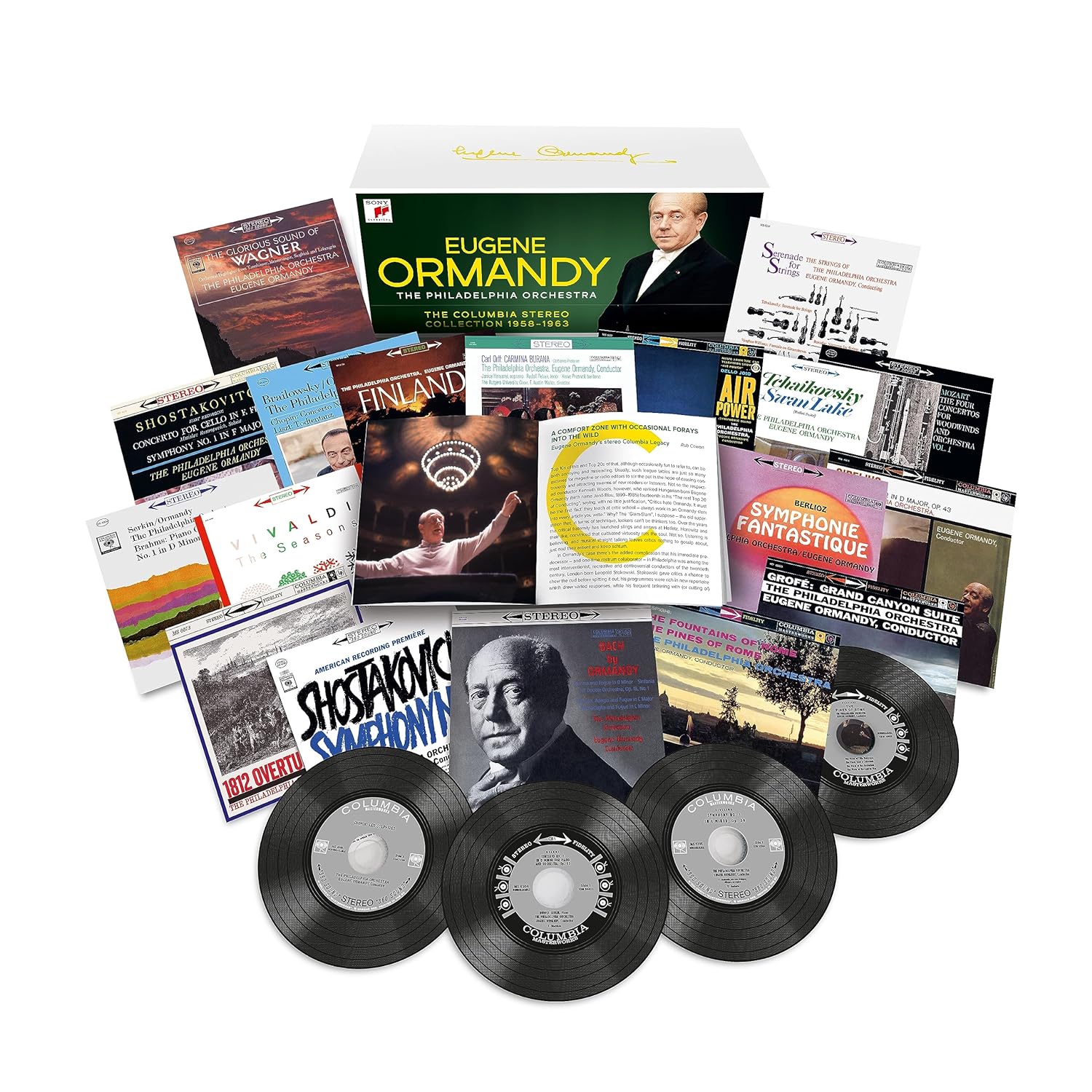
    PLEASE NOTE: Ormandy’s recording of Dello Joio’s “Air Power Suite” will be reissued on Friday, November 17, as part of Sony Classical’s impending 88-CD box, “Eugene Ormandy/The Philadelphia Orchestra: The Columbia Stereo Collection.”

    Schuman’s “Credendum” was reissued in 2021, as part of Sony’s 120-CD box (all mono), “Eugene Ormandy: The Columbia Legacy.”

    Both Sony releases have been newly-remastered.

  • Ormandy’s Stereo Legacy: New Philadelphia Orchestra Box

    Ormandy’s Stereo Legacy: New Philadelphia Orchestra Box

    Here it comes! Two years after my euphoric reception of Sony Classical’s mega-box of mono recordings by Eugene Ormandy and the Philadelphia Orchestra comes news of the first installment of presumably multiple boxes of the partnership’s legendary stereo recordings.

    Of course, now we’re getting into duplication territory, as a fair number of these have been reissued countless times and form the core of the Ormandy/Philadelphia legacy. HOWEVER, they will all be remastered, presumably (if following the blueprint of the earlier set) individually filed in sleeves reproducing the original album notes and cover art, and interleaved with a number of dimly-recollected curiosities from the LP era, some of them never revived in any form.

    Release date: November 17. I placed my pre-order earlier this week. You can shop around for the lowest price. I’m locked in at $170, and for 88 CDs and the luxury packaging, I consider it a steal.

    https://www.sonyclassical.com/releases/releases-details/eugene-ormandy-the-stereo-collection-1958-1963

    I’m projecting there will be four of these boxes in all: the mono set, this stereo release of recordings from 1958-1963, a second stereo set covering 1964-1968, and a stereo set embracing the later RCA years. Last year, there was an Ormandy/Minneapolis set of mono recordings predating his Philadelphia years. I already have a fair amount of that material, but it’s only 11 CDs, so maybe I should take a closer look to be sure it’s not something else I should invest in. But it’s really Philadelphia I want. Including maybe a Robin Hood Dell set!

    In case you missed it, here’s my enthusiastic reception of the “Eugene Ormandy: The Columbia Legacy” boxed set from May 2020.

    The actual press release on Sony Classical’s website is cut-and-pasted with no paragraph breaks and no indication of the actual disc-by-disc content. Here’s a better indication from a secondary source. Still, no mention of the soloists.

    https://www.importcds.com/eugene-ormandy-and-philadelphia-orch-columbia-coll/194399774328

    Okay, Sony, so maybe you’re not the best when it comes to promoting your reissues. Just keep producing sets of the quality of the original Ormandy box, and you can keep taking my money!

  • Romeo Cascarino Rediscovered

    Romeo Cascarino Rediscovered

    I can’t say it’s what the composer intended, but there’s no such thing as bad publicity. Here’s the slow movement of Romeo Cascarino’s Bassoon Sonata – played on theremin and toy piano!

    Cascarino, who was born on this date 101 years ago, grew up in an unforgiving neighborhood in South Philadelphia. With a name like Romeo, he had to learn how to use his fists! While navigating the School of Hard Knocks, he taught himself privately, gleaning the mechanics of music theory from books checked out of the Free Library. He was discovered by composer Paul Nordoff, who recognized his genius, and the two formed a bond that was more like a friendship than teacher-student.

    While still in his teens, Cascarino was handed a letter from Aaron Copland, inviting him to Tanglewood. Romeo’s father had secretly sent the “Dean of American Composers” some of Romeo’s compositions, and Copland responded with an impressively favorable evaluation. At Tanglewood, upon further examination, Copland said he couldn’t suggest any improvements and that Romeo’s works should remain just as they were.

    If you’re interested to know more, I wrote about Cascarino and Copland in further detail last year:

    Later, Cascarino served as a professor of composition at Philadelphia’s Combs College of Music. The recipient of two Guggenheim Fellowships, he labored at his magnum opus, the opera “William Penn,” for the better part of three decades. The work received its premiere at Philadelphia’s Academy of Music in 1982 to mark the 300th anniversary of the founding of the city. Metropolitan Opera singer bass-baritone John Cheek sang the title role.

    “William Penn” is one of American opera’s best-kept secrets. I’m convinced, if only it had been completed 30 years earlier, it would now be spoken of in the same breath with Carlisle Floyd’s “Susannah” and Robert Ward’s “The Crucible.”

    In 2006, a number of Cascarino’s orchestral works were recorded by JoAnn Falletta for the Naxos label. These too are informed by a seductive, twilit beauty.

    The Bassoon Sonata was written at the request of Cascarino’s army buddy, Sol Schoenbach, in 1942. The composer made some sketches, but completed the work only after he was discharged. Schoenbach later became principal bassoonist of the Philadelphia Orchestra and recorded the piece for Columbia Records’ “Modern American Music Series.”

    This was the not only music to came out of the war. Cascarino composed his plaintive elegy, “Blades of Grass,” in 1945. The title refers to Carl Sandburg’s poem “Grass,” written in 1918, in response to the “Great War.” It seems the work was played by the U.S. Marine Band as recently as last month!

    https://www.marineband.marines.mil/News/Article/3502846/playing-americas-music/

    Here it is, performed by English hornist Dorothy Freeman and Philadelphia’s Orchestra 2001.

    Happy birthday, Romeo Cascarino, wherever you are. Your music endures, even if we have to thank the Marines, and not the Army, for playing it!


    Clockwise from left: Cascarino outside the Academy of Music, before a poster of “William Penn;” at Tanglewood with Aaron Copland (Copland standing, arms crossed, center, with Cascarino the big guy holding the cigarette on the right); and Sgt. Cascarino conducting a U.S. Army band

  • Ormandy’s China Tour: An American Overture

    Ormandy’s China Tour: An American Overture

    When Eugene Ormandy took the Philadelphia Orchestra to China for its first concert there, 50 years ago today, he was sure to include, alongside Mozart and Brahms, some music from the American Heartland.

    Roy Harris (1898-1979) was born in a log cabin, in Lincoln County, Oklahoma, on Lincoln’s birthday. If that doesn’t imbue a composer with a sense of destiny, I don’t know what will. Harris went on to became one of our great American symphonists. In particular, his Symphony No. 3 of 1939 has been much beloved and frequently performed. Unfortunately, we don’t hear all that much of his music anymore. And that’s a damned shame.

    Philadelphia would be the first American orchestra to perform in China (the London and Vienna Philharmonic Orchestras had appeared earlier the same year), having received an invitation in response to Nixon’s historic visit in 1972. According to first-hand accounts, audience reactions to the performances were difficult to decipher. On the street, people were curious, but stand-offish. Red banners and likenesses of Mao, Lenin, and Stalin festooned Tiananmen Square. The local orchestra played Western music (Beethoven), but only in rehearsal, for training purposes. In summer, musicians pruned trees.

    Here are some interesting, balanced impressions, from a diary kept by one of the Philadelphians:

    https://www.inquirer.com/arts/philadelphia-orchestra-china-tour-1973-mao-beijing-20190509.html?fbclid=IwAR18VHjKTjBIKdUQlKfwXOzcso2DIy8oDdtrGWd-ZjYUZt6h_9aS9peihuU

    In all, the orchestra played six concerts. This was the trip on which Philadelphia performed the notorious “Yellow River” Concerto, a piano concerto written by committee and overseen by Madame Mao herself. Interesting that a country that did its damnedest to suppress decadent Western influence would shamelessly pilfer from the Western Romantics. As an encore, the pianist played a set of variations on “Home on the Range,” apparently a concession to Nixon. According to the diarist, Madame Mao did not care for “The Pines of Rome.” Mao himself was a no-show.

    Also included on the programs were “The Stars and Stripes Forever” and the “Chinese Worker’s March.” Again, the Beijing audience seemed impassive. Performances were received with more enthusiasm in Shanghai.

    While I haven’t been able to locate any recordings of the Chinese concerts, here’s Ormandy and the Philadelphians playing Harris in Russia in 1958. Additional American offerings included Samuel Barber’s “Adagio for Strings” and George Gershwin’s “An American in Paris,” which were played alongside Igor Stravinsky’s “The Firebird.” You can hear the tepid applause in Russia, when following the link.

    The ”Yellow River” Concerto has been described as a first cousin to Richard Addinsell’s “Warsaw Concerto.” Prior to their departure, the Philadelphia Orchestra gave the U.S. premiere of the piece, one of the works requested by the Chinese to be performed on the impending tour. Daniel Epstein was the soloist at its Saratoga Springs debut. Epstein would accompany the orchestra to China and record the concerto with the the musicians on their return. The album was released on on RCA Records. For some reason, it was never reissued on CD, but is now available for purchase as an mp3.

    Diplomat Nicholas Platt, who accompanied Nixon to Beijing in 1972, and later traveled with and advised Ormandy, talks about some of the complications surrounding the Philadelphia Orchestra’s trip to China.

  • Sawallisch’s Quiet Genius Remembered

    Sawallisch’s Quiet Genius Remembered

    Sometimes I get nostalgic for the days when classical music was very nerdy and very Teutonic.

    Here are four renowned conductors – Wolfgang Sawallisch, Fritz Rieger, Rudolf Kempe, and Rafael Kubelik (okay, so Kubelik was Czech) – rehearsing Bach at their respective keyboards, with members of Kubelik’s Bavarian Radio Symphony Orchestra. You get a sense that this is about as informal as these guys ever got! Anyway, it’s a pleasant diversion for a Sunday morning.

    Sawallisch, later music director of the Philadelphia Orchestra, would have been 100 yesterday. I had my eye on the centenary for the past week, and had meant to post about it, but then I got busy and it just passed me by.

    My first exposure to Sawallisch’s musicmaking was in my 20s, during my days in community radio, when I stumbled across his recording of Smetana’s “Ma Vlast,” which I’m happy to say I’ve always retained an affection for. I’ve got it on CD now, but I kind of miss the original overheated cover, when it was issued on vinyl: with its harpist perched atop a jutting reef, assailed by crashing waves, against the backdrop of a diurnal supermoon; its diaphanous, sword-bearing fairy; and its naked women cavorting in a mountain lake, rendered with all the marvelous vulgarity of 1970s airbrushed van-art.

    I couldn’t believe it when a friend of mine broke the news over coffee one afternoon that Sawallisch was coming to Philadelphia. This was a more leisurely time, before we were all lashed to the internet.

    Sawallisch?!!

    That “Ma Vlast” album cover aside, his was a name I had come to associated with Old World integrity and classic (mono) recordings of Richard Strauss. Had he ever even been to the United States? How old was he? I guess at the time he must have been around 70.

    His tenure as music director in Philadelphia would prove to be a high-profile capstone to a very respectable, indeed enviable – if not exactly glamorous – career. There was always something akin to this Bach video about Sawallisch – earnest and all about the music. But there’s something kind of reassuring about returning it now, when seemingly everything is all about flash and dazzle.

    Sawallisch was music director in Philadelphia from 1993 to 2003. In addition to his directorship of L’Orchestre de la Suisse Romande, he also held posts with the Vienna Symphony (allegedly turning down offers from the Vienna Philharmonic and the Metropolitan Opera), the Hamburg Symphony Orchestra, and the Bavarian State Opera. He died in 2013, six months shy of his 90th birthday.

    Memorably, his abilities as a pianist came in handy during a ferocious snowstorm in 1994, when Philadelphia Orchestra musicians couldn’t make it in for a scheduled concert of scenes from Wagner’s “Tannhäuser” and “Die Walküre” (including all of Act I). He made the impromptu decision to throw open the doors of the Academy of Music and play the accompaniment himself at the keyboard, supporting Deborah Voigt, Heikki Suikola, and chorus, free for the enjoyment of anyone who cared to brave the elements.

    Say want you want about stolid Sawallisch, his generous spirit will not soon be forgotten. If only there were more of the spirit of that “Ma Vlast” van art in his musicmaking.


    Sawallisch conducts “Šárka” from “Má Vlast” in Japan in 1990

Tag Cloud

Aaron Copland (92) Beethoven (95) Composer (114) Film Music (123) Film Score (143) Film Scores (255) Halloween (94) John Williams (187) KWAX (229) Leonard Bernstein (101) Marlboro Music Festival (125) Movie Music (138) Opera (202) Philadelphia Orchestra (89) Picture Perfect (174) Princeton Symphony Orchestra (106) Radio (87) Ralph Vaughan Williams (85) Ross Amico (244) Roy's Tie-Dye Sci-Fi Corner (290) The Classical Network (101) The Lost Chord (268) Vaughan Williams (103) WPRB (396) WWFM (881)

DON’T MISS A BEAT

Receive a weekly digest every Sunday at noon by signing up here


RECENT POSTS