Following a leisurely walk through Rittenhouse Square in Philadelphia about 30 years ago, I sat down at a keyboard in my studio apartment, hoping to recapture the hazy, haunting music that had flitted around the periphery of my consciousness. I smiled with relief and satisfaction, when I knew I had finally gotten it down. I was proud of myself to have created something so beautiful! It was only later that I realized it was “The Girl with the Flaxen Hair.”
Claude Debussy, always stealing my thunder. Happy birthday, mon vieux!
Here it is, performed by flaxen-haired twins in a field full of wild flowers.
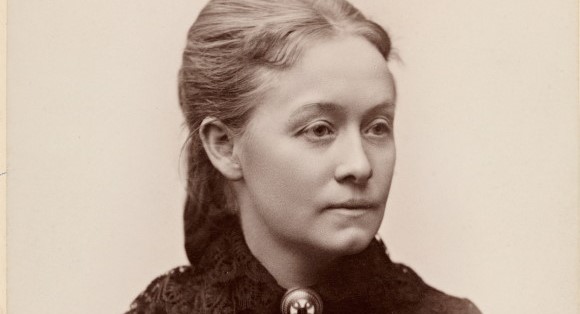
Today is the 175th anniversary of the birth of Norwegian pianist and composer Agathe Backer Grøndahl. Backer, from a well-to-do, art-loving family, studied music in Christiana, Berlin, and Florence. Among her teachers were Theodor Kullak and Hans von Bülow.
She made her professional debut in Christiana in 1868, as soloist in Beethoven’s “Emperor” Concerto, with Edvard Grieg on the podium. Of course, she was also a celebrated interpreter of Grieg’s own piano concerto. In fact, the two artists enjoyed a close friendship. She was also guided by Ole Bull, the famed Norwegian violinist, who recommended teachers and had a special piano constructed for her.
In 1873, she became part of Franz Liszt’s circle at Weimar, and she took lessons with him. She herself was to become an influential teacher. George Bernard Shaw praised her as one of the greatest piano virtuosos of the century.
She married Olaus Andreas Grøndahl, a vocal teacher, in 1875. A mother of three, Backer Grøndahl yet managed to compose more than 400 works for piano, voice, and orchestra. Over 70 of these were published in her lifetime. She died in 1907 at the age of 59.
Her sister was the painter Harriet Backer.
Sara Aimée Smiseth talks about and plays Agathe Backer Grøndahl. Smiseth recorded an album of Grøndahl’s works for the Grand Piano label.
Geir Henning Braaten plays Grøndahl’s 3 Morceaux, Op. 15. The opening “Serenade” is among her most frequently performed works.
PHOTOS: Agathe Backer Grøndahl, top, and at center, at an 1898 music festival in Bergen. To her left (our right) are some of the most famous names in Norwegian music: Edvard Grieg, Christian Sinding, Johan Svendsen, and Johan Halvorsen.
According to a certain school of thought, folk music – music of the land – embodies the spirit of a nation. And no nation’s composers milked that cow quite as soulfully as the English.
This Sunday night on “The Lost Chord,” we’ll have an hour of bucolic reflections for the keyboard of a time lost to technology and industrialization.
We’ll begin with Gerald Finzi’s “Eclogue” for piano and string orchestra. Originally drafted in the mid-‘20s as the projected slow movement of a piano concerto, the material was later reshaped by the composer, who was content to let it stand on its own. In case you’re not familiar with the term, an eclogue is a short pastoral poem.
If you find yourself transported by this, I think you will also really enjoy Cyril Rootham’s “Miniature Suite” of 1921. Rootham, better known for his choral music, was a friend of Ralph Vaughan Williams and Gustav Holst. His work at Cambridge University exerted a significant influence over English musical life. Like the “Eclogue,” the “Miniature Suite” is scored for piano and strings.
In between, I’ll provide a palate cleanser in the form of E.J. Moeran’s “Summer Valley.” Moeran was one of the last composers to really thrive on English folk music. “Summer Valley,” composed for solo piano in 1925, was dedicated to Frederick Delius.
Finally, we’ll engage in a bit of musical time travel. In addition to the whole folk song perspective, England is justifiably proud of its formal musical past. The legacy of the Tudors was a particular influence on works such as Benjamin Britten’s “Gloriana,” Gordon Jacob’s “William Byrd Suite,” and Vaughan Williams’ “Fantasia on a Theme by Thomas Tallis.”
In the case Herbert Howells – like Rootham, a composer better recognized for his choral endeavors – he fell under the spell of the clavichord, after he was lent one by one Herbert Lambert, a photographer with a passion for building replicas of early keyboard instruments.
The fortuitous encounter led to the composition of three suites, written in different periods of Howells’ life, which hark back to the glory days of the “Fitzwilliam Virginal Book.” All three sets are characterized by an inventive blend of Tudor and English folk influences. Each of the individual movements are dedicated to a friend or colleague of the composer. We’ll hear the first set, titled “Lambert’s Clavichord,” written in 1927, which was sanctioned for performance on the modern piano.
I hope you’ll join me for an hour of musical escapes to the countryside and the golden musical past. That’s “Idyll Thoughts” – pastoral English works for piano – this Sunday night at 10:00 EDT, on WWFM – The Classical Network and wwfm.org.
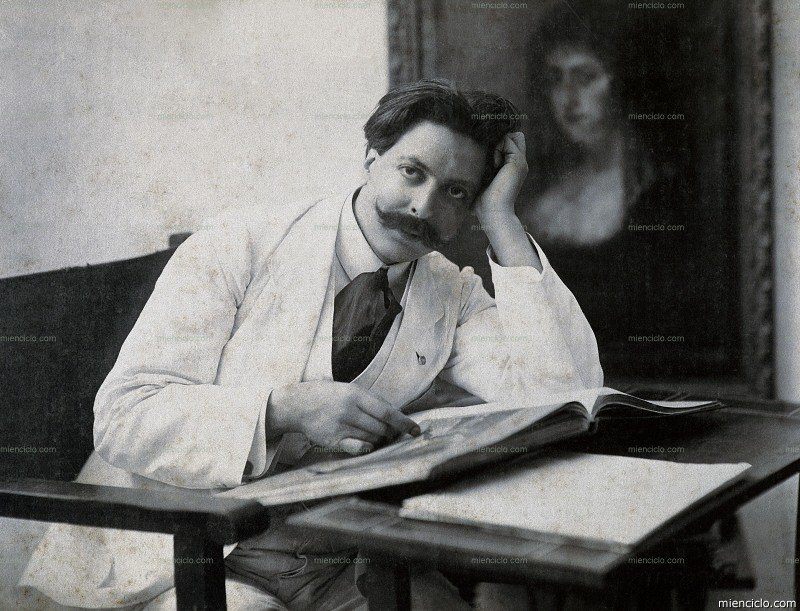
Yesterday, I wrote about the untimely death of Enrique Granados in connection with his delayed return from the U.S., after being invited to the White House by Woodrow Wilson following the sensational debut of his opera “Goyescas” at the Metropolitan Opera. Granados’ ship was torpedoed in the English Channel by a German U-boat, and the composer drowned when attempting to save his wife.
Granados was born on this date in 1867. He is best-remembered, of course, for his delectable piano miniatures, which contain music of great beauty and sensitivity. He’s sometimes described as “the Spanish Chopin.” I prefer to think of him as “the Spanish Grieg.” And that is not in any way to damn him with faint praise. He may be my favorite Spanish composer.
Here’s a pleasing recital by Pablo Matías Becerra (including “Valses poéticos,” Spanish Dance No. 2 “Oriental,” “El pelele,” Spanish Dance No. 7 “Arabesca,” “Allegro de concierto,” and “Escenas románticas”)
Anyone looking to gain a more comprehensive overview of the scope of Granados’ compositional output could do worse than to seek out three volumes of his orchestral works recorded by Pablo González and the Barcelona Symphony Orchestra and National Orchestra of Catalonia, on the Naxos label.
Also, a piece for piano, organ, and three choruses, called “Song of the Stars,” lost for nearly a century.
None of the orchestral pieces rise to the level of the piano music, in my opinion, but they all contain some very charming, wholly neglected music. One of the volumes includes a half-hour symphonic poem, “Dante” (little charm here, perhaps, but plenty of drama), which will surely modify your view of the composer.
Just before Granados’ fateful homeward journey from New York, he made some live-recorded player piano rolls for the Aeolian Company’s “Duo-Art” system. Here are two of them.
Granados playing “The Maiden and the Nightingale” from “Goyescas”
And the Spanish Dance No. 5 “Andaluza”
In 1909, he began a piano concerto. This was interrupted by “Song of the Stars” and the operatic version of “Goyescas.” The concerto would be left unfinished at the time of Granados’ death.
In 2011, the sketches were rediscovered and a realization undertaken. Keep in mind, the completed work is purely conjectural, the first movement built on two surviving fragments. The other movements were adapted from existing Granados works: the Spanish Dance No. 2 “Oriental” and “Capricho español” (for Movement II) and “Allegro de concierto” (for Movement III). Here’s a performance in concert.
An ironic footnote: one of the Granados’ sons, also named Enrique, became a champion swimmer, who competed in the 1952 Summer Olympics.
Happy birthday, Enrique Granados. And gracias.
Alicia de Larrocha plays “Goyescas,” in its original guise
150 summers have passed since the birth of Déodat de Séverac. I suppose it’s only appropriate that the composer best known for “En vacances” be born in the season of vacations.
Musically speaking, there are two types of getaways: (1) actual travel music, inspired by a journey to a particular locale; and (2) the flight of fancy, a vacation of the creative mind. Either lends itself to compiling collections of miniatures, after the fashion, perhaps, of some of the great keyboard works of Robert Schumann.
Séverac studied in Paris with Vincent d’Indy and Albéric Magnard. He also acted as an assistant to Isaac Albéniz, whose character pieces certainly influenced some of his own evocative regionalisms for the keyboard.
Séverac himself composed two sets of piano pieces, which he collected under the title “En vacances” (“On Vacation”). The second of these, sadly, was left incomplete at the time of his death at the age of 48.
These sketches suggest the experiences of his children, Mimi and Toto, in particular, with individual movements titled “Invocation to Schumann,” “Grandmother’s caresses,” “Visit from the little girls next door,” “Toto pretends to be a verger,” “Mimi dresses up as a Marquise,” “In the park,” “On listening to a musical box,” and “Romantic Waltz.”
Enjoy both sets, performed here by Aldo Ciccolini:
Happy birthday, Déodat de Séverac, born 150 years ago!
PHOTO: For Déodat de Séverac, a good smoke is like a vacation