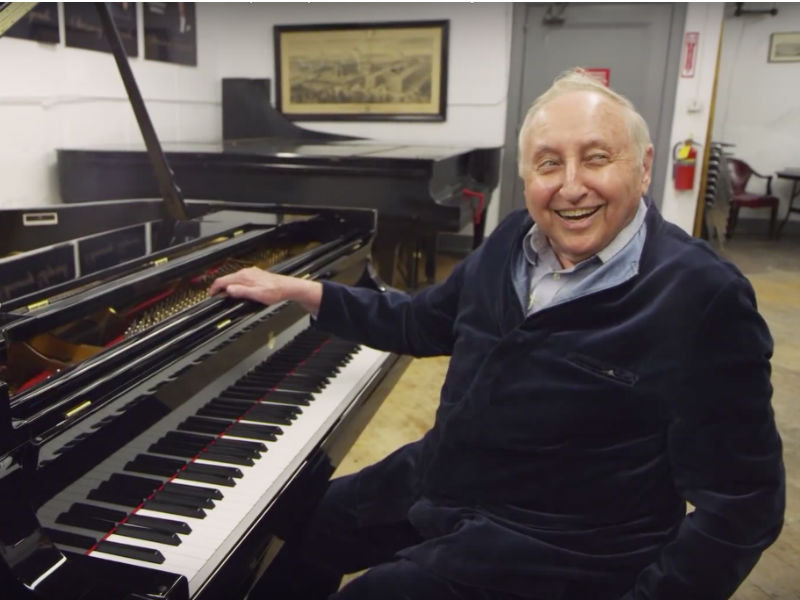
Although he recorded extensively as a soloist for Columbia Records (now Sony Classical), his career as a concert pianist never really seemed to catch fire. Or perhaps I should say, he never captured the public’s imagination quite to the extent of some of his more publicity-friendly contemporaries. This was certainly not for lack of skill or interpretive depth. He just wasn’t interested in playing the fame game. It could be argued that Eugene Istomin found his most comfortable fit away from the spotlight, as a conversational performer and equal voice in one the premier chamber ensembles of his time.
With violinist Isaac Stern and cellist Leonard Rose – as the Istomin-Stern-Rose Trio – he really seemed to find his niche. The trio was an unlikely creation, an all-star ensemble greater than the sum of its parts. And its parts were pretty great. All three musicians were known quantities, “name” soloists who worked very hard to shed their larger-than-life predilections and explore a shared intimacy in chamber music of the masters. Their recordings of the complete Beethoven piano trios, in particular, a Grammy Award winner in 1970, is still highly regarded. Too bad they couldn’t come up with a catchier name for the group.
On his own, Istomin, a contemporary of Leon Fleisher and Gary Graffman, never seemed to excite the way the other two pianists did. This, despite professional associations with Eugene Ormandy, Bruno Walter, Leonard Bernstein, Fritz Reiner, George Szell, Leopold Stokowski, and Pablo Casals. (Istomin later married Casals’ widow.) For one thing, he was more interested in the Viennese classics than he was the Russian showpieces that set audiences aflame. Not that he didn’t love those too. His recording of the Rachmaninoff 2nd with Ormandy and the Philadelphia Orchestra demonstrates that, when he wanted to be, he could be very much the virtuoso. Of course, Fleisher and Graffman’s careers were curtailed by focal dystonia, a repetitive stress malady that effects the fingers and is all-too-common among hard-driving classical performers, with their unforgiving practice regimens.
Istomin had, by his own admission, “pretentious” tastes. He was interested in the music he was interested in, even if it didn’t fit the paradigm of what critics thought he should be tackling at a given stage of his career. (Surely, he was too young to be playing Beethoven and Brahms. This is the time he should be playing Tchaikovsky and Rachmaninoff!) He was also an avid reader and a book collector, at one point hired by Harcourt Brace Jovanovich as an advisor on the publication of facsimile editions of works by Joseph Conrad, Thomas Hardy, and others.
Yet he also had a common touch. An ardent fan of the Detroit Tigers, he toured the Midwest with a twelve-ton truck full of his own Steinway pianos. He wanted to be sure to make the music he loved available to the people.
It’s said that his relationship with Rose, who could be touchy and unforgiving even under the best of circumstances, was damaged when Istomin maneuvered behind the scenes with Columbia to get a shot at a concerto recording at a time when he was supposed to be documenting all the Beethoven sonatas for violin and cello with his companions in the trio. The fact that these were left incomplete because of the resulting rift with the label left Rose with a festering resentment. But nothing was simple between Rose and Istomin. They suited one another perfectly, playing together beautifully, as long as they kept their mouths shut. But they also held very strong convictions and weren’t shy about expressing them. Clearly, they remained intimates, but Rose carried hard feelings over the Beethoven debacle for the rest of his life.
Unquestionably, Istomin found depth in the Viennese masters and fire in the Russians, but it was always on his own terms. He also commissioned and performed works by living composers, including Roger Sessions (his piano concerto), Henri Dutilleux, and Ned Rorem. Again, Istomin was more interested in the substance of music-making than in the publicity machine.
Like Josephine Baker and Jerry Lewis, it’s possible he found greater appreciation in France, where he was the recipient of the Légion d’honneur in 2001.
Istomin died in 2003, 16 days before his 78th birthday. He was a terrific pianist, if perhaps not the most enduringly famous. Remembering him today, with gratitude, on the 100th anniversary of his birth.
Tag: Piano
-

100 Years and 88 Keys of Eugene Istomin
-

Diverse, Disciplined, and Dignified: Philadelphia’s Leon Bates Dies at 76
It is with regret that I learn that Leon Bates, Philadelphia born and bred, has died. With his dual devotion to music and bodybuilding, Bates was a very interesting man, at the time he was making his name not at all fitting the image of what I imagine many people held of a typical concert pianist. Bates stood 6’ 4” and at his physical peak could bench press 300 pounds.
His repertoire was broad, ranging from the meat-and-potatoes classics to works by repertory American composers Edward MacDowell and George Gershwin to those of contemporary masters George Walker, William Bolcom, and Adolphus Hailstork; also, those of jazz pianist Chick Corea. Bates internalized the lessons of jazz in his performance of the classics. At the very least, he believed music should never be performed the same way twice. He also preferred to find his own way to the core of a piece, and when preparing for a concert, he shunned exposure to recorded interpretations by other pianists.
For as interesting as he was as a person, there was nothing flamboyant in his personality. When your interests already seem so wildly diverse and you excel at everything you do, there’s no need to make a big show of it. You just do what you do with precision and grace.
I had the good fortune to interview Bates for the Times of Trenton in 2016. Two years later, he retired from the concert stage at the age of 68, after a diagnosis of Parkinson’s Disease. For a time, he thought maybe he had been drinking too much coffee.
Bates died on Friday. He was 76 years old.
R.I.P.*****
Here’s a link to the article. Since everything is on the internet forever except for the stuff you want, I’m also including the text below.
https://www.nj.com/times-entertainment/2016/12/classical_music_new_addition_t.html
If you’re looking for the inspiration to stick to your New Year’s resolution, you need look no further than pianist Leon Bates. Bates, whose life has been enriched by both music and sports, is as disciplined as they come. The results are evident in a career that has been marked by unflagging energy and an unusual focus on physical fitness.
“It definitely helps with the stamina,” he says of his weight training. “To be able to play a piano concerto, with an orchestra, is a tremendous responsibility. It requires a lot of energy. Discipline is a thing that is extremely important. Any kind of an experience where you have a chance to demonstrate your discipline, you get results. You’re encouraged and you’re reinforced by the results that you get when you do things correctly.”
Bates will join the Capital Philharmonic of New Jersey for its annual New Year’s Eve concert this Saturday night at the Trenton War Memorial. The orchestra’s music director, Daniel Spalding will conduct a program of buoyant classics, including works by Franz von Suppé, Nikolai Rimsky-Korsakov, Leonard Bernstein, and Johann Strauss II. Bates will be the soloist in George Gershwin’s “Rhapsody in Blue.”
“‘Rhapsody in Blue’ has had such favor with audiences I think, because it’s got recognizable melodies that are very enjoyable,” he says. “People, regardless of whether they know music or not, can identify with it. As far as my association with the piece, I try to keep it fresh by injecting little aspects of improvisation here and there. Gershwin had that particular quality of being able to blend elements of jazz, elements of music from the ‘20s, with classical literature. It’s a winning combination which has worked very well for him.”
Bates’ dynamic career has included performances with the Philadelphia Orchestra, the New York Philharmonic, the Cleveland Orchestra, the Los Angeles Philharmonic, and the symphony orchestras of Atlanta, Boston, Detroit and San Francisco. He has toured the United States with the Boston Pops under Keith Lockhart and the Orchestra of France under Lorin Maazel. He has appeared with leading orchestras and at prestigious music festivals around the world.
“When I got involved with weight training, I found that there was a very, very direct corollary between being able to do sets and reps in the gym, trying to train a specific muscle and finding that there was a great deal of discipline involved in doing the activity correctly, with the proper technique, and what I am saying about music, being able to practice an idea over and over until you get that right, and having the stamina and fortitude to do that.”
A native of Philadelphia, he understands just how fortunate he was as a child and teenager to have supportive and nurturing mentors in his life, starting with his parents, who were extraordinary people of limited financial means. His father drove a forklift for Sears, Roebuck & Co., and his mother was a homemaker. Yet they saw to it that Bates never wanted for a musical education.
“My mother was very attentive to me, and as she saw me gravitate towards pianos, she took the initiative to start me with lessons when I was about six,” Bates says. “From the very beginning, I was always ambitious about wanting to be able to play music. I played on a recital for the first time when I was about seven years-old, and I was hooked.” His parents bought him his first piano, which he had until he was 15, and later, a small grand piano to help him prepare for his career as a concert musician.
He is also thankful for his three influential teachers. Cristofor Sinjani taught him privately at his Germantown studio for six years. (“He was a very good role model,” Bates says. “He taught me more than how to play the piano; he taught me how to be a good musician.”) For five years, he studied with Irene Beck at the Settlement Music School. (“She had great aspirations for me to become a concert pianist, which was what I wanted to do since I was 12 or 13.”) He went on to major in Piano Performance at Temple University with the distinguished pedagogue Natalie Hinderas. (“She was really an outstanding performer as well as a very fine teacher.”)
Bates himself has made it a point to share something of his musical good fortune, through conducting master classes with young musicians and by playing for elementary, middle, and high school students. “I think it’s really important for young people to be exposed to these kinds of things, on as many different levels, and through as many different opportunities as possible. You never know what kind of door it will open to them down the road.” -
Funny Men Play Serious Rachmaninoff
As April Fool’s Day and Rachmaninoff’s birthday elide, here are two funny men in recordings that take the composer rather seriously.
Oscar Levant rode his neuroses and mordant wit to fame as a popular panelist on radio and television, the disheveled, chain-smoking second banana in motion pictures, and author of books with titles such as “A Smattering of Ignorance,” “The Memoirs of an Amnesiac,” and “The Unimportance of Being Oscar.” But he was also one of the most respected champions of the music of George Gershwin, a composer who studied with Arnold Schoenberg, and a serious pianist who performed and recorded the standard concerto repertoire with the New York Philharmonic and the Philadelphia Orchestra.
Here, Oscar plays it straight, with Rachmaninoff’s Prelude in G major, Op. 32, No. 5.
The pianist Victor Borge also displayed a genius for comedic improv, early in his career segueing from standard concert recitals to his signature cocktails of music and humor. His Broadway hit, “Comedy in Music,” entered the Guinness Book for the longest run of a one-person show (849 performances, from 1953 to 1956). In the 1960s, Borge was one of the highest-paid entertainers in the world.
Like Levant, he had his personal demons, but their source would appear to have been circumstantial rather than psychological. He attained early popularity in Scandinavia (Borge was born in Denmark), but as his extensive touring took him all over Europe, a Jew getting laughs with anti-Nazi jokes didn’t exactly endear him to Adolf Hitler. When German forces occupied Denmark, Borge hopped a U.S. Army transport out of Finland – though he would return, not long after, disguised as a sailor, to visit his dying mother.
He arrived in the United States in 1940, with 20 dollars in his pocket and no understanding of English. But he was a fast learner, and he taught himself the language by going to American movies.
Here, all jokes aside, Borge plays Rachmaninoff’s arrangement of Fritz Kreisler’s “Liebesleid” (“Love’s Sorrow”).
Kreisler was one of the world’s great violinists. A famous anecdote relates that he and Rachmaninoff were giving a concert in New York. In the middle of a performance, Kreisler suffered a memory lapse, and as he noodled around on his violin, trying to find his way back, he inched closer to his pianist and whispered, “Where are we?” To which Rachmaninoff replied, “Carnegie Hall.”
Rachmaninoff gets the last laugh on April Fool’s Day, as he performs Kreisler’s “Liebesfreud” (“Love’s Joy”).
-

Ruth Slenczynska Rachmaninoff’s Pupil at 100
Ruth Slenczynska, believed to be the last living pupil of Sergei Rachmaninoff, was born 100 years ago today. Slenczynska, who was born in Sacramento, CA, now makes her home in Hershey, PA.
Slenczynska made her debut in Berlin at the age of 6. She performed with orchestra for the first time in Paris at the age of 7. At 15, she walked away from it all, attending Berkeley (she was a psychology major) and hoping to live a normal life. She married at 19, but divorced nine years later.
She began to teach piano for a living, which drew her back into the concert world. She was artist in residence at Southern Illinois University Edwardsville, a full-time position, from 1964 to 1987. In 1957, she published her memoirs, “Forbidden Childhood,” recounting her experiences as a prodigy. She also wrote “Music at Your Fingertips: Aspects of Pianoforte Technique.”
Her complete recordings for American Decca, set down between and 1956 and 1963, have been reissued on compact disc by Deutsche Grammophon. Several albums were released on Ivory Classics. She recorded the music for her most recent release, “Ruth Slenczynska: My Life in Music,” at the age of 97.
The Washington Post published an article on her in February of last year. In it, she recollects Rachmaninoff’s first impression of her, when she met him in Paris at the age of 9. “This very tall man opened the door and looked down at me. He pointed at me with his long finger and said, ‘THAT plays the piano?’”
If that’s not Rachmaninoff, I don’t know what is.
Even without the Rachmaninoff connection, her pedigree is breathtaking. Among her other teachers were Artur Schnabel, Egon Petri, Alfred Cortot, and Josef Hoffman.
Happy birthday, Ruth Slenczynska!
Slenczynska talks and plays Rachmaninoff in 1963
Slenczynska in a Pathé newsreel, at the age of 5
Slenczynska at 99
Nice write-up by Australian Broadcasting Corporation
https://www.abc.net.au/listen/programs/legends/ruth-slenczynska/101790326
-

Horowitz Plays the White House for Carter & More
In 1978, Jimmy Carter invited Vladimir Horowitz to play at the White House. As noted by Jim Lehrer, this was not for some special state occasion, but rather because of Carter’s genuine appreciation for the pianist, whose records he once scrimped to purchase back when he was a young man serving in the U.S. Navy.
It was not Horowitz’s first appearance at the White House. He was invited for the first time by Herbert Hoover in 1931. In 1986, he returned to play for President Reagan. He also allowed some encores to be broadcast from a Carnegie Hall recital, in honor of FDR’s birthday, in 1942.
I provide two links to the Carter recital below. The second is far and away of better quality, but the first includes the president’s opening remarks, which last a little over two minutes.
Carter had an affection for all kinds of music and strove to celebrate it over the course of his presidency. You can tell he held Horowitz particularly dear.
Watch here for the opening remarks:
The actual performance portion in better quality:
Tag Cloud
Aaron Copland (92) Beethoven (94) Composer (114) Conductor (84) Film Music (105) Film Score (143) Film Scores (255) Halloween (94) John Williams (178) KWAX (227) Leonard Bernstein (98) Marlboro Music Festival (125) Movie Music (120) Opera (194) Picture Perfect (174) Princeton Symphony Orchestra (102) Radio (86) Ralph Vaughan Williams (83) Ross Amico (244) Roy's Tie-Dye Sci-Fi Corner (290) The Classical Network (101) The Lost Chord (268) Vaughan Williams (97) WPRB (396) WWFM (881)