Tag: Piano

  • Ruth Slenczynska Rachmaninoff’s Pupil at 100

    Ruth Slenczynska Rachmaninoff’s Pupil at 100

    Ruth Slenczynska, believed to be the last living pupil of Sergei Rachmaninoff, was born 100 years ago today. Slenczynska, who was born in Sacramento, CA, now makes her home in Hershey, PA.

    Slenczynska made her debut in Berlin at the age of 6. She performed with orchestra for the first time in Paris at the age of 7. At 15, she walked away from it all, attending Berkeley (she was a psychology major) and hoping to live a normal life. She married at 19, but divorced nine years later.

    She began to teach piano for a living, which drew her back into the concert world. She was artist in residence at Southern Illinois University Edwardsville, a full-time position, from 1964 to 1987. In 1957, she published her memoirs, “Forbidden Childhood,” recounting her experiences as a prodigy. She also wrote “Music at Your Fingertips: Aspects of Pianoforte Technique.”

    Her complete recordings for American Decca, set down between and 1956 and 1963, have been reissued on compact disc by Deutsche Grammophon. Several albums were released on Ivory Classics. She recorded the music for her most recent release, “Ruth Slenczynska: My Life in Music,” at the age of 97.

    The Washington Post published an article on her in February of last year. In it, she recollects Rachmaninoff’s first impression of her, when she met him in Paris at the age of 9. “This very tall man opened the door and looked down at me. He pointed at me with his long finger and said, ‘THAT plays the piano?’”

    If that’s not Rachmaninoff, I don’t know what is.

    Even without the Rachmaninoff connection, her pedigree is breathtaking. Among her other teachers were Artur Schnabel, Egon Petri, Alfred Cortot, and Josef Hoffman.

    Happy birthday, Ruth Slenczynska!


    Slenczynska talks and plays Rachmaninoff in 1963

    Slenczynska in a Pathé newsreel, at the age of 5

    Slenczynska at 99

    Nice write-up by Australian Broadcasting Corporation

    https://www.abc.net.au/listen/programs/legends/ruth-slenczynska/101790326

  • Horowitz Plays the White House for Carter & More

    Horowitz Plays the White House for Carter & More

    In 1978, Jimmy Carter invited Vladimir Horowitz to play at the White House. As noted by Jim Lehrer, this was not for some special state occasion, but rather because of Carter’s genuine appreciation for the pianist, whose records he once scrimped to purchase back when he was a young man serving in the U.S. Navy.

    It was not Horowitz’s first appearance at the White House. He was invited for the first time by Herbert Hoover in 1931. In 1986, he returned to play for President Reagan. He also allowed some encores to be broadcast from a Carnegie Hall recital, in honor of FDR’s birthday, in 1942.

    I provide two links to the Carter recital below. The second is far and away of better quality, but the first includes the president’s opening remarks, which last a little over two minutes.

    Carter had an affection for all kinds of music and strove to celebrate it over the course of his presidency. You can tell he held Horowitz particularly dear.

    Watch here for the opening remarks:

    The actual performance portion in better quality:

  • Madness & Movie Music The Piano’s Dark Side

    If the definition of insanity is doing the same thing over and over and expecting a different result, then surely Hanon etudes are a ticket to the madhouse.

    This week on “Picture Perfect,” get keyed-up with music from movies about madness and the piano.

    Whenever he hears a loud, discordant sound, unhinged pianist-composer Laird Cregar is compelled to commit murder, in the 1945 film “Hangover Square.” Bernard Herrmann wrote the moody, romantic score, which includes a piano concerto, played by Cregar’s character during the film’s conflagration finale.

    Peter Lorre is an unstable musicologist who is haunted by the disembodied hand of a murdered pianist with a penchant for Brahms’ arrangement of Bach’s Chaconne, in “The Beast with Five Fingers,” from 1946. Max Steiner was the composer. The hand is played by concert pianist Victor Aller, brother-in-law of Felix Slatkin and Leonard Slatkin’s uncle.

    Alan Alda plays a frustrated pianist who falls in with a ring of Satanists, in “The Mephisto Waltz” from 1971. This time, Jerry Goldsmith blends Franz Liszt with amplified instruments and electronics to memorably eerie effect. Five years later, Goldsmith would win his only Academy Award for his music to “The Omen.”

    Finally, Hans Conried plays a dictatorial pedagogue in “The 5,000 Fingers of Dr. T,” released in 1953. “5,000 Fingers” holds the distinction of being the only feature ever written by Dr. Seuss. The film sports an outrageous production design (including a gargantuan keyboard for 500 enslaved boys) and whimsical songs.

    The composer was Frederick Hollander. Born in London, Hollander attained fame in Germany as Friedrich Hollander. His best-known international success was “The Blue Angel,” starring Marlene Dietrich, who introduced his song, “Falling in Love Again.” With the rise of the Nazis, Hollander fled to the United States, where he worked on over 100 films.

    We go crazy for the keyboard this week. Practice makes psychotic on “Picture Perfect,” music for the movies, now in syndication on KWAX, the radio station of the University of Oregon!


    Clip and save the start times for all three of my recorded shows:

    PICTURE PERFECT, the movie music show – Friday at 8:00 PM EDT/5:00 PM PDT

    SWEETNESS AND LIGHT, the light music program – ALL NEW! – Saturday at 11:00 AM EDT/8:00 AM PDT

    THE LOST CHORD, unusual and neglected rep – Saturday at 7:00 PM EDT/4:00 PM PDT

    Stream them, wherever you are, at the link!

    https://kwax.uoregon.edu/

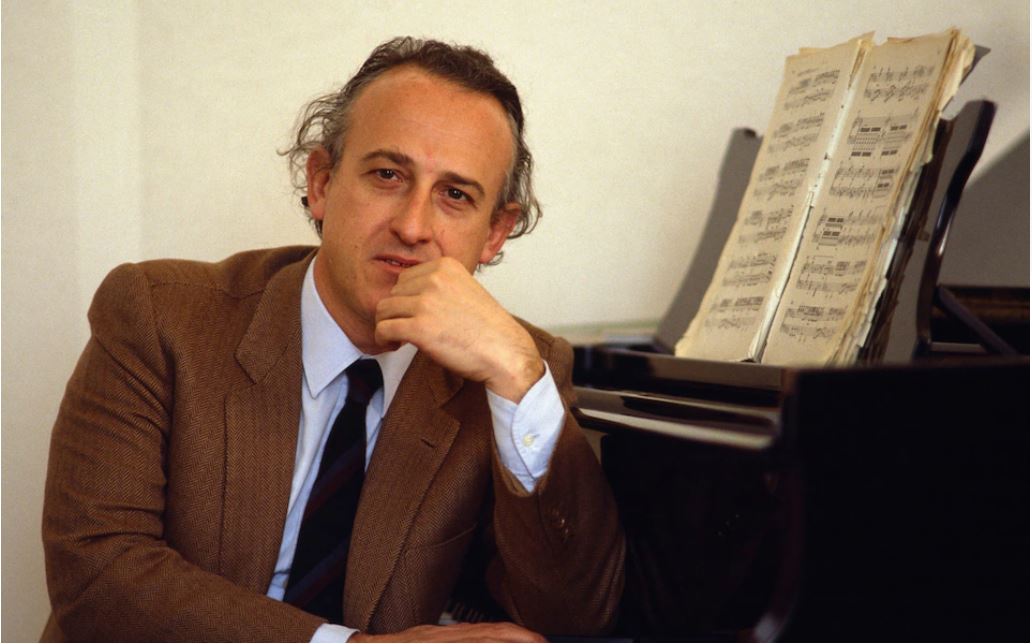
  • Maurizio Pollini A Titan Passes

    Maurizio Pollini A Titan Passes

    In the aftershock of the death of any prominent musician, my thoughts inevitably wend their way to the question of who’s left? It’s been the case for me at least since the ‘90s, when the classical music world lost so many – all old friends, familiar from decades of recordings – and always the evidence seems to be of little cheer. Now, a little over a week after the death of the great pianist Byron Janis, I receive news of the loss of Maurizio Pollini.

    Pollini was renowned for his interpretations of Beethoven and Chopin, certainly, but for me he was more riveting when tackling modernist works. His albums of Webern’s Variations and Boulez’s Piano Sonata No. 2 and Stravinsky’s Three Movements from “Petrushka” and Prokofiev’s Piano Sonata No. 7, all combined when released on CD, are high points of his discography. He was also a champion of the music of Karlheinz Stockhausen and Luigi Nono.

    At his best, he had a way of making even standard repertoire seem experimental. He recorded a magnificent Liszt program, including the monumental Piano Sonata in B minor (surely the most radical sonata of its day), with a truly revelatory selection of the composer’s later, prophetic works that seldom, as under Pollini’s touch, pointed the way so assuredly to the 20th century.

    There was an aura about the man and the artist that exuded integrity, idealism, intelligence, and mystery, between his unwavering embrace of left-wing politics (he was an avowed communist), his notorious perfectionism (he refused to authorize recordings in which he perceived defects that no one else could hear), and last-minute cancellations (including one at Princeton’s McCarter Theatre in 2011).

    Again, the question: who’s left? Of the giants of Pollini’s generation, I mean – certainly of the stable of great pianists who kept the major labels (in Pollini’s case, Deutsche Grammophon) relevant?

    Maurizio Pollini was 82 years-old. An irreplaceable musician. I can’t say I was equally impressed with all of his Beethoven and Chopin, which could come across as a little clinical – I am more of the Janis camp than the Pollini – but when he connected, the rewards were cherishable. I, for one, am very thankful to be able to choose from his recordings. R.I.P.


    Chopin, Nocturne No. 8, Op. 27, No. 2 (live in concert)

    Liszt, “Unstern! Sinistre, Disastro”

    Boulez, Piano Sonata No. 2

    Young Pollini plays Beethoven’s “Emperor” Concerto (live)

  • Louis Kentner Warsaw Concerto Star

    Louis Kentner Warsaw Concerto Star

    When he was hired to play the piano in a World War II potboiler, he asked that he not receive credit, for fear that it would damage his integrity as a concert artist. But when the spin-off record sold millions, he wisely changed his tune.

    Today is the birthday of Louis Kentner (1905-1987). The pianist went by several names. He was born Lajos Kentner to Hungarian parents in the present-day Czech Republic (then Austrian Silesia). Among his teachers at the Royal Academy of Music in Budapest were Arnold Székely (piano), Leó Weiner (chamber music) and Zoltán Kodály (composition). He began performing in public at the age of 15. Until 1931, he was known professionally as Ludwig Kentner. He settled in England in 1935 and became a naturalized citizen in 1946.

    Kentner excelled in the works of Franz Liszt. He founded the British Liszt Society. The sprawling “Years of Pilgrimage” was among the works he tackled complete. He also gave radio broadcasts of the complete sonatas of Beethoven and Schubert, and Bach’s “The Well-Tempered Clavier.” He was the pianist of choice for Béla Bartók, who requested him as soloist for the Hungarian premiere of his Piano Concerto No. 2 and the first European performance of the Concerto No. 3. Later, Kentner gave the British premiere of Bartók’s Scherzo for Piano and Orchestra.

    Also in England, he gave first performances of works by Sir Arthur Bliss, Sir Michael Tippett, and Sir William Walton (Walton’s Violin Sonata, played with his brother-in-law, the violinist Yehudi Menuhin).

    Nothing he played, however, touched so many as Richard Addinsell’s “Warsaw Concerto,” which became world-famous following its use in the 1941 film “Dangerous Moonlight” (known in the U.S. by the more lurid title, “Suicide Squadron”). The piece, never heard complete in the film, took on a life of its own when arranged as a mini Rachmaninoff-style concerto by Addinsell’s frequent collaborator, Roy Douglas. The eight-minute playing time ensured that it would fit perfectly on two sides of a 78 rpm disc. Its sheet music sales went through the roof, and the “Warsaw Concerto” was a smash. It was not the first spin-off concerto from the movies, but it did spark an unlikely rage for concertos at the movies.

    Kentner’s legacy has been tied very closely to my own radio work, since it is he who performs the theme to my weekly show, “The Lost Chord” (which is, for the record, the “Berceuse” from Kentner’s 1972 recording of the “Transcendental Etudes” of Sergei Lyapunov).

    So it is with gratitude, as well as with admiration, that I offer this remembrance of Louis Kentner on his birthday!


    Kentner’s recording of the “Warsaw Concerto”

    “Berceuse” from Lyapunov’s “Transcendental Etudes” (theme music for “The Lost Chord”)

    Bartók’s Piano Concerto No. 3

    Video of Kentner performing Liszt’s “Years of Pilgrimage (Second Year: Italy)” complete

Tag Cloud

Aaron Copland (93) Beethoven (95) Composer (114) Film Music (125) Film Score (143) Film Scores (255) Halloween (94) John Williams (189) KWAX (229) Leonard Bernstein (101) Marlboro Music Festival (125) Movie Music (140) Opera (202) Philadelphia Orchestra (89) Picture Perfect (174) Princeton Symphony Orchestra (106) Radio (87) Ralph Vaughan Williams (85) Ross Amico (244) Roy's Tie-Dye Sci-Fi Corner (290) The Classical Network (101) The Lost Chord (268) Vaughan Williams (103) WPRB (396) WWFM (881)

DON’T MISS A BEAT

Receive a weekly digest every Sunday at noon by signing up here


RECENT POSTS