Tag: Piano

  • Alfred Brendel at 90: A Classical Music Titan

    Alfred Brendel at 90: A Classical Music Titan

    When Alfred Brendel was at his peak as a performer, the classical music industry was still going strong. In a happy coincidence, the compact disc appeared just as he had reached maturity, and allowed him to go back and document much of his core repertoire in clean, modern recordings.

    By extension, he was a regular presence on classical radio, and millions became familiar with him through his interpretations of Haydn, Mozart, Beethoven, Schubert, Schumann, Liszt, Brahms, and perhaps most interestingly, Schoenberg.

    Not always credited with being the most adventurous artist, he was invariably a thoughtful one. He made the first recording of Liszt’s “Weihnachtsbaum” (“Christmas Tree”), back in 1952, and unexpectedly, his first appearance on disc was as soloist in Prokofiev’s Piano Concerto No. 5. He was the first artist to record the complete piano works of Beethoven. He went on to document the complete sonatas no less than three times.

    Late in his career, he struggled against arthritis. When he retired in 2008, at the age of 78, he was at the top of his game, one of the few classical artists still guaranteed to pack halls. He appeared at Carnegie Hall no less than 81 times. Twice, he performed the complete Beethoven sonatas there.

    Bespectacled, crowned with a disheveled widow’s peak, and improbably tall and lank, Brendel often looks all the world like an absent-minded professor. His interpretations have sometimes been criticized for being “cold” or “cerebral.” But the man, better-read than most, also possesses a keen sense of humor. He is a fan of Edward Gorey and Charles Addams and Gary Larson. He collects kitsch and newspaper bloopers. He has gone on record as stating that his favorite occupation is laughing.

    Alongside his many thoughtful essays on musical subjects (including at least one on humor in music), he published two volumes of epigrammatic poetry, “One Finger Too Many” and “Cursing Bagels.”

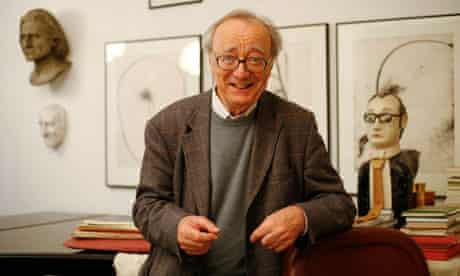
    Happy birthday, Alfred Brendel, 90 years-old today.


    PHOTO: Brendel, flanked by Liszt (left) and Eugene Jardin’s whimsical “Gipsbrendel”
  • Piano Madness Movie Music on WWFM

    Piano Madness Movie Music on WWFM

    If the definition of insanity is doing the same thing over and over and expecting a different result, then surely Hanon etudes are a ticket to the madhouse.

    This week on “Picture Perfect,” get keyed-up with music from movies about madness and the piano.

    Whenever he hears a loud, discordant sound, unhinged pianist-composer Laird Cregar is compelled to commit murder, in the 1945 film “Hangover Square.” Bernard Herrmann wrote the moody, romantic score, which includes a piano concerto, played by Cregar’s character during the film’s conflagration finale.

    Peter Lorre is an unstable musicologist who is haunted by the disembodied hand of a murdered pianist with a penchant for Brahms’ arrangement of Bach’s Chaconne, in “The Beast with Five Fingers,” from 1946. Max Steiner was the composer. The piano is played on the film’s soundtrack by Victor Aller, the brother-in-law of Felix Slatkin – also Leonard Slatkin’s uncle.

    Alan Alda plays a frustrated pianist who falls in with a ring of Satanists, in “The Mephisto Waltz” from 1971. This time, Jerry Goldsmith blends Franz Liszt with amplified instruments and electronics to memorably eerie effect. Five years later, Goldsmith would win his only Academy Award for his music to “The Omen.”

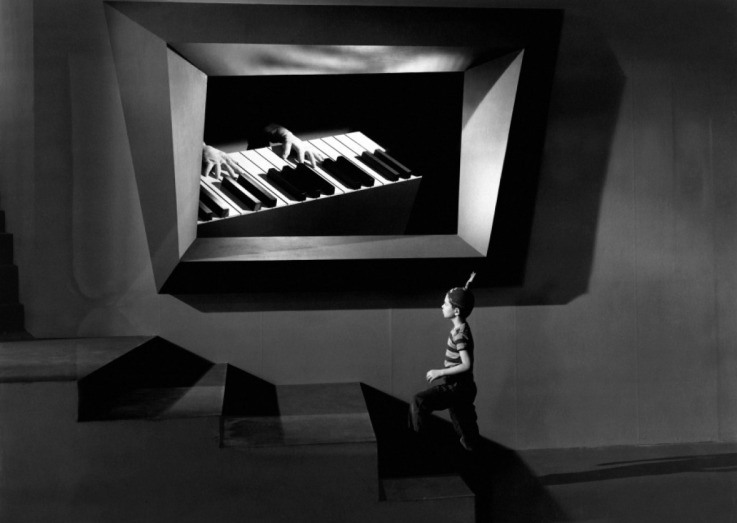
    Finally, Hans Conried plays a dictatorial pedagogue in “The 5000 Fingers of Dr. T,” released in 1953. “5000 Fingers” holds the distinction of being the only feature ever written by Dr. Seuss. The film sports an outrageous production design (including a gargantuan keyboard for 500 enslaved boys) and whimsical songs.

    The composer was Frederick Hollander. Born in London, Hollander attained fame in Germany as Friedrich Hollander. His best-known international success was “The Blue Angel,” starring Marlene Dietrich, who introduced his song, “Falling in Love Again.” With the rise of the Nazis, Hollander fled to the United States, where he worked on over 100 films.

    That’s music from movies about madness and the piano this week, on “Picture Perfect.” Practice makes psychotic, THIS SATURDAY EVENING AT 6:00 EDT, on WWFM – The Classical Network and wwfm.org.

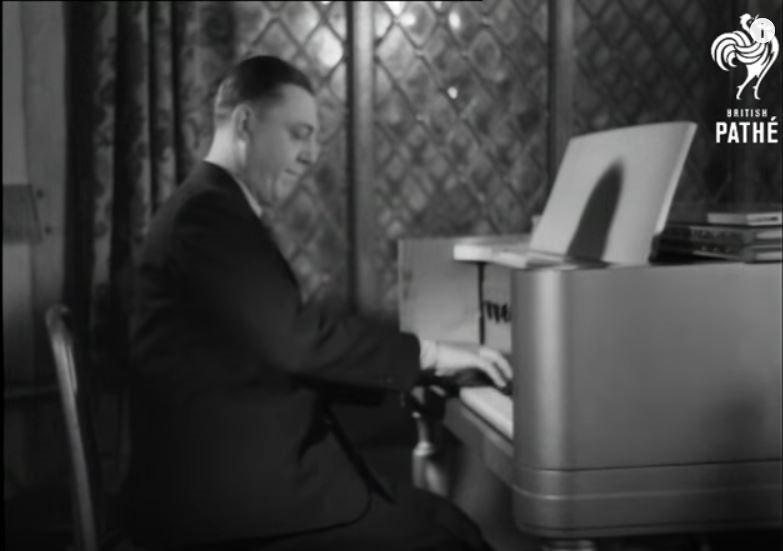
  • Billy Mayerl Plays Marigold Novachord

    Billy Mayerl Plays Marigold Novachord

    Since yesterday’s post about Billy Mayerl attracted some attention, here’s a follow-up with Mayerl performing his best-known composition, “Marigold” – on the Novachord.

    He’s joking about his having composed it in 1865, though it was requested so much of him, it probably felt that long.

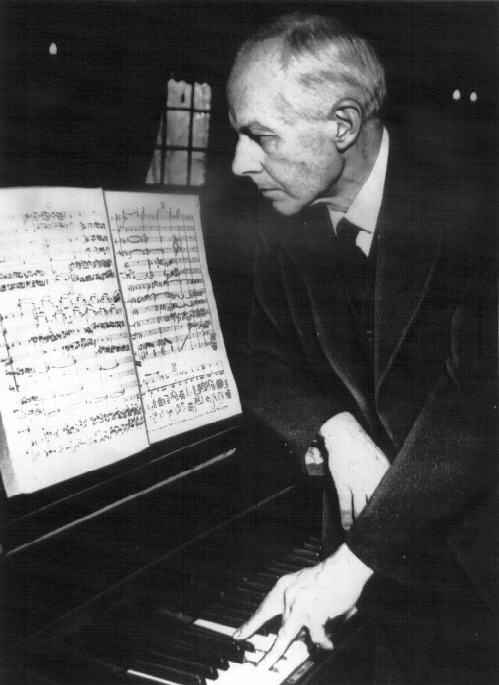
  • Béla Bartók Birthday Listen to Bartók Play Himself

    Béla Bartók Birthday Listen to Bartók Play Himself

    Happy birthday, Béla Bartók. Hear Bartók play (and introduce) Bartók.

    https://www.youtube.com/watch?v=5acxks1LuVI

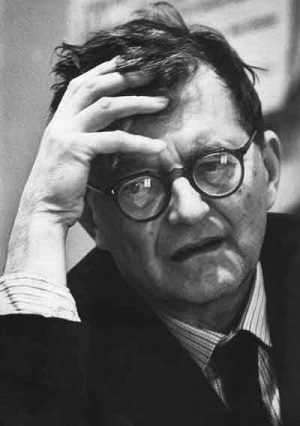
  • Shostakovich Plays Shostakovich

    Shostakovich Plays Shostakovich

    Last week, in promoting “The Lost Chord,” I wound up executing a shameless bait-and-switch, tying Shostakovich to the Super Bowl by emphasizing his rabid enthusiasm for football (albeit of the international variety).

    This week, I contemplate a sequel. To coincide with the Academy Awards, I could just as easily spin the composer’s ties to the cinema, first as a house pianist who eked out a living with his improvisations, then later as a composer of over two dozen original film scores.

    Admittedly, both of these angles, football and the movies, would make for interesting shows in themselves. Unfortunately, neither topic has anything to do with tonight’s program.

    Rather the focus, once again, will be on a 5-CD boxed set, “Shostakovich Plays Shostakovich,” issued on the Melodiya label, made up of Russian state recordings set down largely between 1946 and 1958, with the composer at the keyboard.

    As I mentioned the last time, Shostakovich was a fabulous pianist, who began serious studies at the age of 9. He continued, formally, at the Petrograd Conservatory, upon his acceptance there, at the age of 13. Once he began to receive international attention for his original compositions, for works such as his Symphony No. 1, written when he was only 19, his principal focus began to shift. He did, however, continue to perform and record his own music.

    The documents in this box are riveting, not only for the musicianship they enshrine, but also because of their biographical fascination and their sense of history.

    By way of example, we’ll hear a harrowing account of the Piano Trio No. 2 in E minor. Given its premiere only months after the liberation of Leningrad, the trio predates Shostakovich’s String Quartet No. 8. Both share in common a kind of inexorable, klezmer-inflected danse macabre.

    Shostakovich always felt a special kinship with the Jewish people. Furthermore, the trio is dedicated to his friend, Ivan Sollertinsky, artistic director of the Leningrad Philharmonic, who was an enthusiast of the music of Gustav Mahler. Sollertinsky died of a heart attack in Siberia, following his evacuation during the Siege of Leningrad.

    In 1947, Shostakovich sat down in front of the microphones to record the work, with violinist David Oistrakh and cellist Miloš Sádlo.

    On a lighter note, “Children’s Notebook” is a collection of trifles (March, Waltz, Sad Tale, Merry Tale, The Bear, The Clockwork Doll, and Birthday). However, they certainly take on added interest when introduced by the composer, as they will be tonight.

    The hour will open with the Concertino for Two Pianos – performed by Shostakovich and his son, Maxim – and conclude with the Piano Concerto No. 2, written for Maxim’s 19th birthday. Maxim introduced the concerto at his graduation from the Moscow Conservatory. Here, Shostakovich himself performs at the conservatory’s Grand Hall, at fever pitch, with the Moscow Radio Symphony conducted by Alexander Gauk.

    In America, artists play with authority. In Soviet Russia, authorities play with you! Shostakovich gets all keyed up, on “Black and White and Red Redux,” this Sunday night at 10:00 EST, on WWFM – The Classical Network and wwfm.org.

Tag Cloud

Aaron Copland (93) Beethoven (95) Composer (114) Film Music (125) Film Score (143) Film Scores (255) Halloween (94) John Williams (189) KWAX (229) Leonard Bernstein (101) Marlboro Music Festival (125) Movie Music (140) Opera (202) Philadelphia Orchestra (89) Picture Perfect (174) Princeton Symphony Orchestra (106) Radio (87) Ralph Vaughan Williams (85) Ross Amico (244) Roy's Tie-Dye Sci-Fi Corner (290) The Classical Network (101) The Lost Chord (268) Vaughan Williams (103) WPRB (396) WWFM (881)

DON’T MISS A BEAT

Receive a weekly digest every Sunday at noon by signing up here


RECENT POSTS