Tag: Rachmaninoff

  • Rachmaninoff’s April Fool’s Humor & Busoni’s Epic

    Rachmaninoff’s April Fool’s Humor & Busoni’s Epic

    Happy April Fool’s birthday to laugh-riot Sergei Rachmaninoff.

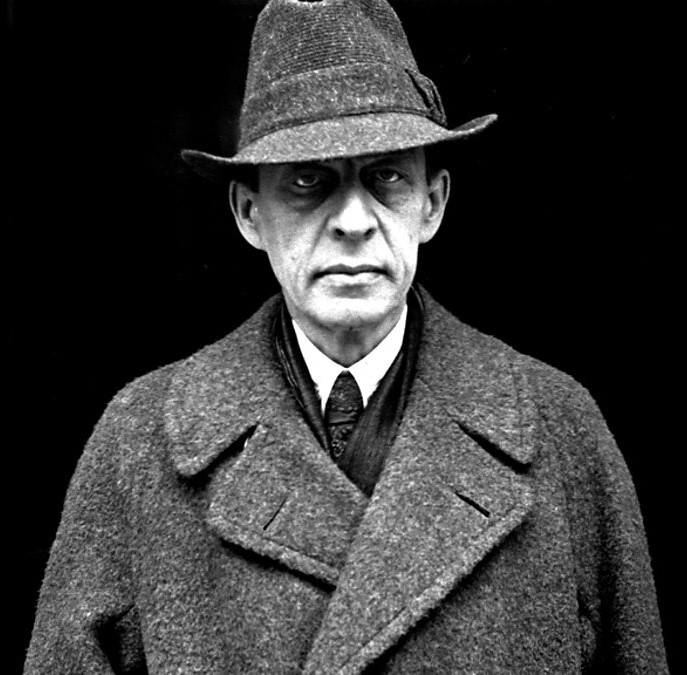
    Depending on where you look, Igor Stravinsky described his dour compatriot as either “six-foot-two of Russian gloom” or “a six-and-a-half-foot scowl.” Perhaps both. It’s true, you won’t find very many photos of Rachmaninoff smiling. But just to prove he was not entirely without a sense of humor, I share with you the following anecdote:

    Rachmaninoff was a favorite recital partner of violinist Fritz Kreisler. Once, in the middle of a concert in New York, Kreisler suffered a memory lapse. As he continued to noodle on his violin, feigning nonchalance while attempting to grope his way out of the labyrinth, he subtly inched closer to his pianist.

    “Where are we?” he whispered.

    To which Rachmaninoff replied, “Carnegie Hall.”

    On this day devoted to fun and frivolity, the two friends are reunited in spirit in Rachmaninoff’s transcription of Kreisler’s “Liebesfreud,” or “Love’s Joy.”

    Also, a shout-out to inadvertent prankster Ferruccio Busoni, another great pianist born on this date. Actually, his parents named him Ferruccio Dante Michelangelo Benvenuto Busoni. So clearly he had a sense of destiny. Or at any rate, he had a lot to prove! Perhaps that’s what spurred him to write what could very well be the most grandiose piano concerto of all time.

    Busoni’s concerto swings for the fences, with an epic, 70-minute running time, large orchestration, demanding solo part, and men’s chorus in the finale (which doesn’t start singing until an hour in).

    The text, from Adam Oehlenschläger’s verse-drama “Aladdin,” begins:

    “Deep and quiet, the pillars of rock begin to sound:
    Lift up your hearts to the power eternal,
    Feel Allah’s presence, behold all his works!”

    In the score, Busoni instructs that the chorus should be “invisible.” Somehow, this was mistranslated, resulting in a widespread belief that he actually wanted the singers to perform nude. Whether or not it’s ever been presented that way (in the interest of authenticity) is anyone’s guess.

    Oddly, the concerto isn’t designed as a showcase for a fire-eating virtuoso. Beyond it being something of an endurance test for the soloist, there aren’t really any flashy cadenzas or too many opportunities to hot dog. The work is more like a gargantuan piano fever dream.

    I particularly like the movement “All’Italiana,” evocative of Italian folk music and popular song. It always makes me think of Chico Marx.

    To give you a sense of perspective, Rachmaninoff’s ever-popular Piano Concerto No. 2, at less than half the length, was first performed three years earlier, in 1901. The work would later be used on the soundtrack to “Brief Encounter.” There is nothing brief about Busoni’s concerto.

    The pianist here is Marc-André Hamelin, who used to come into my bookshop looking for arcane sheet music, back in the day. Just a few years before this video, as a matter of fact. About a decade later, I saw him perform Busoni’s concerto at Carnegie Hall.

    The Chico Marx business begins about 46 minutes in. The movement gets zanier and zanier.

    Here Eileen Joyce plays Rachmaninoff’s Piano Concerto No. 2 in “Brief Encounter,” with Celia Johnson and a young Trevor Howard:

    Happy birthday, Busoni and Rachmaninoff!
  • Capital Philharmonic NJ Anniversary

    Capital Philharmonic NJ Anniversary

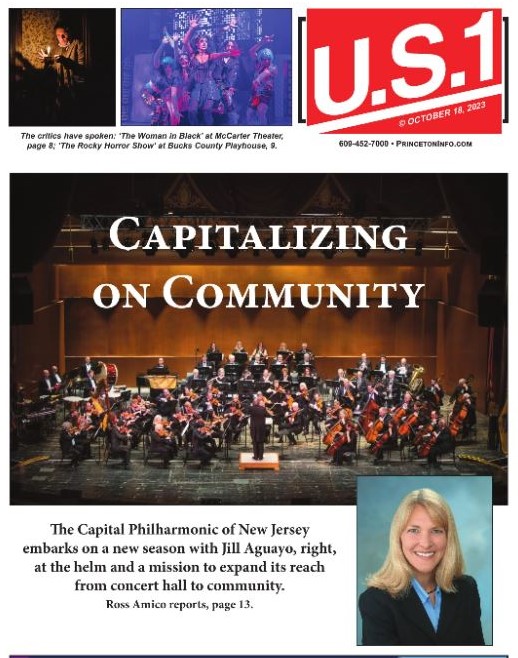
    Speaking of the Princeton weekly U.S. 1 (see yesterday’s post about Dan Aubrey’s article that reveals a surprising connection between magicians Penn & Teller and composer Othmar Schoeck), I’ve scored this week’s cover story.

    The Capital Philharmonic of New Jersey embarks on its tenth anniversary season with Rachmaninoff’s Piano Concerto No. 3, with Maja Rajković the soloist, and Mussorgsky’s “Picture at an Exhibition.” The latter will be accompanied by projections of works by local artists inspired by the music.

    It’s one way in which the Capital Phil will be expanding its reach from concert hall to community in what promises to be the orchestra’s most adventurous season yet. Keep an eye out for George Antheil’s “Ballet Mecanique” at the Roebling Machine Shop this spring!

    Thanks to executive director Jill Aguayo for taking the time to chat and to fill me in on some of the orchestra’s plans.

    Read all about it in this week’s U.S. 1 Newspaper – PrincetonInfo, available in area vending machines and at local businesses through Tuesday, or access it online here:

    https://www.communitynews.org/princetoninfo/eeditions/page-page-13/page_2649a030-52e5-5c95-9ab0-657c616207b1.html

    New Jersey Capital Philharmonic Orchestra

  • Remembering André Watts Philadelphia’s Piano Icon

    Remembering André Watts Philadelphia’s Piano Icon

    I am very sorry to learn that André Watts has died. Watts was a familiar presence in Philadelphia for decades. Indeed, he was the soloist on the first Philadelphia Orchestra concert I ever saw, playing the Rachmaninoff Piano Concerto No. 2, at the Mann Center for the Performing Arts in Fairmount Park, on July 16, 1984, with Michael Tilson Thomas conducting.

    An army brat born in Nuremberg, Germany, to a Hungarian mother (a pianist) and an African American father (a non-commissioned officer), Watts moved to Philadelphia with his family at the age of 8. Prior to that, he had studied violin in Europe. His mom gave him his first piano lessons.

    Like most children, he disliked practicing. She captured his imagination by telling him about the young Franz Liszt and what he was able to achieve by applying himself and practicing faithfully.

    Watts would continue to find inspiration in Liszt throughout his career. He was a great champion of the composer. In fact, it was as soloist in Liszt’s Piano Concerto No. 1 that he rocketed to fame after a performance with the New York Philharmonic conducted by Leonard Bernstein, televised as part of one the orchestra’s Young People’s Concerts, in January 1963. Watts was 16-years-old.

    Later in the month, Glenn Gould fell ill, and Watts was invited back to play the Liszt concerto on an actual subscription concert. The performance generated such electricity that the hardboiled musicians of the Philharmonic joined the audience in a standing ovation. The performance was recorded and released on Columbia Masterworks, the thrill of the occasion preserved for posterity, as “The Exciting Debut of André Watts.”

    Watts studied at the Philadelphia Musical Academy (now part of the University of the Arts), and then at the Peabody Institute in Baltimore under Leon Fleisher. In the meantime, his dance card was filling up fast. By 1969, his concerts were being booked three years in advance. He signed an exclusive recording contract with Columbia on his 21st birthday.

    Alas, in more recent years, Watts suffered his share of health difficulties. In 2002, he underwent emergency surgery for a subdural hematoma. In 2004, a ruptured disc affected the use of his left hand. In 2019, he underwent surgery for further nerve damage.

    An inveterate cigar smoker, he was diagnosed with (possibly unrelated?) prostate cancer in 2016. The cancer went into remission in 2017, but would return to claim him.

    Despite his medical setbacks, Watts continued to perform. Personal illness did nothing to dampen his passion for playing in public, but the pandemic threw up some pretty steep barriers.

    For certain, with half a century of performances and recordings behind him, and a National Medal of the Arts, among other honors, Watts had nothing more to prove. But he was determined to do what he loved for as long as he possibly could.

    In an interview, he claimed that early on, what he really wanted to be was a writer. For Watts, communication with an audience – storytelling, if you will – was key.

    He will be missed. R.I.P.


    Introduced by Leonard Bernstein, then playing the stuffing out of Liszt

    Visiting “Mr. Rogers’ Neighborhood”

    Playing Mendelssohn with John Williams and the Boston Pops

    Rachmaninoff in New York

    Liszt’s etude after Paganini’s “La Campanella”

  • Rachmaninoff at 150 Anniversary Celebration

    Rachmaninoff at 150 Anniversary Celebration

    Sergei Rachmaninoff may have been born on April 1, but he was nobody’s fool. Frequently derided by critics, he knew just what the public wanted – good tunes and heart-on-the-sleeve emotion! His Piano Concertos Nos. 2 & 3, the “Rhapsody on a Theme of Paganini,” the Symphony No. 2, the “Vocalise,” and more solo piano works than I care to list, including the Prelude in C-sharp minor – so ubiquitous the composer himself came to hate it – have never been out of the active repertoire.

    Rachmaninoff has been my focus on “The Lost Chord” several times over the years – I devoted a show to his friendship with Nikolai Medtner and another to his achievements as a recitalist – but the program most easily referenced is the one that aired this past Sunday on WWFM – The Classical Network.

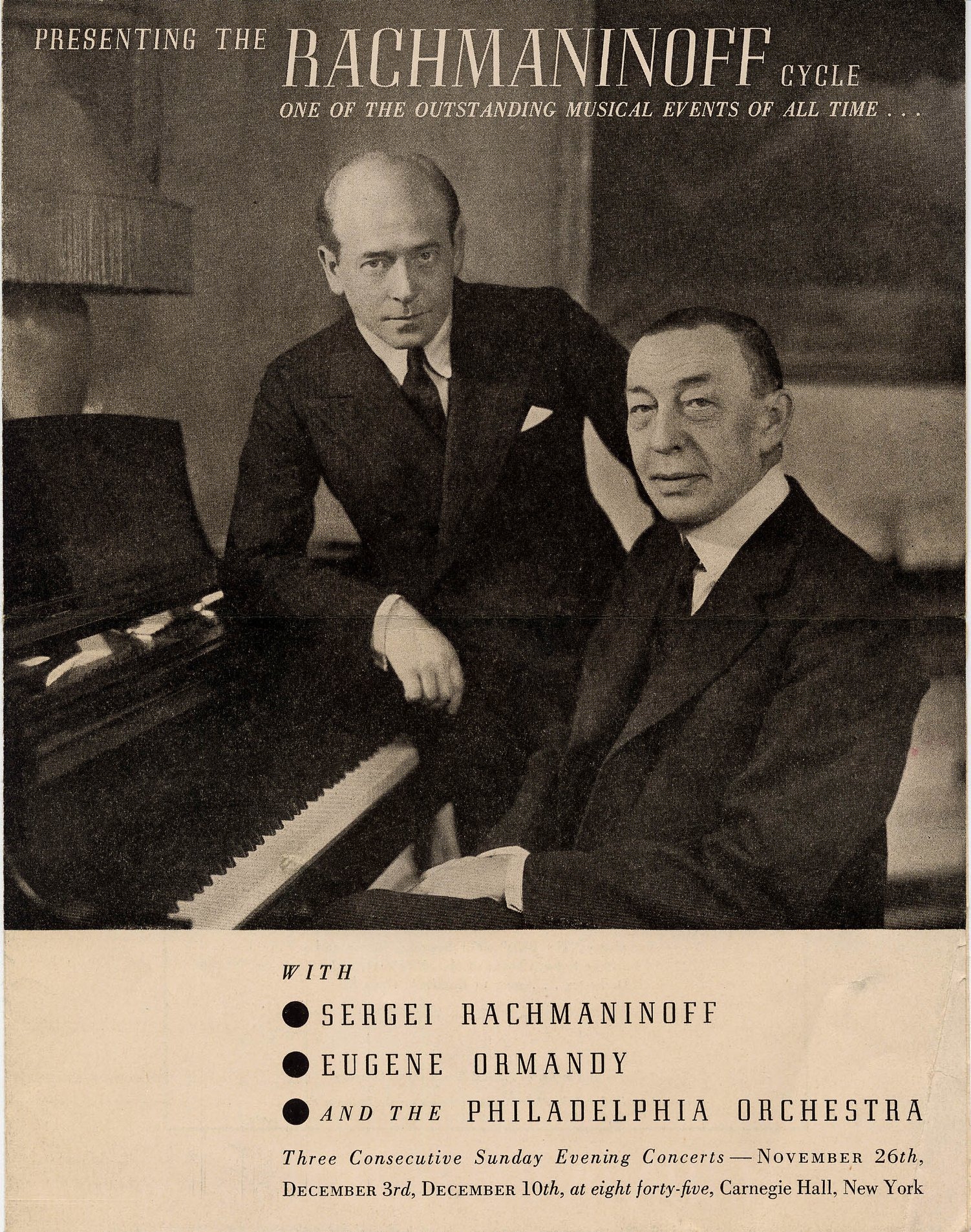
    For Rachmaninoff’s 150th birthday, enjoy an hour of vintage recordings of his music, including one of the composer playing his own “Symphonic Dances,” on the piano of Eugene Ormandy, in 1940. Also, Ormandy introduces – and conducts – the Philadelphia Orchestra in a memorial performance of “Isle of the Dead,” given only days after Rachmaninoff’s death in 1943. The hour concludes with a literal party piece, as Rachmaninoff tosses off the folk song “Bublichki,” or “Bagels,” in 1942.

    The recordings are taken from a 3-CD boxed set on the Marston Records label. Get a piece of the Rach! Enjoy the webcast by following the link and clicking on “listen.”

    https://www.wwfm.org/show/the-lost-chord-with-ross-amico/2023-03-24/the-lost-chord-march-26-rach-of-ages

    Happy 150, Sergei Rachmaninoff!

  • Rachmaninoff 150th Birthday Broadcast

    Rachmaninoff 150th Birthday Broadcast

    This Sunday night on “The Lost Chord,” get a piece of the Rach!

    With the impending sesquicentenary of the birth of Sergei Rachmaninoff on April 1, enjoy an hour of historic performances.

    We’ll hear Rachmaninoff play his own “Symphonic Dances” in a recently rediscovered, fly-on-the-wall recording, captured surreptitiously at the home of Eugene Ormandy in 1940. Then Ormandy will introduce – and conduct – the Philadelphia Orchestra, in a special memorial performance of Rach’s “Isle of the Dead,” given only days after the composer’s death, in 1943.

    We’ll round out the hour with a literal party piece – as Rachmaninoff tosses off the Ukrainian folk song, “Bublichki,” or “Bagels,” in 1942.

    The recordings are from a 3-CD boxed set issued by Marston Records, the record label of industry legend Ward Marston. Now based in West Chester, PA (he was born in Philadelphia in 1952), Marston is one of classical music’s most revered audio engineers. Incredibly, he has been blind since birth.

    Marston’s work in restoration and conservation of historic audio has been both miraculous and rapturously received. His acclaimed remasterings have appeared on the Andante, Biddulph, Naxos, Pearl, RCA, and Romophone labels. For more information and a complete catalogue of Marston Records releases, visit marstonrecords.com.

    Then join me for an hour of Sergei Rachmaninoff in vintage recordings. That’s “Rach of Ages,” for the 150th birthday of Sergei Rachmaninoff, this Sunday night at 10:00 EDT, on WWFM – The Classical Network and wwfm.org.

Tag Cloud

Aaron Copland (92) Beethoven (95) Composer (114) Film Music (120) Film Score (143) Film Scores (255) Halloween (94) John Williams (185) KWAX (229) Leonard Bernstein (100) Marlboro Music Festival (125) Movie Music (135) Opera (198) Philadelphia Orchestra (88) Picture Perfect (174) Princeton Symphony Orchestra (106) Radio (87) Ralph Vaughan Williams (85) Ross Amico (244) Roy's Tie-Dye Sci-Fi Corner (290) The Classical Network (101) The Lost Chord (268) Vaughan Williams (103) WPRB (396) WWFM (881)

DON’T MISS A BEAT

Receive a weekly digest every Sunday at noon by signing up here


RECENT POSTS