Tag: Rachmaninoff

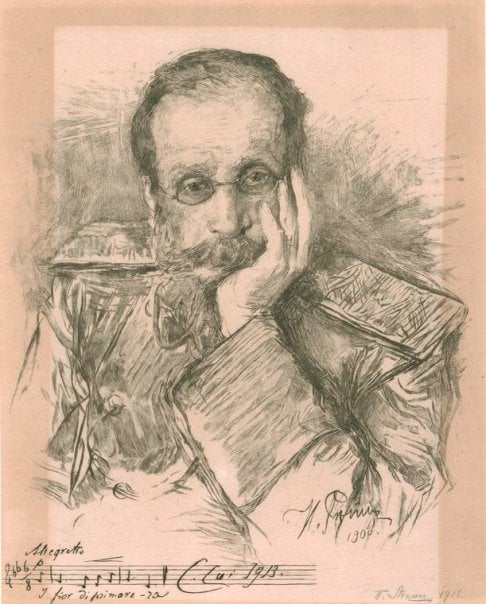
  • César Cui: The Forgotten Mighty Handful

    César Cui: The Forgotten Mighty Handful

    Among the followers of Mily Balakirev that collectively came to be known as “The Mighty Handful” or “The Five,” unquestionably the least well-known is César Cui. Nikolai Rimsky-Korsakov, Modest Mussorgsky, and Alexander Borodin all went on to attain a kind of immortality in Russian music, each having left his indelible mark.

    Cui wrote 15 operas, believe it or not – one of them, “William Ratcliff,” earning the highest praise from Franz Liszt – but today, he is remembered, if at all, as a miniaturist, or perhaps as a composer of art song, and at that, the least Russian-sounding of the five.

    He shared in common with the others the fact that for him music was an avocation. He paid his bills as a military engineer. Beyond that, however, he was a bit of an outsider – born in Vilnius (now in Lithuania) to a father who had been a general in Napoleon’s army, who stayed and married a local. In addition to Russian, Cui grew up speaking French, Polish and Lithuanian. Perhaps this broader cultural perspective led to a more cosmopolitan approach to music.

    As a critic, he was prolific, and he could be blistering in his sarcasm. Perhaps most notorious was his reception of Rachmaninoff’s First Symphony:

    “If there were a conservatory in Hell, and if one of its talented students were to compose a program symphony based on the story of the Ten Plagues of Egypt, and if he were to compose a symphony like Mr. Rachmaninoff’s, then he would have fulfilled his task brilliantly and would delight the inhabitants of Hell. To us this music leaves an evil impression with its broken rhythms, obscurity and vagueness of form, meaningless repetition of the same short tricks, the nasal sound of the orchestra, the strained crash of the brass, and above all its sickly perverse harmonization and quasi-melodic outlines, the complete absence of simplicity and naturalness, the complete absence of themes.”

    The assessment plunged Rachmaninoff into a two-year depression, during which he was unable to compose until being lifted out of his funk by hypnotic therapy. Of course, today everyone knows Rachmaninoff’s music (if not his First Symphony). How many, I wonder, know Cui’s?

    On the anniversary of Cui’s birth, enjoy his “Deux morceaux” for cello and orchestra.

    25 Preludes for Piano, Op. 64

    Nocturne in F-sharp minor

    Suite No. 3 “In modo populari”

    Cui’s greatest hit? Perhaps “Orientale” from his collection for violin and piano “Kaleidoscope,” for many years a popular encore. Here are two contrasting treatments.

    Efrem Zimbalist

    and Midori

    Finally, the Carmen Dragon treatment

    A work that’s received a lot of notice since Covid: the one-act opera “A Feast in Time of Plague”

    Happy birthday, César Cui!


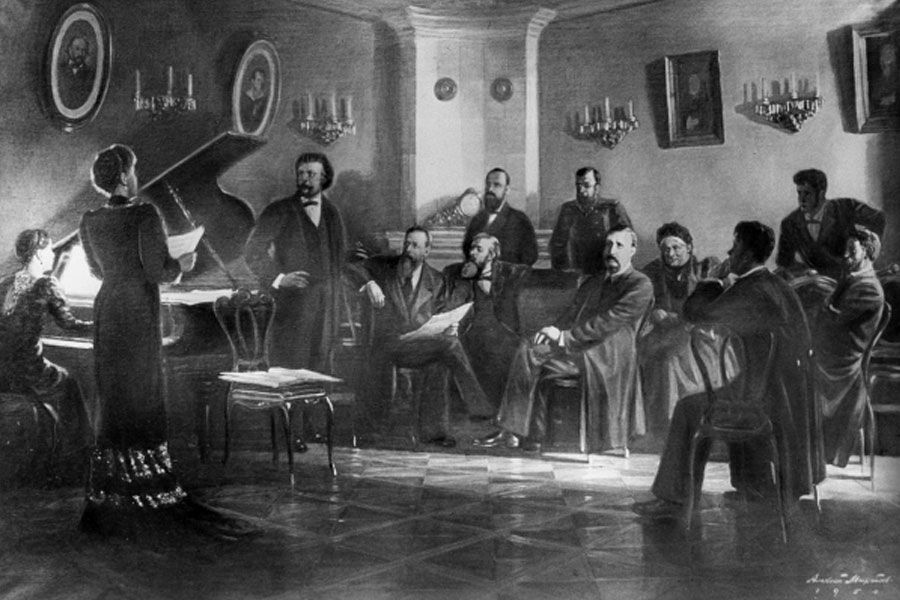
    IMAGE: With so many whiskers in the room, you know you must be in the company of The Five. Center, left to right: Modest Mussorgsky (standing, by the piano), Nikolai Rimsky-Korsakov, critic and champion Vladimir Stasov (seated), Mily Balakirev (standing behind), César Cui (standing, with spectacles), and Alexander Borodin (seated).

  • Eugene Ormandy Philadelphia’s Underrated Genius

    Eugene Ormandy Philadelphia’s Underrated Genius

    What’s the big deal about this guy, Jenő Blau? Well, you probably know him better by his adopted name, Eugene Ormandy.

    Ormandy, a Hungarian-born violinist who had studied with Jenő Hubay (for whom he was named), became a naturalized American citizen in 1927. He ultimately wound up directing The Philadelphia Orchestra for 44 years. In that capacity, he became one of the world’s most-recorded conductors.

    However, in some respects, he remains a vastly underrated one. Sure, he was a superb interpreter of 19th century and post-Romantic classics (his Columbia stereo recording of Tchaikovsky’s “Pathétique” was one of my go-to favorites as a teen, and he was an authoritative conductor of Rachmaninoff and Sibelius), but he also championed much contemporary music and new works written by his adopted countrymen. Also, if ever there was a more sensitive accompanist in the concerto repertoire, I don’t know of him.

    One of my favorite Ormandy records was also one of his later ones. Throughout his career Ormandy succeeded in selling Sibelius’ “Four Legends from the Kalevala,” a collection of tone poems inspired by the Finnish national epic the “Kalevala,” for the early masterpiece that it is.

    Here again is the final section, “Lemminkainen’s Homeward Journey,” even more thrilling, in 1940. Not on YouTube, for some reason, but I found it posted on archive.org. You may have to adjust the volume under the video.

    https://archive.org/details/Lemminkainens_Journey

    The legendary Philadelphia strings in Vaughan Williams’ “Fantasia on a Theme by Thomas Tallis”

    Hindemith, “Concert Music for Strings and Brass”

    Ivan Davis joins Ormandy and the Philadelphians for Liszt’s “Hungarian Fantasy,” slight abridged

    Bruckner “Te Deum” with Temple University Choir

    World premiere performance of Samuel Barber’s Violin Concerto

    Shostakovich Symphony No. 4

    Reinhold Glière’s “Russian Sailor’s Dance”

    Rachmaninoff Piano Concerto No. 2, with Eugene Istomin

    Ormandy conducts “Scheherazade” (complete). This is the Philly Orchestra I remember from my college years.

    Debussy, “Reverie”

    Saint-Saens’ Symphony No. 3 “Organ”

    Happy birthday, Eugene Ormandy (1899-1985)!

  • Bard Music Fest Focuses on Rachmaninoff

    He was a visiting scholar at the Bard Music Festival in 2018, an event devoted to Nikolai Rimsky-Korsakov and “his world.” A mere blip in Taruskin’s career, but he was awarded an honorary degree from the college’s president, and the festival music director, Leon Botstein. Rachmaninoff will be the focus of this year’s festival, August 5-14. For more information, follow the link (in no way associated with Taruskin’s obituary).

    https://fishercenter.bard.edu/whats-on/programs/bard-music-festival/

  • Bach or Rachmaninoff Music Styles Compared

    Bach or Rachmaninoff Music Styles Compared

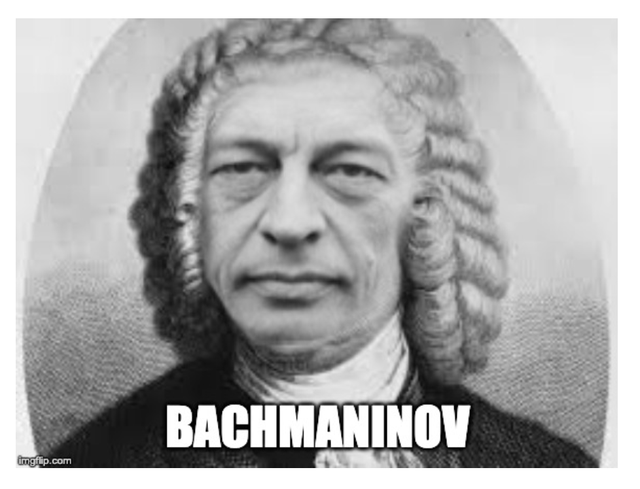
    Is it Bach or Rachmaninoff?

    When Rachmaninoff’s birthday falls on April Fool’s Day, it can only be…

  • César Cui Birthday Rediscovering the Forgotten Five

    César Cui Birthday Rediscovering the Forgotten Five

    It’s January 18. Get queasy on Cui, for his birthday!

    Among the followers of Mily Balakirev that collectively came to be known as “The Mighty Handful,” or “The Five,” unquestionably the least well-known is César Cui (1835-1918). Nikolai Rimsky-Korsakov, Modest Mussorgsky, and Alexander Borodin all went on to attain a kind of immortality in Russian music, each having left his indelible mark.

    Cui wrote 15 operas, believe it or not – one of them, “William Ratcliff,” earning the highest praise from Franz Liszt – but today, he is remembered, if at all, as a miniaturist, or perhaps as a composer of art song, and at that, the least Russian-sounding of the five.

    He shared in common with the others the fact that for him music was an avocation. He paid his bills as a military engineer. Beyond that, however, he was a bit of an outsider – born in Vilnius (now in Lithuania) to a father who had been a general in Napoleon’s army, who stayed and married a local. In addition to Russian, Cui grew up speaking French, Polish and Lithuanian. Perhaps this broader cultural perspective led to a more cosmopolitan approach to music.

    As a critic, he was prolific, and he could be blistering in his sarcasm. Perhaps most notorious was his reception of Rachmaninoff’s First Symphony:

    “If there were a conservatory in Hell, and if one of its talented students were to compose a program symphony based on the story of the Ten Plagues of Egypt, and if he were to compose a symphony like Mr. Rachmaninoff’s, then he would have fulfilled his task brilliantly and would delight the inhabitants of Hell. To us this music leaves an evil impression with its broken rhythms, obscurity and vagueness of form, meaningless repetition of the same short tricks, the nasal sound of the orchestra, the strained crash of the brass, and above all its sickly perverse harmonization and quasi-melodic outlines, the complete absence of simplicity and naturalness, the complete absence of themes.”

    His assessment plunged Rachmaninoff into a two-year depression, during which he was unable to compose until lifted out of his funk by hypnotic therapy. Of course, today everyone knows Rachmaninoff’s music (if not his First Symphony). How many, I wonder, know Cui’s?


    2 Morceaux for cello and orchestra, Op. 36

    3 Morceaux for piano duo, Op. 69 (with Yakov Flier and Emil Gilels)

    Orchestral Suite No. 3, Op. 43, “In modo populari”

    Mischa Elman plays “Orientale”

    “A Feast in Time of Plague” (which has gotten a lot of play, suddenly, since 2020)

    Rachmaninoff, Symphony No. 1 (which Cui compared to the 12 plagues of Egypt)

    https://www.youtube.com/watch?v=hOzcmIQ37Qw

    Cui, “Everywhere Snow”

Tag Cloud

Aaron Copland (92) Beethoven (95) Composer (114) Film Music (120) Film Score (143) Film Scores (255) Halloween (94) John Williams (185) KWAX (229) Leonard Bernstein (100) Marlboro Music Festival (125) Movie Music (135) Opera (198) Philadelphia Orchestra (88) Picture Perfect (174) Princeton Symphony Orchestra (106) Radio (87) Ralph Vaughan Williams (85) Ross Amico (244) Roy's Tie-Dye Sci-Fi Corner (290) The Classical Network (101) The Lost Chord (268) Vaughan Williams (103) WPRB (396) WWFM (881)

DON’T MISS A BEAT

Receive a weekly digest every Sunday at noon by signing up here


RECENT POSTS