Tag: Rachmaninoff

  • Respighi: Modesty, Bikinis & Roman Spectacle

    Respighi: Modesty, Bikinis & Roman Spectacle

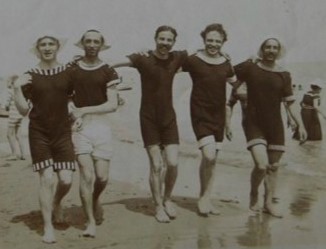
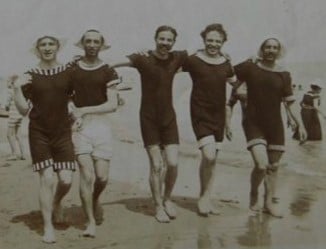
    In a week that saw the 75th anniversary of the bikini (unveiled on July 5. 1946), Ottorino Respighi hangs on to his modesty by rocking a one-piece bathing suit with four of his amici.

    You won’t detect much of that modesty in his rafter-rattling tone poems, “Fountains of Rome” (1916), “Pines of Rome” (1924), and “Roman Festivals” (1928). But he also had his softer side, as evidenced by the time-tripping Renaissance lute recreations, the “Ancient Airs and Dances” (composed in 1917, 1923 & 1932).

    I’m reminded that Respighi died in 1936 at the age of 55. Mortality is staring me in the face!

    Incredibly, his wife, Elsa, outlived him by some 60 years. A singer and composer herself, she died in 1996, one week shy of her 102nd birthday! She remained her husband’s biggest cheerleader, tirelessly promoting his music. She even completed his final opera, “Lucrezia,” given its debut in 1937.

    As a soundtrack to the photo: In 1929, when conductor Serge Koussevitzky formulated the idea that Respighi should orchestrate some of Rachmaninoff’s keyboard pieces, Rachmaninoff was nothing if not enthusiastic. He supplied Respighi with hidden programs behind the works to lend additional insights into their creation. Koussevitzky was impressed with the results, which he debuted with the Boston Symphony Orchestra in 1931. More importantly, Rachmaninoff found the orchestrations to be faithful to the spirit of the originals.

    Here is “The Sea and the Seagulls,” from “Cinq Études-Tableaux” by Respighi, after Rachmaninoff.

    Also, footage of Arturo Toscanini conducting “Pines of Rome” in 1952, with the NBC Symphony. Toscanini conducted the work’s U.S. premiere, with the New York Philharmonic, in 1926. The bird calls begin at 14:43.

    A mesmerizing performance, from 1949, of the “Arie de corte” from the “Ancient Airs and Dances Suite No. 3,” with Eugene Ormandy conducting the Philadelphia Orchestra (part of Sony’s recently-released “Eugene Ormandy: The Columbia Legacy” boxed set):

    Finally, a guilty pleasure that’s so over-the-top, it would have made Cecil B. DeMille blush: a suite from the ballet “Belkis, Queen of Sheba,” a quasi-Biblical spectacle set at the court of King Solomon. The work was given its first performance at La Scala Milan in 1932. The finale featured over a thousand performers, which likely accounts for its subsequent neglect. Grandiose even by Respighi standards, the concluding orgiastic dance whipped the opening night audience into a frenzy.

    Romantic, Classicist, Impressionist, AND supermodel – Happy birthday, Ottorino Respighi!


    PHOTO: Respighi (second from right) and friends horsing around, like an outtake from Fellini’s “I Vitelloni”

  • Rachmaninoff Busoni April Fools’ Birthday

    Rachmaninoff Busoni April Fools’ Birthday

    Depending on where you look, Igor Stravinsky described Sergei Rachmaninoff as either “six-foot-two of Russian gloom” or “a six-and-a-half-foot scowl.” Perhaps both. It’s true, you won’t find very many photos of Rachmaninoff smiling. But just to prove that he was not entirely without a sense of humor, I share with you the following anecdote:

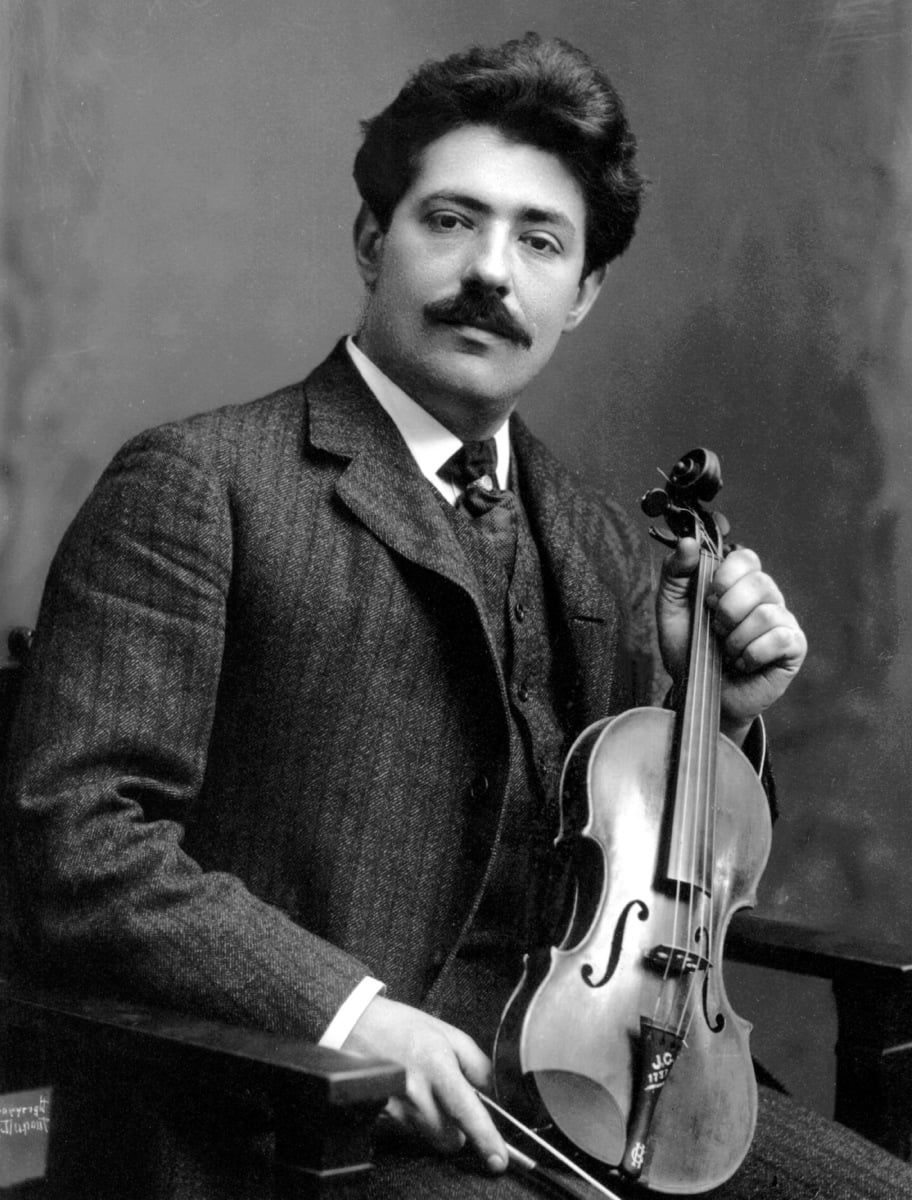
    Rachmaninoff was a favorite recital partner of violinist Fritz Kreisler. Once, in the middle of a concert in New York, Kreisler suffered a memory lapse. As he noodled heroically on his violin, trying to appear nonchalant while attempting to grope his way back, he subtly inched closer to his pianist.

    “Where are we?” he whispered.

    Rachmaninoff replied, “Carnegie Hall.”

    On this April Fool’s Day – which also happens to be Rachmaninoff’s birthday – the two friends are reunited, in spirit, in Rachmaninoff’s transcription of Kreisler’s “Liebesfreud,” or “Love’s Joy.”

    Today is also the anniversary of the birth of another of the great pianist-composers, Ferruccio Dante Michelangelo Benvenuto Busoni. With a name like that, clearly his parents had great expectations!

    While Ferruccio Busoni could bust his knuckles with the best of them, and weave a web of counterpoint so dense it would have made Max Reger sweat, here’s something a little lighter, in keeping with the spirit of April Fool’s – the “Lustspielouverture,” or “Comedy Overture.”

    Also, a fantasy on themes from Mozart’s elevated farce, “The Marriage of Figaro.”

    Happy birthday to the Rach (born 1873) and Ferruccio (born 1866) – making fools of aspiring pianists for the better part of 150 years.


    PHOTO: Sergei Rachmaninoff, grim reaper

  • Kreisler & Heifetz: Violin Legends Remembered

    Kreisler & Heifetz: Violin Legends Remembered

    Today encompasses the anniversaries of the births of two of the greatest fiddlers who ever lived.

    Fritz Kreisler, the sweet-toned confectioner and purveyor of violin bonbons, was born in Vienna on this date in 1875. Jascha Heifetz, the superhuman technician, who imbued perfection with tonal beauty, was born in Vilnius in 1901. Kreisler was warm, gregarious and easygoing. Heifetz acquired a reputation for a certain cool intensity.

    At a point, Kreisler ruffled feathers, not with his playing, but because he casually let slip that many of the 18th century “rediscoveries” he had used to charm audiences, critics, and musicologists were not in fact rediscoveries at all. Nor did they date from the 18th century. Rather they were composed by Kreisler himself. When the professionals complained, Kreisler shrugged.

    It would be futile to argue against his serious musical credentials. He gave the world premiere of the Elgar concerto and became a favorite recital partner of Sergei Rachmaninoff. A famous anecdote relates that Kreisler and Rachmaninoff were giving a concert in New York. In the middle of a performance, Kreisler suffered a memory lapse, and as he noodled around on his violin, trying to find his way back, he inched closer to his pianist. “Where are we?” Kreisler whispered. To which Rachmaninoff replied, “Carnegie Hall.”

    In 1941, Kreisler was crossing the street, when he was hit by a milk truck. The accident fractured his skull and put him in a coma. Like something out of an early Woody Allen comedy, when he awoke, he could communicate only in Latin and Greek. Thankfully, the effect was only temporary.

    Kreisler met Heifetz for the first time at a private press party in 1912. After listening to the boy play through the Mendelssohn concerto, he declared, “We can all just break our fiddles over our knees.” Arthur Nikisch, conductor of the Berlin Philharmonic, said he had never heard such an excellent violinist. The year before, Heifetz had played before a crowd of 25,000, and police had to be summoned to prevent the young virtuoso from being mobbed.

    A little more collected was Groucho Marx. When Heifetz met Groucho, he mentioned that he had been earning his living as a violinist since the age of seven. Groucho responded, “Before that, I suppose, you were just a bum.”

    Aside from his astounding accomplishments on the concert stage, Heifetz appeared as a mess hall jazz musician in Allied camps across Europe during the Second World War. Under a pseudonym, he wrote “When You Make Love to Me (Don’t Make Believe)” for Bing Crosby. In addition, Heifetz and Bing recorded the “Lullaby” from Benjamin Godard’s opera “Jocelyn.”

    Heifetz was an advocate for certain socio-political and environmental causes. Decades before it was a thing, he had his Renault converted into an electric vehicle, and he lobbied for the acceptance of 911 as an emergency number.

    Once, after a performance in Israel, he was attacked by a man wielding a crowbar for programming a violin sonata by Richard Strauss. Strauss had remained in Germany during World War II and maintained a fraught relationship with the Nazis. Heifetz, by the way, was Jewish.

    Composers who wrote music for him, or whose music he premiered, include Mario Castelnuovo-Tedesco, Erich Wolfgang Korngold, and Sir William Walton. Heifetz commissioned Arnold Schoenberg’s Violin Concerto, but he never played it.

    His standard of performance was stratospheric, and he subjected himself to a punishing, though strictly secret, regimen of self-discipline. He delivered until he felt he no longer could, retiring from the concert stage in 1972.

    Itzhak Perlman reflected, “The goals he set still remain, and for violinists today, it’s rather depressing that they may never really be attained again.”

    Here’s a French film about Heifetz. Interestingly, it opens with him playing one of Kreisler’s forgeries, the “Praeludium and Allegro in the Style of Pugnani”

    Kreisler plays the “Meditation” from Massenet’s “Thaïs”

    Kreisler plays the Mendelssohn concerto

    Kreisler, master of the miniature

    Two-part radio interview on the occasion of Kreisler’s 80th birthday, with spoken tributes from Elman, Menuhin, Milstein, Stern, Szigeti and others:

    Footage of Heifetz performing Grigoras Dinicu’s “Hora Staccato.” The conductor is Donald Vorhees, longtime music director of the Allentown Symphony Orchestra in Allentown, PA.

    Heifetz plays the first movement of the Tchaikovsky Violin Concerto in the 1947 film “Carnegie Hall.” That’s Fritz Reiner on the podium.

    From back in the day when classical music was still popular entertainment, Heifetz playing Schubert and Mendelssohn in a short film, with Piatigorsky and Rubinstein. The three of them actually get to act (albeit badly).

    Heifetz and Jack Benny

    Heifetz and Bing Crosby with the “Lullaby” from Godard’s “Jocelyn”

    Heifetz’s popular hit (as Jim Hoyle), sung by Bing

    Heifetz plays it – on the piano!

  • Eugene Ormandy Underrated Maestro

    Eugene Ormandy Underrated Maestro

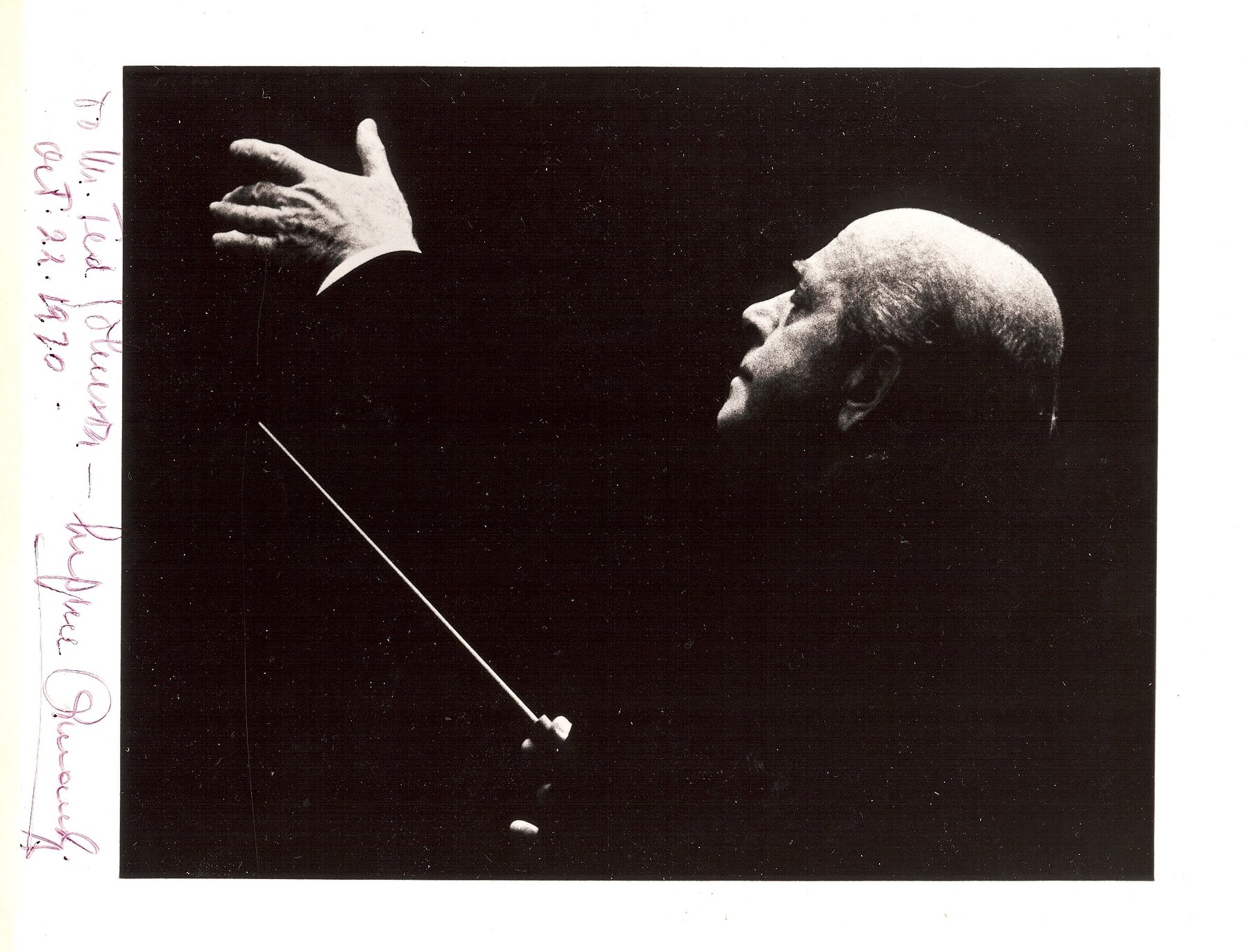
    What’s the big deal about this guy, Jenő Blau? Well, you probably know him better by his adopted name, Eugene Ormandy.

    Ormandy, a Hungarian-born violinist who had studied with Jenő Hubay (for whom he was named), became a naturalized American citizen in 1927. He ultimately wound up directing The Philadelphia Orchestra for 44 years. In that capacity, he became one of the world’s most-recorded conductors.

    However, in some respects, he remains a vastly underrated one. Sure, he was a superb interpreter of 19th century and post-romantic classics (his Columbia recording of Tchaikovsky’s “Pathétique” was one of my go-to favorites as a teen, and he was an authoritative conductor of Rachmaninoff and Sibelius), but he also championed much contemporary music and new works written by his adopted countrymen. Also, if ever there was a more sensitive accompanist in the concerto repertoire, I don’t know of him.

    One of my favorite Ormandy records was also one of his later ones. Throughout his career Ormandy succeeded in selling Sibelius’ “Four Legends from the Kalevala,” a collection of tone poems inspired by the Finnish national epic the “Kalevala,” for the early masterpiece that it is.

    Here again is the final section, “Lemminkainen’s Homeward Journey,” even more thrilling, in 1940:

    https://www.youtube.com/watch?v=FzQMyCsB8eQ

    The legendary Philadelphia strings in Vaughan Williams’ “Fantasia on a Theme by Thomas Tallis”

    Hindemith, “Concert Music for Strings and Brass”

    Ivan Davis joins Ormandy and the Philadelphians for Liszt’s “Hungarian Fantasy,” slight abridged:

    Bruckner “Te Deum” with Temple University Choir

    World premiere performance of Samuel Barber’s Violin Concerto:

    Shostakovich Symphony No. 4:

    Reinhold Glière’s “Russian Sailor’s Dance”

    Rachmaninoff Piano Concerto No. 2, with Eugene Istomin

    Ormandy conducts “Scheherazade” (complete). This is the Philly Orchestra I remember from my college years.

    Debussy, “Reverie”

    Saint-Saens’ Symphony No. 3 “Organ”


    Happy birthday, Eugene Ormandy (1899-1985)!

  • Respighi’s Long Shadow Classical Music Surprises

    Respighi’s Long Shadow Classical Music Surprises

    Wow! Did you know that Respighi’s widow died in 1996? That’s as crazy to contemplate as the fact that Gustav Mahler (whose birthday it was on Tuesday) would have turned 80 on the day Ringo Starr was born. And of course, there are those photos of Alma talking with Leonard Bernstein. History is collapsing in on itself like a telescope!

    Respighi’s wife, Elsa, outlived him by some 60 years. A singer and composer herself, she died one week shy of her 102nd birthday. She remained her husband’s biggest cheerleader, tirelessly promoting his music, after his own untimely death in 1936, at the age of 55, and even completed his last opera, “Lucrezia.”

    Respighi, of course, is best known for his trilogy of opulent, at times rafter-rattling tone poems celebrating the scenes and history of Rome – “Fountains of Rome” (1916), “Pines of Rome” (1924), and “Roman Festivals” (1928) – and his time-tripping sets of Renaissance lute recreations, the “Ancient Airs and Dances” (composed in 1917, 1923 & 1932).

    In 1929, when conductor Serge Koussevitzky suggested Respighi orchestrate some of Rachmaninoff’s keyboard pieces, Rachmaninoff responded enthusiastically. He supplied Respighi with hidden programs behind the works to lend additional insights into their creation. Koussevitzky was impressed with the results, which he unveiled with the Boston Symphony Orchestra in 1931. More importantly, Rachmaninoff found the orchestrations to be faithful to the spirit of the originals.

    Here is “The Sea and the Seagulls,” from “Cinq Études-Tableaux” by Respighi, after Rachmaninoff.

    Also, footage of Arturo Toscanini conducting “Pines of Rome” in 1952, with the NBC Symphony. Toscanini conducted the work’s U.S. premiere, with the New York Philharmonic, in 1926.

    https://www.youtube.com/watch?v=vThMQzLbN-Y

    Happy birthday, Ottorino Respighi!


    PHOTO: Respighi (second from right), horsing around with quattro vitelloni

Tag Cloud

Aaron Copland (92) Beethoven (95) Composer (114) Film Music (120) Film Score (143) Film Scores (255) Halloween (94) John Williams (185) KWAX (229) Leonard Bernstein (100) Marlboro Music Festival (125) Movie Music (135) Opera (198) Philadelphia Orchestra (88) Picture Perfect (174) Princeton Symphony Orchestra (106) Radio (87) Ralph Vaughan Williams (85) Ross Amico (244) Roy's Tie-Dye Sci-Fi Corner (290) The Classical Network (101) The Lost Chord (268) Vaughan Williams (103) WPRB (396) WWFM (881)

DON’T MISS A BEAT

Receive a weekly digest every Sunday at noon by signing up here


RECENT POSTS