Tag: Ray Harryhausen

  • Jason Argonauts Medea Outer Limits Discussion

    Jason Argonauts Medea Outer Limits Discussion

    Ever wonder why “Jason and the Argonauts” (1963) ends where it does? Because Medea gets the final cut!

    Seriously, how can you possibly top a duel with seven meticulously-animated skeletons? The three-minute sequence took stop-motion virtuoso Ray Harryhausen 4 ½ months to complete.

    But nobody seems to care that Jason never does get around to retaking the kingdom of his father. Learn more about Medea’s grisly solution to seemingly everything during last night’s discussion about this beloved classic.

    We’ll be off next Friday, but next Sunday Roy will be joined by a very interesting panel, as the topic with be a new book about the seminal sci-fi-horror-dark fantasy television series “The Outer Limits,” focused specifically on the unforgettable episode “Nightmare” (1963).

    Zooming in to talk about it will be Dave Rash (who put together the book), Dominick Stefano (son of scriptwriter and series creator Joseph Stefano), David Frankham (who has a substantial role in the actual episode), and Michael L. Schuman (whose critical assessment of the episode is included in the book).

    The conversation is guaranteed to be “out there.” Join Roy and company for a chat about “The Outer Limits,” on the next Roy’s Tie-Dye Sci-Fi Corner, livestreamed on Facebook, next Sunday evening, August 7, at 7:30 pm EDT!

    https://www.facebook.com/roystiedyescificorner


    BONUS! For anyone who loves Bernard Herrmann’s music for “Jason and the Argonauts,” I’ll be featuring a substantial selection from it on “Picture Perfect,” music for the movies, this Saturday evening at 6:00 EDT, on WWFM – The Classical Network and wwfm.org!

  • Jason and the Argonauts Hydration Tips

    Jason and the Argonauts Hydration Tips

    Remember: in the summer, it’s important to stay “hydrated.”

    On the next Roy’s Tie-Dye Sci-Fi Corner, we’re enlisting a crew of hirsute, out-of-shape fighting men (including a 39 year-old Hercules, who looks, at best, to be in his late 50s) for a journey to the far-side of the world in our quest for the Golden Fleece and a discussion of “Jason and the Argonauts” (1963).

    Everything that you loved about this movie as a kid still holds up: the vindictive, fruit-loving harpies, an oversized bronze automaton in serious need of WD-40, destruction by crumbling cliff-faces narrowly averted by tuna-tailed Triton, and sinister skeleton warriors sprung nonsensically from hydra’s teeth. Also, Nancy Kovack (a.k.a. Mrs. Zubin Mehta) and Honor Blackman!

    Roy and I will do our best to emulate the perfect alchemy of Ray Harryhausen and Bernard Herrmann this week, when we talk about “Jason and the Argonauts.” Are we stop-motion animation, or is it just Roy’s internet connection? Pour yourself a tall glass of water and join the conversation in the comments section. We livestream on Facebook, this Friday evening at 7:30 EDT!

    https://www.facebook.com/roystiedyescificorner

  • Golden Voyage of Sinbad Sci-Fi with John Phillip Law

    Golden Voyage of Sinbad Sci-Fi with John Phillip Law

    After suffering through “The Assassination Bureau,” Roy made the command decision to nix it. It turns out there’s no science fiction in it.

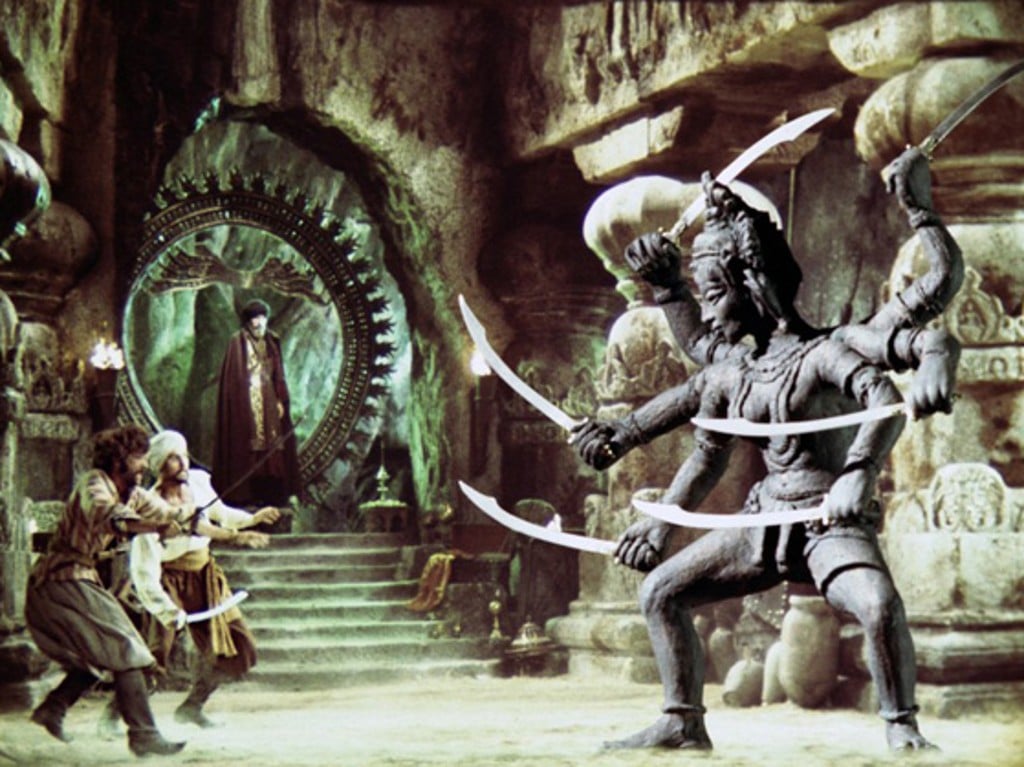
    Therefore, our John Phillip Law festival continues with “The Golden Voyage of Sinbad” (1973). Legendary stop-motion artist Ray Harryhausen breathes life into the Dynamation homunculi, dueling Kali statue, centaur-cyclops, golden griffin, and perhaps myth’s most impassive Siren. That’s some serious Sinbad science! Law, you’ll recall, played Pygar the angel in last Friday’s film topic, “Barbarella.”

    Miklós Rózsa’s portentous score still echoes in my ears, even as a well-oiled Caroline Munro lingers in my memory. Tom Baker, on the very eve of “Doctor Who” celebrity, plays the villainous necromancer Koura. In the days before anyone ever heard of cultural appropriation, a blue-eyed Sinbad swashbuckles his way through a mish-mash of mythologies.

    Join us, as we too shall sin bad, on the next Roy’s Tie-Dye Sci-Fi Corner. Your destiny is written in the comments section, as we livestream on Facebook, this Friday evening at 7:00 EST!

    https://www.facebook.com/roystiedyescificorner

  • Moross’s Wild West Film Music

    Moross’s Wild West Film Music

    “[A]s we hit the Plains I got so excited,” recollected composer and pianist Jerome Moross. It was 1936 and, at George Gershwin’s invitation, he was en route to Los Angeles to participate in the West Coast premiere of “Porgy Bess.” When he stepped off the bus in Albuquerque, it changed him forever. “…I got to the edge of town and then walked out onto the flat land with a marvelous feeling of being alone in the vastness, with the mountains cutting off the horizon. The whole thing was just too much for me… it was marvelous, and I just fell in love with it.”

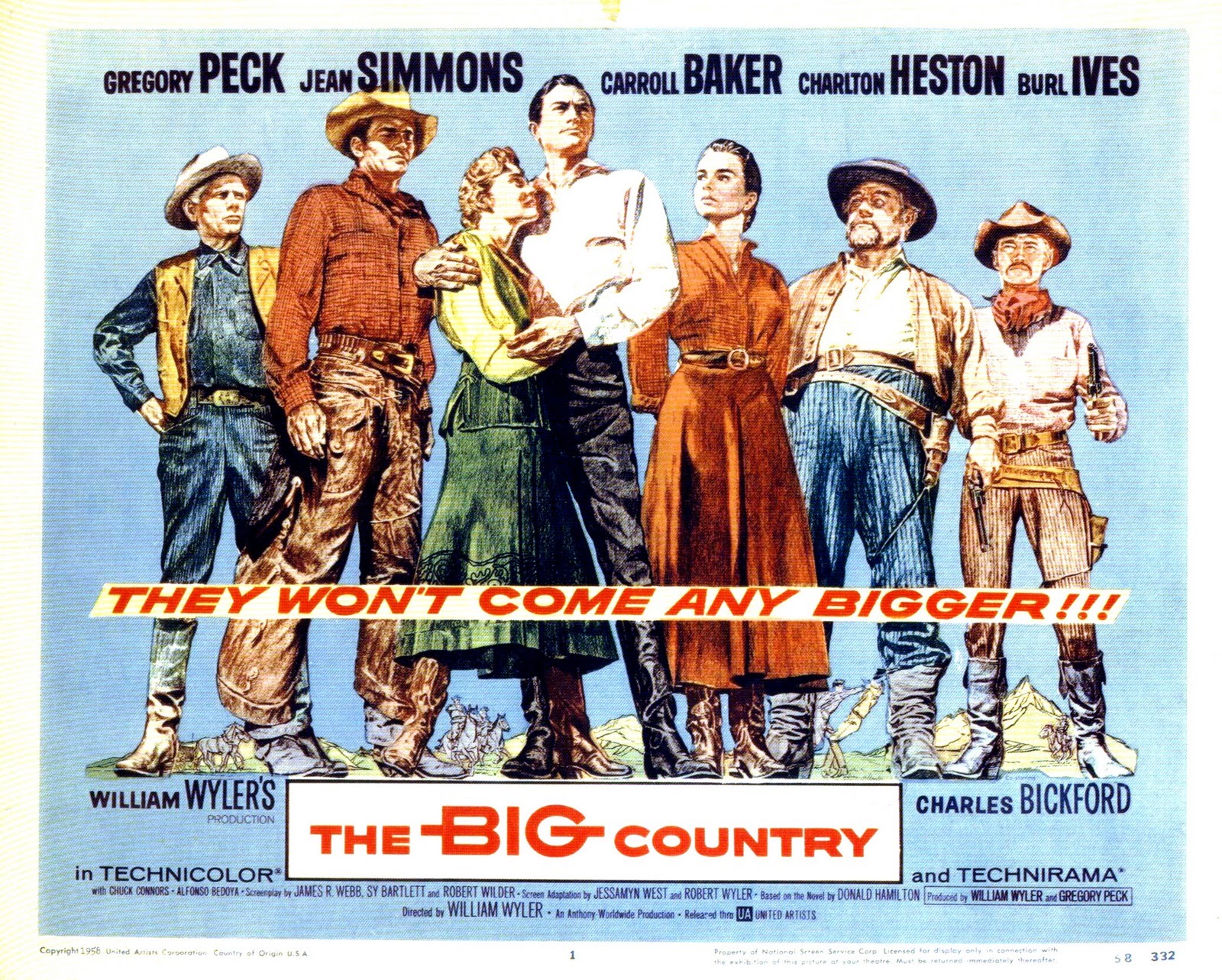
    He would recall this powerful communion with the American West decades later when he came to write his best-known music, the Academy Award-nominated score for “The Big Country” (1958). Indeed, the “western” sound would color many of his future film and concert works, with the energetic syncopations of his native New York City supporting an easy lyrical gift that could easily pass for genuine American folk music.

    This week on “Picture Perfect,” we’ll saddle up for selections from four of Moross’ big screen westerns. The success of “The Big Country” put Moross much in demand as Hollywood’s troubadour of the great outdoors. The trail was still fresh when he was enlisted for “The Proud Rebel” (1958). The film starred Alan Ladd, as a Civil War veteran with a troubled past, and the late Olivia De Havilland, as the ranch owner who takes responsibility for him. Tensions mount as a corrupt landowner and his sons attempt to drive the woman off her ranch.

    While “The Proud Rebel” tapped into predictable western archetypes, “The Valley of Gwangi” (1969) exploded all expectations. A cross-genre western that might best be described as “Annie Get Your Gun” meets “King Kong,” the film’s premise hinges on the discovery by an enterprising band of cowboys of an Allosaurus in a lost valley in Mexico, which of course they press into service at their Wild West show. What could possibly go wrong? In a time before starships and superheroes dominated the cinematic landscape, “Gwangi” must have been very heady stuff for six-year old boys everywhere.

    The project was conceived decades earlier by Willis O’Brien, the special effects legend who created Kong. But it was left to his protégé, the great Ray Harryhausen, to bring the film to fruition. The result, while never scaling the operatic heights of “Kong,” is a fascinating mélange, a movie that is part cowboy, part creature-runs-amok.

    For those of a certain age, one of Moross’ most recognizable melodies must surely be the theme to the television series “Wagon Train.” Unfortunately, that music was soon discovered to bear a striking resemblance to a secondary theme in “The Jayhawkers” (1959). Fortunately for Moross, competing studios were willing to look the other way. “The Jayhawkers,” which starred Jeff Chandler and Fess Parker, is set in the days of Bleeding Kansas.

    We are borne west on music of great vitality. Breathe the open air with Jerome Moross, on “Picture Perfect,” music for the movies, this Friday evening at 6:00 EDT, on WWFM – The Classical Network and wwfm.org.

  • Arabian Nights Cinematic Delights

    Arabian Nights Cinematic Delights

    Open sesame! It’s an Aladdin’s Cave of cinematic delights.

    This week on “Picture Perfect,” the focus is on tales from “The Arabian Nights.”

    These traditional folk stories from the Orient have come down to us filtered through the sensibilities of Western translators. Further translation was required to get the stories from page to screen; so it’s hardly surprising to find Sinbad, for instance, fighting a giant walrus at the North Pole.

    The film versions are often showcases for the work of production designers and special effects artists, but composers have certainly gotten in on the act with suitably imaginative scores.

    Bernard Herrmann lent plenty of color and wit to the skeleton duel in “The Seventh Voyage of Sinbad” (1958) by employing a battery of castanets, xylophone, and brass. Stop motion artist Ray Harryhausen was responsible for the memorable effects. “Sinbad” proved to be a dry run for the climax of “Jason and the Argonauts,” in which Harryhausen outdid himself by animating not one, but seven skeletons, and again, Herrmann supplied the music.

    Harryhausen animated two further Sinbad adventures – “The Golden Voyage of Sinbad” (1974) and “Sinbad and the Eye of the Tiger” (1977). Over the course of the three “Sinbad” films, audiences were treated to fantastic encounters with, in addition to the skeleton, a Cyclops, a roc, a dragon, a statue of the goddess Kali, a centaur, a giant walrus, and a saber-tooth tiger, among others.

    “Sinbad and the Eye of the Tiger” was scored by Roy Budd. Budd’s reputation was largely that of a jazz musician and composer. He wrote scores for over 50 films, including “Get Carter” and “The Wild Geese,” before his early death of a brain hemorrhage, at the age of 46, in 1993.

    Walt Disney created a modern classic in “Aladdin” (1992). The music was by Alan Menken, with lyrics by Howard Ashman and Tim Rice. “Aladdin” won Academy Awards for Best Original Score and Best Original Song (“A Whole New World”). Menken has a whole shelf full of Oscars for his work for Disney. Need I say, Robin Williams was the voice of the manic, freewheeling Genie?

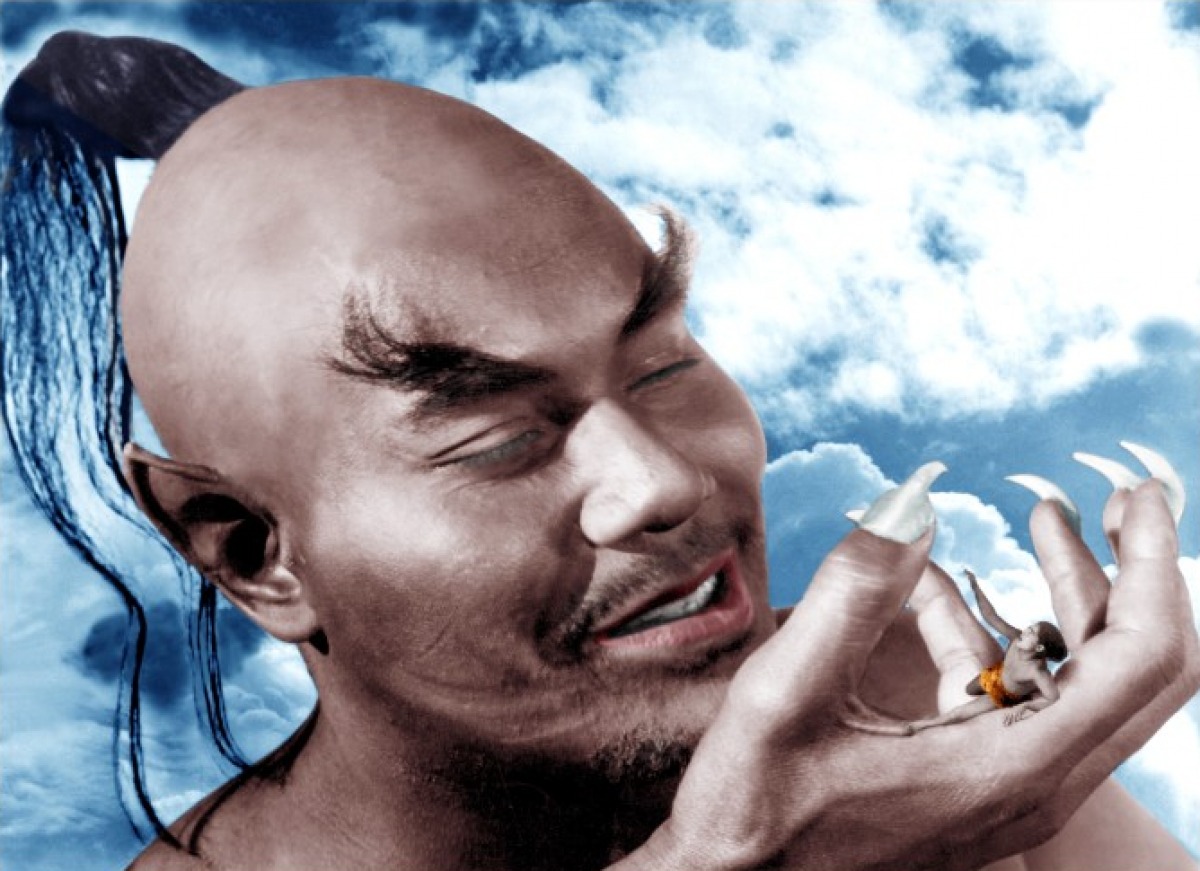
    Rex Ingram’s Genie steals the show in “The Thief of Bagdad” (1940). Ingram emerges from his magic lamp and looms over a cowering Sabu, whom he addresses as “Little Master of the Universe.” The beach resounds with his maniacal laughter. There was an earlier, justly celebrated, silent version of “Thief,” with Douglas Fairbanks. The remake splits the thief and the prince into two separate characters. Sabu plays the incorrigible Abu (the thief), and Conrad Veidt is his nemesis, the treacherous vizier Jaffar.

    The score is by three-time Academy Award winner Miklós Rózsa. Rózsa was in London, in the employ of Alexander Korda, when the lavish Technicolor production was moved to Hollywood on account of the Blitz. Rózsa would go on to become one of Hollywood’s greatest composers. His music for “Ben-Hur” alone has earned him a place in the film music pantheon. He never wrote a more charming score, however, than he did for this.

    I hope you’ll join me for an hour of cinematic enchantments. That’s “A Thousand and One Nights at the Movies,” on “Picture Perfect,” this Friday evening at 6:00 EDT, on WWFM – The Classical Network and wwfm.org.

Tag Cloud

Aaron Copland (92) Beethoven (95) Composer (114) Film Music (120) Film Score (143) Film Scores (255) Halloween (94) John Williams (185) KWAX (229) Leonard Bernstein (100) Marlboro Music Festival (125) Movie Music (135) Opera (198) Philadelphia Orchestra (88) Picture Perfect (174) Princeton Symphony Orchestra (106) Radio (87) Ralph Vaughan Williams (85) Ross Amico (244) Roy's Tie-Dye Sci-Fi Corner (290) The Classical Network (101) The Lost Chord (268) Vaughan Williams (103) WPRB (396) WWFM (881)

DON’T MISS A BEAT

Receive a weekly digest every Sunday at noon by signing up here


RECENT POSTS