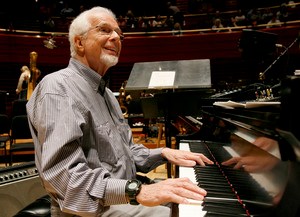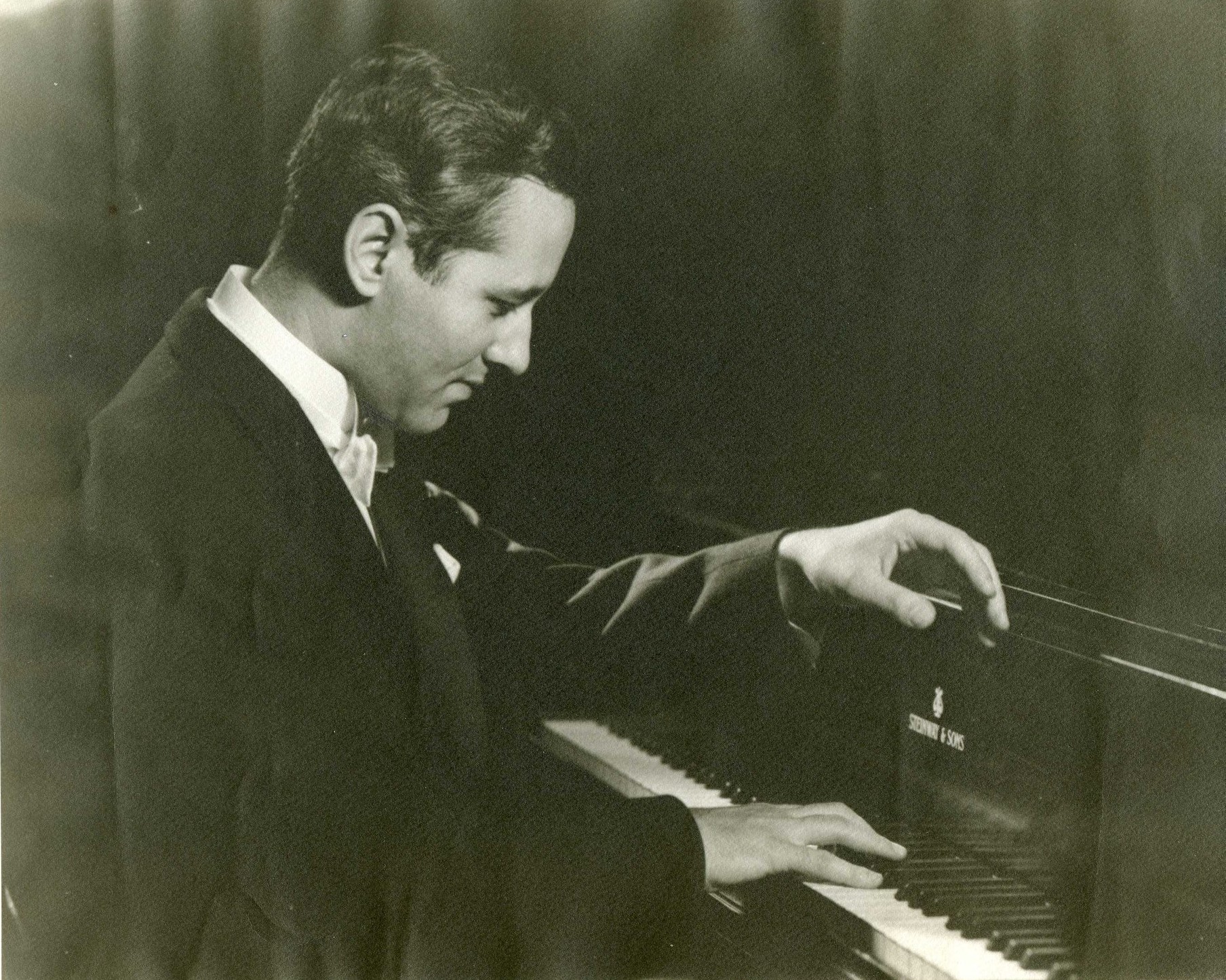
He liked his keys and he liked his cards. One hundred years ago today, pianist and bridge master Leonard Pennario was born in Buffalo, New York.
Pennario gave his first public performance in a department store there at the age of 7. After his father’s shoe business collapsed during the Great Depression, he and his family moved to Los Angeles when he was 10. Los Angeles was to remain his base of operations for the rest of his career, until his retirement in 2005.
Pennario was a born musician with an outstanding memory. At the age of 12, he was recommended by Sir Eugene Goossens to the Dallas Symphony Orchestra as a substitute for an ailing pianist. Asked if he knew Grieg’s Piano Concerto, Pennario said yes, when in fact he had never even heard it. He was able to learn the piece in six days, without missing any school. His debut was a triumph and the beginning of an extraordinary career.
He rose to prominence without ever attending a music college or entering a piano competition. He did, however, take lessons from Isabelle Vengerova, whose other students included Samuel Barber, Leonard Bernstein, Gary Graffman, and Abbey Simon. He also studied composition with Ernst Toch at the University of Southern California.
He served in the U.S. Army during the Second World War, and made his debut with the New York Philharmonic under Artur Rodzinski, in Liszt’s First Piano Concerto, while still in uniform, in 1943.
Temperamentally, he was the polar opposite of Glenn Gould, who, early on, abandoned public concertizing, in favor of the hermetic environment of the recording studio, or even Vladimir Horowitz who suffered harrowing bouts of stage fright. Pennario adored performing before an audience, and his magnetism and self-confidence were evident to those who were lucky enough to have heard him live. His was an unshakeable technique, characterized by clarity, speed, and accuracy, combined with a sense of spontaneity and soulfulness.
His recordings of Gershwin and Rachmaninoff have seldom, if ever, been out of the catalogue. His “Rhapsody in Blue” was one of the most popular of all classical LPs, and he was the first pianist after the composer to record all the Rachmaninoff concertos. In 1959, he was declared the best-selling American pianist. He was also the first to record the works of Louis Moreau Gottschalk. In all, he made over 60 records.
Pennario’s association with Hollywood unsettled some musical elitists, especially when he recorded an album like “Concertos Under the Stars,” featuring Addinsell’s “Warsaw Concerto,” among other potboilers, or when he adapted his own “Midnight on the Cliffs” for the Doris Day film “Julie.” He dated Elizabeth Taylor and palled around with Judy Garland. He was an early champion of the concert music of Academy Award-winning film composer Miklós Rózsa. In the meantime, he was also recording piano trios with Jascha Heifetz and Gregor Piatigorsky.
In addition to being an exceptional pianist, he was an accomplished card player. He discovered bridge in 1965, formed a celebrity quartet with Don Adams (of “Get Smart”), band leader Les Brown, and Joan Benny (Jack Benny’s daughter), and under the tutelage of his friend, columnist Alfred Sheinwold, attained an enviable level of expertise. In fact, he became a Life Master in tournament bridge, and earned a listing in the Official Encyclopedia of Bridge.
Apparently, Sheinwold shared Pennario’s passion for music. During their get-togethers the pianist would sometimes accompany him in lieder of Schubert and Brahms. Said Pennario, “He had a fine tenor voice… I would accompany him and he in turn would partner me in tournaments. Each of us felt he had the better deal!”
In the late 1990s, the onset of Parkinson’s Disease forced Pennario into retirement. Bridge became the solace of his old age. He died in La Jolla, California, on June 28, 2008, at the age of 83.
Fondly remembering Leonard Pennario on the 100th anniversary of his birth!
“Rhapsody in Blue”
With Fiedler and the Boston Pops: Rachmaninoff’s “Rhapsody on a Theme of Paganini,” César Franck’s “Symphonic Variations,” and Henry Charles Litolff’s Scherzo from the Concerto Symphonique No. 4
Live performance of Miklós Rózsa’s Piano Concerto, with post-performance interview
Trios with Heifetz and Piatigorsky
“Midnight on the Cliffs”
On Kraft Music Hall with Nelson Eddy in 1947