The most widely-recognized of American classics? Perhaps. Next to “Fanfare for the Common Man” and “The Stars and Stripes Forever,” I can think of few others. George Gershwin’s “Rhapsody in Blue” is 100 today.
I once heard it performed on a New Year’s Day concert in Milan. As late as the mid ‘90s, it seemed European musicians still hadn’t acquired that innate ability to swing. But the world’s a lot smaller place now, and they seem to have gotten it.
Here’s the first recording, with Gershwin at the piano and Paul Whiteman conducting. The work is abridged and played a little faster than we’re accustomed to hearing today, in large part to be able to fit it onto two sides of a 12-inch 78 rpm record.
The first recording I acquired, on LP, was with Leonard Bernstein as conductor and pianist with the New York Philharmonic, made for Columbia Records in 1964. The performance really is more expansive than most. As the years went by, I enjoyed hearing different takes on the piece, some of them attempting to recreate its original jazz band debut.
The work has been dismissed by cognoscenti as corny. In 1934, composer Constant Lambert derided it as “neither good jazz nor good Liszt.” As recently as two weeks ago, the New York Times ran an article under the title “The Worst Masterpiece,” with pianist Ethan Iverson making a straw man argument that Duke Ellington was a more important composer. Of course the “Rhapsody” is not true jazz, any more than Brahms’ Hungarian riffs could be construed as authentic Hungarian music. But it is 100 percent American.
“Rhapsody in Blue” is one of those rare pieces of classical music whose appeal transcends genre. I have an uncle, who is by no means a classical music person, who is obsessed with the work. It’s a crowd-pleaser, and deservedly so. If anything, its winning combination of optimism, energy, and naiveté reminds us of America’s “better angels” (a phrase I borrow from Lincoln on his birthday). The work is as refreshing now as it ever was, even if, one hundred years on, it seems more and more like a distant dream. It’s still a dream to be celebrated.
Bernstein, 1964
Bernstein live, 1976
Michael Tilson Thomas’ quite different conception
Incorporating Gershwin’s 1925 piano roll
Peter Nero and the Philly Pops at Independence Hall
In Woody Allen’s “Manhattan”
Paul Whiteman, who conducted the premiere of “Rhapsody in Blue,” introduces and leads it here, beginning at the 51-minute mark (with interlude for “voodoo drums???”) in the insane, pre-Code curio, “King of Jazz” (1930). Just don’t watch it too close to bed!
Live footage of Gershwin playing “I Got Rhythm” in 1931
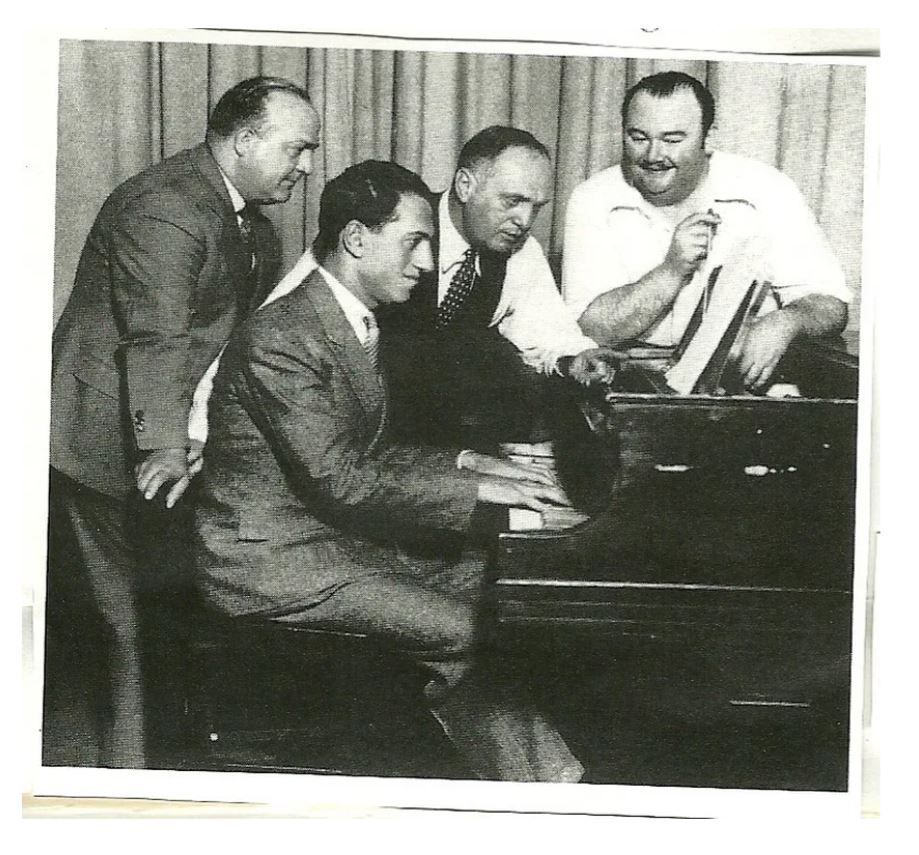
PHOTO: (left to right) Ferde Grofé, Whiteman’s orchestrator and later composer of the “Grand Canyon Suite;” Gershwin at the piano; theatrical impresario Samuel “Roxy” Rothafel; and Whiteman, with his baton
Leave a Reply