This Sunday night on “The Lost Chord,” with the lingering evidence of our last winter storm still coating lawns and piled high around parking lots in the Trenton-Princeton area, we welcome spring with selections from Nikolai Rimsky-Korsakov’s “The Snow Maiden.”
Based on an allegorical Russian fairy tale of humans, quasi-mythological creatures, and the eternal forces of nature, “The Snow Maiden” is the story of a star-crossed love that brings about the end of a 15-year winter. The orchestral suite – which climaxes with the “Dance of the Tumblers” – is fairly popular, but the opera, as with all of Rimsky’s 16 efforts in the form, is virtually unknown in the West.
The recording, on the Capriccio label, which features the Bulgarian Radio Symphony conducted by Stoyan Angelov, doesn’t hold a candle to the best Rimsky opera recordings by conductors like Nikolai Golovanov, but it’s enough to give a taste of what American opera lovers are missing.
I hope you’ll join me for “Thaw of the Wild,” tonight at 10:00 EDT, on WWFM – The Classical Network and at wwfm.org.
What precautions have you taken against Rusalka Week? None, you say? (Crosses self.)
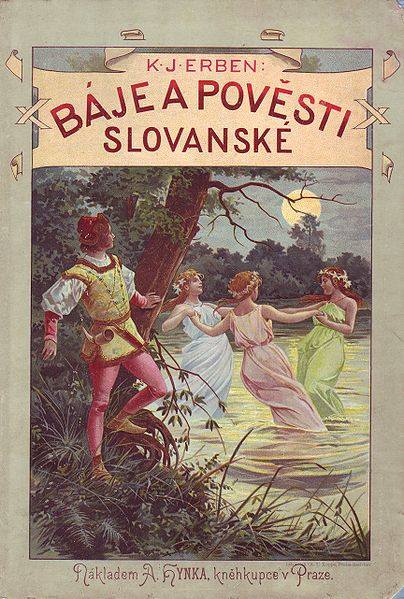
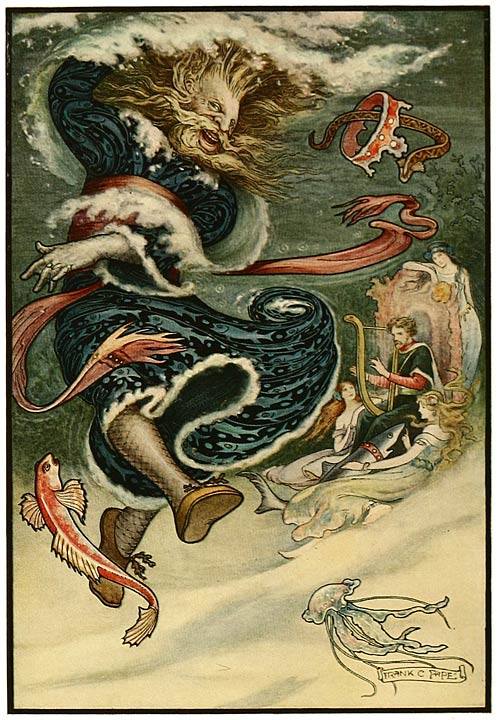
In Slavic mythology, a rusalka is a spirit that dwells at the bottom of a river or lake. She lures unsuspecting men with her song, invariably resulting in a watery doom. Rusalki are never more dangerous than in early June, when the spirits roam free.
There have been innumerable pieces of music written about water spirits – sirens, naiads, lorelei, undines, mermaids and melusinas. One of the best known of the bunch is Dvořák’s “Rusalka,” inspired by Czech fairy tales of Karel Jaromir Erben and Božena Němcová. Here is its most famous aria, the “Song to the Moon,” sung by Lucia Popp:
Alexander Dargomizhsky, one of the pioneers of Russian nationalism in music, also composed an opera called “Rusalka.” His was based on a dramatic poem by Pushkin. Chaliapin recorded selections, but the complete opera is as rare as hen’s teeth.
Rusalka Week is the backdrop for Rimsky-Korsakov’s opera, “May Night,” drawn from Gogol’s collection, “Evenings on a Farm Near Dikanka.” The Nikolai Golovanov recording from 1948 is still the one to beat.
Of course, it being YouTube, you will have to search for plot synopses and libretti yourself. You should have plenty of time to do so. You shouldn’t be out wandering at night during Rusalka Week anyway.
Right now, we’re listening to selections from Rimsky-Korsakov’s “Sadko.”
Stay with me for musical depictions of the nefarious cossack and freebooter Stepan Razin and the heroic bogatyr Ilya Muromets, by way of the epic Symphony No. 3 by Reinhold Gliere.
It’s all music inspired by Russian folklore this morning, until 11 ET, on WPRB 103.3 FM and wprb.com.
A few days ago, on the occasion of Nikolai Rimsky-Korsakov’s birthday anniversary, I was going on about his operas. This Sunday night on “The Lost Chord,” you’ll have a chance to sample one of them, as we welcome spring with selections from “The Snow Maiden.”
Based on an allegorical Russian fairy tale of humans, quasi-mythological creatures, and the eternal forces of nature, it’s the story of a star-crossed love that brings about the end of a 15-year winter. The orchestral suite – which climaxes with the “Dance of the Tumblers” – is fairly popular, but the opera, as with all of Rimsky’s 16 efforts in the form, is virtually unknown in the West.
The recording, on the Capriccio label, which features the Bulgarian Radio Symphony conducted by Stoyan Angelov, doesn’t hold a candle to the best Rimsky opera recordings by conductors like Nikolai Golovanov, but it’s enough to give a taste of what American opera lovers are missing.
I hope you’ll join me for “Thaw of the Wild,” tonight at 10 ET, with a repeat Wednesday evening at 6, or that you’ll listen to it later as a webcast at http://www.wwfm.org.
Today is the birthday of Nikolai Rimsky-Korsakov (Julian date Mar. 6, 1844), who wrote so much enchanting music, and yet so much of it is comparatively unknown.
In particular, his operas have failed to really secure a toehold in the West. This, despite a pre-political hot potato Valery Gergiev’s efforts to bring a taste of their opulence and pageantry to BAM, the odd touring company (the Bolshoi) bringing concert versions to Lincoln Center, or the now defunct New York City Opera putting together an English-language version of “Le coq d’or” for Beverly Sills and Norman Treigle – now almost 50 years ago!
His works for the stage are often dismissed by Western critics, who apparently find them insubstantial, as if (non-Wagnerian) folklore is somehow less valid than an evening of Italian oom-pah-pah culminating in a jester discovering his dying daughter in a burlap sack.
Be that as it may, I find what I’ve heard of his operas (and I’ve probably heard more than most) enthralling. He composed 16 in all, if we count the original version of “Mlada,” which he wrote in collaboration with other composers of The Mighty Handful.
Sadly, Gergiev’s cycle of recordings for the Philips label was curtailed after only five operas, leaving one to feel one’s way through the thickets of mostly unreviewed (at least in the West) Russian recordings. The sound quality on these can be hit and miss, and the singing can be variable, but every once in a while, one hits pay dirt.
Why is it that the most powerful recordings are from the pre-stereo era, when larger-than-life figures like Feodor Chaliapin and Mark Reizen walked the boards? If you don’t mind listening through a soup can, anything conducted by Nikolai Golovanov will knock your socks off. If ever I acquire a time-traveling DeLorean, I would make it my mission to round up some modern recording engineers and slip into the Soviet Union under Stalin’s moustache.