Tag: Robert Schumann

  • Clara Schumann’s Liszt Problem

    Clara Schumann’s Liszt Problem

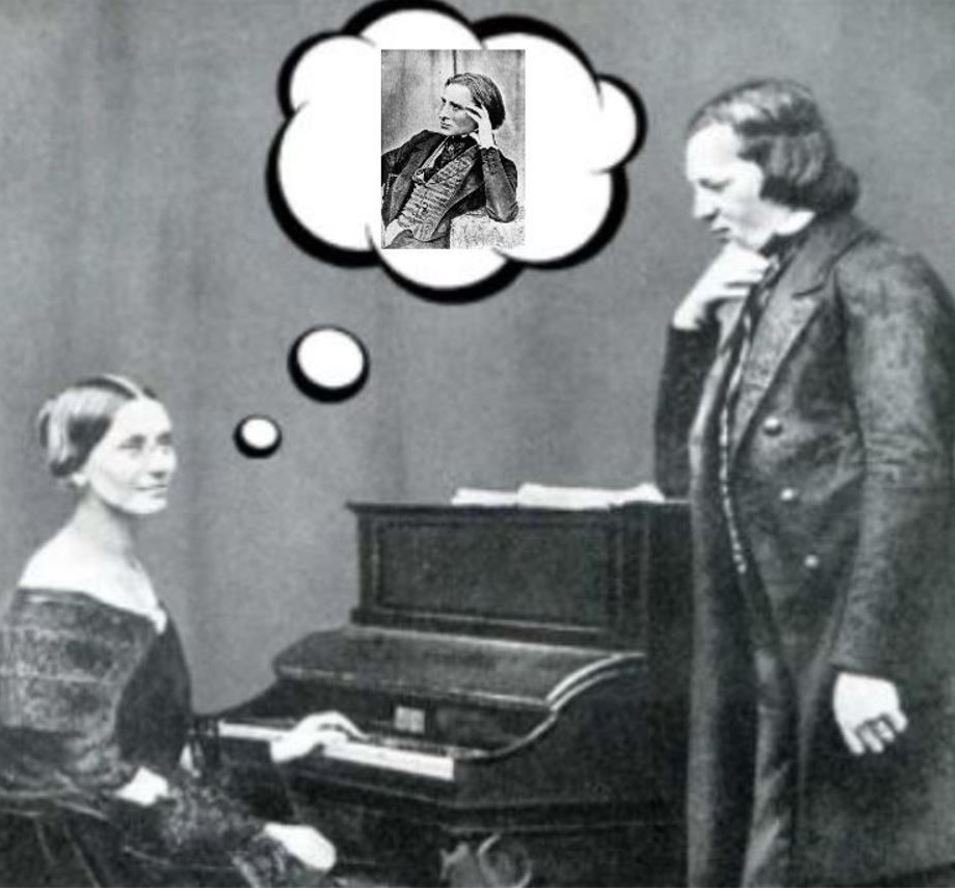
    For whatever reason, Franz Liszt really rubbed Clara Schumann the wrong way. Essentially, everything about him ran counter to what she and her husband thought music should be. But it wasn’t always the case.

    Clara first met Liszt in 1838, prior to her marriage. Clara Wieck was 19 years-old. Like everyone else, she was in awe of his superhuman technique, but it also made her feel inadequate, especially when they played piano four-hands.

    For his part, Liszt was very complimentary. In a letter to his mistress, Marie d’Agoult, he wrote, “Her compositions are truly remarkable, especially for a woman. They contain a hundred times more inventiveness and real feelings than all former and present fantasias by Thalberg.” Sigismond Thalberg was one of Liszt’s chief rivals. But this wasn’t simply “trash talk.” Liszt was consistently impressed by both Schumanns.

    In 1840, he dedicated his “Transcendental Etudes” to Clara. She continued to include his music on her concert programs until 1847. Sadly, familiarity bred contempt, and increasingly she came to find everything about him repugnant. She didn’t like that he was a showboat. She recoiled when he took liberties with the scores he played. And she was totally put off by the indelicacy with which Liszt described her husband’s Piano Quintet as “typically Leipzig.”

    Liszt, clueless, continued to make friendly overtures, championing Robert’s music. Robert, for his part, responded cordially. Liszt published a long essay in praise of the artistry of both Schumanns in 1855, but Clara remained implacable.

    As the War of the Romantics began to heat up in 1860, with heightened antagonism between the Brahmsians (including the Schumanns) and the New German School (followers of Liszt and Wagner), contact became rare.

    In 1884, Clara wrote to Liszt with the aim of copying the correspondence he maintained with her husband, who had died in 1856. Liszt responded that he hadn’t saved any of the letters. That essentially ended all interaction between them.

    45 years earlier, in 1839, Schumann completed his “Fantasie in C major,” during an imposed separation from his future wife. Clara’s father, Schumann’s piano teacher, flew into a rage when he discovered their relationship and forbade any further contact between them. (Clara had not yet reached her majority and had no say in the matter.) Following a protracted and acrimonious legal battle, the court found in favor of the young lovers, and the two married the day before Clara turned 21 – at which age she could have done as she pleased!

    Schumann wrote to Clara about the “Fantasie,” “The first movement is the most passionate I have ever composed; it is a profound lament on your account.”

    Ironically, it was Liszt who received the dedication. Liszt returned the favor by dedicating his own Piano Sonata in B minor to Schumann in 1854.

    Clara confided to her diary, “Today, Liszt sent me a Sonata dedicated to Robert and some more pieces, together with a polite note. But those pieces are so creepy! Brahms played them to me and I felt really miserable… This is only blind noise – no more healthy thoughts, everything is confused, one cannot see any clear harmonies! And, what is more, I still have to thank him now – this is really awful.”

    Of course, Robert, at 44, had already lost his grip on sanity and was by then confined to an asylum.

    With that in mind, on Robert Schumann’s birthday, enjoy his Fantasy in C major.

    Schumann vs. Wieck

    https://interlude.hk/composers-in-the-court-room-robert-schumann-versus-friedrich-wieck/

    Henry Daniell, one of Hollywood’s stock villains, hilariously cast as Liszt in “Song of Love” (1947), with Katharine Hepburn as Clara Schumann and Paul Henreid as Robert. As if this weren’t ridiculous enough, Robert Walker plays Brahms!

    Hepburn pantomimes selections from Schumann’s “Carnaval.”

    Van Cliburn in concert, playing Liszt’s transcription of Schumann’s “Widmung,” written as a wedding present for Clara.

  • Beecham’s Byronic Manfred

    Beecham’s Byronic Manfred

    “Oh God! If it be thus, and thou art not a madness and a mockery, I yet might be most happy…” So laments Lord Byron’s Manfred when confronted by the specter of Astarte.

    Manfred is the quintessential Byronic hero, a romantic superman who endures unimaginable sufferings and mysterious guilt in connection with the death of his beloved. He wanders the Alps, longing for extinction, and meets his fate defiantly, rejecting all authority, corporeal and supernatural.

    Robert Schumann was intoxicated by Byron’s dramatic poem from the time he first encountered it at the age of 19 in 1829. In 1848, he began to compose music for it, concurrently with that for his “Scenes from Goethe’s ‘Faust.’” Wrote Schumann, “I have never before devoted myself to a composition with such love and such exertion of my powers as to ‘Manfred.’” The piece was given its first performance in Weimar in 1852, with Franz Liszt conducting.

    This Sunday night on “The Lost Chord,” we’ll hear highlights from a recording made 102 years later by Sir Thomas Beecham.

    When Beecham came to record Schumann’s incidental music in 1954, it was an act of total reimagination. Unquestionably the work, as written, contains much attractive music. However, if we’re to be completely frank, it can be a bit dramatically static at those times when the music falls silent in deference to florid monologue. Beecham recognized this and enlisted the help of Eugene Goossens and Julius Harrison to assist him in orchestrating a number of Schumann’s piano pieces to be used as underscore for some of the spoken dialogue. He also incorporated a couple of part-songs and even invented a ballet. Fear not! Beecham’s license is nowhere as extreme as that he would later take with Handel’s “Messiah.”

    Beecham’s Byronic credentials are unimpeachable. Byron was among his favorite poets. Of course, he also happened to conduct one of the great recordings of “Harold in Italy” (after “Childe Harold’s Pilgrimage”), with the violist William Primrose. Furthermore, Beecham had been familiar with Schumann’s “Manfred” since at least 1918, when he led two performances of the complete incidental music at the age of 39. Some 36 years later, he decided to resurrect the work via a broadcast performance and then as a program at Royal Festival Hall.

    I first encountered this remarkable recording in the 1980s, in the middle of the night, when it was broadcast over the late, lamented WFLN, for 48 years Philadelphia’s classical music station. Henry Varlack used to play it from time to time on his program, “Sleepers Awake.” Having not heard it for a while, I called in to his Friday night/Saturday morning listener request show, and he told me with regret that the record had become so worn that it was no longer suitable for airplay.

    Imagine my excitement, then, when I learned in the mid-‘90s that it was being reissued on CD. I promptly special-ordered it from England, and it couldn’t get here fast enough. That was on the Beecham Collection label – alas now long out of print. It has since appeared and disappeared (like Astarte?) on Sony.

    The recording features actors, chorus, and orchestra. Laidman Browne may be a bit long-in-the tooth for Byron’s anti-hero, but no one relishes “eeeeeeeeviiiiiiiiiiiiiiiiiiiiiiiiiilllllllll” quite like him.

    I hope you’ll join me for “Byronic Beecham,” this Sunday night at 10:00 EDT, on WWFM – The Classical Network and wwfm.org.

  • Robert Schumann Tormented Genius

    Robert Schumann Tormented Genius

    A would-be concert pianist, he’s said to have destroyed his hand through the use of a finger-strengthening device of his own design.

    He took his underage sweetheart’s father – who also happened to be his teacher – to court, to sue for the right to marry, ultimately winning that right the day before she came of age.

    He went mad from syphilis, hurled himself into the Rhine, and spent his final months in an asylum.

    His name was Robert Schumann, and he was one of the most romantic of Romantic composers.

    It’s hardly surprising that such an overheated personality would write such emotionally turbulent music. Whether tender (as per “Kinderszenen,” his reminiscences of childhood) or troubled (the “Nachtstücke,” a premonition of his brother’s death), Schumann was the ne plus ultra of tormented genius.

    Happy birthday, Florestan! Or should that be Eusebius?


    “Kinderszenen” (“Scenes from Childhood”), performed by Clara Haskil

    “Nachtstücke” (“Night Pieces”), performed by Emil Gilels

    “Fantasie in C major,” performed by Valdimir Horowitz

    The “Fantasie” was completed in 1839, during Schumann’s enforced separation from Clara Wieck, his future wife. He wrote to her: “The first movement is the most passionate I have ever composed; it is a profound lament on your account.”

    In the end, he dedicated the work to Franz Liszt. Liszt returned the favor by dedicating his Piano Sonata in B minor to Schumann in 1854. By that time, Liszt had long been persona non grata to the Schumanns. Clara, in particular, loathed him and his music.

    She confided in her diary: “Liszt sent Robert today a sonata dedicated to him and several other things with a friendly letter to me. But the things are dreadful! [Johannes] Brahms played them for me, but they made me utterly wretched … This is nothing but sheer racket – not a single healthy idea, everything confused, no longer a clear harmonic sequence to be detected there! And now I still have to thank him – it’s really awful.”

    In any case, Robert, at 44, was already in the asylum.

  • Asteroid Schumann & the Election of 2020

    Asteroid Schumann & the Election of 2020

    NASA’s projected arrival of Asteroid 2018 VP1 on November 2, the eve of the Presidential Election, reminds me of Robert Schumann and Clara Wieck’s 1840 legal victory over her father. The two had initiated a long and acrimonious lawsuit against Friedrich Wieck, Schumann’s former teacher, in the hope of overriding his opposition to their marriage. By the time the court ruled in their favor, and they were allowed to tie the knot, it was the last day of Clara’s 20th year. One more day, and she would have attained majority status. At 21, as a matter of course, the decision to marry would have been legally hers.

    Where was this asteroid in 2016, when we really needed it?*


    Kaija Saariaho’s “Asteroid 4179 – Toutatis”

    Schumann’s “Widmung” (“Dedication”), a gift to his new bride


    *Not to worry, it’s only 6 to 12 feet wide and likely to burn up, mostly, or explode in the atmosphere.

    https://en.wikipedia.org/wiki/2018_VP1

  • Schumann Quintet Bernstein Juilliard Recording

    Schumann Quintet Bernstein Juilliard Recording

    On Robert Schumann’s birthday, here’s a favorite recording of the Piano Quintet in E-flat major, with Leonard Bernstein and the Juilliard String Quartet:

Tag Cloud

Aaron Copland (92) Beethoven (95) Composer (114) Film Music (120) Film Score (143) Film Scores (255) Halloween (94) John Williams (185) KWAX (229) Leonard Bernstein (100) Marlboro Music Festival (125) Movie Music (135) Opera (198) Philadelphia Orchestra (88) Picture Perfect (174) Princeton Symphony Orchestra (106) Radio (87) Ralph Vaughan Williams (85) Ross Amico (244) Roy's Tie-Dye Sci-Fi Corner (290) The Classical Network (101) The Lost Chord (268) Vaughan Williams (103) WPRB (396) WWFM (881)

DON’T MISS A BEAT

Receive a weekly digest every Sunday at noon by signing up here


RECENT POSTS