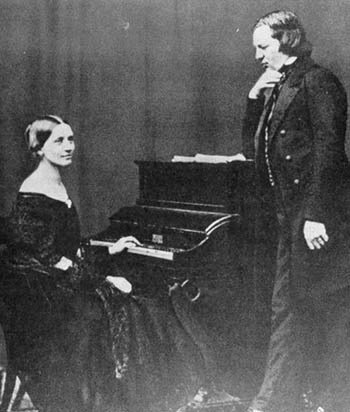
On Robert Schumann’s birthday, here’s a favorite recording of the Piano Quintet in E-flat major, with Leonard Bernstein and the Juilliard String Quartet:
Tag: Robert Schumann
-

Happy Birthday Schumann Symphony No 4
Happy birthday, Robert Schumann!
Here’s a fabulous performance of Schumann’s Symphony No. 4, from perhaps an unexpected source:
I. https://www.youtube.com/watch?v=y-V6qHLCyto
II. https://www.youtube.com/watch?v=jXWHDBcAy0o
III. https://www.youtube.com/watch?v=22Gr4oS8xAI
IV. https://www.youtube.com/watch?v=l5gyhln2Veg
Nice to hear Sir Adrian excel in something other than Elgar and Vaughan Williams!
-
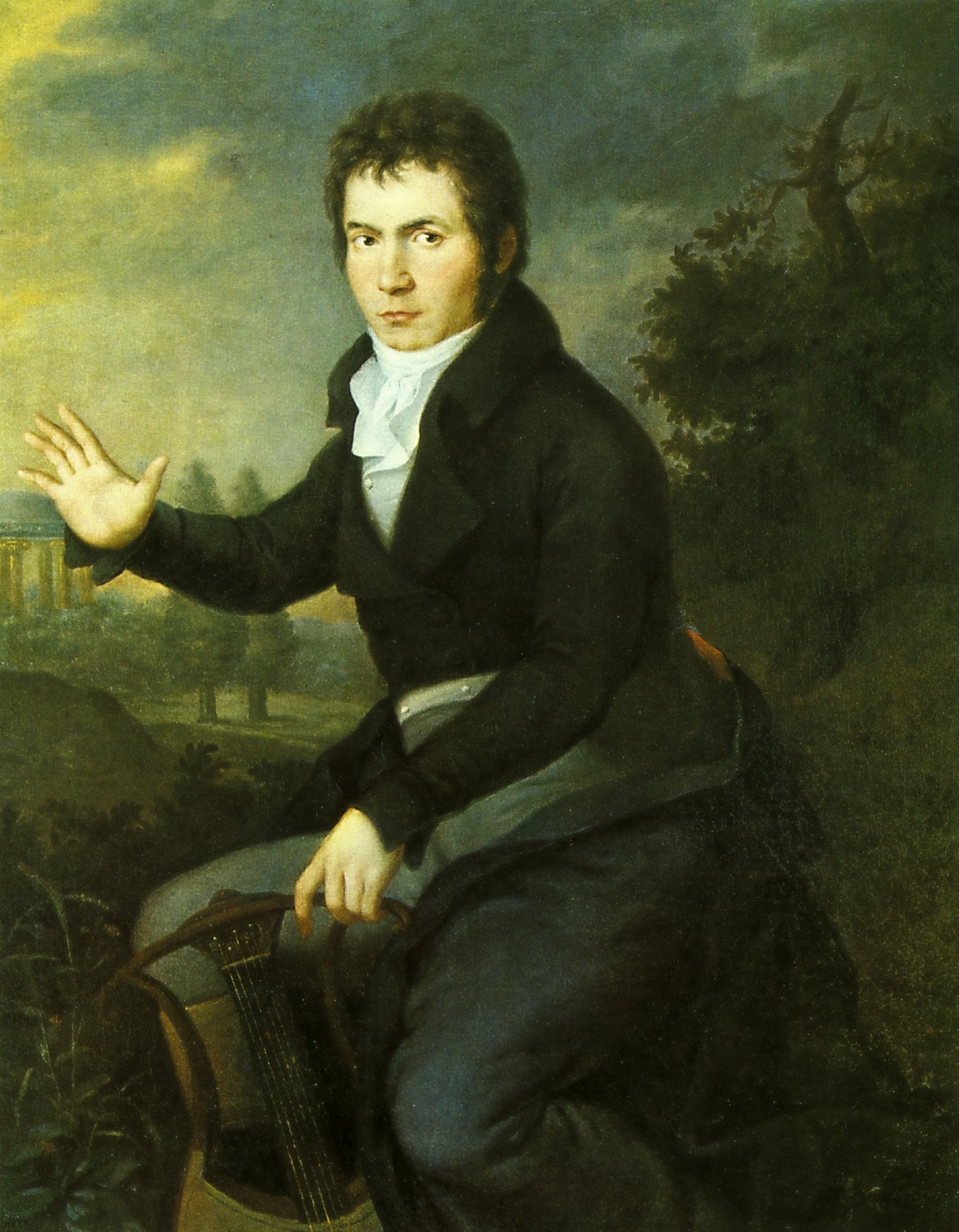
Beethoven’s 4th Symphony: A WWFM Birthday Bash
BEETHOVEN BIRTHDAY BASH
WWFM – The Classical Network’s symphony marathon continues!
NOW PLAYING: Symphony No. 4 in B flat major (English Chamber Orchestra/Michael Tilson Thomas)
It was Robert Schumann who memorably described Beethoven’s 4th Symphony as “a Greek maiden between two Norse giants.” While I certainly find that image provocative, I assume he meant it to signify the work’s relative restraint, geniality, and refinement in comparison to the more ambitious, and perhaps even a little uncouth, Symphonies Nos. 3 & 5.
Let’s hear it for the maiden! Please support it by calling 1-888-232-1212, or by donating online at wwfm.org.
Thank you for your generous contribution!
Portrait (1804-05), Joseph Willibrord Mähler
-

Woldemar Bargiel Birthday Forgotten Composer
Today is the birthday of… He Who Must Not Be Named.
Oh, wait a minute. Sorry. Case of mistaken identity. It’s actually the birthday of WOLDEMAR BARGIEL. Bargiel, who lived from 1828 to 1897, was the half-brother of Clara Schumann.
Bargiel’s mother had been married to Clara’s father, Friedrich Wieck – unhappily, I might add – which should come as little surprise, considering Wieck was the man who threatened to shoot Robert Schumann for courting his daughter. He faced the would-be couple down in court, violated Clara’s privacy, spread vicious rumors about her, and even promoted a rival pianist in her place in the hopes that she would supplant his own daughter. Wieck was so unruly in his determination to see “justice” done that he himself was ordered to pay the lovers a hefty sum and sentenced to jail for 18 days. Amazingly, everyone eventually reconciled, once Wieck became a grandfather, though he never completely abandoned his slippery-yet-inflexible ways.
It was he who drove Bargiel’s future mother, Mariane, into the arms of one of his friends, a fellow music teacher, who would soon become her second husband.
Despite the turbulence that rocked their parents’ world, Woldemar and Clara – who was nine years his senior – enjoyed a warm relationship. Thanks to her advocacy, Bargiel was welcomed by both Robert Schumann and Felix Mendelssohn, and was admitted to the Leipzig Conservatory, where he studied with Ignaz Moscheles, Niels Gade and Julius Rietz. Later, Clara and Robert arranged for the publication of some of his early works.
Bargiel would one day repay the favor by coediting with Johannes Brahms a complete edition of Robert Schumann’s scores.
Avada Kedavra! Happy birthday, Woldemar Bargiel!
Bargiel’s Adagio for Cello and Orchestra:
His Piano Trio No. 1:
-
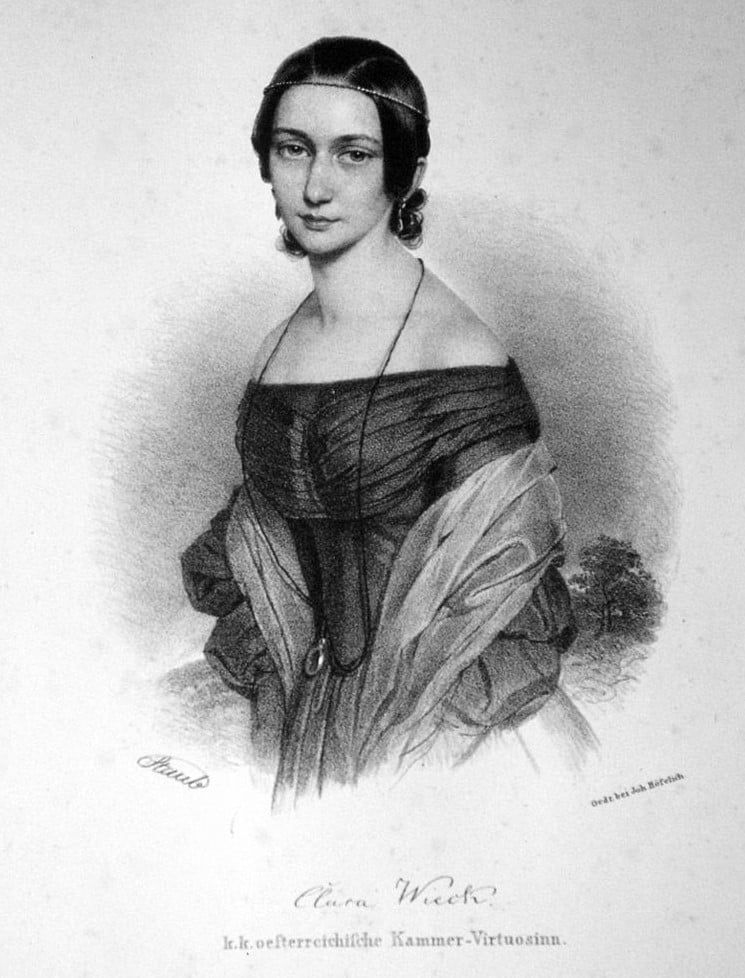
Celebrating Clara Schumann’s Bicentennial
I invite you to join me today in celebrating the bicentennial of the birth of Clara Schumann. Clara Schumann was born Clara Wieck on this date in 1819; she died in 1896.
While she composed comparatively little herself, if we were to stack her manuscripts alongside those of her associates, Robert Schumann and Johannes Brahms, based on what survives, she really sold herself short.
Still, there’s no underestimating her influence as a pianist. Not only was she praised for her imaginative and sensitive interpretations at the keyboard, as a successful performer, she was also able to keep enough food on the table to sustain her large family and to hold it all together when her mercurial husband slipped off the rails.
For the last two decades of her life, she taught at the Hoch Conservatory in Frankfurt. This shot out tendrils in all directions, including to the Juilliard School, where one of her pupils taught Malcolm Frager and Bruce Hungerford.
Fortunately, enough of her music survives to put together a decent salute. We just heard her Piano Trio in G minor on “Music from Marlboro” on Wednesday. Today, we’ll enjoy her “Three Romances” for violin and piano, as well as her Konzertsatz in F minor, the first movement of an intended second piano concerto. We’ll also hear Robert Schumann’s “Variations on a Theme by Clara Wieck” (her maiden name) and “Widmung,” or “Dedication,” a song Robert composed for his new bride.
I am celebrating women all month long. To this end, we’ll also hear Elisabetta Brusa’s opulent Schumann tribute, “Florestan.” Then at 6:00, we’ll hear film scores of Doreen Carwithen, alongside those of her decades-long partner and future husband, William Alwyn.
I hope you’ll join me for Clara Schumann and more, from 3 to 6:00 EDT – with “Picture Perfect” following at 6 – on WWFM – The Classical Network and wwfm.org.
Tag Cloud
Aaron Copland (93) Beethoven (95) Composer (114) Film Music (144) Film Score (143) Film Scores (255) Halloween (94) John Williams (195) KWAX (229) Leonard Bernstein (104) Marlboro Music Festival (125) Movie Music (159) Mozart (90) Opera (212) Philadelphia Orchestra (89) Picture Perfect (174) Princeton Symphony Orchestra (109) Radio (88) Ross Amico (244) Roy's Tie-Dye Sci-Fi Corner (290) The Classical Network (101) The Lost Chord (269) Vaughan Williams (105) WPRB (397) WWFM (881)