If this project is successful, it will be the most exciting cinematic discovery since the complete “Metropolis” was uncovered in Buenos Aires in 2008. Then maybe Orson Welles and Robert Wise will be reconciled in heaven.
After shooting wrapped for “The Magnificent Ambersons” in 1942, Welles took off for Rio de Janeiro to begin work on his next project, entrusting Wise, his editor, to carry his plans to fruition – which he dutifully did. However, following a disastrous preview screening, Wise suddenly found himself in an awkward position. RKO ordered him back into the editing booth to reconfigure Welles’ original blueprint, this time under hardnosed studio supervision. Furthermore, he was instructed to shoot a new ending. Needless to say, Welles and Wise, both nominated for Academy Awards for “Citizen Kane” (Welles won, with Herman Mankiewicz, for his screenplay), would never work together again.
In all, 43 minutes of footage were cut from “The Magnificent Ambersons” and melted down for nitrate during World War II, dashing any hope that the film might be restored to its original version.
Until now.
Could we actually see “The Magnificent Ambersons” in the form Welles originally intended?
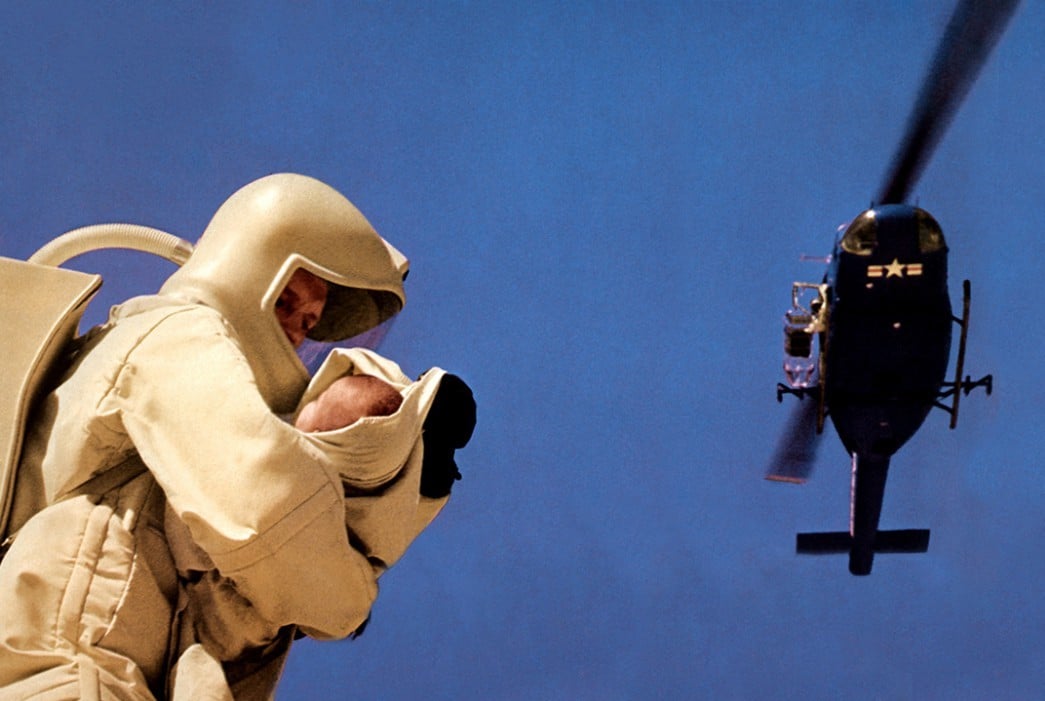
Is Robert Wise’s adaptation of Michael Crichton’s seminal techno-thriller “The Andromeda Strain” (1971) the most suspenseful boring science lesson ever? Hold my beer.
Roy and I will be joined by Rob Kash for the next Roy’s Tie Dye Sci Fi Corner and a three-way discussion of this sci-fi classic, 50 years-old and still terrifyingly fresh.
Surely, if there’s anything more dangerous than a virus from outer space, it’s man: his ignorance, negligence, skepticism, bureaucracy, opportunism, and stubborn inability – or unwillingness – to think ahead. Interestingly, though all of these things are touched upon in “The Andromeda Strain,” it isn’t really what the story’s about. This is not an entertainment predicated on low-hanging fruit.
Rather, the focus is on the nuts and bolts of research against the clock, exhaustive analysis, the methodical process of arriving at knowledge and solutions, to meet the challenges of containment, immunity, and eradication. You know, SCIENCE. How very quaint.
The craftsmanship and restraint are impressive. Douglas Trumbull’s low-key, wholly believable special effects are entirely at the service of the story, while Gil Mellé’s insidious electronic score rachets up the psychological tension. There are no big-name actors, no histrionics, no inflated conflicts; just a good, solid, frighteningly believable story, absorbingly told.
Half a century later, in the middle of a pandemic, “The Andromeda Strain” is, if anything, more relevant, even as it’s unlikely a film like this would ever be released today. It’s too deliberate and thoughtful an enterprise for a world fueled by sound bites, outlandish conspiracy theories, and opinions at the expense of fact.
Unnervingly, 50 years on, things have gotten a whole lot worse. But those issues can be addressed at another time. In “The Andromeda Strain,” contagion is conflict enough.
For now, better start slamming the Sterno. It will be like we’re dodging automated lasers on our race to disable an atomic bomb, metaphorically speaking, on the next Roy’s Tie-Dye Sci-Fi Corner. Cry your lungs out in the comments section, when we livestream on Facebook, this Sunday night at 7:00 EST!
“Barbarella” must have been a real trip – literally – back in the day. But they still haven’t perfected virtual LSD, so now it’s just a slog. At least for me. Still, there was certainly plenty interesting to talk about it. It takes a lot of talented and quirky people to make a movie as bad as “Barbarella.”
At the risk of inflicting whiplash, we’ll shift gears pretty severely tomorrow night, for a three-way conversation about Robert Wise’s “The Andromeda Strain” (1971). Rob Kash will be our guest, as we don the hazmat suits for a deadly-serious adaptation of this Michael Crichton contagion thriller.
Your comments are the only antidote, as we livestream on Facebook, this Sunday evening at 7:00 EST!
Roy and I talk about a few “Things” last night, during our unscientific analysis of Howard Hawks’ “The Thing from Another World” (1951). Definitely make it a point to watch this movie; then watch the show. Most important: KEEP WATCHING THE SKIES!
Then if you’ve got anything left, on Sunday join us for a chat about “Star Trek: The Motion Picture” (1979). I haven’t seen Robert Wise’s director’s cut yet, but it’s supposed to be a vast improvement over the theatrical release. At any rate, it couldn’t hurt!
Roy’s Tie-Dye Sci-Fi Corner live-streams on Facebook, Friday and Sunday evenings at 7:00 EST.
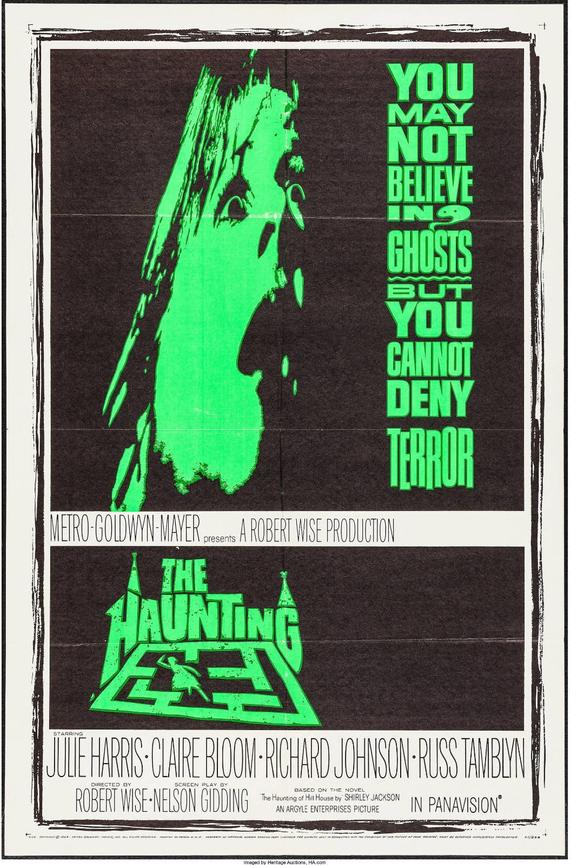
My favorite haunted house movie is still “The Haunting.” Not the overegged 1999 Steven Spielberg-produced remake, with every “chill” projected boldly in state-of-the-art CGI, but the spine-tingling Robert Wise original from 1963 – black and white, insinuating, and creepy as hell.
The direction, cinematography, editing, screenplay, and acting are all first-rate (Russ Tamblyn’s wisecracking Luke aside), and the film still makes for an effective hair-raiser, when viewed alone, late at night, with the lights out.
“In the night… in the dark,” as Mrs. Dudley says.
Adding another dimension to the piece is the unsettling score of Humphrey Searle. Searle manages to take “The Haunting” to a whole other level with his weird atonality and menacing avant-gardisms.
As a concert composer, Searle, two years younger than Benjamin Britten, is about as far from the pastoral tradition of Ralph Vaughan Williams and Gerald Finzi as any English composer of his generation could possibly be (with the possible exception of Elizabeth Lutyens). Britten was contemporary, and cosmopolitan, but Searle was radical, propelled by “Wozzeck” and Franz Liszt (a composer whose works he catalogued, and about whom he wrote an influential book). Searle’s principle mode of expression may have been dodecaphonic (i.e. twelve-tone), but he liked to characterize himself as romantic.
All of Searle’s symphonies have been recorded, but to date, there has been no commercial release of his music for “The Haunting.” For me, this is on my short list of scores I hope one day to be able to purchase. It remains one of the most effective horror scores I have ever heard. Thankfully, for the present, some of it has been posted on YouTube:
I understand that Searle’s symphonies may not be everyone’s cup of tea. They can be austere, grumpy (or perhaps Searle-y), acerbic, tough, and even violent. But the Second, written to the memory of his first wife, Lesley, suggests a tonal center of D and is therefore perhaps a tad more orienting.
For a serialist (who was introduced to Anton Webern by Schoenberg pupil Theodor Adorno), Searle was not without a sense of humor. Here is his “Punkt Contrapunkt,” written under the pseudonym of Bruno Heinz Jaja, a musical joke composed for one of the notorious Hoffnung Music Festival concerts. The speakers are Gerard Hoffnung and John Amis.
And a setting of “Young Lochinvar,” after Walter Scott, also composed for Hoffnung, with Gerard Hoffnung and Yvonne Arnaud.
By coincidence, it was as Searle was on his to Liverpool to attend the premiere of his Symphony No. 2 (link posted above) that he learned of Hoffnung’s death, of a heart attack, at the age of 34.
Searle also composed scores for Hammer Films’ “The Abominable Snowman,” with Forrest Tucker and Peter Cushing, and the Doctor Who serial “The Myth Makers,” with William Hartnell.
Happy birthday, Humphrey Searle!
CLOCKWISE FROM LEFT: “The Haunting;” Searle at work; and Searle, seldom without cat or cigarette, caricatured by Gerard Hoffnung