While I think of it, on a slow news day, I want to remind everyone that the exhibition “Caspar David Friedrich: The Soul of Nature” is now on display at The Metropolitan Museum of Art, New York. But not for much longer!
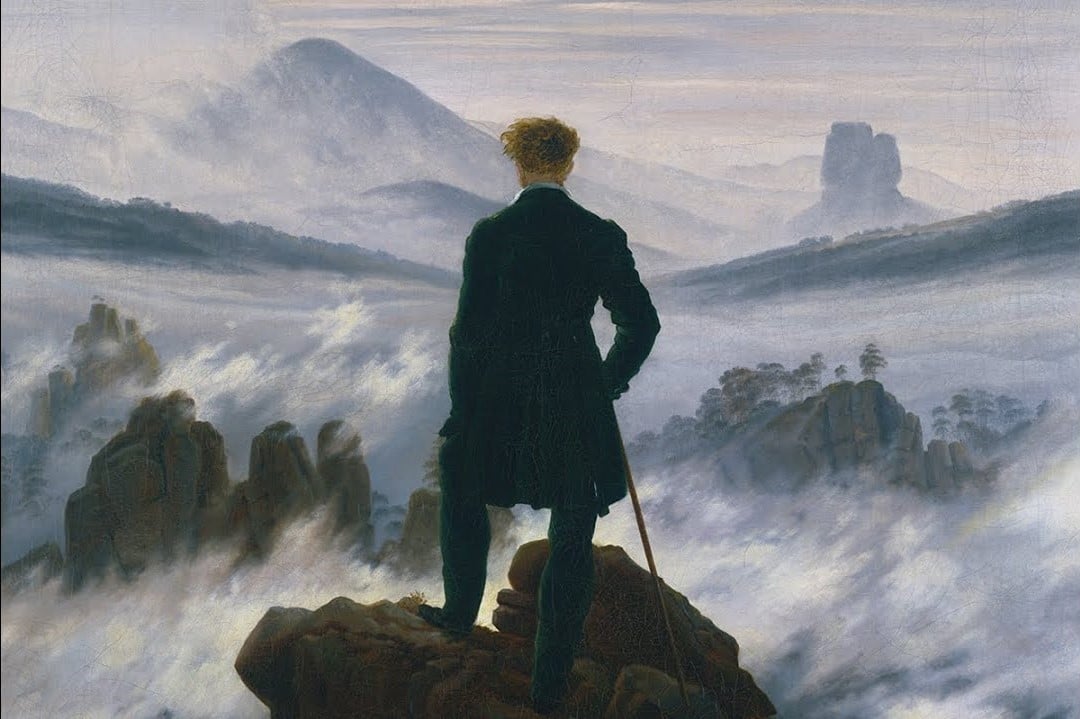
For all us latent Romantics – by which I mean those of us with a predilection not for flowers and candlelit dinners, but rather withered trees, wan moons, ruined monasteries, wayside shrines, lonely seashores, and heavy woolen cloaks – Friedrich is the ne plus ultra of emo German painters. Anyone with an extensive classical music record collection or a long acquaintance with literary paperbacks will recognize his work, which has adorned many an album and book cover.
I’ve been waiting for this show for months, ever since I was tipped off about it by H. Paul Moon, who saw it in Germany in 2023 (and made a five-minute film about it). For one reason or another, I hadn’t been able to make it in to the city for anything other than a concert or work since the show opened on February 8.
The other week, all at once, I became conscious of the sands of the hourglass, as I realized my calendar for the coming weeks was filling up fast, AND I DID NOT WANT TO MISS IT! In a rare act of spontaneity, I hopped the train on a rainy Friday for a whirlwind round-trip, at the heart of which I was able to spend a couple of hours at the Met Museum. It was 100-percent worth it.
Hard to believe, for an artist whose 250th anniversary was last year, that this is the first comprehensive exhibition of his works in the United States. I loved it! If it sounds at all appealing to you, if your taste runs to E.T.A. Hoffmann, Byron, Poe, or Wagner, there’s still time to brood, but you need to act soon. Hie thee to the Met by May 11!
I used one of Friedrich’s most famous canvases to illustrate this post from 2022 about a favorite television series from the golden age of A&E. Does anyone else remember “The Romantic Spirit?”
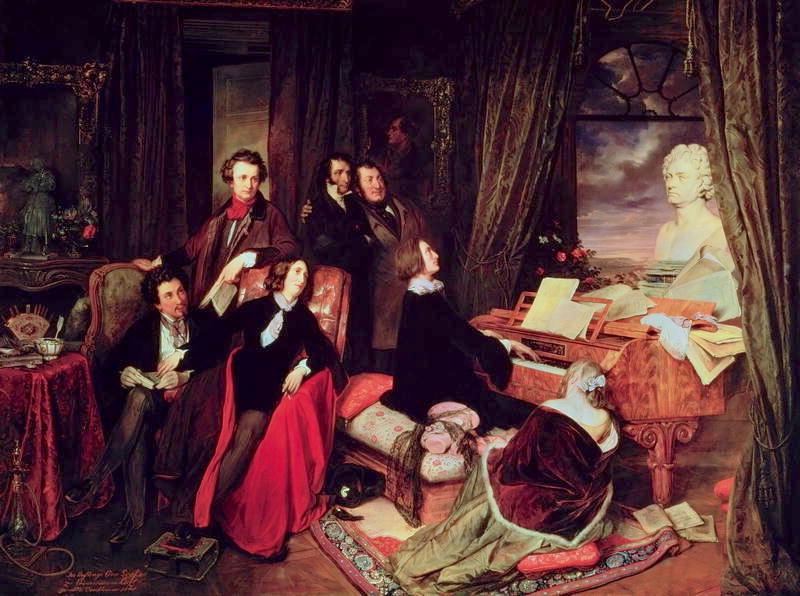
On Beethoven’s birthday, here’s “Liszt at the Piano,” a famous painting, oil on wood, by Josef Danhauser, who lived from 1805 to 1845. Depicted is quite the salon, with, left to right, writers Alexandre Dumas, Victor Hugo, and George Sand; violinist Niccolò Paganini; with his arm around him, composer Gioachino Rossini; at the keyboard, the titular Franz Liszt; and at Liszt’s feet, his mistress during his Paris years, the Comtesse Marie d’Agoult – also a writer (who published under the name Daniel Stern) and the mother of Liszt’s three children. Their daughter Cosima would marry the conductor Hans von Bülow and then leave him for Richard Wagner.
Why am I posting a painting of Liszt and his peeps to celebrate Beethoven? Take a gander at that surreal, luminous bust floating outside the window. Yes, that’s right – it’s the likeness of Ludwig van, remarkably similar to the famous bust sculpted in 1821 by Anton Dietrich.
The painting was completed in 1840, 13 years after Beethoven’s death. Everyone else depicted would have still been alive – actually Paganini died the same year – with the exception of Lord Byron (if you look closely, you’ll see his gilt-framed portrait behind Rossini), who died of fever in 1824, while fighting for the cause of Greek Independence against the Ottoman Empire.
What is the point of this gathering of super-artists? Were they all even ever in the same room together? Where is Sand’s lover, Frédéric Chopin? Why Rossini and not Hector Berlioz, who was a friend and beneficiary of both Paganini and Liszt? (Actually, there is some question as to whether that might not be Berlioz and NOT Hugo between Dumas and Sand.)
I can only assume Rossini’s inclusion is because he actually made the pilgrimage to meet Beethoven, who was inadvertently condescending in praising Rossini’s “The Barber of Seville,” but dismissive of any attempt at serious opera by Italian composers. (Anyone who’s read Berlioz’s Memoirs knows that Beethoven wasn’t alone in this, though Berlioz adored Spontini and Beethoven owed a thing or two to Cherubini.) But beyond that, Rossini’s standing in this company is tenuous at best.
One of the privileges of painting is that an artist can conjure truths that transcend mere photographic realism. (You don’t really think about cameras being around at this time, but Chopin was photographed not too long after.) Obviously, Danhauser intended this as a kind of Pantheon of the Romantics. (Why else include Byron?) All of them are transfixed, enraptured even, by the music conjured by Liszt at the piano. All of them look to Beethoven as a spiritual father.
Beethoven, more than any other composer, was seen as a bridge from 18th century Classicism – the tidy, rational Enlightenment – to a new age of sensation – intensity of feeling, raw passion, and heaven-storming aspiration. His personal struggle was evident. Perfection did not come easily to Beethoven. He grappled with it. And he captured that struggle in his music. In struggling to express what he was compelled to express, he pushed hard through countless trials to forge new paths. Plagued by deafness, he remained defiant. Unbowed, he transcended personal and human limitations to express the sublime in all of us. His indomitable drive and achievement caused him to be perceived by many as the proto-Romantic. The development from his Haydnesque Symphony No. 1 to the Mahler-in-utero Symphony No. 9 is one of the great artistic journeys of all time. And those late string quartets? Fuhgeddaboudit.
One of the scores on Liszt’s piano is the slow movement from Beethoven’s Piano Sonata No. 12. It bears the superscription “Marcia funebre – Sulla morte d’un Eroe” (“Funeral March – On the death of a Hero”).
Beethoven’s heroism has burned with Promethean daring for artists and listeners who, down the ages, have sought affirmation of, and consolation in, the inherent possibility of all that is great in humanity.
That’s my lofty observation. The painting was actually commissioned by Conrad Graf, a piano builder, so it also functions on the more mundane level as an advertisement!
Happy birthday, LvB.
Piano Sonata No. 12, Movement III: “Funeral March – On the death of a Hero”
Some time ago, I also wrote about the meeting of Beethoven and Liszt
Geysers erupt to Schubert’s “Unfinished Symphony.” Waterfalls cascade from vertiginous crags. Horses cavort in surf and flame. Just some of the feverish iconography of “The Romantic Spirit” (1982).
So earnest at times, you could swear you’re watching a Monty Python parody, “The Romantic Spirit” is as overheated as those it celebrates – the late 18th/early 19th century revolutionaries in art, politics, and life who pushed emotional intensity beyond the breaking point.
The line-up at the beginning of each episode reminds us of some of the firebrands of the movement, as the names of Beethoven, Berlioz, Byron, Chateaubriand, Chopin, Delacroix, Goethe, Hugo, Novalis, Schiller, Schubert, Schumann, and Shelley sweep inexorably toward the viewer. British thespian Anthony Andrews hosts “from the house of John Keats, Hampstead, London.” Among the readers who recite passages from seething letters and florid literary works is Derek Jacobi. It’s a heady mix of declamation, painting, music, and reenactment. Part one concludes with an epic artgasm, those ubiquitous geysers exploding to Berlioz’s “Symphonie fantastique.”
At the time I first viewed this series, rising early to catch it on A&E, I was still in my early 20s – the Romantic wheelhouse. Looking back on it now, in middle age, my heart continues to beat in sympathy, and I wonder how the hell it was that I didn’t die defending Greece from the Turks, of consumption, of an opium overdose, or of a pistol ball to the temple.
If the series was ever issued commercially on DVD in the U.S., I do not know of it. There seems to be no trace of it in the listings of either online retailers or e-commerce websites. The only reason I own it is because a good friend of mine ordered it for me once, from one of those underground archivists who had the foresight to videotape everything, and now burns it on demand onto DVD-Rs in his basement.
To be honest, the quality is not much better than what you will find on YouTube. But when I received them, and for years after, they were nowhere else to be found.
Give me a troupe of classically-trained British actors, spouting quotes, reciting poems, and intoning the names of Romantic icons, and I am as happy as Caspar David Friedrich gazing through withered trees at a beguiling moon.
Today is the birthday of E.T.A. Hoffman (1776-1822), and what a good day for it! Mid-winter is the perfect time to enjoy Hoffmann’s tales of madness and obsession.
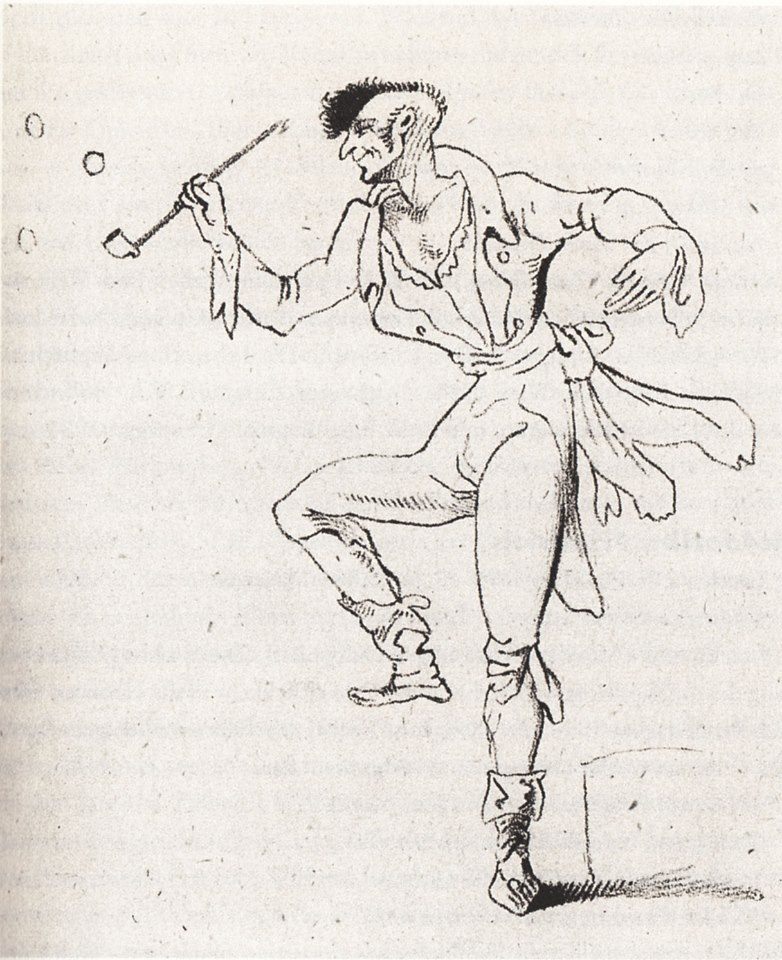
Not only was Hoffmann a seminal author of dark fantasy and horror, he was also a jurist, a draftsman, a caricaturist, and of course a composer and music critic.
Well, perhaps I shouldn’t say “of course.” Hoffmann is most famous for his writings, and justifiably so. None of his musical compositions have attained anything like repertoire status. However he did manage to turn out a lovely Harp Quintet, and his opera, about the water spirit “Undine,” certainly shows promise, though given the source – after all, he was the author of “The Sandman” and “Mademoiselle de Scuderi” – it is a mite disappointing.
Perhaps that’s the viewpoint of someone looking back from a more jaded era, when the fantastic is routinely hammered home in all its CGI vulgarity. By contrast, Hoffmann’s tales are dream-like and insinuating in ways that still have the power to haunt across the centuries.
Musically, from our perspective, Hoffmann is perhaps more important for having inspired other, more enduring composers, who wrote works like “Coppelia” (Delibes), “The Nutcracker” (Tchaikovsky) and of course “The Tales of Hoffmann” (Offenbach). Even so, these works seldom reflect the spirit of Hoffmann’s originals.
Of the Romantics, surprisingly, only Robert Schumann seems to have really got it. You can really hear how Hoffmann got into his head in works like “Kreisleriana” and the “Nachtstücke.” But Schumann was perhaps one step away from “Sandman” material anyway.
Hoffmann’s tales have had a more palpable influence on 19th century literature, firing the creative imaginations of writers from Dostoyevsky to Dumas to (least surprisingly) Edgar Allan Poe.
If all you know is “The Nutcracker” or the Offenbach opera, you don’t really know Hoffmann. Though Tchaikovsky had an intuitive grasp of the idiom, he was working from a watered down adaptation by Dumas. It took Maurice Sendak to bring the story back to its roots.
Sadly, Pacific Northwest Ballet discontinued its annual presentations of this gutsy production. Apparently, it was too freaky for audiences expecting to be spoon-fed sugar plums. Instead the company has taken up the insipid Balanchine version, which inexplicably thrives like fungus on a fruitcake. Is this really the same artist who choreographed “Agon?”
Fortunately, the PNB Sendak version was made into a feature film in 1986.
This is a “Nutcracker” that will put hair on your chest.
Anyway, “The Nutcracker, “The Tales of Hoffmann,” and especially “Coppelia” are almost like children’s book versions of the originals. If you have a taste for such things, you owe it to yourself to at least read “The Sandman.” Here it is, though it’s really not the kind of story you should read off of a computer:
Tomorrow marks the birthday anniversary of Johann Wolfgang von Goethe (1749-1832), widely regarded as Germany’s greatest literary figure. Goethe’s significance in German culture cannot be overestimated.
His novel, “The Sorrows of Young Werther,” virtually initiated the Romantic movement, with its protagonist’s relentless subjectivity and precipitous despair instigating a cult of suicide. His bildungsroman, “Wilhelm Meister’s Apprenticeship,” was praised as one of the greatest novels ever written. And the influence and perpetual reinvention of his dramatic poem “Faust” would appear to be inexhaustible.
Goethe captivated the imagination of virtually every major German-language composer of the 19th century. We’ll honor him with a full program inspired by his works, including lieder, symphonic poems, symphonies, operas and oratorios.
So much Romanticism is a presentiment of fall and chill nights passed gazing up at the moon through withered leaves in a Caspar David Friedrich tricorn.
Join me tomorrow morning at 6 ET for five hours of music inspired by the writings of Goethe, on WPRB 103.3 FM or at wprb.com. You don’t have to sell your soul to experience great music on Classic Ross Amico.