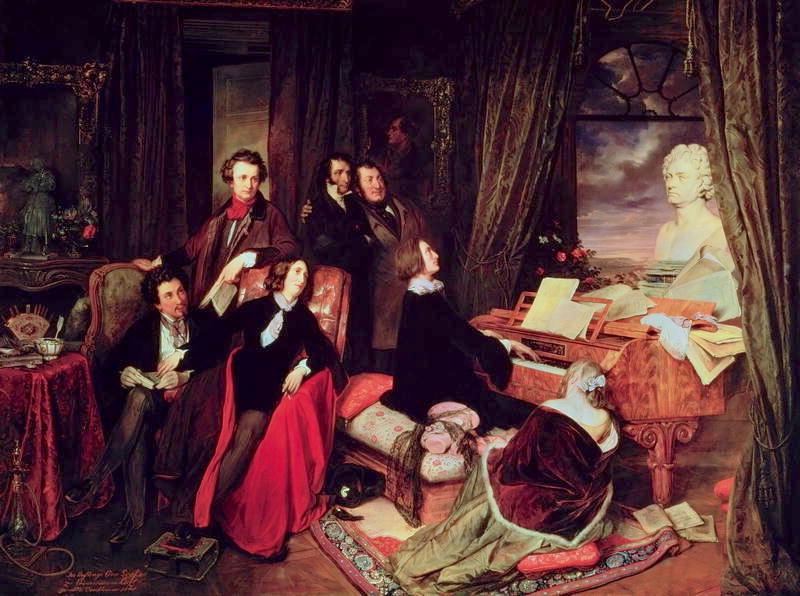
On Beethoven’s birthday, here’s “Liszt at the Piano,” a famous painting, oil on wood, by Josef Danhauser, who lived from 1805 to 1845. Depicted is quite the salon, with, left to right, writers Alexandre Dumas, Victor Hugo, and George Sand; violinist Niccolò Paganini; with his arm around him, composer Gioachino Rossini; at the keyboard, the titular Franz Liszt; and at Liszt’s feet, his mistress during his Paris years, the Comtesse Marie d’Agoult – also a writer (who published under the name Daniel Stern) and the mother of Liszt’s three children. Their daughter Cosima would marry the conductor Hans von Bülow and then leave him for Richard Wagner.
Why am I posting a painting of Liszt and his peeps to celebrate Beethoven? Take a gander at that surreal, luminous bust floating outside the window. Yes, that’s right – it’s the likeness of Ludwig van, remarkably similar to the famous bust sculpted in 1821 by Anton Dietrich.
The painting was completed in 1840, 13 years after Beethoven’s death. Everyone else depicted would have still been alive – actually Paganini died the same year – with the exception of Lord Byron (if you look closely, you’ll see his gilt-framed portrait behind Rossini), who died of fever in 1824, while fighting for the cause of Greek Independence against the Ottoman Empire.
What is the point of this gathering of super-artists? Were they all even ever in the same room together? Where is Sand’s lover, Frédéric Chopin? Why Rossini and not Hector Berlioz, who was a friend and beneficiary of both Paganini and Liszt? (Actually, there is some question as to whether that might not be Berlioz and NOT Hugo between Dumas and Sand.)
I can only assume Rossini’s inclusion is because he actually made the pilgrimage to meet Beethoven, who was inadvertently condescending in praising Rossini’s “The Barber of Seville,” but dismissive of any attempt at serious opera by Italian composers. (Anyone who’s read Berlioz’s Memoirs knows that Beethoven wasn’t alone in this, though Berlioz adored Spontini and Beethoven owed a thing or two to Cherubini.) But beyond that, Rossini’s standing in this company is tenuous at best.
One of the privileges of painting is that an artist can conjure truths that transcend mere photographic realism. (You don’t really think about cameras being around at this time, but Chopin was photographed not too long after.) Obviously, Danhauser intended this as a kind of Pantheon of the Romantics. (Why else include Byron?) All of them are transfixed, enraptured even, by the music conjured by Liszt at the piano. All of them look to Beethoven as a spiritual father.
Beethoven, more than any other composer, was seen as a bridge from 18th century Classicism – the tidy, rational Enlightenment – to a new age of sensation – intensity of feeling, raw passion, and heaven-storming aspiration. His personal struggle was evident. Perfection did not come easily to Beethoven. He grappled with it. And he captured that struggle in his music. In struggling to express what he was compelled to express, he pushed hard through countless trials to forge new paths. Plagued by deafness, he remained defiant. Unbowed, he transcended personal and human limitations to express the sublime in all of us. His indomitable drive and achievement caused him to be perceived by many as the proto-Romantic. The development from his Haydnesque Symphony No. 1 to the Mahler-in-utero Symphony No. 9 is one of the great artistic journeys of all time. And those late string quartets? Fuhgeddaboudit.
One of the scores on Liszt’s piano is the slow movement from Beethoven’s Piano Sonata No. 12. It bears the superscription “Marcia funebre – Sulla morte d’un Eroe” (“Funeral March – On the death of a Hero”).
Beethoven’s heroism has burned with Promethean daring for artists and listeners who, down the ages, have sought affirmation of, and consolation in, the inherent possibility of all that is great in humanity.
That’s my lofty observation. The painting was actually commissioned by Conrad Graf, a piano builder, so it also functions on the more mundane level as an advertisement!
Happy birthday, LvB.
Piano Sonata No. 12, Movement III: “Funeral March – On the death of a Hero”
Some time ago, I also wrote about the meeting of Beethoven and Liszt
https://www.facebook.com/photo/?fbid=1077344973184565&set=a.883855802533484
Leave a Reply