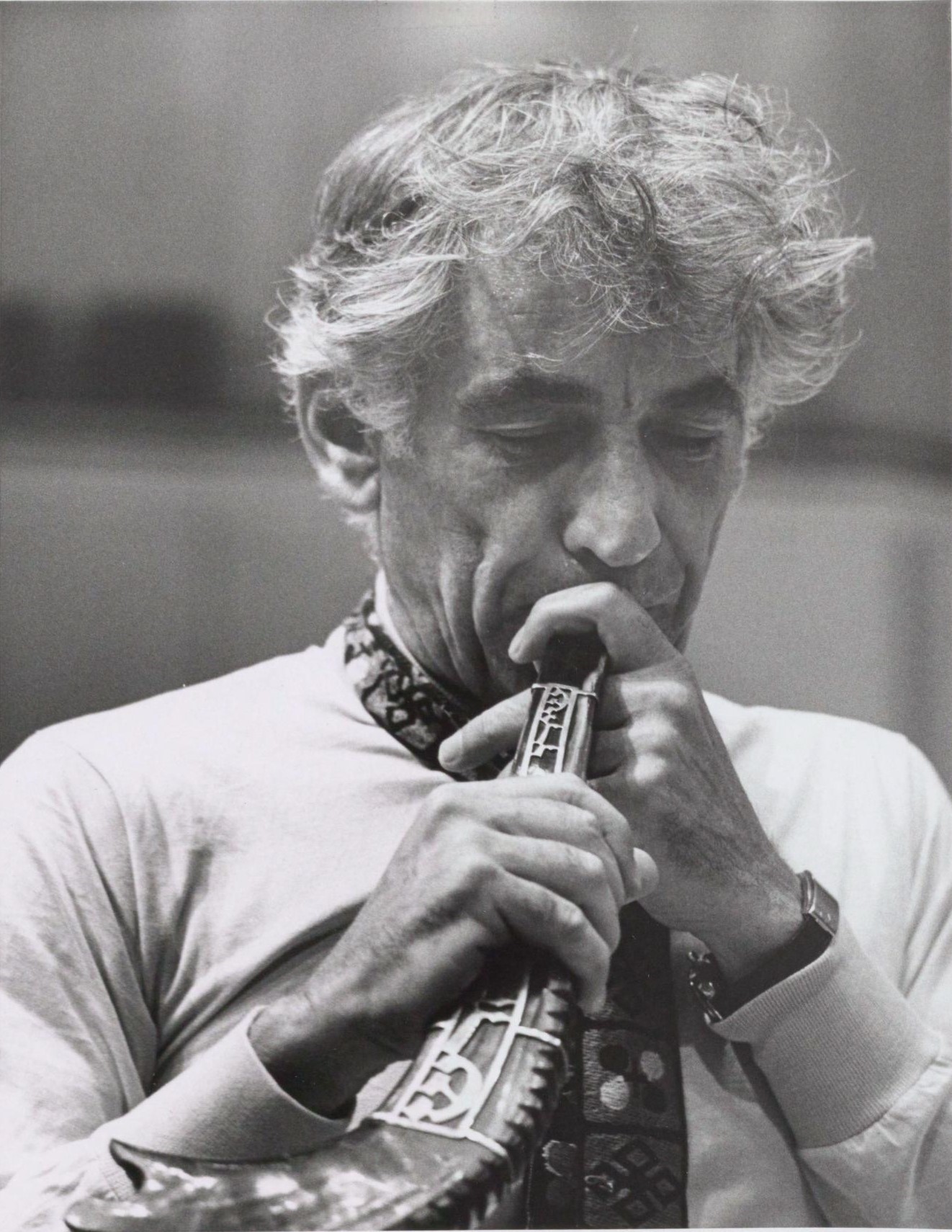
Here’s Leonard Bernstein playing the shofar during a rehearsal for his nonsectarian, humanistic “Mass” at the Kennedy Center in September 1971. It’s been observed that there are echoes of the shofar’s tekiah in both “West Side Story” and “Candide.” Many other classical composers have been influenced by and have emulated this distinctive call on the ram’s horn. Some have even employed the horn itself.
More on this another time. For now, if you observe the holiday, may you be inscribed, and best wishes for a sweet new year!
Shana tova! Rosh Hashanah began last night at sundown. To my Jewish friends, best wishes for a good and sweet 5783. Apples and honey all around.
This year’s observance happens to coincide with the birthday of George Gershwin (born Jacob Gershowitz to Jewish immigrant parents who settled on New York City’s Lower East Side).
Many sources claim that Gershwin, while culturally Jewish, was not particularly observant. Nevertheless, Kitty Carlisle recollected a zany Seder at the Gershwin home with Oscar Levant in attendance; Gershwin was an active supporter of Jewish charities; allegedly he wouldn’t marry Kay Swift, his lover of over ten years, because she wasn’t Jewish (Gershwin’s mother disapproved); and following his untimely death at the age of 38, he was remembered in bicoastal Jewish funeral services.
Furthermore, sharp-eared listens with some familiarity with Jewish tradition have identified Jewish themes and motifs in his music. It’s been remarked that you could keep Gershwin out of shul, but you couldn’t keep shul out of Gershwin. Here’s an interesting article on the subject.
Sadly, we’ll never know what an abandoned opera on Szymon Ansky’s “The Dybbuk” would have sounded like. (It was scrapped because of copyright issues.)
Early on, Gershwin expressed interest in writing for the Yiddish theater. He even made some piano rolls of Yiddish songs. Here’s one from 1917, a rendition of a 1903 Yiddish theater tune by Meyerowitz titled “Gott un Sein Mishpet Is Gerecht.”
Happy birthday, George Gershwin, and have a sweet New Year!
The Jewish High Holy Days snuck up on me this year. As the sun set on Labor Day, Rosh Hashanah was only just getting underway, kicking off the Jewish new year. 5782! How time flies. I hope it’s a happy, healthy, and sweet one for all of you who observe it.
In searching for something unusual to share, I happened across this Concerto for Violin, Horn, Shofar and Orchestra by Brazilian-born, Vienna-based composer Miguel Kertsman. Kertsman is a multidisciplinary musician. He founded the Amazonica Universal Orchestra, a Brazilian jazz ensemble, in 1989. He’s also interested in progressive rock, electronica, theater, film, and interactive video games. And of course, classical concert music. One thing’s for sure, he knows how to call up some colorful orchestrations.
I wouldn’t say the concerto is a festive-sounding one, necessarily, but it is romantic and evocative, incorporating plaintive tekiot on the ram’s horn (or perhaps the antelope’s), heard so prevalently on Rosh Hashanah and at the close of Yom Kippur. Three tuned shofarot are played during the course of the concerto.
Shana tova! Rosh Hashanah, the Jewish New Year, begins at sunset. The two-day observance commences ten Days of Awe, concluding with Yom Kippur, the holiest day on the Jewish calendar.
I hope you’ll be able to join me this Sunday night at 10:00 EDT, as I’ll be presenting music for the High Holy Days – including Herman Berlinski’s “Shofar Service,” David Stock’s “Yizkor,” and John McCabe’s “The Chagall Windows” – on “The Lost Chord,” on WWFM – The Classical Network and wwfm.org.
Of course, I’ll be posting more about it on Sunday. In the meantime, I am wishing everyone a sweet, happy, and healthy 5781!
For those of you who celebrate, I extend my best wishes for a good and sweet new year. The two-day observance of Rosh Hashana began last night at sunset.
To mark the occasion, and with the shofar still fresh in our ears, this afternoon on The Classical Network, I’ll present Meira Warshauer’s “Tekeeya: Concerto for Shofar, Trombone and Orchestra.”
Warshauer’s unusual concerto nicely dovetails with my month-long celebration of women composers, to coincide with the bicentennial of the birth of Clara Schumann.
On this last day of September, I’ll have one more work by Schumann herself; also the “Psalm” for cello and orchestra by Irish composer Ina Boyle (a pupil of Ralph Vaughan Williams).
As if all that weren’t enough, I’ll send out musical birthday greetings to Johan Svendsen, Sir Charles Villiers Stanford, David Oistrakh, and Valentin Silvestrov.
The playlist will be as sweet as a mouth full of apples and honey, from 4 to 7 p.m. EDT, on WWFM – The Classical Network and wwfm.org.