Tag: Rossen Milanov

  • Oliverson’s Joyful Dvořák Shines

    Oliverson’s Joyful Dvořák Shines

    I wonder if it’s a truism that when violinist Aubree Oliverson is happy, she plays well. Because on the two occasions I’ve seen her, she’s exuded joy and played very well indeed. Last night, she followed her bliss in the Dvořák Violin Concerto on the first of two concerts presented this weekend by the Princeton Symphony Orchestra.

    Last year, I had a few quibbles about her take on the Tchaikovsky concerto, as I thought it lacked emotional depth, but I can’t deny that it was an exuberant performance. Just not sure that Tchaikovsky is always the most exuberant composer. Melancholy and angst don’t appear to be in Oliverson’s vocabulary. She takes the microphone before a performance and offers a brief, sunny anecdote about her first encounter with the work she’s about to play, and it’s evident from the first note that none of that giddy sense of discovery has waned. (Oliverson is still only in her 20s.) But perhaps in my 50s, I err too far in the other direction.

    Dvořák seems to be a better fit for her. For sure, there is plenty of drama and wistfulness in the piece, but also lots of cheer and abundant charm in its Czech-inflected melodies and rhythms. Performer and music were as one in the buoyant final movement. I wish all good things for Oliverson. At her age, I was already a bitter fellow (though not at the expense of heart and humor).

    Even in her encore, Olivia Marckx’s arrangement of Joseph Kosma’s melancholy standard, “Autumn Leaves,” there was little sense of heartbreak and instead a lot of jazzy playfulness.

    Here’s an Oliverson performance compilation I found on YouTube. You can get a taste of her Dvořák as it’s the third selection. Her playing sells itself. In person, she is a ball of positive energy.

    The second half of the program was devoted to Arnold Schoenberg’s orchestration of Johannes Brahms’ Piano Quartet No. 1 in G minor. The work is more fun if you’re familiar with the Brahms in its original incarnation (which the PSO presented on a chamber music concert on Thursday night). Schoenberg’s impression of Brahms is a bit like Rich Little’s impressions of most people who aren’t George Burns – you chuckle more because you recognize who they’re supposed to be than for their uncanny accuracy.

    But in Schoenberg’s case, I’m not sure that’s even entirely the point. Schoenberg complained once in a letter to critic Alfred Frankenstein that the quartet is “always very badly played,” with the piano frequently overwhelming the strings. (That was not the case on Thursday night.) “I wanted to hear everything – and this I achieved.” So you say, Arnie. But there are times in Schoenberg’s orchestrations of other composers’ music, and not just here, that everything just turns to clotted cream.

    The work is at its most pleasing when it emulates Brahms’ style. I was grateful for the sense of spaciousness achieved in the outer sections of the third movement, for instance, when the strings are allowed to breathe and the woodwinds offer touches of expressive color. At other times, it’s like washing down buttermilk with bock. There were passages when the textures became so claggy that I found myself longing for one of Schoenberg’s auditorium-clearing twelve-tone masterpieces that are at least held on a tighter leash, compellingly-argued at a fraction of the length.

    Furthermore, there is a tendency in parts for his work here to slide into vulgarization. In Schoenberg’s arrangement, the march that emerges from the third movement is not inspiring, as it is in Brahms’ original, but crass, I suppose the way many marches are when played by ceremonial bands. Brahms’ music can be earthy on occasion, but he is never vulgar, not even when incorporating drinking songs into his “Academic Festival Overture.”

    On the other hand, at those moments when Schoenberg really swings for the fences and brings in xylophones and glockenspiels, so that the ersatz gypsy czardases of the work’s final movement take on an almost cartoonish quality, it zings to life. As with Stokowski’s Bach, there’s an undeniable thrill in anticipating how garish and bizarre it will all become.

    Of course, all matters of questionable Schoenbergian taste aside, the orchestra played marvelously, under Rossen Milanov’s assured direction. Milanov has been music director of the PSO since 2009.

    The concert opened with a brief but attractive work by Bulgarian composer Dobrinka Tabakova, “Orpheus’ Comet.” Suggesting the form of a toccata and unfolding in a swirl of orchestral bees (in Virgil’s “Georgics,” Eurydice is pursued by a bee-keeper, prior to the fatal snake-bite that sends her to the underworld), the work is sensitively orchestrated and full of interesting colors. It culminates in a quotation of Monteverdi’s famous fanfare from his opera “L’Orfeo.” Even without the stunt payoff, the piece is a lot of fun, and at five minutes it does not outstay its welcome. Tabakova clearly understands what Schoenberg did not – that brevity is the soul of wit.

    These are just a few of my impressions. You should hear my George Burns. (Say goodnight, Gracie.) You’ll have a chance to draw your own conclusions when the program is repeated at Princeton University’s Richardson Auditorium this afternoon at 4:00. For more information, visit princetonsymphony.org.

  • The Princeton Festival’s “Tosca” Takes Flight

    The Princeton Festival’s “Tosca” Takes Flight

    Once you see “Tosca,” you never forget it. But I never expected to be haunted by it!

    I remember the first time I saw it on PBS back in the 1980s. It was one of those “Great Performances” broadcasts from the Metropolitan Opera, with Hildegard Behrens in the title role and Cornell MacNeil as the villainous Scarpia. Placido Domingo was Cavaradossi. From the perspective of my 19-year-old self, Domingo, especially, seemed a little long in the tooth to be cutting the romantic figure of a dashing young painter turned political prisoner. Funny to think back on it now, as he must have only been in his 40s at the time. And he’s still singing!

    Now, 40 years on, what a difference it makes to experience the work with someone with the pipes AND the youth to really put it across. Last night at The Princeton Festival, tenor Victor Starsky sang Cavaradossi with power and vigor. In fact, all three leads, including soprano Toni Marie Palmertree as Tosca and baritone Luis Ledesma as Scarpia, were extraordinarily well-matched, at every turn heightening the drama and intensifying the passion, in what is really a lean chamber piece writ large by Giacomo Puccini. Frankly, I never recognized its genius before.

    Never had I found myself so engrossed in the work’s interweaving themes, both musical (the interplay of heart-rending leitmotifs clearly paving the way for Hollywood film scores of the 1930s & ’40s) and textual (the libretto a fascinating blend of religion, politics, and sexuality). It really got me thinking about how each of the characters relates to love, death, and God in various combinations. And I thought “Tristan” was perverse in its celebration of love-death! Clearly, Wagner was not Italian.

    It’s the kind of reflection one engages in when one experiences opera as theater, as opposed to listening to it on a recording, where the music and the quality of the singing take precedence. In the opera house, you get the total experience, as you’re also focusing on the action and the words.

    “Tosca” really begins to insinuate itself as it explores various permutations of faith and blasphemy, eroticism and nihilism. Far from the laugh-out-loud experience of that PBS “Tosca” that had me howling in Act III, the opera, when done right, makes you forget how trashy the subject matter really is. It’s no longer the “shabby little shocker” derided by musicologist Joseph Kerman, but rather like Victor Hugo at his most twisted. You just don’t know how to feel about certain things, but you can’t help FEELING. Is there a more desolate aria than Cavaradossi’s “E lucevan le stelle?” Sometimes you’re just screwed. Interesting, though, that the character couches thoughts of impending doom in meditations on all the hot nights he’s going to be missing out on with Tosca. Molto Italiano!

    Tosca’s thoughts, on the other hand, in her own expression of hopelessness, the aria “Vissi d’arte,” turn on contemplations as to why God has deserted her. For Scarpia, virile, dangerous, and subtle, well, he sings – in church no less – “Tosca, you make me forget God!” Because he’ll do anything to have her.

    Ledesma not only has the voice, but the imposing carriage to convince as the morally bankrupt chief of police, who is the recipient of the opera’s most awe-inspiring leitmotif. He is an edifice in himself, the embodiment of power corrupted. We hear echoes of it, even as Tosca enacts a pious ritual with candles and crucifix over his corpse, as if to note, how the mighty have fallen.

    Scarpia is no cartoon villain. He invokes Iago in the first act. Even in death, he dominates. It’s not for nothing that Tosca’s last line is “I’ll see you before God, Scarpia!” The full extent of his calculated evil comes to light only posthumously, and he looms over the fates of the other characters, just as the grim prison of the Castel Sant’Angelo looms over Rome.

    For such a swift opera (Puccini was ruthless in trimming numbers from the libretto, based on a sprawling melodrama conceived by Victorien Sardou as a vehicle for Sarah Bernhardt), the characters are fascinatingly layered. Some contemporaries complained about the resulting sacrifice of lyricism (alleged), but the drama is inexorable. Since there are no set pieces or flashy effects (beyond perhaps that chorus at the end of Act I), it’s essential that all the singers be able to pull their weight, vocally and as actors.

    The opera certainly offers a plum part for a soprano – a diva playing a diva – and Palmertree left nothing on the table. Like Starsky, she brought it when it counted. Tosca’s journey takes her from the comparative innocence of love, religious devotion, and petty jealousy in Act I to desperation and resourcefulness, as she pushes back against Scarpia’s objectification and harassment in Act II, to the point that she takes matters into her own hands. Palmertree made you feel the anguish of Tosca trying to keep her lover’s secret, even as she hears him being tortured in the next room, only to have to rein it in a few moments later to strike the right tone of introspection to navigate her dark night of the soul in “Vissi d’arte.”

    The Princeton Symphony Orchestra was in impressive tune with its conductor, Rossen Milanov, who led the performance as to the manner born. Milanov has ample experience conducting opera and ballet in the U.S. and Europe, but it’s only comparatively recently that we’ve been exposed to that facet of his artistry in Princeton. Nothing I’ve heard at the Princeton Festival since its post-COVID resurrection in 2022 prepared me for what I heard and saw last night. Milanov conjured waves of sound and navigated passionate breakers, but he did so most undemonstratively, as a collaborator, yes, but also as a sensitive accompanist. Conducting opera is like steering a ship, and no matter how turbulent the drama got, Milanov at the helm kept his cool and rode the blue. I don’t know if it’s just that I haven’t been paying close enough attention, but even when conducting the orchestra’s regular subscription concerts at Richardson Auditorium, he really does seem to be more relaxed and just getting better all the time.

    Also, not to be undersold was the production’s stage direction by Eve Summer. Even though I emphasize “Tosca’s” intimacy, the opera would seem to call for grand sets, at least for the outer acts. How do you believably conjure the church of Sant’Andrea della Valle on a stage the size of the one inside the performance pavilion on the grounds of Morven Museum & Garden? And how on earth do you hope to convey the height and imposing grandeur of the Castel Sant’Angelo, and still have room for a firing squad, much less to pull off the opera’s famous ending. Yet Summer and scenic designer Ryan McGettigan made it work. A masterstroke came at the end of the first act, when the chorus (prepared by Vinroy Brown), attired in cowls and miters, processed from the stage up and down the aisles of the tent to surround the audience with spinetingling sonorities.

    Furthermore, I must say, I expected something far less spectacular from Tosca’s final act of defiance. Instead of simply dropping from the parapet, as I anticipated, Palmertree suddenly put on a burst of speed, dashing along the length of the battlement, at the far end flinging herself headlong into oblivion. Kudos for going for broke! I am nearly always slammed by a wave of emotion at the end of an opera, but the music, the visual, and the audience reaction really put it over the top.

    I admit, when I first heard that the opera this summer was going to be “Tosca,” I had my doubts. Previously, the post-COVID, Princeton Symphony Orchestra incarnation of the Princeton Festival had dealt solely in comedy – “The Barber of Seville,” “Albert Herring,” “Cosi fan tutte,” “The Impresario” and “Scalia/Ginsburg” – certainly apt, given the season and the venue. These all had their enjoyments, but I was unprepared for “Tosca,” which despite the stage limitations, was a triumph.

    Anything else this week is bound to seem anticlimactic, but there’s something to be said for just relaxing and enjoying a concert. The Princeton Festival runs through Saturday. For the remainder of this year’s schedule, visit https://www.princetonsymphony.org/festival.

  • Rachmaninoff Shine at Princeton Symphony

    Rachmaninoff Shine at Princeton Symphony

    For better or worse, whenever I think of Sergei Rachmaninoff’s Piano Concerto No. 3, I can’t help but remember John Gielgud in the 1996 film “Shine.” Can it really have been 29 years ago?

    Gielgud addresses Noah Taylor, as the psychologically frail Australian pianist David Helfgott, in Yoda-like bromides, cautioning him against the hazards of the “Rach 3” and shepherding him through a training sequence pitched somewhere between Dagobah and “The Mask of Zorro.” I guess this is effective shorthand for the masses, communicating the concerto’s challenges in a concise, three-minute montage that honestly has very little to do with the music.

    “Shine” was showered with Oscar love in 1997 – the recipient of seven Academy Award nominations and a Best Actor trophy for Geoffrey Rush – but no amount of “pop” corn can convey the true drama of arguably Rachmaninoff’s most intense masterpiece, which can be heard on two concerts of the Princeton Symphony Orchestra this weekend. PSO favorite Natasha Paremski will be the soloist. Rossen Milanov will conduct at Princeton University’s Richardson Auditorium.

    The Westminster Symphonic Choir will also appear, on the program’s first half, to perform Pyotr Ilych Tchaikovsky’s “Hymn to the Cherubim” from the “Liturgy of St. John Chrysostom” and Johannes Brahms’ “Schicksalslied” (“Song of Destiny”).

    All the shine will be in the music, tonight at 8:00 and tomorrow afternoon at 4:00. For tickets and information, visit princetonsymphony.org.
  • Tchaikovsky’s Manfred Symphony: A Missed Ending?

    Tchaikovsky’s Manfred Symphony: A Missed Ending?

    I stated in an earlier post that there should be an organ in Tchaikovsky’s “Manfred Symphony.” And while an organ is certainly featured in many performances and recordings of the work, it turns out the composer actually called for a harmonium. Live and learn.

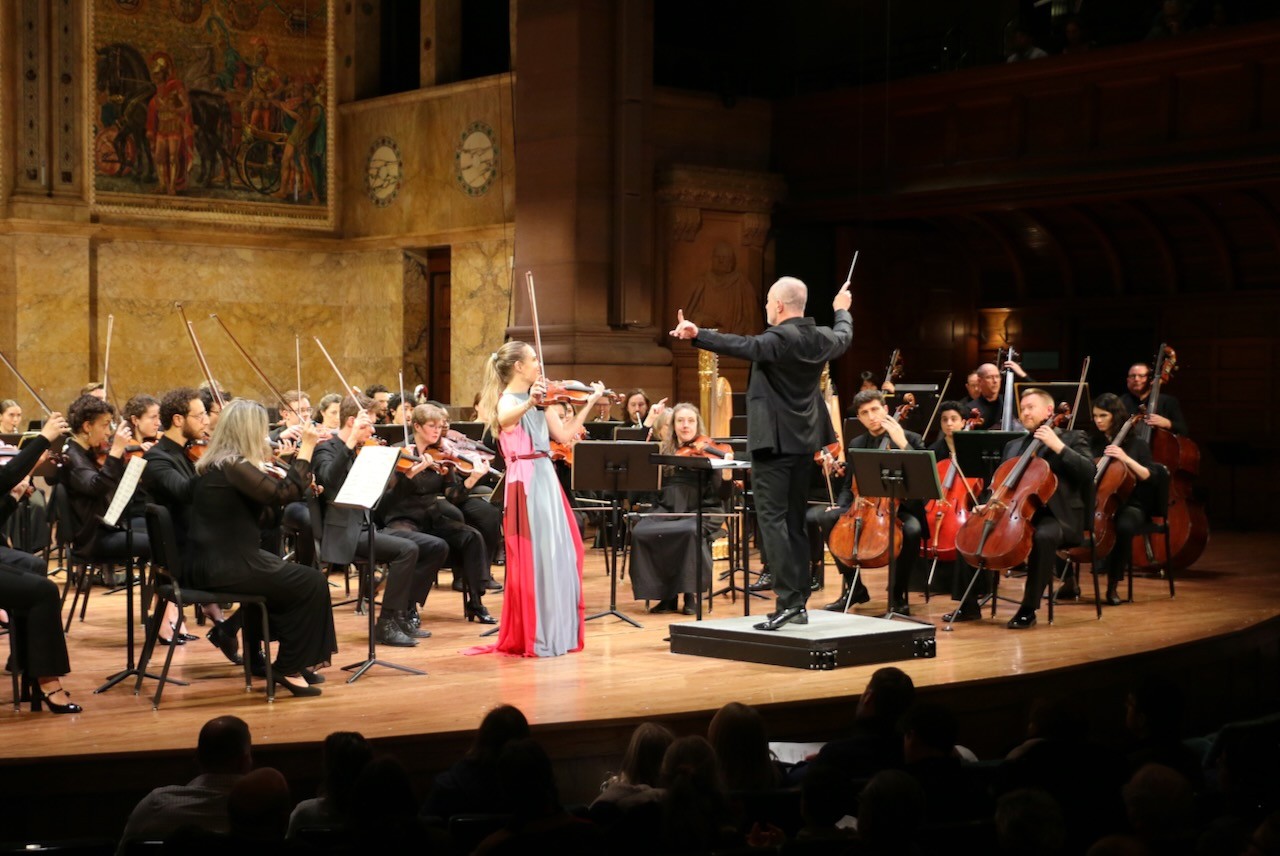
    That said, last night’s otherwise superb performance by the Princeton Symphony Orchestra of this sublime work (in my opinion, one of Tchaikovsky’s most compelling; then again, I’m a fan of Byron’s dramatic poem, overheated film scores, and Romantic seething in general), reverted to the outmoded practice of ditching the reflective denouement (with organ/harmonium) in favor of reprising the powerfully intense coda of the work’s first movement. (Richardson Auditorium’s pipe organ, installed in 1910, has been out of commission for three quarters of a century.) No redemption for this Manfred. I’m pretty sure Tchaikovsky wouldn’t have been happy, but I loved it all the same.

    I confess I also missed the fire of Jeremy Levine’s blazing timpani (Levine had the weekend off, but it turns out had to be called back in as a substitute on the cataclysmic bass drum), which would have pushed this “Manfred” as far over the top as this glorious score deserves.

    At the other end of the spectrum, Stravinsky’s Violin Concerto, as immaculate as a Fabergé egg (though not at the expense of heart and humanity, especially in the Baroque arioso throwback of the work’s third movement), was more than mere icing on the cake – an apt metaphor, it turns out, for a program in celebration of music director Rossen Milanov’s 60th birthday. The soloist was Leila Josefowicz, well-toned in both senses of the word. It’s always a privilege to hear a concerto like this one in such an intimate hall.

    The concert will be repeated at Princeton University’s Richardson Auditorium this afternoon at 4:00. Both works are comparative rarities. As predicted, for me, this proved to be one of the highlights of the season. Miss it to your own detriment.

    https://princetonsymphony.org/


    PSO staff photo

  • Princeton Symphony Tchaikovsky’s Manfred

    Princeton Symphony Tchaikovsky’s Manfred

    From the repertoire alone, how could this weekend’s concerts of the Princeton Symphony Orchestra not stand as a highlight of the current season? And positing that, I take into account the bigger brand name orchestras in the adjacent metropolises of New York and Philadelphia. Rossen Milanov will conduct Tchaikovsky’s vertiginous, broody, and magnificent “Manfred Symphony” at Princeton University’s Richardson Auditorium in two performances, this Saturday at 8 p.m. and Sunday at 4 p.m.

    This music is Romantic with a capital R. The quintessential Byronic hero, Manfred is weary but indomitable, an unconquerable superman, tormented by unimaginable suffering. Haunted by mysterious guilt (in connection with the death of his beloved), he wanders the Bernese Alps, longing for extinction, and meets his fate defiantly, rejecting all authority, corporeal and supernatural. And as you know, it doesn’t take much to get Tchaikovsky to seethe most eloquently.

    It will be very interesting to see how the group tackles this foray into the sublime, which requires a large orchestra with organ. (Richardson’s was removed years ago.) The work was originally scheduled for the ill-fated pandemic season of 2019-20, then coupled with Reinhold Glière’s Harp Concerto. If it could be thus, and it were not a madness and a mockery, I might have been most happy!

    But I will definitely be content with Stravinsky’s Violin Concerto, one of the loveliest works of the composer’s neoclassical period, to be heard on the reconstituted program’s first half. Temperamentally, the concerto is worlds away from Tchaikovsky’s Alpine awesomeness, but its prismatic reflections on Baroque airs can be quite seductive, with the spirit of Bach flitting around the composer’s crystalline heart. Leila Josefowicz, last heard here in Alban Berg’s concerto in 2016, will return to Princeton as the work’s soloist.

    The concerts are being presented in celebration of PSO music director Rossen Milanov’s 60th birthday. In the spirit of Manfred, I defy the solace of both cake and conviviality! However, I confess, I can’t wait to hear this program.

    For tickets and information, visit princetonsymphony.org.
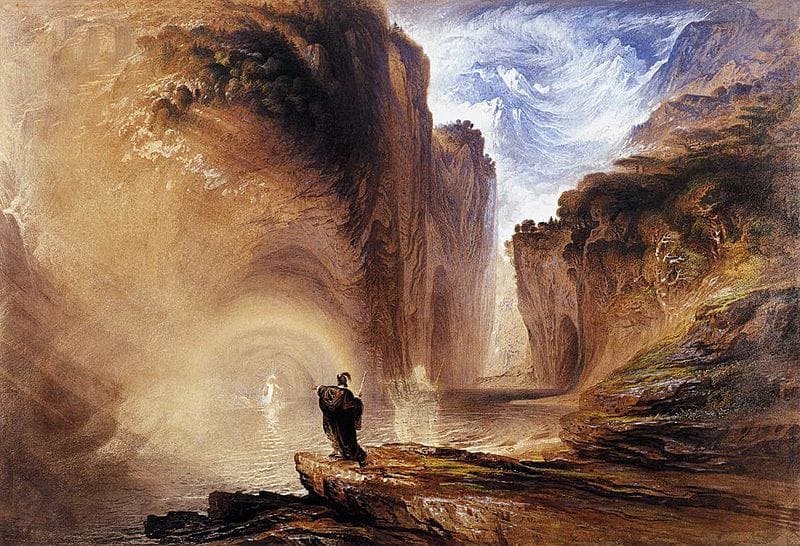

    IMAGE: John Martin, “Manfred and the Witch of the Alps” (1837)

Tag Cloud

Aaron Copland (92) Beethoven (94) Composer (114) Film Music (116) Film Score (143) Film Scores (255) Halloween (94) John Williams (185) KWAX (228) Leonard Bernstein (99) Marlboro Music Festival (125) Movie Music (131) Opera (197) Philadelphia Orchestra (86) Picture Perfect (174) Princeton Symphony Orchestra (106) Radio (86) Ralph Vaughan Williams (85) Ross Amico (244) Roy's Tie-Dye Sci-Fi Corner (290) The Classical Network (101) The Lost Chord (268) Vaughan Williams (99) WPRB (396) WWFM (881)

DON’T MISS A BEAT

Receive a weekly digest every Sunday at noon by signing up here


RECENT POSTS