Tag: Rutland Boughton

  • Where Have All the Oratorios Gone?

    Where Have All the Oratorios Gone?

    It’s January 6. Epiphany. The Feast of the Three Kings. The Christian feast day that marks, among other things, the Magi’s visit to the Christ Child.

    I know I’ve lamented in the past about how so many of the magnificent classical music Christmas works of the past millennium have disappeared from the airwaves. Of the larger works, it seems only Handel’s “Messiah,” Bach’s “Christmas Oratorio,” and of course Tchaikovsky’s (secular) “The Nutcracker” are guaranteed.

    Thankfully, I have an enormous record library with at least three shelves devoted exclusively to Christmas music, so I’m able to work through a lot of the forgotten and/or neglected masterworks at home and in the car. But it’s not the same as somebody else pulling and programming the music and knowing that I am part of a unified listening community.

    I feel the same way when watching a movie that is broadcast, or actually in a theater, as opposed to playing it from my own collection or streaming it. It’s wonderful to live in an age when these things are possible, but it is just not the same as knowing that I’m a part of a communal experience. (That said, I’m certainly not going to watch “It’s a Wonderful Life” on network television with a thousand commercial breaks!)

    I must give a tip of the Ebenezer Scrooge top hat to Yle Klassinen in Helsinki for airing Franz Liszt’s “Christus” complete. That station really is a marvel. Oh how I love my digital radio! Of course, I don’t speak Finnish, but I can usually make out the performers when they are announced and the playlists are posted online.

    Anyway, I had already listened to the Dorati recording on my own time. I’ve done so for many, many years. It’s enriched my Christmases ever since I first encountered it on the air, broadcast on Philadelphia’s late, lamented WFLN, back in the early 1980s. Time was, when serious classical Christmas music commenced with Advent. Yes, it was leavened with gems like Victor Hely-Hutchinson’s “Carol Symphony,” the aforementioned “Nutcracker,” and Leopold Mozart’s “A Musical Sleigh-Ride,” in the hilarious recording by the Eduard Melkus Ensemble that includes the neighing horses and barking dogs. I looked forward to hearing that every year. I snapped it up when it was reissued on compact disc and have included it in my own broadcasts for decades.

    Those works have their place, but it seems the serious, large-scale choral works are all going away. Commerce, secularism, short attention spans, ignorance, and grievance all work against the simple enjoyment of a lot of masterful music. It’s much safer to play three-minute arrangements of familiar Christmas carols. Over and over and over again.

    I grant you, three hours is a lot of radio real estate to give up to Liszt’s “Christus.” But can’t anyone even carve out an hour for Vaughan Williams’ “Hodie?” I suppose I should just shut up and be thankful that RVW’s “Fantasia on Christmas Carols” is still in rotation.

    I count myself very fortunate to have been able to share “Christus” many times over the years. I know I’ve played it complete on WXLV, WPRB, and WWFM – once I even preempted the weekly opera broadcast – and excerpted the purely orchestral movements even more frequently, working them into my morning and afternoon playlists. “The March of the Three Holy Kings” is a high point.

    I am sorry I don’t have a stretch of air-time during which to play it for you now, but the entire Dorati recording of the oratorio (one of three recordings I own, and still my preferred) is posted on YouTube.

    If you want to cut to the chase, here’s the march of the Kings.

    Think it sounds an awful lot like Wagner’s Wotan? There’s likely a reason for that. I’ve posted about it before.

    https://rossamico.com/2023/01/06/three-kings-music-mystery-wagner-liszt/

    I try to be sensitive to other people’s faiths and belief systems, and frankly I am no zealot, but when it comes to music, I am very much a fundamentalist. This is not about pushing Christianity down anyone’s throat as much as a desire to preserve and disseminate the sublime Christmas works, many of them by top-tier composers, presented, like the classic movies on TCM, complete and uncut.

    Of course, most of these recordings I’ve played over the years are from my own collection. I was very fortunate to be able to do my own programming, for hours at a time, for the better part of three decades. In such a situation, when a radio host loses his platform, countless hours of repertoire go with him. You’ll still get “Messiah,” but you probably won’t get Josef Rheinberger’s “The Star of Bethlehem” (here posted as a playlist of nine separate videos).

    Rutland Boughton’s “Bethlehem” is another Christmas work I’m crazy about. You won’t find it in many record libraries at radio stations here in the U.S. But I’ve got it, and I’ve aired it. Rather than write about it again, I’ll refer you to one of my teasers from a few years ago.

    https://rossamico.com/2017/12/21/merlin-in-bethlehem-a-christmas-music-surprise/

    If you’re a Vaughan Williams fan, I think you will find it delightful. For a long time, I was unable to share any of the audio online, due to Hyperion Records’ justifiably Draconian practice of not allowing any its recordings on YouTube. But the company is now in other hands, so here it is, finally, as a playlist – albeit with the tracks posted separately, so prepare to have to skip an occasional ad.

    On the Twelfth Day of Christmas, your resident classical music curmudgeon gives to you… three Christmas oratorios. If I splurged for a dozen, this post would be four times the length!

    Have yourself a merry “Little Christmas!”

    ——–

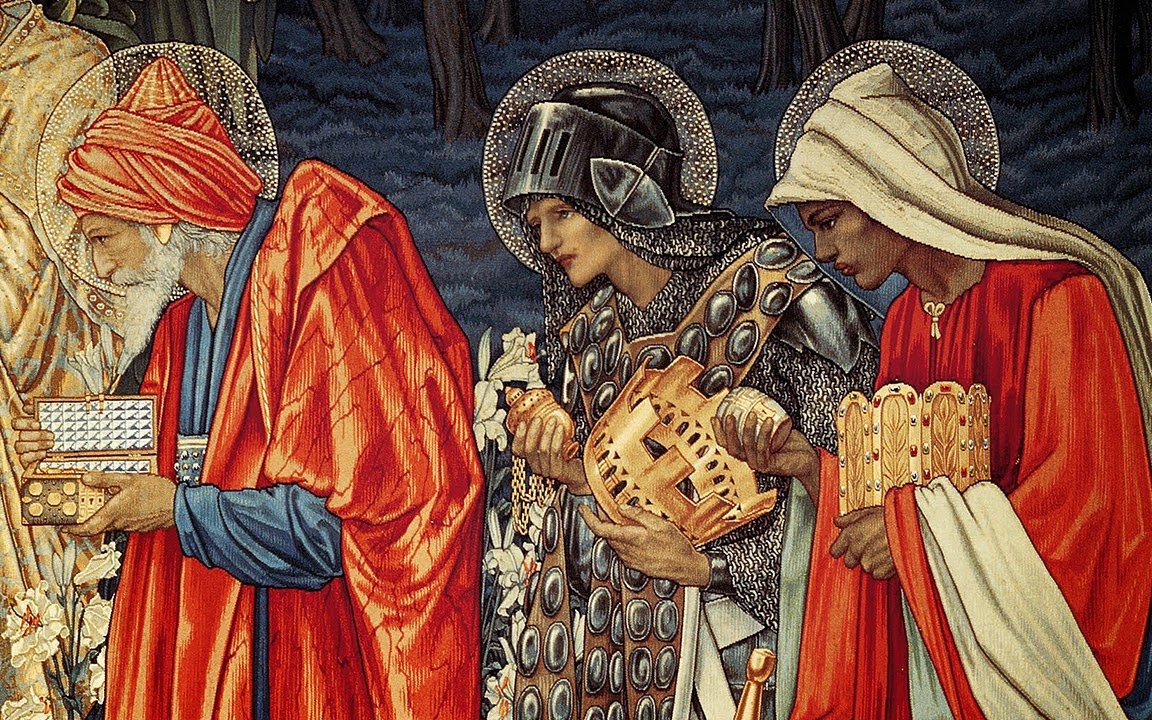
    IMAGE: Detail from Edward Burne-Jones’ “Adoration of the Magi”
  • Epiphany Music Christmas Traditions

    Epiphany Music Christmas Traditions

    I can hardly hear myself think, with twelve drummers drumming!

    While I am generally all for extending Christmas for as long as possible, we have come finally to the twelfth day, the Feast of the Epiphany, and the official close of the season. At least in the West. For the Orthodox, today is Christmas Eve.

    For the rest of us, this is traditionally the day to take down the Christmas tree and all the festive decorations and to let the tree spirits go about their business. Our wise forebears believed that it is bad luck to take down the decorations earlier. Taking them down later is equally unlucky, so that if you miss the date, you’re supposed to leave everything up for the rest of the year. Ignore this advice at the peril of your crops! (If you ask me, the bylaws need to me emended to include a clause against putting out decorations before Thanksgiving.)

    I hope La Befana, the Christmas witch, was good to you and that you’re not one of those nuts who pounds a drum in frigid water. I’d rather climb out of a warm bed to find a gift in my shoe.

    In case you missed it yesterday, here again is the last section of Respighi’s tone poem “Feste Romane” (“Roman Festivals”), titled “La Befana.” It’s often given in English as “Epiphany,” but it’s really named for the Christmas witch, whom Italians embrace as part of their January 6 celebrations.

    However you choose to celebrate, I hope your Epiphany is a festive one!


    Who likes it when Merlin shows up in the Christmas story? We all do, of course!

    One of my favorite Christmas pieces is Rutland Boughton’s “Bethlehem,” a choral drama adapted from the 14th century Coventry Nativity Play. Composed in 1915, and written very much in the English pastoral idiom, the work incorporates settings of familiar carols, such as “O come, all ye faithful” and “The Holly and the Ivy.”

    Taking a page from Richard Wagner, Boughton composed a cycle of five operas on Arthurian themes and started a Glastonbury Festival, in the style of Bayreuth. Alas, neither the operas nor the festival, as it was originally conceived, have endured.

    In Boughton’s “Bethlehem,” the shepherds bear gifts of a penny whistle, a hat, and a pair of warm mittens. The Three Wise Men hobnob with Herod, Zarathustra, and, yes, Merlin. If you gravitate toward the music of Ralph Vaughan Williams, you’re bound to fall under the work’s disarming spell.

    For years, I was unable to share any audio from the piece, due to Hyperion Records’ justifiably Draconian practice of not allowing any its recordings on YouTube. But the company is now in other hands, so here it is, finally, as a playlist – albeit with the tracks posted separately, so prepare to have to skip an occasional ad.

    BONUS! “March of the Three Holy Kings” from Franz Liszt’s “Christus”

    Epiphany traditions from around the world

    https://matadornetwork.com/read/epiphany-celebrations-around-world/


    IMAGES: (top) Detail from Edward Burne-Jones’ “Adoration of the Magi;” (left to right) Twelfth Night holly man; banging the drum in Bulgaria; and Befana the Christmas witch

  • Classical Christmas Music Beyond the Carols

    Classical Christmas Music Beyond the Carols

    This time of year, with Christmas still weeks away, I’m never quite sure if I’m programming too much holiday music, or not quite enough. I walk away from an air shift feeling vaguely uneasy, as if I’ve served up a platter that is neither fish nor fowl.

    Of course, if I were putting together a playlist entirely for myself, it would be all-mistletoe all the time. But I’m confident that, as the Big Day draws nigh, I will cross the tipping point and everything will start to feel a bit more natural and perhaps more satisfying. In the classical music world, the demarcation seems to be Beethoven’s birthday (December 16).

    When it comes to Christmas, I think classical music stations tend to work against themselves. By the third week of December, listeners have already been subjected to countless arrangements of the same ten or 15 carols. Naturally, a kind of fatigue begins to creep in. 1000 years of Christmas music, and the scale tips in favor of “Hark! The Herald Angels Sing.”

    If stations were more creative in their programming for Christmas, balancing the secular with the sacred, and broadening the coverage to incorporate music from all eras, from the Middle Ages to the present – allowing for abundant interludes in the form of winter portraits or evocations of the seasons – it could make for a truly stimulating month, and perhaps the backlash wouldn’t be so extreme. There’s so much music that we never get to hear.

    Consider all this as preamble to today’s Noontime Concert on The Classical Network. Piffaro, The Renaissance Band will be joined by Les Canards Chantants and actors Mark Jaster and Sabrina Mandell for a program of 15th century Christmas music, titled “A French Noël.” David Osenberg will be your host and Piffaro artistic directors Joan Kimball and Robert Wiemken will provide commentary.

    I’ll be around at 1:40. At 2:00, we’ll cross the channel for Rutland Boughton’s “Bethlehem,” a choral drama adapted from the 14th century Coventry Nativity Play. Composed in 1915 and written very much in the English pastoral idiom, the work incorporates familiar carols, such as “O come all ye faithful” and “The Holly and the Ivy.”

    Taking a page from Richard Wagner, Boughton composed a cycle of five operas on Arthurian themes and started a Glastonbury Festival, in the style of Bayreuth. Alas, neither the operas nor the festival, as it was originally conceived, have endured.

    In Boughton’s “Bethlehem,” the shepherds bear gifts of a penny whistle, a hat, and a pair of warm mittens. The Three Wise Men hobnob with Herod, Zarathustra, and yes, Merlin. If you gravitate toward the music of Ralph Vaughan Williams, you’re bound to fall under the work’s disarming spell.

    It’s never too early to be Early. Join us for a Piffaro Noël, and then on to Coventry, from 12 to 4 p.m. EST, on WWFM – The Classical Network and wwfm.org.

  • Merlin in Bethlehem A Christmas Music Surprise

    Merlin in Bethlehem A Christmas Music Surprise

    Who likes when Merlin shows up in the Christmas story? We all do, of course!

    Join me around 9:00 this Thursday morning on WPRB to hear Rutland Boughton’s “Bethlehem,” a choral drama adapted from the 14th century Coventry Nativity Play. Composed in 1915, and written very much in the English pastoral idiom, the work incorporates settings of familiar carols, such as “O come, all ye faithful” and “The Holly and the Ivy.”

    Taking a page from Richard Wagner, Boughton composed a cycle of five operas on Arthurian themes and started a Glastonbury Festival, in the style of Bayreuth. Alas, neither the operas nor the festival, as it was originally conceived, have endured.

    In Boughton’s “Bethlehem,” the shepherds bear gifts of a penny whistle, a hat, and a pair of warm mittens. The Three Wise Men hobnob with Herod, Zarathustra, and, yes, Merlin. If you gravitate toward the music of Ralph Vaughan Williams, you’re bound to fall under the work’s disarming spell.

    It’s one of our featured highlights this Thursday morning, from 6 to 11 EST, as we anticipate the winter solstice (at 11:28), on WPRB 103.3 FM and wprb.com.

  • Welcome Yule Celebrate the Winter Solstice on WPRB

    Welcome Yule Celebrate the Winter Solstice on WPRB

    Welcome Yule!

    No matter what your personal creed, the real reason for the season is the Winter Solstice, the shortest day, which is why this time of year so many of the world’s cultures pull out all the stops with music, drink, evergreen, gifts, and bizarre localized customs like the Yule Goat (see my post of Dec. 9). It all goes back to man’s primordial desire to restore the sun and drive the cold winter away.

    This Thursday morning on WPRB, we’ll mark the year’s shortest day – and the longest night – with abundant reflection and revelry, all distilled into a cheering playlist of music for midwinter.

    Of course, the morning will be heavily slanted toward the reigning midwinter festival of Christmas. There will be at least two large-scale Christmas works for chorus and orchestra – Josef Rheinberger’s “The Star of Bethlehem” and Rutland Boughton’s “Bethlehem” – to anchor all the pagan tomfoolery.

    I hope you’ll join me in piling the wood high, in anticipation of a midwinter bonfire, this Thursday morning from 6 to 11 EST, on WPRB 103.3 FM and wprb.com. If all goes as planned, it should go something like this, on Classic Ross Amico:

Tag Cloud

Aaron Copland (92) Beethoven (94) Composer (114) Film Music (116) Film Score (143) Film Scores (255) Halloween (94) John Williams (185) KWAX (228) Leonard Bernstein (99) Marlboro Music Festival (125) Movie Music (131) Opera (197) Philadelphia Orchestra (86) Picture Perfect (174) Princeton Symphony Orchestra (106) Radio (86) Ralph Vaughan Williams (85) Ross Amico (244) Roy's Tie-Dye Sci-Fi Corner (290) The Classical Network (101) The Lost Chord (268) Vaughan Williams (99) WPRB (396) WWFM (881)

DON’T MISS A BEAT

Receive a weekly digest every Sunday at noon by signing up here


RECENT POSTS