I can hardly hear myself think, with twelve drummers drumming!
While I am generally all for extending Christmas for as long as possible, we have come finally to the twelfth day, the Feast of the Epiphany, and the official close of the season. At least in the West. For the Orthodox, today is Christmas Eve.
For the rest of us, this is traditionally the day to take down the Christmas tree and all the festive decorations and to let the tree spirits go about their business. Our wise forebears believed that it is bad luck to take down the decorations earlier. Taking them down later is equally unlucky, so that if you miss the date, you’re supposed to leave everything up for the rest of the year. Ignore this advice at the peril of your crops! (If you ask me, the bylaws need to me emended to include a clause against putting out decorations before Thanksgiving.)
I hope La Befana, the Christmas witch, was good to you and that you’re not one of those nuts who pounds a drum in frigid water. I’d rather climb out of a warm bed to find a gift in my shoe.
In case you missed it yesterday, here again is the last section of Respighi’s tone poem “Feste Romane” (“Roman Festivals”), titled “La Befana.” It’s often given in English as “Epiphany,” but it’s really named for the Christmas witch, whom Italians embrace as part of their January 6 celebrations.
However you choose to celebrate, I hope your Epiphany is a festive one!
Who likes it when Merlin shows up in the Christmas story? We all do, of course!
One of my favorite Christmas pieces is Rutland Boughton’s “Bethlehem,” a choral drama adapted from the 14th century Coventry Nativity Play. Composed in 1915, and written very much in the English pastoral idiom, the work incorporates settings of familiar carols, such as “O come, all ye faithful” and “The Holly and the Ivy.”
Taking a page from Richard Wagner, Boughton composed a cycle of five operas on Arthurian themes and started a Glastonbury Festival, in the style of Bayreuth. Alas, neither the operas nor the festival, as it was originally conceived, have endured.
In Boughton’s “Bethlehem,” the shepherds bear gifts of a penny whistle, a hat, and a pair of warm mittens. The Three Wise Men hobnob with Herod, Zarathustra, and, yes, Merlin. If you gravitate toward the music of Ralph Vaughan Williams, you’re bound to fall under the work’s disarming spell.
For years, I was unable to share any audio from the piece, due to Hyperion Records’ justifiably Draconian practice of not allowing any its recordings on YouTube. But the company is now in other hands, so here it is, finally, as a playlist – albeit with the tracks posted separately, so prepare to have to skip an occasional ad.
BONUS! “March of the Three Holy Kings” from Franz Liszt’s “Christus”
Epiphany traditions from around the world
https://matadornetwork.com/read/epiphany-celebrations-around-world/
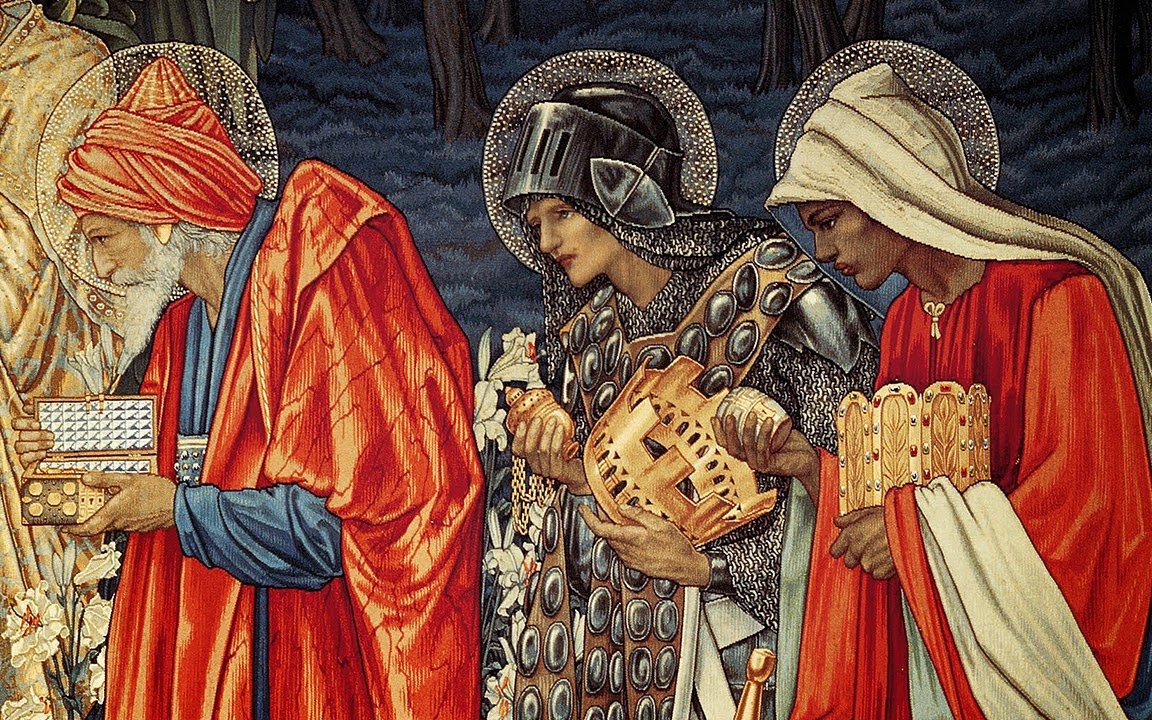
IMAGES: (top) Detail from Edward Burne-Jones’ “Adoration of the Magi;” (left to right) Twelfth Night holly man; banging the drum in Bulgaria; and Befana the Christmas witch
Leave a Reply