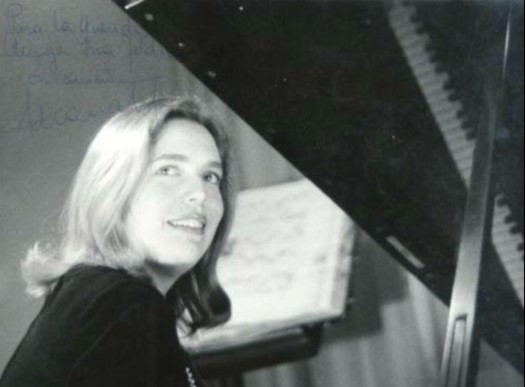
The Italian pianist Maria Tipo died yesterday at the venerable age of 93.
Her first teacher was her mother, who was a pupil of Ferruccio Busoni. Tipo also studied with Alfredo Casella and Guido Agosti.
When she first toured the United States in the 1950s, she was hailed as “the Neapolitan Horowitz.” Her classic 1955 Vox LP of Scarlatti sonatas (later reissued on CD, with two Mozart piano concertos) was declared by Newsweek “the most spectacular record of the year.” (Newsweek should go back to reviewing classical records.) Her recording of Bach’s “Goldberg Variations” is also highly-prized.
Tipo was a pianist’s pianist, admired by Martha Argerich among others, who attained her fame at a time when being a piano virtuoso was largely a man’s game. She herself was also a dedicated teacher. But all you really know is right there on the recordings. R.I.P.
Scarlatti in 1955
34 years later, playing Mozart’s Piano Concerto No. 21
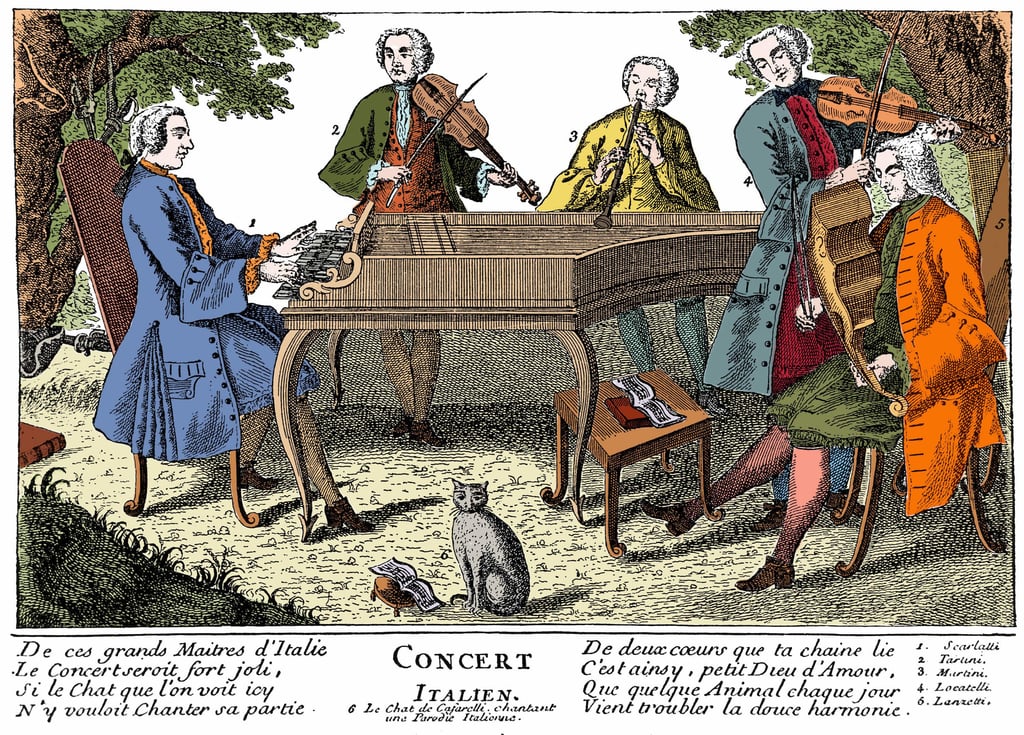
I’ve related both of these stories here perhaps several times before, but they are enlivened somewhat by the discovery of this whimsical engraving of superstar Italian musicians performing at a jam session with a singing cat.
At the harpsichord is Domenico Scarlatti, whose birthday it is today; on the violins are Guiseppe Tartini and Pietro Locatelli; on the flute Giovanni Battista Martini; and on the cello (held most peculiarly) Salvatore Lanzetti.
There’s a famous anecdote, perhaps spurious, about Scarlatti’s cat, Pulcinella, walking across his master’s keyboard. Scarlatti is said to have seized a sheet of paper and jotted down the notes sounded for use as the lead subject of one of his most famous sonatas, the work commonly known as the “Cat’s Fugue.”
As a bonus: Tartini claimed to have once been visited in a dream by the Devil, who perched himself at the foot of his bed while playing Tartini’s own instrument. “How great was my astonishment on hearing a sonata so wonderful and so beautiful, played with such great art and intelligence, as I had never even conceived in my boldest flights of fantasy,” he recollected.
Then he woke up, lit a candle, and scribbled down what he could. Yet he found the result lacking. “The music which I at this time composed is indeed the best that I ever wrote, and I still call it the ‘Devil’s Trill,’ but the difference between it and that which so moved me is so great that I would have destroyed my instrument and have said farewell to music forever if it had been possible for me to live without the enjoyment it affords me.”
As is so often case, the Devil grants a wish (indenturing himself in exchange for Tartini’s soul in the dream), only to drive his “master” to despair through the composer’s inability to recapture the perfect beauty of what he had experienced. Still, it went on to become Tartini’s most famous piece.
On the birthday of Domenico Scarlatti, beware his “Cat’s Fugue.” Scarlatti’s feline companion, Pulcinella, used to walk across the keys of his harpsichord. The story goes that on one of those occasions, the composer jotted down the notes and used it as the lead subject for his famous sonata. Spooky.