Tag: Schubert

  • Celebrating Serkin A Marlboro Music Birthday

    Celebrating Serkin A Marlboro Music Birthday

    This week on “Music from Marlboro,” we’ll serve up a great big musical cake for Rudolf Serkin’s birthday.

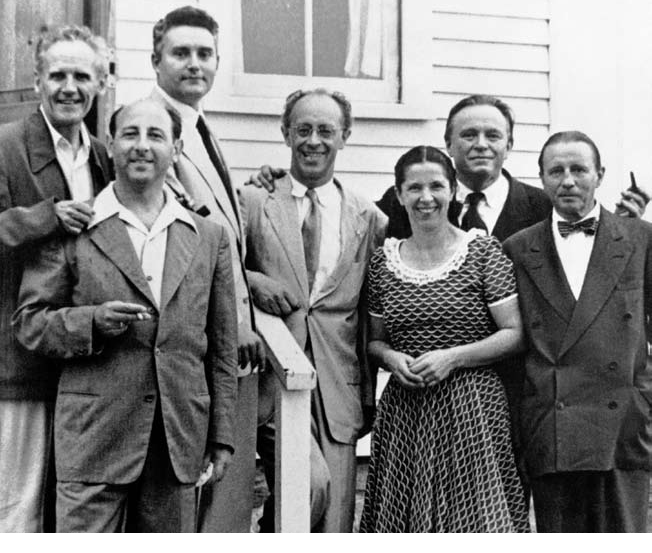
    Serkin, one of the indisputably great pianists of the 20th century, co-founded, with Adolf and Hermann Busch, and Marcel, Blanche, and Louis Moyse, the Marlboro Music School and Festival in 1951. Above and beyond his own artistic achievements, Serkin inspired countless young musicians, both as a pedagogue at – and then director of – the Curtis Institute of Music in Philadelphia and as artistic director of the Marlboro Music Festival for 40 years, until his death in 1991.

    We’ll supplement that cake with a little sherbet – better make that Schubert – and a special recording of the Piano Trio No. 2 in E-flat major, op. 100, set down in Brattleboro, VT, right at the very beginning, in October of 1951, with Serkin and the Brothers Busch. This is music-making between friends – and relatives – of the highest caliber.

    Then we’ll enjoy an additional treat in the form of Schubert’s “Auf dem Strom” (“On the River”). Serkin will join Philadelphia-based soprano Benita Valente and hornist Myron Bloom for a performance of this work that was composed in tribute to Beethoven. Ludwig Rellstab’s text was originally intended for the older master. The song was first performed on the only concert devoted exclusively to Schubert’s music during Schubert’s lifetime, which took place on the first anniversary of Beethoven’s death, March 26, 1828. The Marlboro performance dates from 1960.

    I hope you’ll join me in celebrating Rudolf Serkin, on the anniversary of his birth, with an all-Schubert program, this Wednesday evening at 6:00 EDT, on WWFM – The Classical Network and wwfm.org.

    Marlboro School of Music and Festival: Official Page


    PHOTO: Serkin (center) with his Marlboro family, co-founders Marcel Moyse, Louis Moyse, Blanche Moyse, Adolf Busch, and Hermann Busch (with cellist Nathan Chaikin second from left)
  • Schubert’s Light & Shadow From Marlboro

    Schubert’s Light & Shadow From Marlboro

    When we think of the music of Schubert’s final year, what comes across most strikingly, perhaps, is the complexity of feeling. Sensitively modulated light and shadow – the unpredictable contrasts of major and minor, agitation and calm, ecstasy and depression – create a sensation not unlike that experienced when wisps of cloud sweep across the sun on a mild autumn day. We find it in the late piano sonatas; we find it in the transcendent String Quintet in C major. It’s a beauty so intense that it actually kind of hurts.

    Every rule has its exception, of course, and on this week’s “Music from Marlboro,” we catch Schubert in a comparatively light-hearted mood – which I think appropriate on the occasion of his birthday – with his Piano Trio No. 1 in B-flat major, D. 898. While the trio does venture into remote keys and has its share of turbulence, the overarching spirit is very, very far from the eerie resignation of “The Hurdy-Gurdy Man.” In fact, it’s a pretty happy piece. We’ll hear it performed at the 2008 Marlboro Music Festival by pianist Jonathan Biss, violinist David Bowlin, and cellist Marcy Rosen.

    Then we’ll round out the hour with what might possibly have been the final music Schubert ever wrote. “The Shepherd on the Rock,” D. 965, on a text by Wilhelm Müller and Karl August Varnhagen von Ense, was composed barely a month before the composer’s death at the age of 31. The multi-sectional “lied” traverses a wide range of moods, as a shepherd listens to echoes from the valley below, grapples with his feeling of loneliness, and finds hope in the prospect of Spring and rebirth.

    Marlboro veterans, soprano Benita Valente, clarinetist Harold Wright, and pianist Rudolf Serkin, set down a classic – indeed legendary – recording of the work in 1960. This live performance was captured at Marlboro nine years later. In the words of Rudolf Serkin, “An artistic achievement cannot and should not be repeated. Isn’t it a miracle that a performance never is the same?”

    Get ready to share his wonder. It’s an all-Schubert hour, on this week’s “Music from Marlboro,” this Wednesday evening at 6:00 EST, on WWFM – The Classical Network and wwfm.org.

    Marlboro School of Music and Festival: Official Page

  • Schubert’s Quintet: A Marlboro Masterpiece

    Schubert’s Quintet: A Marlboro Masterpiece

    On this week’s “Music from Marlboro,” we’ll have a single work – but what a work it is! Franz Schubert’s String Quintet in C major (D. 956, Op. posth. 163) sits at the very pinnacle of the composer’s mountain of masterpieces – which is to say, it is among the greatest pieces of chamber music ever written.

    Schubert wrote at least 15 string quartets. Here he doubles his cellos (a break from Mozart and Beethoven, who preferred to double their violas), enriching the ensemble’s lower register. The quintet’s emotional terrain is as comprehensive and kaleidoscopic as the ever-shifting autumnal skies.

    Though the work was completed in 1828, two months before Schubert’s death, its first public performance did not take place until 1850 – 22 years later.

    We’ll hear a recording made in conjunction with the 1986 Marlboro Music Festival, featuring Pamela Frank and Felix Galimir, violins; Steven Tenenbom, viola; and Peter Wiley and Julia Lichten, cellos.

    I hope you’ll join me for this, the quintessence of quintets, on “Music from Marlboro,” this Wednesday evening at 6 EST, on WWFM – The Classical Network and wwfm.org.

    Marlboro School of Music and Festival: Official Page


    Always refreshing: orange Schubert

  • Schubert’s Unfinished Symphony Live Tonight

    Schubert’s Unfinished Symphony Live Tonight

    Be there for the B minor.

    Join The Classical Network for a live broadcast of “What Makes It Great,” featuring composer, conductor, author, and commentator Rob Kapilow. The event will take place tonight at 8:00 at Princeton High School, where select young musicians from three area youth orchestras – the Youth Orchestra of Central Jersey, the Greater Princeton Youth Orchestra, and the Youth Orchestra of Bucks County – will combine into an All-Star Youth Orchestra to perform Franz Schubert’s Symphony No. 8 in B minor, the so-called “Unfinished.”

    Kapilow will discuss what makes the symphony “great,” his observations illustrated with passages played by the orchestra, and then the orchestra will perform the symphony in its entirety. A Q&A session will follow. The concert will be broadcast and also streamed live on the station’s Facebook page:

    https://www.facebook.com/wwfmtheclassicalnetwork/.

    Admission is free. For directions and additional venue details, see the WWFM events calendar:

    http://wwfm.org/community-calendar/event/147952

    Please note: because the concert will be broadcast live, The Classical Network requests that members of the audience be in their seats by 7:50 pm.

    “Exploring Music” will not be heard tonight. Tune in on Tuesday at 6 p.m. for a double-dollop of Bill McGlaughlin.

    Today, yours truly will host into the early evening hours, providing music for your afternoon commute and getting you primed for the 8 p.m. broadcast of “What Makes It Great.” I’ll be spinning the discs, beginning at 4 p.m. EDT, on WWFM – The Classical Network and wwfm.org.

  • Classical Music Broadcast Schubert Glass Gliere WWFM

    Classical Music Broadcast Schubert Glass Gliere WWFM

    This Tuesday morning at 10:00, Alice Weiss will host “The Classical Network in Concert,” featuring winners of the 2016 Astral Artists National Auditions, in a program that was recorded at the Perelman Theater at the Kimmel Center for the Performing Arts in Philadelphia.

    That means there will be no noontime concert today, leaving me with a blank canvas on which to paint for the next four hours. During that time, we will not only mark the 220th anniversary of the birth of Franz Schubert, we will also celebrate the 80th birthday of Philip Glass. Glass will be represented by his Violin Concerto, with Gidon Kremer the soloist. Kremer will appear with his chamber orchestra, Kremerata Baltica, at McCarter Theatre Center in Princeton on Friday.

    Because there is always so much room to play with on Tuesday afternoons, I usually try to accommodate a larger work, on a scale not generally encountered on radio in the middle of the day. This afternoon will be no exception, as we take a 72-minute break from Schubert to enjoy Reinhold Gliere’s Symphony No. 3, subtitled “Ilya Muromets,” in a stunning performance by the Buffalo Philharmonic Orchestra, conducted by JoAnn Falletta. Gliere’s programmatic symphony evokes the heroic exploits of the legendary bogatyr, who employs his superhuman strength against a series of formidable opponents.

    The Buffalo performance has been described by David Hurwitz of classicstoday.com as “the finest version yet recorded,” and by Peter J. Rabinowitz of Fanfare Magazine as “beyond excellent.”

    There will be plenty of blood and thunder to counterbalance the delicacy of Schubert and the minimalism of Glass, from 12 to 4:00 p.m. EST, on WWFM – The Classical Network and at wwfm.org.

Tag Cloud

Aaron Copland (92) Beethoven (95) Composer (114) Film Music (119) Film Score (143) Film Scores (255) Halloween (94) John Williams (185) KWAX (229) Leonard Bernstein (99) Marlboro Music Festival (125) Movie Music (134) Opera (198) Philadelphia Orchestra (86) Picture Perfect (174) Princeton Symphony Orchestra (106) Radio (87) Ralph Vaughan Williams (85) Ross Amico (244) Roy's Tie-Dye Sci-Fi Corner (290) The Classical Network (101) The Lost Chord (268) Vaughan Williams (102) WPRB (396) WWFM (881)

DON’T MISS A BEAT

Receive a weekly digest every Sunday at noon by signing up here


RECENT POSTS