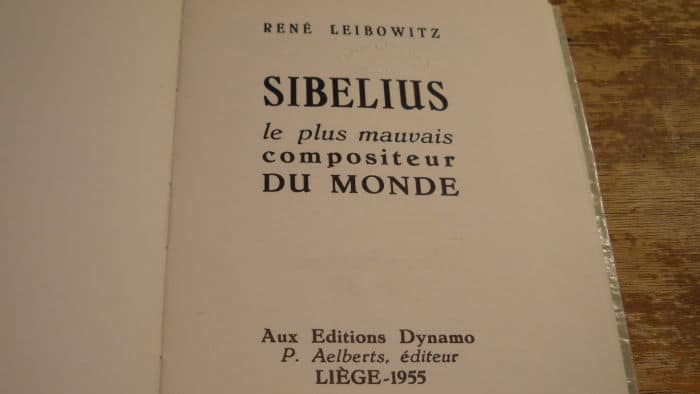
I don’t know how good your French is, but it’s obvious René Leibowitz wasn’t as much of a Sibelius fan as I am. Tell us what you really think, René! For the record, Leibowitz, a Schoenberg disciple, also dismissed Béla Bartók for pandering to popular taste with works like his Concerto for Orchestra. I haven’t read Leibowitz’s monograph, but I have to hand it to him, it’s got one of the great titles. Sibelius was still alive, by the way. He died in 1957 at the age of 91. But it’s Sibelius who had the last laugh. Royalties earned from his compositions continue to be among the highest of all classical music composers currently within copyright.
I so often observe musical birthdays and anniversaries on this page, especially round ones, but from time to time one will slip past, either because I’d already done a post about one of my shows or there simply weren’t enough hours in the day.
During my interminable wait for jury consideration in a Zoom antechamber the past couple of mornings, I passed the time in part by running my eyes across my CD shelves, which not surprisingly, in a collection containing some 10,000 specimens, yielded a number of curiosities and a few discs I had never even listened to. One is a 2-CD set on the Dutton label of music by Arthur Butterworth, whose centenary, I noted, as I read the liner notes, commenced on August 4.
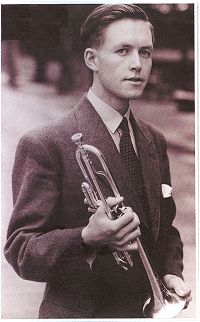
I was familiar with Butterworth (no relation to Vaughan Williams’ friend George Butterworth) only from a recording of his Symphony No. 1 of 1957, coupled on another album, on the Classico label, with the Symphony No. 2 of Ruth Gipps. The Dutton program also includes Butterworth’s 1st, conducted by Sir John Barbirolli, along with the 4th Symphony and the Viola Concerto, both conducted by the composer. Butterworth, a brass player, took up the instrument for a better understanding of how to write for strings.
Prior to that, like the composer Malcolm Arnold, he acquired ample experience of the orchestra from the inside, as a trumpeter in the Scottish National Orchestra, from 1949-55, and in the Hallé Orchestra, from 1955-62. He was also closely associated with the brass band movement, working with Besses o’ th’ Barn (of which he was a member) and the Black Dyke Band and writing test pieces for various brass championships.
In common with so many other English composers, Butterworth clearly revered Sibelius. His musical language is conservative and broadly tonal; accessible, if not exactly tunefully ingratiating. It can be dark and at times rather desolate, but also blistering and exhilarating. In addition, the 4th Symphony recalls Carl Nielsen, the great Dane, whose distinctive sound also pervades the works of Butterworth’s compatriot, Robert Simpson.
Many composers can be somewhat bashful about admitting to extramusical influences on their work, insisting that their music should be regarded as just that – absolute music, rigorously argued by putting it through abstract forms. Above all, it should not be interpreted as evocative of anything else. But Butterworth was a nature poet, clearly prone to introspection, and he credits his slow movements, especially, to the impressions he received while on walks with his dog across the forests and beaches of Scotland.
Butterworth also had a Vaughan Williams connection, taking lessons with RVW, beginning in 1950, when his mentor was in his late 70s.
Interestingly, Butterworth is not the only composer from the vicinity of Manchester to have gravitated to Scotland and pick up on its Nordic vibe. Peter Maxwell Davies was born outside Manchester 11 years later. Max kept a home in the Orkney Islands for some 45 years. For me, the latter’s symphonies, for as much as I enjoy some of his other music, have been tough nuts to crack – and it’s not been for want of trying!
Also included in the Butterworth set is a 27-minute spoken lecture, in which the composer talks about his life, work, and influences.
He died as recently as 2014, like Sibelius, attaining the venerable age of 91.
If you’re interested in mid-century English music and you are fascinated by Sibelius at his most austere and strangely beguiling, this music might be for you. No doubt there is worth in this butter, but it doesn’t exactly melt in your mouth!
Happy belated 100th, Arthur Butterworth!
The individual movements of the Dutton album have been posted separately as a YouTube playlist at the link:
Dalia Stasevska has given birth to a baby daughter.
Stasevska, chief conductor of the Lahti Symphony Orchestra and principal guest conductor of the BBC Symphony Orchestra, is married to Lauri Porra, Sibelius’ great-grandson. Porra trained on the cello but found fame as the bassist for Finnish metal band Stratovarius.
Get a load of this awesome electric guitar concerto.
Stasevska conducted a satisfying performance of Sibelius’ 5th Symphony in Philadelphia last season. Here’s 90 seconds of her conducting Sibelius’ 3rd, the work over which the composer’s grandson and I bonded. Ask me about it sometime.
The couple announced the pregnancy on August 22. The birth occurred on October 12. Congratulations to the happy parents!
The great Finnish composer Einojuhani Rautavaara was born on this date in 1928. In his later years, he was rightly regarded as one of the world’s great composers, the grand old man of Finnish music and the spiritual heir of Jean Sibelius. As a young man, he had actually worked as Sibelius’ chauffeur! In all, he composed eight symphonies, nine operas, 14 concertos, and dozens of other orchestral and vocal compositions. After he died in 2017 at the age of 87, I presented a five-hour marathon of his music on WPRB Princeton.
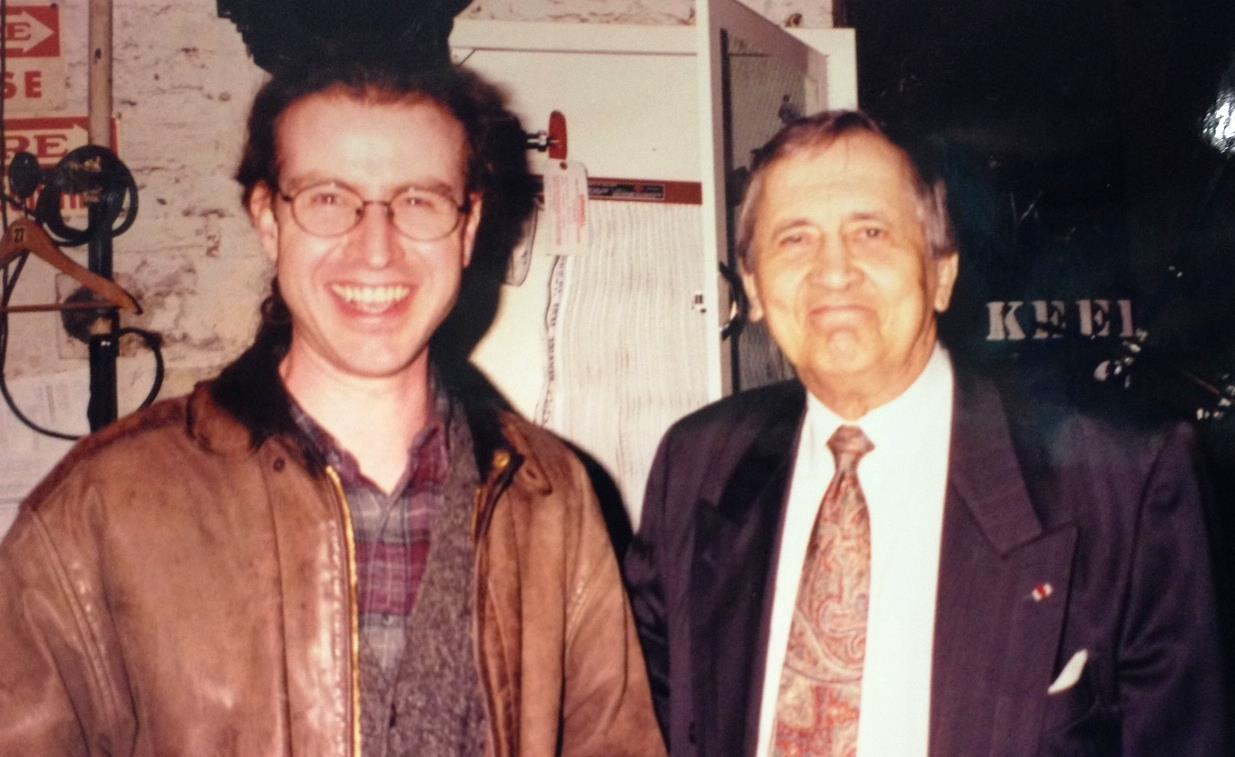
I was lucky to meet him once, in 2000, backstage at Philadelphia’s Academy of Music, prior to the first performance of his Symphony No. 8. He was kind enough to sign my Naxos CD of his Symphony No. 3, the Piano Concerto No. 1, and the so-called concerto for birds and orchestra “Cantus Arcticus.” I wonder what he thought of this peculiar, 33-year-old, American fan?
Here’s a performance of the Piano Concerto No. 1, with my recent acquaintance, Yifei Xu of the New Jersey Festival Orchestra, as the soloist.
The Philadelphia Orchestra touring Rautavaara’s Symphony No. 8, “The Journey.” I didn’t even know this video existed!
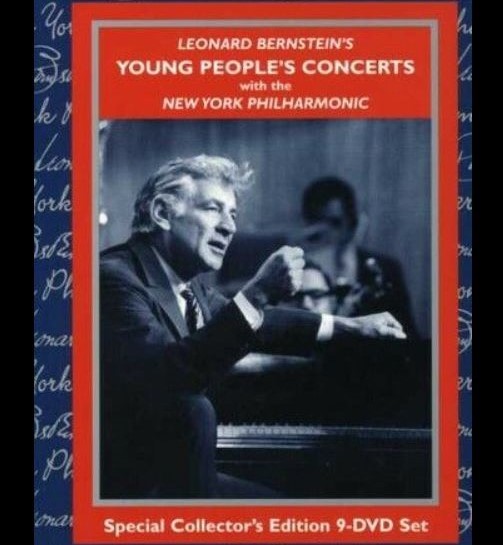
Last night, I pulled out my collection of Leonard Bernstein’s Young People’s Concerts with the New York Philharmonic to see if I owned a DVD of the broadcast that introduced a young André Watts in the Liszt Piano Concerto No. 1. I do not – though thankfully someone else posted it on YouTube. I decided instead to view “A Tribute to Sibelius,” presented in honor of the composer’s 100th anniversary.
I learned from Bernstein’s spoken introduction that President Johnson declared 1965 “Sibelius Year” in the United States. And yes, there was a time when Sibelius was that popular in America, though I would say it was a few decades earlier. In 1935, the composer’s 70th year, the New York Philharmonic surveyed 12,000 listeners of its Sunday afternoon radio broadcasts to learn their musical preferences. When asked who their favorite composer was, Sibelius was mentioned more than any other. Beethoven came in second. I always suspected I was born too late!
I also thought it was clever of Bernstein to compare Sibelius’ handling of his thematic material to a good detective story, in which clues are planted at the beginning, the true significance of which is only gradually revealed. He demonstrates this by following a three-note motif through its various permutations in the Second Symphony. “Those three innocent scale-notes turning up in a hundred different disguises…. [I]n the end they all link up, so that when the final light dawns, and all is made clear, you feel the thrill of having solved a great mystery, you yourself.” It’s an apt simile, even a brilliant one, in that it makes the listener feel like an active participant. But Bernstein was always an effective popularizer.
The young soloist in the Violin Concerto is the Romanian-born Sergiu Luca, who would later distinguish himself as an early music pioneer. Among Luca’s teachers was Ivan Galamian, who also taught Itzhak Perlman. At the age of 9, Luca made his debut with the Haifa Symphony Orchestra. (At the time, his family was living in Israel.) Like Watts, his U.S. debut was with the Philadelphia Orchestra, conducted by Eugene Ormandy – in Luca’s case, playing the Sibelius concerto – which brought him to the attention of Bernstein and led to his appearance on the New York Philharmonic telecast later that year.
Also of interest, from the end credits, I notice that the assistant to the director was none other than John Corigliano, Jr., son of the Philharmonic’s concert master, who went on to become a Pulitzer Prize and Academy Award winning composer himself. Corigliano won the Oscar for Best Original Score for his music for “The Red Violin.” He also scored “Altered States.”
Assistant to the producer was Mary Rodgers, daughter of Richard Rodgers and composer of “Once Upon a Mattress.” On the side, she also wrote “Freaky Friday.”
But arguably the part of the broadcast that brought me the most amusement was when Bernstein, conducting the Symphony No. 2, in the thrill of the moment, loses his grip on the baton when gearing up for the return of the big tune around 43 minutes in. I was all set to watch him ride it out with nothing but his bare hands, à la Stokowski, but a few seconds later, sure enough, he reaches under his music stand and produces as spare!
Hopefully nobody lost an eye.
Bernstein’s Young People’s Concerts were broadcast nationwide on CBS television and were eventually picked up around the world. The series, which ran from 1958 to 1973, received multiple Emmy, Peabody, and Edison Awards.
Crazy to look back at the orchestra now and realize there were no women, much less people of color. I remember reading a piece by Dave Barry once, decades ago, in which he humorously described white jazz clarinetists of yore as snapping their fingers in front of a bunch of guys dressed like dentists. The musicians of the New York Philharmonic from this era are kind of like that, only without the snapping fingers.
Predictably, some of the kids in the audience look a little distracted, though still well-behaved (and well-dressed), but a surprising number of them appear to be genuinely engaged. It’s sad that young people lack these kinds of opportunities anymore to be exposed to this kind of music. Classical music plays less of a part in American life now than it ever has since the rise of broadcast media.
There was a time in our history when people aspired to be better and believed that the way to do that was to acquire an education and expose themselves to the finer things. It was still like that when I was growing up, in the 1970s and early ‘80s. But that’s a long time ago now. From the perspective of the 21st century, we have passed our peak. This sort of television programming, especially from a network, endures only in memory or, if we’re lucky, in archival footage.
It seems like only yesterday that I was listening to the “Grand Canyon Suite” in music class and watching film strips of “Madama Butterfly” and “Amahl and the Night Visitors.” I feel sorry for anyone who has never been exposed to longer-form music, experienced its fantasy or been made to shudder at its ennobling beauty.
There’s so much more to music – and to life – than three-minute cuts manufactured in a recording studio. I don’t think I would have made it this far if I thought that’s all the world had to offer. Are these noble monuments to our shared humanity all really in danger of just fading away?
And in case you missed it when I shared the link earlier this week, a 16-year-old André Watts plays Liszt’s Piano Concerto No. 1 (broadcast date: 1/15/63)