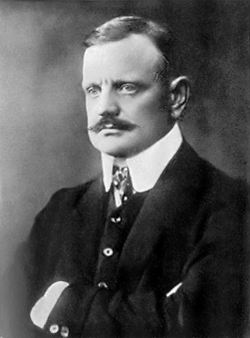
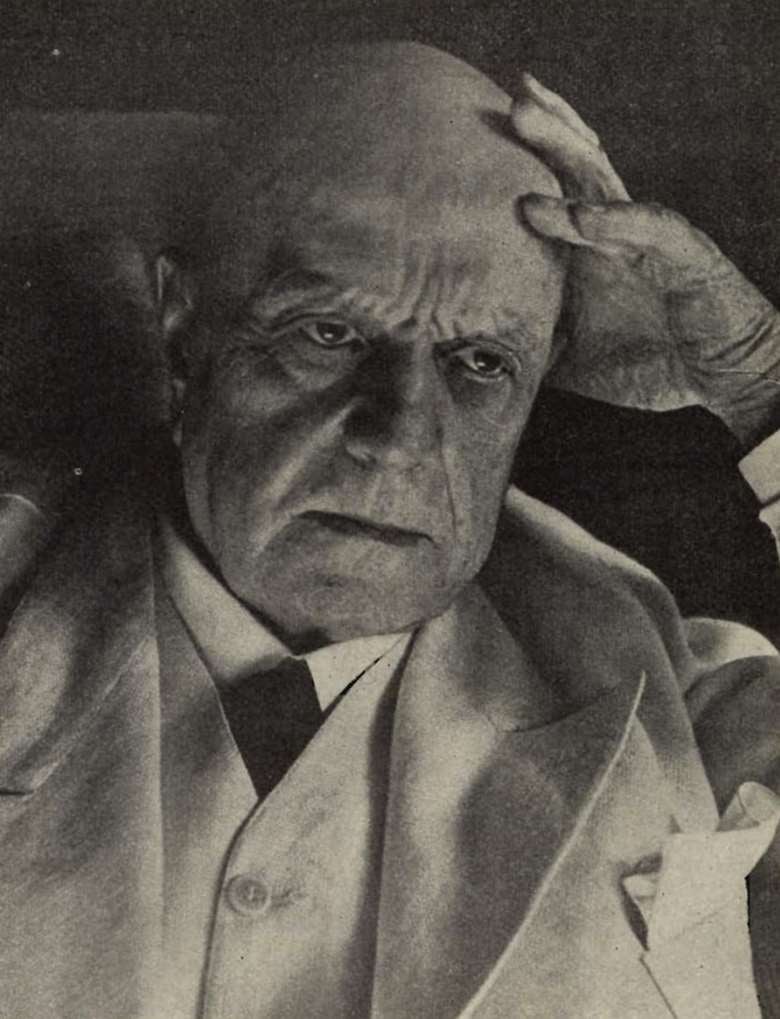
Jean Sibelius’ Symphony No. 6 was performed for the first time, in Helsinki under the composer’s baton, on this date 100 years ago. Kile Smith shares his thoughts on this gorgeous, enigmatic work (as might describe much of Sibelius’ greatest music), on this month’s “Fleisher Discoveries.”
Sibelius noted that the symphony always reminded him of the first scent of snow. He also penned the descriptive phrase “When shadows lengthen.” It’s funny, I don’t find the work at all gloomy, but then I’ve always disliked the sun.
The Symphony No. 6 is rarely encountered in U.S. concert halls. I think in my 40 years of attending orchestral concerts, I have heard it only once, on the same program with the equally underperformed Symphony No. 3 (with Osmo Vänskä, unsurprisingly, guest conducting in Philadelphia).
Sibelius remarked, “Whereas most other modern composers are engaged in manufacturing cocktails of every hue and description, I offer the public cold spring water.” This from a man who knew a thing or two about libations! Listen to Sibelius’ Symphony No. 6, with Kile’s commentary, at the link.
I don’t know what’s going on with me. First of all, it doesn’t feel like Christmas. I could blame it on the early start for Advent or the weather being too warm. The grass keeps greening here, and there’s still new growth. And now, suddenly, it’s the birthday of Jean Sibelius. So much for “8 Days of Sibelius,” as I have been known in past years to celebrate the composer in a series of daily posts starting at the beginning of the month. Whatever it is that has gotten into me, I seem to have become unstuck in time. And not like Vonnegut’s Billy Pilgrim, mind you.
Be that as it may, so much of the wonder of music, especially long-form music, is how it plays with our perception of time. Symphonies are often narratives, even if there is no story. The internal logic of a piece creates the illusion of movement, a sense of connections being made, and even varying degrees of momentum.
Sibelius was a master at manipulating time in works like his Symphony No. 5. The piece begins with a musical sunrise, the merest suggestion of the grandeur to come, with perhaps a meditation of the natural world stirring to life; and then somehow, before we know it, the ground is shifting seismically beneath our feet, and we’re in the middle of a scherzo. The effect is thrilling, yet, when executed properly (always a challenge for conductors), seems totally organic.
And that ending! There is no other symphony like it in the repertoire. It’s as if the composer has mastered time itself, and brought everything to an abrupt halt, over six staggered, monolithic chords, leaving the listener suspended at the very peak of sublimity,.
Sibelius worked hard to achieve his effects. The Symphony No. 5 was given its world premiere on his 50th birthday, December 8, 1915. A second version, which only partly survives, was unveiled the next year. The final version, the version we all know and love, was given its performance on November 24, 1919. To contemplate the level of objectivity he managed to attain in reshaping the raw material of his first thoughts is staggering. Like Beethoven, Sibelius worked very hard to realize his genius.
Perhaps whenever I get to feeling unstuck, a healthy attitude would be to imagine myself, like someone listening to Sibelius’ Symphony No. 5, suspended between moments of sublimity.
Happy birthday, Jean Sibelius.
Symphony No. 5 (final version, 1919)
Original version (1915, with some very notable differences)
What’s the big deal about this guy, Jenő Blau? Well, you probably know him better by his adopted name, Eugene Ormandy.
Ormandy, a Hungarian-born violinist who had studied with Jenő Hubay (for whom he was named), became a naturalized American citizen in 1927. He ultimately wound up directing The Philadelphia Orchestra for 44 years. In that capacity, he became one of the world’s most-recorded conductors.
However, in some respects, he remains a vastly underrated one. Sure, he was a superb interpreter of 19th century and post-Romantic classics (his Columbia stereo recording of Tchaikovsky’s “Pathétique” was one of my go-to favorites as a teen, and he was an authoritative conductor of Rachmaninoff and Sibelius), but he also championed much contemporary music and new works written by his adopted countrymen. Also, if ever there was a more sensitive accompanist in the concerto repertoire, I don’t know of him.
One of my favorite Ormandy records was also one of his later ones. Throughout his career Ormandy succeeded in selling Sibelius’ “Four Legends from the Kalevala,” a collection of tone poems inspired by the Finnish national epic the “Kalevala,” for the early masterpiece that it is.
Here again is the final section, “Lemminkainen’s Homeward Journey,” even more thrilling, in 1940. Not on YouTube, for some reason, but I found it posted on archive.org. You may have to adjust the volume under the video.
Sibelius at the Russian embassy! Finnish protesters sing the “Finlandia Hymn,” substituting “Ukraina” for “Suomi” (Finland).
Historically, Finland is all too familiar with life under Russian occupation. “Finlandia,” composed in 1899 (rev. 1900), was banned from performance by the Russian authorities for stirring nationalistic fervor. (Finland was part of the Russian Empire from 1809.) In its early days, Sibelius’ most flagrant expression of Finnish patriotism was presented under many names, in order to circumvent the censors. The work was first performed in Helsinki on July 2, 1900. Finland formally declared its independence from Russia on December 6, 1917.
The ”Finlandia Hymn” is a reworking by the composer of the serene, hymn-like interlude of his popular symphonic poem. It has been embraced by the Finnish people as the country’s unofficial anthem.
Hundreds of Finns gather to sing the “Finlandia Hymn” in 2015 for Sibelius’ 150th birthday:
Sung during the pandemic by the Sibelius High School Chamber Choir:
The symphonic poem “Finlandia” given the full treatment, in a stirring presentation, complemented by Northern Lights, imposing forests, and stunning wildlife footage. Nine minutes well-spent.
PHOTO: A further display of solidarity in Helsinki’s Senaatintori (Senate Square) on April 18
Okay, this will probably be my last Sibelius post for the present. But I wrote most of it yesterday, and I don’t want it to go to waste!
Even now, 64 years after his death, no composer has held as profound an influence over the cultures of the North. Given that Sibelius composed no major works for the last 30 years of his life, we’re talking about close to a century. That’s quite a long shadow.
Here’s an interesting work by Norwegian composer Ragnar Søderlind (born 1945). His Symphony No. 8, “Jean Sibelius in memoriam,” was written in 2004-05. The symphony alludes to some of Sibelius’ own music, including the organ work “Surusoitto.” “Surusoitto” is thought to contain material from Sibelius’ own unreleased Eighth Symphony.
Sibelius never completed his Symphony No. 8, or so he’d have us believe. Perhaps he just didn’t complete it to his satisfaction. After the Symphony No. 7 and the tone poem “Tapiola,” written in the mid-1920s, he’s said to have completed no further major works. But it certainly wasn’t for want of trying.
At the very least, he grappled with the Eighth, the manuscript of which he is supposed to have destroyed. I heard as much from the mouth of his own grandson, who claimed to have been present at its burning. Did Sibelius finish it?
Only within the past ten years, a few tantalizing sketches have surfaced, seemingly out of nowhere. Is it possible more could have survived? Perhaps somewhere, among the composer’s papers, a draft might even exist. I’m not in favor of “reconstruction” from mere fragments, but if there is a somewhat complete version of the symphony, even in embryonic form, it would be a thrill to be able to hear it.
It makes my heart ache to listen to these sketches and contemplate that there actually could have been another Sibelius symphony. Had the composer only been able to defy his demons and hold it together one more time!
Could it have topped his crowning achievement, the Seventh Symphony? Sibelius didn’t think so, which is why, likely, he consigned it to flames of woe.
“Surusoitto” (“Funeral Music”) – does it contain material intended for the Symphony No. 8?