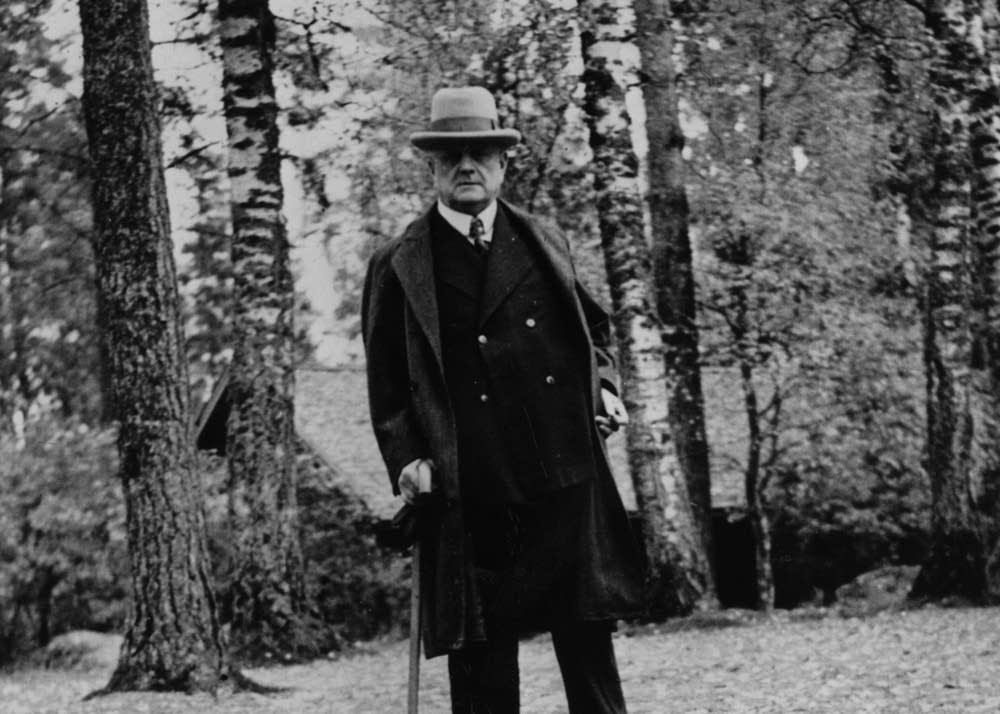
Tag: Sibelius

  • Sibelius Rediscovered: Maiden in the Tower Overture

    Sibelius Rediscovered: Maiden in the Tower Overture

    Yesterday’s modern premiere of a Sibelius overture, said to have been rediscovered in the manuscript of the composer’s one-act opera, “The Maiden in the Tower,” sent me back to a complete recording of the stage work.

    At 35 minutes, Sibelius’ grandiose music is too much for the slight libretto – a simple story about a damsel in distress, a lecherous bailiff who abuses his authority, the maiden’s devoted lover, ready to defend her to the death, and a deus ex machina in the form of the castle’s justice-loving chatelaine. As a secular cantata, I can see how this might be regarded as something of an action-packed potboiler, a pre-Raphaelite painting in sound; but as “opera,” there’s no way. The whole thing just buckles. How I wish the composer had followed through on his earlier design of a grand opera after the Kalevela.

    What I didn’t understand until today’s reencounter with a work I have not listened to in years is that the resurrected overture – not to be confused with the opera’s brief orchestral prelude – is basically a compilation of material that already exists within the larger piece. It doesn’t, however, explain away the overture’s potpourri character, since the prelude and first scene are presented, as near as I can tell, as is, within the “new” work. It rather puts me in the mind of the overture to Vaughan Williams’ “The Poisoned Kiss,” in form rather than character, since both are basically constructed on tunes from the opera.

    It was the conductor of yesterday’s modern premiere, Tuomas Hannikainen, who, as a doctoral candidate, discovered not a separate score, but rather handwritten clues left by the composer on the opera itself suggesting a new orchestral work, or “overture,” hidden within the piece. So basically, that’s the story behind this Sibelius rediscovery. The composer is said to have conducted a couple of performances of the work back in 1900. The 12-minute overture should not be confused with the three-minute prelude to the opera.

    Sibelius suppressed “The Maiden in the Tower” after a few early performances in 1896, with the intention of revising the entire work, which he never got around to addressing. Indications for the new overture may have been the composer’s attempt to salvage some of the best bits from the opera. After all, material from an earlier, incomplete opera, “The Building of the Boat,” was recycled in his “Four Legends from the Kalevala” – with “The Swan of Tuonela” forming the opera’s original prelude – and his symphonic poem “The Wood Dove.”

    Yesterday’s performance of the overture reconstructed from “The Maiden in the Tower” is now posted on the YouTube channel of the Avanti Chamber Orchestra. If I understand correctly, a complete concert will be made available there on May 30, which will include not only this “premiere,” but also Sibelius’ melodrama “The Countess’ Portrait” and a suite from his incidental music to “Belshazzar’s Feast.” Also featured will be André Caplet’s “Conte fantastique” for harp and string orchestra, after Edgar Allan Poe’s “The Masque of the Red Death.”

    For more information, visit the Avanti website.

    Avanti! conducted by Tuomas Hannikainen resurrects Sibelius work dormant for 120 years

    Whatever this overture is, I am glad to have heard it!

    A complete recording of “The Maiden in the Tower”


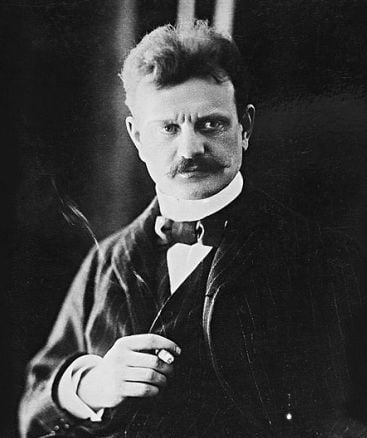
    Sibelius, enjoying a smoke, circa 1900

  • Lost Sibelius Overture Rediscovered & Performed

    Lost Sibelius Overture Rediscovered & Performed

    We’re only a few hours away from the first modern performance of a long-lost work of Jean Sibelius.

    News of the 2019 rediscovery of the score of this “Concert Overture” (found with the manuscript of Sibelius’ only completed opera, “The Maiden in the Tower”) somehow eluded my notice. The overture was last performed in 1900. This is not to be confused with either the Concert Overture in E (1891) or the Concert Overture in A minor (1902), both recorded by Neeme Järvi and others.

    You can watch a performance of the “new” work live on the YouTube channel of the Avanti! kamariorkesteri / Avanti! Chamber Orchestra today at 12 pm EDT:

    Or wait for the video to be posted on May 30. Learn more about it here:

    Avanti! conducted by Tuomas Hannikainen resurrects Sibelius work dormant for 120 years

    The complete concert program will feature two more Sibelius rarities – the melodrama “The Countess’ Portrait” and a suite from “Belshazzar’s Feast” – as well as André Caplet’s “Conte fantastique” for harp and string orchestra, after Edgar Allan Poe’s “The Masque of the Red Death.”

    News of the rediscovery in 2019:

    Concert Overture by Sibelius rediscovered

    The Concert Overture in E major (1891)

    The Concert Overture in A minor (1902)

    An earlier attempt at a grand opera, “The Building of the Boat,“ was abandoned in 1893, though much of the material was reworked by the composer into “Four Legends from the Kalevala” and the symphonic poem “The Wood Nymph.” One of his most frequently-programmed pieces, “The Swan of Tuonela,” was originally planned as the prelude to this opera.


    UPDATE: Having just watched the modern premiere, here’s my assessment. The overture won’t change anyone’s fundamental understanding of Sibelius, but it is by turns evocative, dramatic, charming, exciting, and beautiful. If you’re a fan of the “Lemminkäinen” symphonic poems, I think you will enjoy this. A magical treat, and at 12 minutes, not an insignificant one. I’ll be checking back for the full concert on May 30. Just what I needed on a 90-degree day. Thank you, Avanti!

    UPDATE #2: The performance of the overture is now posted.

  • Remembering Bliss Michelson

    Remembering Bliss Michelson

    I’ve been thinking about Bliss Michelson incessantly since I learned of his death late yesterday afternoon. Bliss, who was production manager at WWFM The Classical Network from 1992 to 2011, died on Sunday of complications from COVID-19. His wife, Peggy, preceded him on February 26.

    First of all, thank you for your condolences. I want to make it very clear that this is not “my” loss, so much as it is a loss to anyone who knew or listened to him. Bliss was so talented at what he did. I already stated, he was probably the best all-around radio host I ever worked with, in terms of being able to do it all – knowledgeable, efficient, personable, conversational, an avuncular presence, impeccable in his pronunciation, and a varied, balanced, and interesting programmer – a real pro. I never saw anyone navigate production work the way he did, while simultaneously doing a live air shift. And he was such a nice man.

    I certainly do not want to give the impression that we were joined at the hip, but we did have a very long association, dating back to 1995, which continued when we worked together at WRTI. If anything, he was like an uncle to me. You can learn a little more about our interactions if you read my post from yesterday.

    Of course, on the most basic level, we shared a passion for music, and because of Bliss’ love of composers from the Northern countries, I have a lot of fond memories of our bonding over Sibelius.

    Perhaps cryptically, I concluded last night by mentioning Sibelius’ Fourth. This is Sibelius’ weirdest, gloomiest symphony, a work written under the shadow of death, as the composer had recently undergone a series of surgeries for throat cancer. It is an austerely beautiful piece, though admittedly it does go to some very strange places.

    Bliss’ morning air shift on The Classical Network ran to 10 a.m. Earlier in the morning, he would mix up the Vivaldi and the Haydn and the Dvořák, with enough lesser-known repertoire to keep it fresh and engaging. But by 9, he would often go for something a little longer, and sometimes a little more challenging. Personally, with Sibelius’ Fourth, I can’t understand what all the fuss is about, but it tends to rub listeners the wrong way. Or at least it manages to wind up the one crank in the audience who is going to call and complain.

    Bliss was generally pretty unflappable, but I remember at least once he was not happy with a phone message from a listener that it fell upon me to convey. I hasten to add, for the most part Bliss was a teddy bear, not a bottle of nitroglycerin, as I tend to be. But I chuckle sometimes to think of his reaction.

    At any rate, a memo was passed around that we shouldn’t be playing Sibelius’ Fourth in the mornings. I prefer to think that this was not disobeyed, but rather conveniently forgotten.

    This one’s for you, Bliss.

    (By coincidence, the video was posted by someone using the screen name Furtwangler, who happened to be one of Bliss’ favorite conductors.)

  • Sibelius at 155 A Finnish Hero’s Legacy

    Sibelius at 155 A Finnish Hero’s Legacy

    EIGHT DAYS OF SIBELIUS – DAY 8

    Well, today is the day. The 155th anniversary of the birth of Jean Sibelius.

    The Sibelius legacy is an interesting one. In Finland, he is regarded as a national hero – so much more than a composer – since essentially, he provided the soundtrack for Finnish independence. His image has adorned statues, stamps, and currency. Finnish Flag Day is even celebrated on his birthday (December 8).

    Outside of Finland, Sibelius’ reputation has been a little spottier, his path to the pantheon a bit more circuitous. Broadly speaking, he has fared better in England and the Commonwealth, the United States and, naturally, Scandinavia. In Germany and France, much less so. In the modernist era, his music became regarded in some circles as a hopeless throwback. Here was a tonal composer who, in his naiveté, still wrote tunes! René Leibowitz went so far as to call him “the worst composer in the world.”

    There are still some who remain deaf to Sibelius’ charms, and blind to his significance. But in his way, he was every bit as innovative – and every bit as subversive – as Stravinsky or Schoenberg. Like Franz Liszt before him, the great Finn blazed his own trail, rejecting forms that had been developed over generations, particularly those of German origin, to reinvent the symphony, in a manner that would become recognized as wholly characteristic of the North.

    Few composers’ music has been so tied-up with the spirit of their homeland. Sibelius came of age at a time when artists of the “provincial” countries of Europe began to chafe against imperial domination, and to assert their own national identities. Sibelius loved Finland. He loved its history. He certainly loved its natural beauty.

    All this is reflected in his most famous piece, the tone poem “Finlandia,” his most flagrant expression of Finnish patriotism, performed under many names in its early days, in order to circumvent the Russian censors. The work was first heard in Helsinki on July 2, 1900. The conductor on that occasion was Sibelius’ good friend Robert Kajanus.

    YOU OWE IT TO YOURSELF TO WATCH THIS EXCEPTIONAL VIDEO! “Finlandia” is given a stirring presentation, complemented by Northern Lights, imposing forests, and stunning wildlife footage. I guarantee it will be nine minutes of your day well-spent. An inspiring visual interpretation that breathes new life into an overplayed favorite.

    The serene melody at the heart of “Finlandia” is often heard separately as the “Finlandia Hymn.” Though not the Finnish national anthem, it is basically the Finnish national song. Listen to this lovely performance, recorded in November, by the Sibelius High School Chamber Choir. In this case, social distancing need not mean isolation.

    HAPPY BIRTHDAY JEAN SIBELIUS!


    PHOTO: “Passio Musicae” (1967) by Eila Hiltunen, the Sibelius Monument in Helsinki

  • Sibelius’s Andante Festivo a world greeting

    Sibelius’s Andante Festivo a world greeting

    EIGHT DAYS OF SIBELIUS – DAY 7

    Sibelius hadn’t been in front of an orchestra for over a decade, when the music critic Olin Downes – Sibelius’ great champion at the New York Times – sent out a request for the composer to conduct one of his own works, as a kind of “greeting to the world,” in honor of the New York World Exhibition in 1939. Remarkably, Sibelius obliged, essentially coming out of retirement at the age of 73 to lead the performance on New Year’s Day.

    The work, “Andante Festivo,” originally conceived for string quartet, was commissioned to mark the 25th anniversary of a sawmill, of all things, in 1922. Sibelius transcended the, um, run-of-the-mill occasion by crafting a genuinely inspired, soulful composition that is none the worse for its touching simplicity. For the World’s Fair radio transmission, allowing for the technological limitations of the day, he rescored the piece for string orchestra and timpani. In retrospect, the full-throated, free-flowing hymn could be seen almost as a religious statement, with the world teetering on the brink of war.

    This is the only recording that exists of Sibelius conducting. The tempo he chooses is slower and more solemn than usual, but hardly surprising, considering the circumstances. For years, another recording, set down on the same day, at an even slower tempo, was thought to be the one conducted by the composer, but the confusion has since been sorted out.

    The work would later be played at Sibelius’ funeral. It’s so like Sibelius to find wistfulness in “festivity.”

    Here’s a modern recording, at a more customary tempo, with Neeme Järvi conducting the Gothenburg Symphony Orchestra:

Tag Cloud

Aaron Copland (92) Beethoven (95) Composer (114) Film Music (119) Film Score (143) Film Scores (255) Halloween (94) John Williams (185) KWAX (229) Leonard Bernstein (99) Marlboro Music Festival (125) Movie Music (134) Opera (198) Philadelphia Orchestra (86) Picture Perfect (174) Princeton Symphony Orchestra (106) Radio (87) Ralph Vaughan Williams (85) Ross Amico (244) Roy's Tie-Dye Sci-Fi Corner (290) The Classical Network (101) The Lost Chord (268) Vaughan Williams (102) WPRB (396) WWFM (881)

DON’T MISS A BEAT

Receive a weekly digest every Sunday at noon by signing up here


RECENT POSTS