Tag: Sibelius

  • Sibelius’ Silence Lost Symphony & Cigars

    Sibelius’ Silence Lost Symphony & Cigars

    EIGHT DAYS OF SIBELIUS – DAY 6

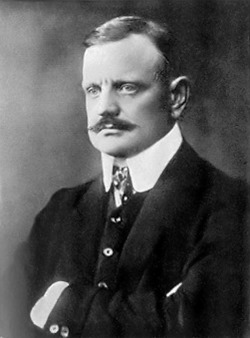
    I’ve got two Sibelius autographs in my possession. One is a signed copy of the famous Yousuf Karsh portrait from 1949 that I am currently using as my profile pic. I have been unable to locate it since my last move, but I assure you it’s around here somewhere!

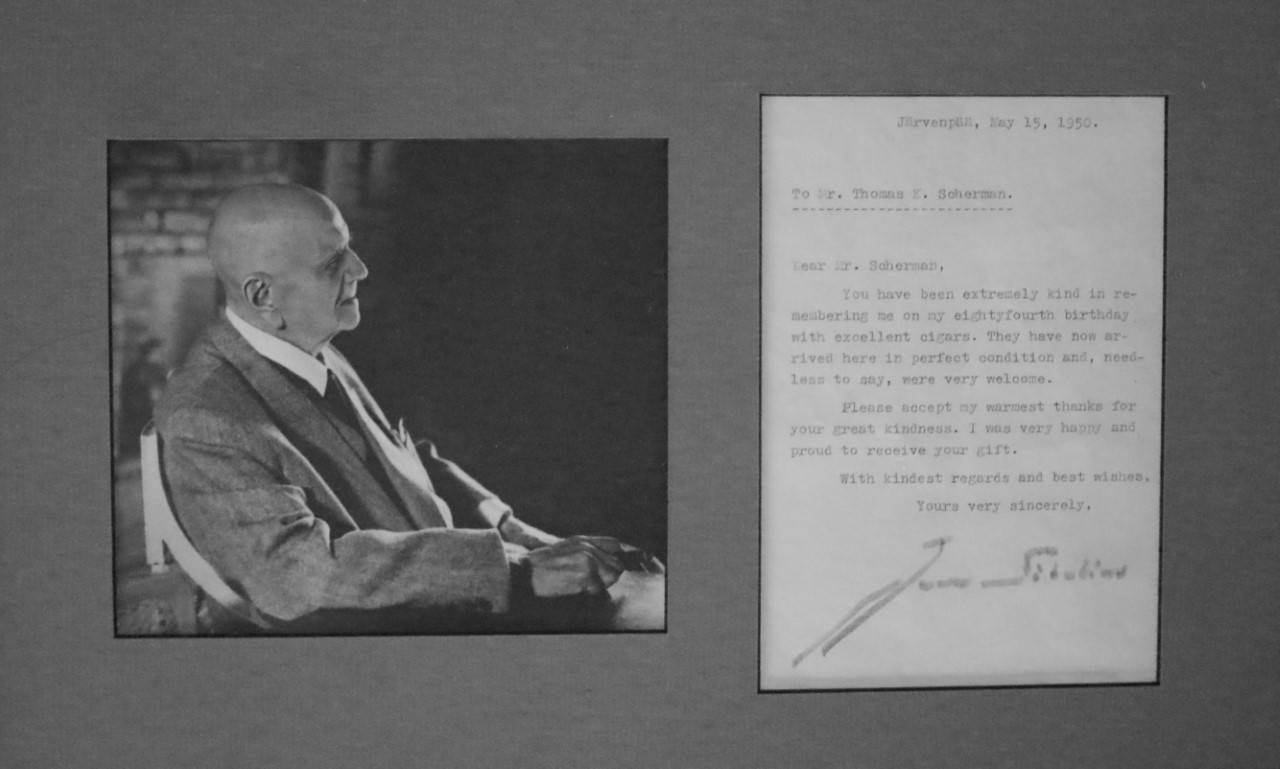
    The other, as you can see, when you click on the image to enlarge, is a note of thanks for a gift of cigars on the occasion of the composer’s 84th birthday. The accompanying photo (note the cigar in his hand) was copied for me by Anssi Blomstedt, the composer’s grandson. I had the two matted and framed together.

    Evidently, Sibelius never lost his fondness for cigars – and vodka – though he abstained for a time, beginning in 1908, a harrowing period for the composer, during which he underwent a series of operations to have a cancerous tumor removed from his throat. Understandably, this brush with mortality dominated his thoughts until the clouds began to lift in 1913. Then, just as his prospects seemed to be improving, war enveloped Europe. It was during his health crisis that Sibelius composed his Symphony No. 4, a work he himself described as “a psychological symphony.” It is certainly the strangest of his oeuvre, unsettling, bleak, even desolate, but also quite beautiful.

    Sibelius suffered periods of depression and self-doubt throughout his life, and they only worsened the more famous and acclaimed he became. Following his Symphony No. 7 of 1922-24, the purest distillation of his revolutionary approach to symphonic form (the entire work, a breathtaking, organic expanse of 20-25 minutes in length), and his sublime tone poem “Tapiola” of 1926 (Tapio being the forest god of the “Kalevala”), he acknowledged no further major works. Both pieces were met with some of the greatest acclaim of his career, but combined they help to induce such overwhelming pressure that he was essentially hobbled.

    The Symphony No. 7:

    “Tapiola”:

    Sibelius had just turned 61 at the time “Tapiola” was premiered. Though for a time he would labor heroically at an Eighth Symphony, the effort made him miserable. Several leading conductors, including Serge Koussevitzky and Eugene Ormandy, were jockeying for the work’s first performance, and the composer experienced increased anxiety to meet expectations and push beyond what he had already expressed. A kind of paralysis ensued, though a number of people, pupils, colleagues, and family, insist that the symphony had been completed.

    It is thought that Sibelius destroyed the work – actually I have it on good authority from Anssi, who says that he was present at its burning – but at least some of the sketches have survived. It was only in 2011 that a few fragments came to light. They are maddeningly gnomic and make the Sibelius lover yearn for more. What would it be like to hear a new Sibelius symphony?

    But if the composer didn’t think it was up to his standards, perhaps it is best that it is lost. Here are two-and-a-half minutes that have survived:

    Sibelius’ retirement was a long one. He would finish nothing of consequence for his last 30 years. This period has been enshrined in legend as the “Silence of Järvenpää.” During this time, though the composer was not overly fond of company, he continued to receive some notable guests at his home, Ainola, located 23 miles north of Helsinki. A number of these were still hoping to wrest from him the elusive Eighth Symphony.

    Once, Ormandy showed up with the entire Philadelphia Orchestra. Though in frail health and cripplingly shy, the composer was convinced by Ormandy to walk out onto the porch and acknowledge the musicians. It was a raw day, and everyone had been waiting in the rain, but when the door opened finally, and the composer emerged, he was met with a resounding cheer.

    Sibelius died two years later, in 1957, at the age of 91.
  • Sibelius Day 5 Wicks & Porra Concertos

    Sibelius Day 5 Wicks & Porra Concertos

    EIGHT DAYS OF SIBELIUS – DAY 5

    Two concertos today.

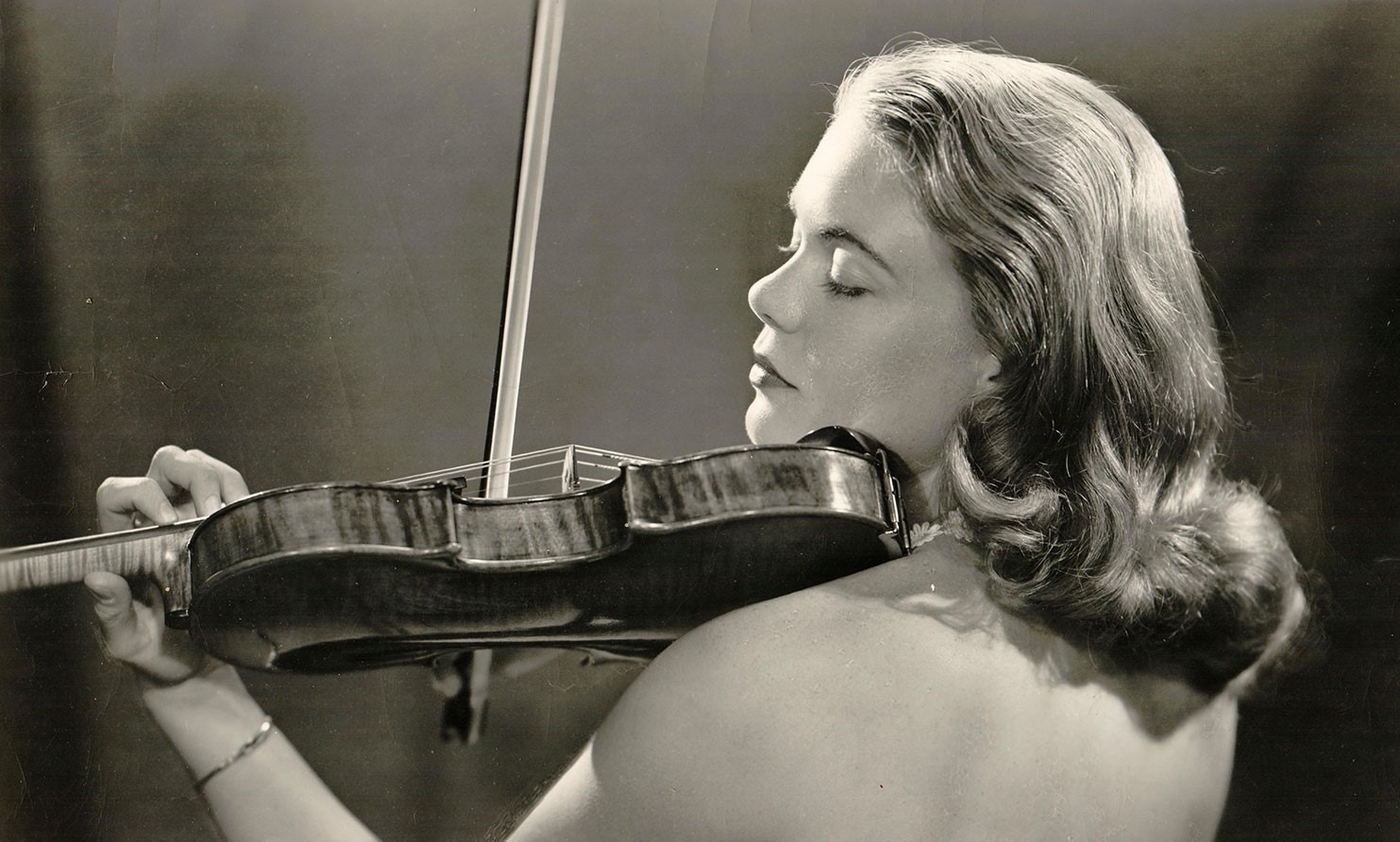
    The first is Sibelius’ lone violin concerto. As a young man, it had been the composer’s ambition to become a virtuoso violinist. Fate – and limited ability – had other plans. Fortunately, he was able to channel that creative impulse into amassing an impressive body of original music.

    This recording is by the American violinist Camilla Wicks. Wicks, who was of Norwegian descent, mastered a broad range of repertoire. She enjoyed particular popularity in the Scandinavian countries for championing works by lesser-known Nordic composers.

    She was one of the first female violinists to establish a major international career. Isaac Stern called her “the greatest violinist.” When questioned if he meant the greatest female violinist, he clarified, “No. The greatest.”

    She also drew particular praise from Sibelius, who singled her out as his favorite interpreter of his concerto.

    Wicks died on November 25, at the age of 92.

    https://www.youtube.com/watch?v=cgr6zgZYviU

    The second concerto is by Sibelius’ great-grandson, Lauri Porra. Porra, who trained as a cellist, plays bass guitar with the Finnish metal band Stratovarius. Get a load of this awesome electric guitar concerto.

    http://www.classiclive.com/porra-entropia-full-video

  • Sibelius’s Symphony No 5 Day 4 of 8

    Sibelius’s Symphony No 5 Day 4 of 8

    EIGHT DAYS OF SIBELIUS – DAY 4

    With his 50th birthday imminent, Jean Sibelius received a commission from the Finnish government to write a brand-new symphony. The Symphony No. 5 was given its world premiere in 1915, with the composer conducting the Helsinki Philharmonic – though the original version was quite different, in many respects, from the masterwork we know today. In a remarkable feat of objectivity, Sibelius extensively revised his symphony twice, in 1916 and then again in 1919.

    One of the work’s major innovations (showing the influence of Liszt, whom Sibelius greatly admired) involved the elimination of the break between the first two movements of the original four-movement structure. The demarcations are blurred so that the first movement now slips inexorably into a scherzo, and the listener is swept along, as if caught up in a powerful current, or precipitated into a sublime avalanche, to thrilling effect.

    The transition has always been a challenge for conductors, since this sneaking accelerando should feel as if it’s completely organic. It has to unfurl naturally. Sibelius would further experiment with the telescoping of movements and the subversion of classical expectations in his Symphony No. 7.

    Perhaps the most striking revision is in how the final movement builds to a climax of impressive grandeur, a sublime apotheosis of its ennobling “swan theme,” only to come up against a series of powerful, monolithic chords, each isolated from the next by a moment of silence. The first five serve to suspend the effect. The sixth falls, like Thor’s hammer, with an indisputable sense of finality. Truly, this is music of the gods.

    The Sibelius 5th is among the noblest in the entire literature. I have long regarded it as my favorite symphony.


    Herbert von Karajan conducts the 5th Symphony:

    Osmo Vänskä conducts the original 1915 version!

  • Sibelius & the Kalevala Finnish Epic

    Sibelius & the Kalevala Finnish Epic

    EIGHT DAYS OF SIBELIUS – DAY 3

    No celebration of Sibelius would be complete without a post dedicated to the influence of the “Kalevala.” This disparate collection of long narrative poems, frequently referred to as the Finnish national epic, tells of the creation of the Earth, the loves, antagonisms, and retaliations of its peoples, and the forging, theft, and attempted recovery of a mysterious talisman called the Sampo.

    Its fantastic and heroic tales informed the work of Finland’s greatest artists at a time when the country began its surge toward independence, after 700 years of Swedish rule, and another century as a duchy of the Russian Empire. The “Kalevala” resonated with Finns to an extent it may be difficult for foreigners to comprehend. It has inspired holidays, the naming of cities, and innumerable paintings, books, and pieces of music.

    Sibelius, fiercely patriotic, was “Kalevala”-crazy. A significant portion of his output was influenced by this fount of Finnish lore – “Four Legends from the Kalevala,” “Kullervo,” “Pohjola’s Daughter,” “Tapiola,” “The Origin of Fire,” and “Kyllikki,” to name a few. Some of the symphonic poems had their roots in a projected opera, “The Building of the Boat,” which was never completed.

    I’ve done several radio shows, over the years, programmed around themes from the “Kalevala.” This one, “Epic Finnish,” last aired on January 6, 2019, on “The Lost Chord,” on WWFM – The Classical Network.

    https://www.wwfm.org/post/lost-chord-january-6-epic-finnish

    The playlist includes “Aino” by Sibelius champion Robert Kajanus, the “Kalevala Suite” by Uuno Klami, and a Sibelius rarity, “A Song for Lemminkäinen.”

    I am also appending, as an added bonus, Leonard Bernstein and the New York Philharmonic in Sibelius’ “Pohjola’s Daughter.” I’m a little mixed on Bernstein’s recordings of the symphonies, but here I think he really excels. The performance is a wonder. Steadfast old Väinämöinen, the wizard, attempts to woo the Daughter of the North, whom he espies seated atop a rainbow, weaving a cloth of gold. She agrees to marry him only if he is able to complete a series of impossible tasks. (My favorite is tying an egg into invisible knots!) Unfortunately, Väinämöinen, always unlucky in love, wounds himself grievously with an axe while attempting to construct a boat from fragments of her distaff.

    In addition, I know I posted the link recently, on Eugene Ormandy’s birthday, but here it is again. This is, quite simply, one of my favorite Sibelius recordings of all time. Ormandy conducts the Philadelphia Orchestra in “Four Legends from the Kalevala.” Its four movements evoke the swashbuckling Lemminkäinen and his adventures among the maidens of Saari; the Swan of Tuonela gliding through the realm of the dead; the resurrection of Lemminkäinen, treacherously slain; and finally, Lemminkäinen’s homeward journey.

    As an encore, Ormandy raises a ruckus, in an even more hair-raising rendition of the finale, from 1940.

    https://www.youtube.com/watch?v=FzQMyCsB8eQ


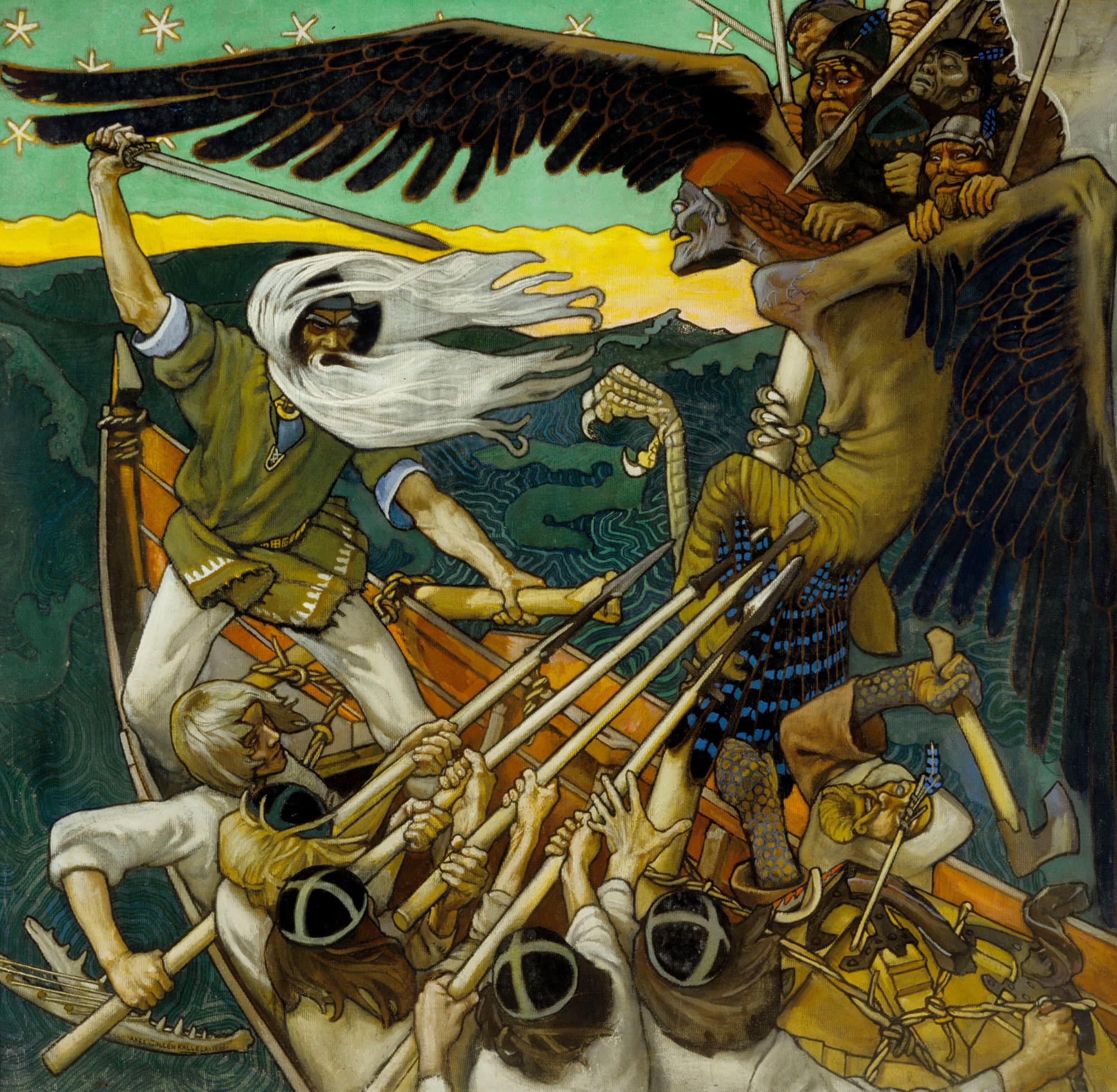
    “The Defense of the Sampo” (1896), by Akseli Gallén-Kallela. Väinämöinen the wizard faces off against the evil witch Louhi.

  • Sibelius Birthday Memories

    Sibelius Birthday Memories

    EIGHT DAYS OF SIBELIUS, in anticipation of the composer’s birthday anniversary on December 8:

    One day, back in the late ‘90s, when I was still an antiquarian bookseller with a weekend full of radio obligations, a stranger wandered into my shop and stood transfixed. Robert Kajanus’ world premiere recording of Sibelius’ Symphony No. 3, set down in 1932, was emanating from the mantle speakers. The man turned to me and remarked upon the quality of the performance. I told him it was Kajanus, which he acknowledged with a nod. Then he introduced himself by saying the music was composed by his grandfather. This is how, by purest chance, I struck up a friendship with Anssi Blomstedt, a documentary filmmaker, then living in Philadelphia, and the youngest grandchild of Jean Sibelius.

    Not long after, I made some phone calls and was able to get Anssi into a rehearsal of Simon Rattle conducting the Philadelphia Orchestra in Sibelius’ Symphony No. 5. The ebullient Rattle was overjoyed to meet him. The encounter happened to coincide with an interview Rattle was doing backstage with somebody from Vanity Fair, I think, and somewhere there is a photograph of the future Sir Simon planting a kiss on Anssi’s forehead.

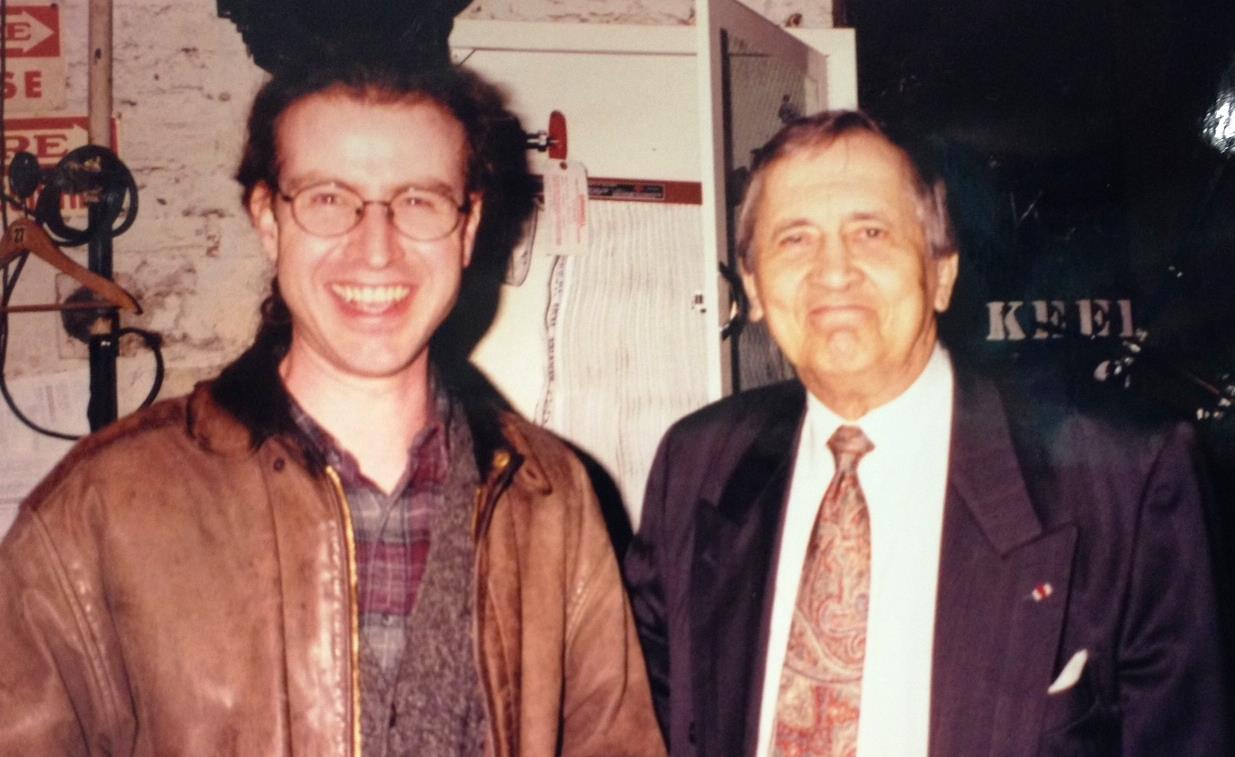
    One good turn deserves another, and it was through Anssi that I actually got to meet Einojuhani Rautavaara, back in the year 2000. At the time, Rautavaara was Finland’s most revered living composer. As a young man, he had actually worked as Sibelius’ chauffeur! Now he was in Philadelphia for the first performance of his own Symphony No. 8, subtitled “The Journey.” Anssi took me backstage at the Academy of Music to introduce us. The venerable composer was friendly and obviously amenable to a photograph (taken by Anssi, and posted here, in all its pre-digital glory).

    Rautavaara was also kind enough to sign my Naxos CD of his Symphony No. 3, the Piano Concerto No. 1, and the Concerto for Birds and Orchestra, known as “Cantus Arcticus.” I wonder what he thought of this peculiar, 33-year-old, American fan.

    It was through Anssi that I also acquired an autographed photo of Sibelius, which he brought back from the composer’s home, Ainola, in Järvenpää, Finland, located 23 miles north of Helsinki. I have yet to come across it since my move to Princeton, but it is around here somewhere! Sometime this week, I’ll try to post a photo of the Sibelius letter I acquired earlier, as a bookseller, which I had framed with a photo of the composer enjoying a good cigar. (The letter is a note of thanks for a box of cigars, one of Sibelius’ notable weaknesses.)

    Later, Anssi lived for a time in Easton, PA, another amazing coincidence, since Easton happens to be my hometown. He then moved back to Finland, so it’s been a number of years since we’ve seen one another. I’m thinking today might be a good time to try to reestablish contact.


    Sibelius’ Symphony No. 3, conducted by Robert Kajanus:

    Probably Einojuhani Rautavaara’s most frequently-heard work, the “Cantus Arcticus,” with bird songs recorded by the composer in the bogs of Liminka, near the Arctic Circle:

    https://www.youtube.com/watch?v=CmL8oKuefOQ

Tag Cloud

Aaron Copland (92) Beethoven (95) Composer (114) Film Music (119) Film Score (143) Film Scores (255) Halloween (94) John Williams (185) KWAX (229) Leonard Bernstein (99) Marlboro Music Festival (125) Movie Music (134) Opera (198) Philadelphia Orchestra (86) Picture Perfect (174) Princeton Symphony Orchestra (106) Radio (87) Ralph Vaughan Williams (85) Ross Amico (244) Roy's Tie-Dye Sci-Fi Corner (290) The Classical Network (101) The Lost Chord (268) Vaughan Williams (102) WPRB (396) WWFM (881)

DON’T MISS A BEAT

Receive a weekly digest every Sunday at noon by signing up here


RECENT POSTS