Tag: Sibelius

  • Eugene Ormandy Underrated Maestro

    Eugene Ormandy Underrated Maestro

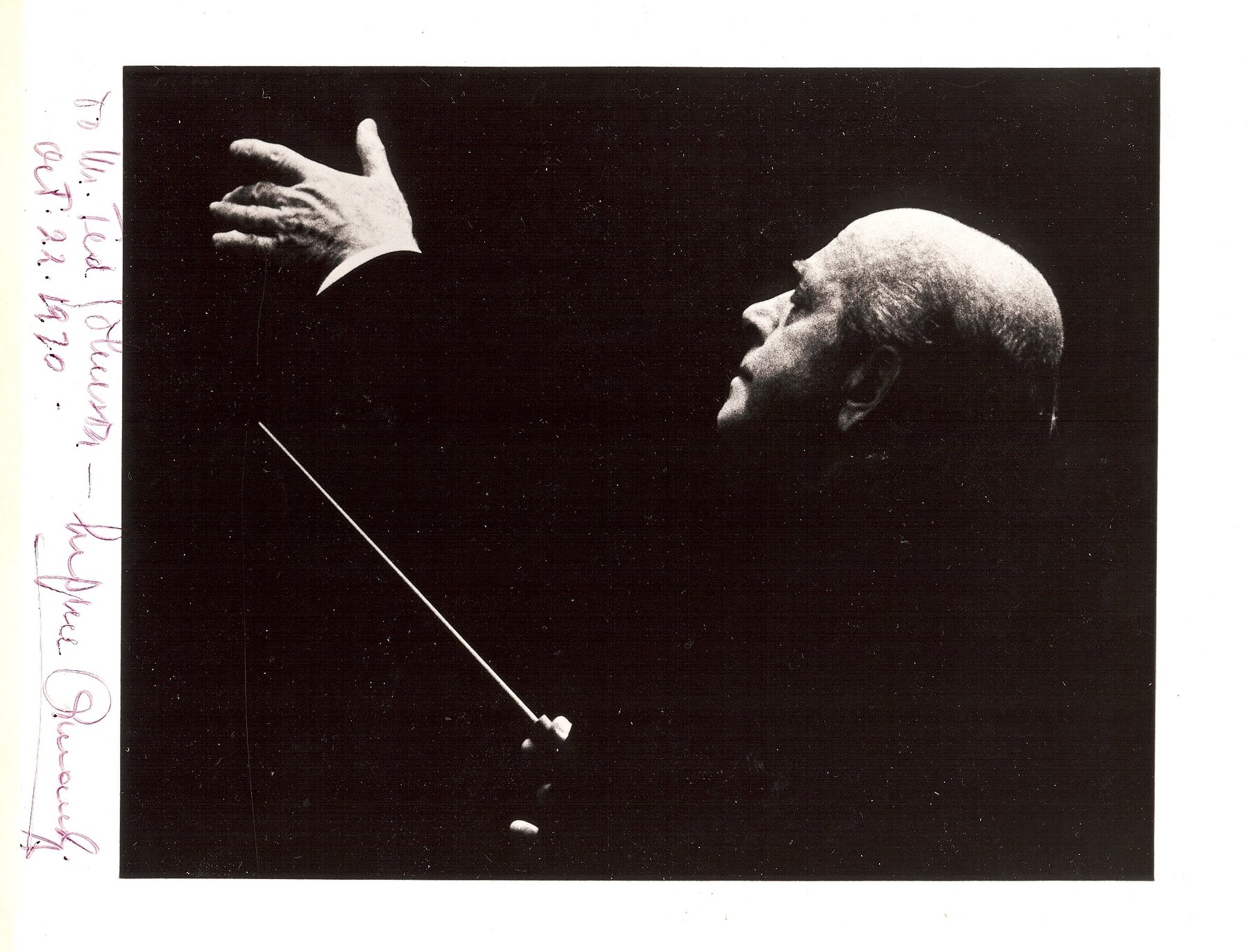
    What’s the big deal about this guy, Jenő Blau? Well, you probably know him better by his adopted name, Eugene Ormandy.

    Ormandy, a Hungarian-born violinist who had studied with Jenő Hubay (for whom he was named), became a naturalized American citizen in 1927. He ultimately wound up directing The Philadelphia Orchestra for 44 years. In that capacity, he became one of the world’s most-recorded conductors.

    However, in some respects, he remains a vastly underrated one. Sure, he was a superb interpreter of 19th century and post-romantic classics (his Columbia recording of Tchaikovsky’s “Pathétique” was one of my go-to favorites as a teen, and he was an authoritative conductor of Rachmaninoff and Sibelius), but he also championed much contemporary music and new works written by his adopted countrymen. Also, if ever there was a more sensitive accompanist in the concerto repertoire, I don’t know of him.

    One of my favorite Ormandy records was also one of his later ones. Throughout his career Ormandy succeeded in selling Sibelius’ “Four Legends from the Kalevala,” a collection of tone poems inspired by the Finnish national epic the “Kalevala,” for the early masterpiece that it is.

    Here again is the final section, “Lemminkainen’s Homeward Journey,” even more thrilling, in 1940:

    https://www.youtube.com/watch?v=FzQMyCsB8eQ

    The legendary Philadelphia strings in Vaughan Williams’ “Fantasia on a Theme by Thomas Tallis”

    Hindemith, “Concert Music for Strings and Brass”

    Ivan Davis joins Ormandy and the Philadelphians for Liszt’s “Hungarian Fantasy,” slight abridged:

    Bruckner “Te Deum” with Temple University Choir

    World premiere performance of Samuel Barber’s Violin Concerto:

    Shostakovich Symphony No. 4:

    Reinhold Glière’s “Russian Sailor’s Dance”

    Rachmaninoff Piano Concerto No. 2, with Eugene Istomin

    Ormandy conducts “Scheherazade” (complete). This is the Philly Orchestra I remember from my college years.

    Debussy, “Reverie”

    Saint-Saens’ Symphony No. 3 “Organ”


    Happy birthday, Eugene Ormandy (1899-1985)!
  • Carl Nielsen The Underrated Northern Composer?

    Carl Nielsen The Underrated Northern Composer?

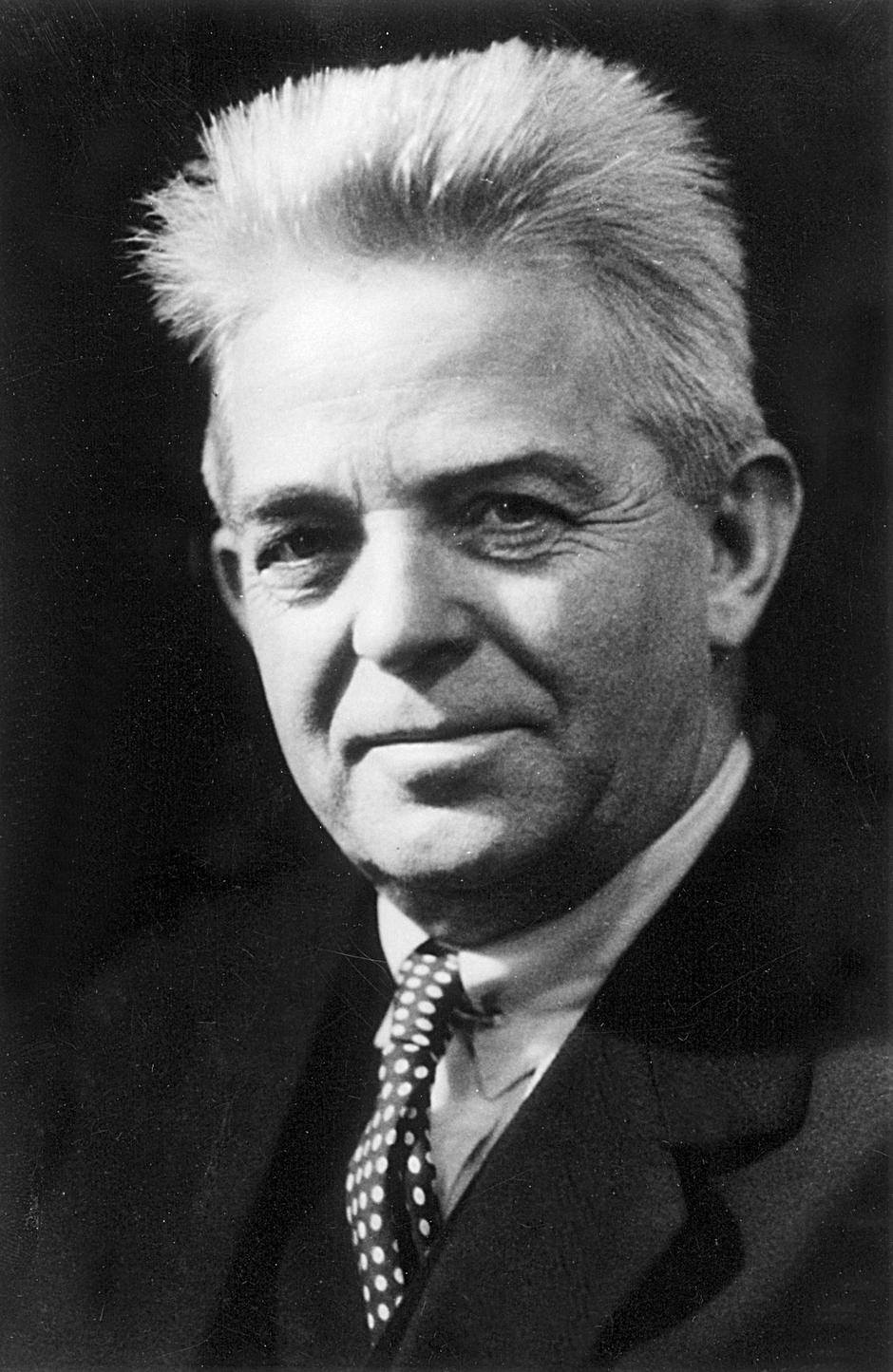
    With the specter of COVID looming over the prospect of a trip to the hair salon, perhaps the time is ripe for a resurgence of the Carl Nielsen haircut?

    Of the great composers of the North, why is Sibelius so widely lauded (in Scandinavia, England, and the United States, anyway), while Nielsen continues to languish as the Ugly Duckling of Danish music?

    Far from being a simple Sibelius knock-off, Nielsen forged his own, immediately-recognizable style – which can’t always be said, with as much conviction, about a lot of other fin de siècle Scandinavian composers. Not that I don’t love their music.

    Leonard Bernstein believed Nielsen’s rightful place was as Sibelius’ equal:

    “I think many people are in for pleasant surprises as they get to know Nielsen,” he said at a centennial celebration of the composer’s birth, “his rough charm, his swing, his drive, his rhythmic surprises, his strange power of harmonic and tonal relationships – and especially his constant unpredictability – all these are irresistible. I feel confident that Nielsen’s time has come.”

    That was in 1965. Yet, fifty-five years on, with many more recordings and performances to choose from, Nielsen continues stubbornly to be an acquired taste.

    What’s not to like? There’s struggle in the music and harmonic ambiguity – key relationships don’t always play out the way you expect they should (they don’t always in life, either, so why should they in music?) – there is conflict and violence, anxiety, but also great beauty and even humor. At its core, and at the end of the journey, there is, for me, an optimism in much of Nielsen’s output, a love for life, a belief that there is indeed, as the subtitle of his Fourth Symphony professes, something “Inextinguishable” in all of us, that I find inspiring.

    A tip of the blond brush cut to Carl Nielsen on his birthday!


    Take a gander at the Duckling on film! This is the only known surviving footage of Denmark’s greatest composer. You’ll find translations of the intertitles when you click on “show more” beneath the video.

  • Sibelius Board Game and Incidental Music This Sunday

    Sibelius Board Game and Incidental Music This Sunday

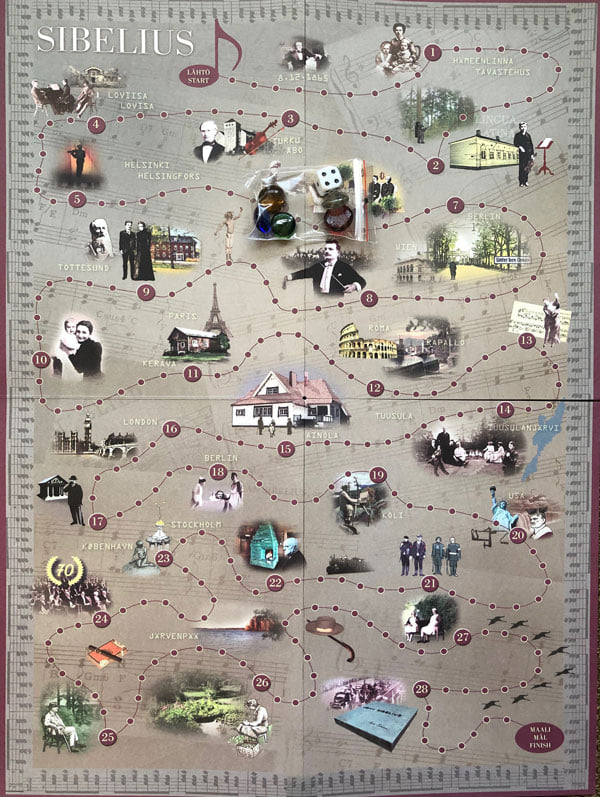
    Looking to kill time until tonight’s episode of “The Lost Chord?” Why not gather the family for a rollicking game of Sibelius? I’m not kidding, there really is a Sibelius board game (see below).

    Then join me for “Sibelius, Incidentally” – an hour of incidental music by Finland’s most famous composer – this Sunday night at 10:00 EST, on WWFM – The Classical Network and wwfm.org.

    Is this a drinking game?

    Sibelius Board Game

  • Sibelius’ Lost Symphony The Mystery of Ainola

    Sibelius’ Lost Symphony The Mystery of Ainola

    For the last 30 years of his life, Jean Sibelius was gripped by what became known as “The Silence from Järvenpää.” Järvenpää is the name of the Finnish market town outside of which the composer made his home. He called that home Ainola, after his wife, Aino, who in turn was named for a character in the Kalevala, the Finnish national epic.

    After the completion of the Symphony No. 7 and the tone poem “Tapiola” in the mid-1920s, Sibelius created no further major works. Or did he? He was known to have grappled with the composition of an eighth symphony, the manuscript of which he is said to have destroyed. I heard as much from the mouth of his own grandson, who claimed to have been present at its burning.

    However a few tantalizing sketches emerged, seemingly out of nowhere, in 2011. Is it possible that more may have survived? Perhaps somewhere, among the composer’s papers, a draft could even exist. I’m not in favor of reconstruction from mere fragments, but if there is a somewhat complete version of the symphony, even in embryonic form, I would be very interested to hear it.

    It makes my heart ache to listen to these sketches and contemplate that there might actually have been another Sibelius symphony, had the composer only been able to conquer his demons and hold it together one more time.

  • Nielsen & Sibelius at Marlboro School of Music and Festival

    Nielsen & Sibelius at Marlboro School of Music and Festival

    We head north on this week’s “Music from Marlboro” for selections by the most famous composers from Denmark and Finland, respectively.

    Like “The Ugly Duckling” of his compatriot, Hans Christian Andersen, Carl Nielsen emerged from humble beginnings to blossom into Denmark’s national composer. Internationally, Nielsen has flitted in and out of the seemingly inescapable shadow of Finnish master Jean Sibelius. Both men were born in 1865. In fact, Nielsen was six months older. But it is an unfair comparison, not so much apples and oranges; more like kipper and pickled herring.

    The very fact that Nielsen is not referred to reductively as “The Sibelius of Denmark” is attributable to an unusually strong individual voice. His music is modern, yet traditional; Scandinavian, yet Germanic. Most important, it is full of personality, freshness and vitality.

    Nielsen’s Wind Quintet of 1922 reflects the composer’s optimism and good humor. These he retained despite great personal, professional, and global turmoil. Each part of the quintet was tailored to the personality of the individual performer for which it was written (all members of the Copenhagen Wind Quintet). There is also something of the outdoors about the piece. Nielsen was always fascinated by nature, and there are ample suggestions of bird song woven into the texture of the work’s pastoral neoclassicism.

    We’ll enjoy a recording made at Marlboro in 1971, with Paula Robison, flute; Joseph Turner, oboe; Larry Combs, clarinet; William Winstead, bassoon; and Robin Graham, horn.

    Sibelius too was influenced by nature. However, the very subtitle of his String Quartet in D minor, “Voces Intimae,” suggests a looking inward. The piece was composed in 1909, between the Third and Fourth Symphonies. It is the only chamber work of Sibelius’ maturity. The composer wrote to his wife, “It turned out as something wonderful. The kind of thing that brings a smile to your lips at the hour of death. I will say no more.”

    If Nielsen suggests the Ugly Duckling, Sibelius is more like the Swan of Tuonela.

    We’ll hear his quartet performed at the 2005 Marlboro Music Festival, by Dan Zhu and Sarah Kapustin, violins; Samuel Rhodes, viola; and Amir Eldan, cello.

    The prevailing winds will be from the north (strings, too, for that matter), on the next “Music from Marlboro,” this Wednesday evening at 6:00 EST, on WWFM – The Classical Network and wwfm.org.

    Marlboro School of Music and Festival: Official Page

Tag Cloud

Aaron Copland (92) Beethoven (95) Composer (114) Film Music (119) Film Score (143) Film Scores (255) Halloween (94) John Williams (185) KWAX (229) Leonard Bernstein (99) Marlboro Music Festival (125) Movie Music (134) Opera (198) Philadelphia Orchestra (86) Picture Perfect (174) Princeton Symphony Orchestra (106) Radio (87) Ralph Vaughan Williams (85) Ross Amico (244) Roy's Tie-Dye Sci-Fi Corner (290) The Classical Network (101) The Lost Chord (268) Vaughan Williams (102) WPRB (396) WWFM (881)

DON’T MISS A BEAT

Receive a weekly digest every Sunday at noon by signing up here


RECENT POSTS