Tag: Sibelius

  • Sibelius Birthday Tribute Finnish Music

    Sibelius Birthday Tribute Finnish Music

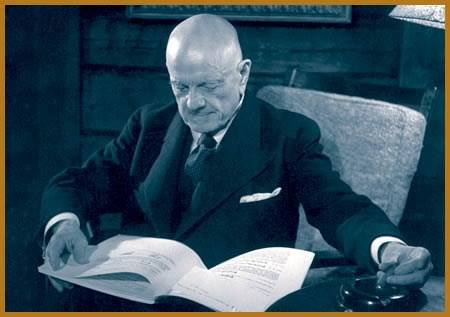
    All hail Finland’s great composer! Happy birthday, Jean Sibelius!

    Sibelius wrote a ton of music inspired by the Kalevala, the Finnish national epic. Join me for one of the lesser known of these, tomorrow night on “The Lost Chord,” at 10:00 EST, on WWFM – The Classical Network and wwfm.org. The program will also include works by Robert Kajanus and Uuno Klami.

    Cigars and vodka all around!


    Here’s Kajanus conducting Sibelius’ Symphony No. 3.

    https://www.youtube.com/watch?v=5kaz56nbwns

    I was playing this recording when Sibelius’ grandson fortuitously wandered into my bookshop in, I believe, 1998. A formula for instant friendship!


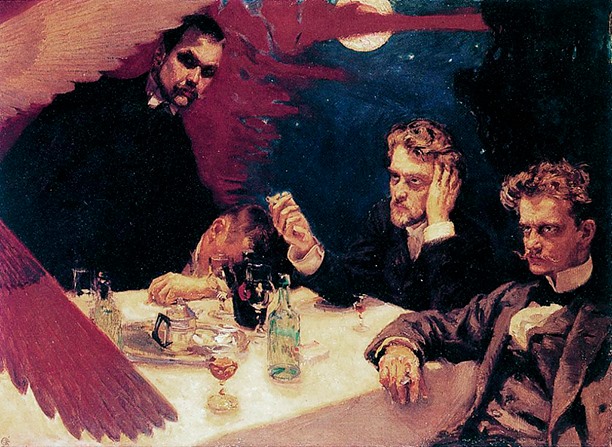
    IMAGE: “Kajustaflan,” painted by Akseli Gallén-Kallela. Pictured (from left to right): the artist, composer Oskar Merikanto (blacked out), Robert Kajanus and Jean Sibelius.

    More about “The Symposium,” with the original version of Gallén’s painting, here:

    http://www.sibelius.fi/english/elamankaari/sib_symbosion.htm

    Party on, gentlemen!

  • Sibelius & Schubert Marlboro Chamber Music

    Sibelius & Schubert Marlboro Chamber Music

    Save me, Sibelius! I can’t take it any longer.

    We’ll attempt to beat the heat with the one and only chamber work from the great Finnish master’s maturity – the String Quartet in D minor. It’s subtitle, “Voces Intimae,” suggests a looking inward. That’s fine with me. There’s no sun inside.

    The piece was composed in 1909, between the Third and Fourth Symphonies. Sibelius wrote to his wife, Aino, “It turned out as something wonderful. The kind of thing that brings a smile to your lips at the hour of death. I will say no more.” Ah, sweet nothings.

    We’ll hear it performed at the 2005 Marlboro Music Festival, by Dan Zhu and Sarah Kapustin, violins; Samuel Rhodes, viola; and Amir Eldan, cello.

    Then we’ll enjoy another presentiment of death – Franz Schubert’s Introduction and Variations on his lied, “Trock’ne Blumen” (“Withered Flowers”), from the song cycle “Die schöne Müllerin.” Paula Robison will be the flutist and Marlboro co-founder Rudolf Serkin the pianist, in a recording from 1968.

    Nothing refreshes on a hot day like cold wind from the grave, on this week’s “Music from Marlboro” – chamber music performances from the legendary Marlboro Music Festival – this Wednesday evening at 6:00 EDT, on WWFM – The Classical Network and wwfm.org.

    Marlboro School of Music and Festival: Official Page

  • Nielsen & Sibelius at Marlboro

    Nielsen & Sibelius at Marlboro

    We head north for this week’s “Music from Marlboro” for selections by the most famous composers from Denmark and Finland, respectively.

    Like “The Ugly Duckling” of his compatriot, Hans Christian Andersen, Carl Nielsen emerged from humble beginnings to blossom into Denmark’s national composer. Internationally, Nielsen has flitted in and out of the seemingly inescapable shadow of Finnish master Jean Sibelius. Both men were born in 1865. In fact, Nielsen was six months older. But it is an unfair comparison, not so much apples and oranges; more like kipper and pickled herring.

    The very fact that Nielsen is not referred to reductively as “The Sibelius of Denmark” is attributable to an unusually strong individual voice. His music is modern, yet traditional; Scandinavian, yet Germanic. Most important, it is full of personality, freshness and vitality.

    Nielsen’s Wind Quintet of 1922 reflects the composer’s optimism and good humor. Each part was tailored to the personality of the individual performer for which it was written (members of the Copenhagen Wind Quintet). There is also something of the outdoors about the piece. Nielsen was always fascinated by nature, and there are ample suggestions of bird song woven into the texture of the work’s pastoral neoclassicism.

    We’ll enjoy a recording made at Marlboro in 1971, with Paula Robison, flute; Joseph Turner, oboe; Larry Combs, clarinet; William Winstead, bassoon; and Robin Graham, horn.

    Sibelius, too, was influenced by nature. However, the very subtitle of his String Quartet in D minor, “Voces Intimae,” suggests a looking inward. The piece was composed in 1909, between the Third and Fourth Symphonies. It is the only chamber work of Sibelius’ maturity. The composer wrote to his wife, “It turned out as something wonderful. The kind of thing that brings a smile to your lips at the hour of death. I will say no more.” Ah, sweet nothings.

    We’ll hear it performed at the 2005 Marlboro Music Festival, by Dan Zhu and Sarah Kapustin, violins; Samuel Rhodes, viola; and Amir Eldan, cello.

    The prevailing winds will be from the north (strings, too, for that matter), on “Music from Marlboro,” this Wednesday evening at 6:00 EST, on WWFM – The Classical Network and wwfm.org.

    Marlboro School of Music and Festival: Official Page


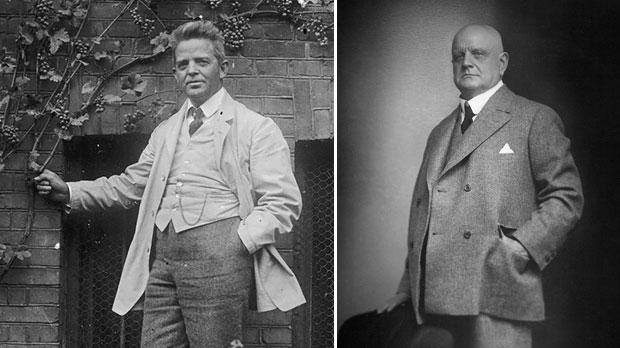
    HAIR TODAY, GONE TOMORROW: Carl Nielsen (left) and Jean Sibelius
  • Vaughan Williams & Sibelius Symphonies on WWFM

    Vaughan Williams & Sibelius Symphonies on WWFM

    Self-indulgence alert!

    This Monday afternoon, we’ll hear two symphonies: Ralph Vaughan Williams’ Symphony No. 8, with its striking use of percussion (no pun intended), and Jean Sibelius’ Symphony No. 6.

    The Vaughan Williams has been playing in my car pretty much incessantly since the composer’s birthday last Thursday. Beyond the “Sinfonia Antarctica” – the Symphony No. 7, with its programmatic associations with the film “Scott of the Antarctic” – we don’t really hear much of Vaughan Williams’ later symphonies. This one is a gem, with its tuned gongs and movement-long showcases for the wind and string sections. It also happens to be the shortest of Vaughan Williams’ symphonies, and, though marked by ambiguity, it seems not to slip into intimations of the unknown (i.e. death) in quite the same way as the Symphonies Nos. 6, 7 & 9 appear to do. That said, the third movement contains a theme that brings to mind the chorale “O Sacred Head, Now Wounded,” used in Bach’s “St. Matthew Passion.” Vaughan Williams wrote the work when he was in his early 80s, between 1953 and 1955.

    Sibelius’ 6th, completed in 1923, always puts me in an autumnal frame of mind, probably in part because of the composer’s suggested motto: “When shadows lengthen.” Sibelius described the work as “cold spring water;” no doubt an antidote to the contemporary “cocktails,” as he called them, being served up by Igor Stravinsky. It certainly opens with some of the composer’s most hypnotic and gorgeous music. Sibelius said of the work, “The sixth symphony always reminds me of the scent of first snow.” We all know winter comes early to Finland.

    We’ll also hear from Hungarian flutist and composer Franz Doppler, an associate of Franz Liszt; Bohemian Baroque master Jan Dismas Zelenka; contemporary Estonian composer Erkki-Sven Tüür; and Russian baritone Dmitri Hvorostovsky, on their birthdays. I hope you’ll join me for autumnal symphonies and more, from 4 to 7 p.m. EDT, on WWFM – The Classical Network and wwfm.org.


    Sardanapalus wants all his pleasures at once

  • Sibelius Incidental Music Rediscovered

    Sibelius Incidental Music Rediscovered

    Jean Sibelius was the composer of seven authorized symphonies that stand like granitic monoliths at the heart of 20th century music. Less well known, perhaps, is the abundant incidental music he composed for the theater. Join me for an historic 1932 recording of selections written for the play “Belshazzar’s Feast,” with Robert Kajanus conducting, and a more recent, digital premiere of the complete incidental music composed for “Everyman,” made under the baton of Osmo Vänskä. Enjoy this neglected-but-worthwhile music on “Sibelius, Incidentally,” this Sunday night at 10 EDT on WWFM – The Classical Network and wwfm.org.

Tag Cloud

Aaron Copland (92) Beethoven (95) Composer (114) Film Music (119) Film Score (143) Film Scores (255) Halloween (94) John Williams (185) KWAX (229) Leonard Bernstein (99) Marlboro Music Festival (125) Movie Music (134) Opera (198) Philadelphia Orchestra (86) Picture Perfect (174) Princeton Symphony Orchestra (106) Radio (87) Ralph Vaughan Williams (85) Ross Amico (244) Roy's Tie-Dye Sci-Fi Corner (290) The Classical Network (101) The Lost Chord (268) Vaughan Williams (102) WPRB (396) WWFM (881)

DON’T MISS A BEAT

Receive a weekly digest every Sunday at noon by signing up here


RECENT POSTS