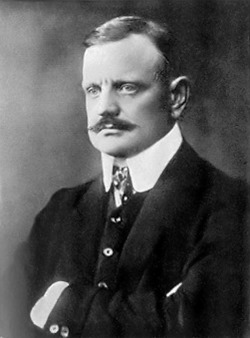
EIGHT DAYS OF SIBELIUS – DAY 4
With his 50th birthday imminent, Jean Sibelius received a commission from the Finnish government to write a brand-new symphony. The Symphony No. 5 was given its world premiere in 1915, with the composer conducting the Helsinki Philharmonic – though the original version was quite different, in many respects, from the masterwork we know today. In a remarkable feat of objectivity, Sibelius extensively revised his symphony twice, in 1916 and then again in 1919.
One of the work’s major innovations (showing the influence of Liszt, whom Sibelius greatly admired) involved the elimination of the break between the first two movements of the original four-movement structure. The demarcations are blurred so that the first movement now slips inexorably into a scherzo, and the listener is swept along, as if caught up in a powerful current, or precipitated into a sublime avalanche, to thrilling effect.
The transition has always been a challenge for conductors, since this sneaking accelerando should feel as if it’s completely organic. It has to unfurl naturally. Sibelius would further experiment with the telescoping of movements and the subversion of classical expectations in his Symphony No. 7.
Perhaps the most striking revision is in how the final movement builds to a climax of impressive grandeur, a sublime apotheosis of its ennobling “swan theme,” only to come up against a series of powerful, monolithic chords, each isolated from the next by a moment of silence. The first five serve to suspend the effect. The sixth falls, like Thor’s hammer, with an indisputable sense of finality. Truly, this is music of the gods.
The Sibelius 5th is among the noblest in the entire literature. I have long regarded it as my favorite symphony.
Herbert von Karajan conducts the 5th Symphony:
Osmo Vänskä conducts the original 1915 version!
Leave a Reply