Tag: St John’s Eve

  • St. John’s Eve Bonfires, Folklore & Fun

    St. John’s Eve Bonfires, Folklore & Fun

    Just as you’ve recovered from your solstice hangover, here comes St. John’s Eve!

    You can thank the Romans. They’re the ones who designated June 24 the summer solstice – hence, the discrepancy between the longest day (June 21) and Midsummer. The Romans gave us roads, aqueducts, and a legacy of midsummer debauchery. Why split hairs?

    Later, as was so often the case with the placement of religious holidays, the Church figured out it had the highest probability of winning friends and influencing people if it diverted the stream of paganism, rather than outright dam(n) it. To this end, June 24 became the Feast Day of St. John. This worked out very nicely indeed, since St. Luke implies the birth of John the Baptist occurred six months before that of Jesus. Which reminds us: only 185 shopping days until Christmas!

    On the eve of St. John’s nativity (observed), the night of June 23, good Christians celebrate as only reformed pagans can, with an understanding that everyone will be up to fulfill their religious obligations on the morrow. What happens on St. John’s Eve stays on St. John’s Eve.

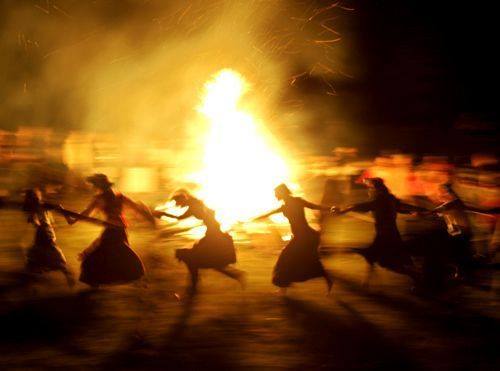
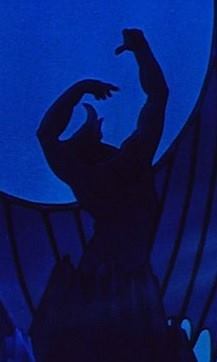
    For tonight, it will be a time for harvesting St. John’s Wort, with its miraculous healing powers. It will be a time for seeking the fern flower, which can bring good fortune, wealth, and the ability to understand animal speech. It will be a time for the lighting of bonfires against evil spirits, and even dragons, which roam the earth, as the sun again pursues a southerly course. And it will be a time when witches are believed to rendezvous with powerful forces, such as the Slavic demon Chernobog, who emerges from the Bald Mountain at the climax of Disney’s “Fantasia.” (Erroneously, the narrator, Deems Taylor, claims that it’s Walpurgis Night.)

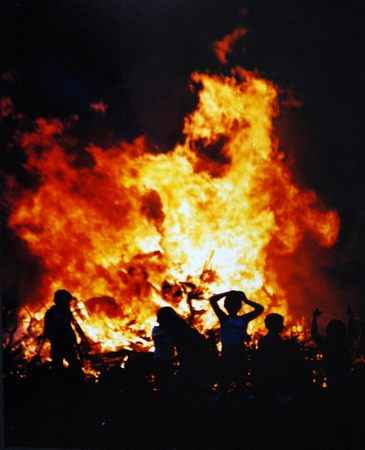
    Leaping over a bonfire is seen as a surety of prosperity and good luck. Not to light a bonfire is seen as offering up one’s own house for destruction by fire. The bigger the fire, the further at bay are kept evil spirits. The further the evil spirits, the better guarantee of a good harvest.

    So get out there and cavort heartily under a strawberry moon!
    Chernobog loves strawberry.

    Leopold Stokowski conducts the Philadelphia Orchestra in this Disney showstopper by Modest Mussorgsky:

    http://www.cornel1801.com/disney/Fantasia-1940/film8.html

    Happy St. John’s Eve!

  • Gogol St. John’s Eve Summer Reading

    Gogol St. John’s Eve Summer Reading

    So Saturday was the first day of summer?

    The calendar I’m using this year doesn’t have any holidays printed on it, which I suppose is only appropriate for life in Coronaworld, where every day runs into another.

    Be that as it may, the seasons are not governed by the calendar, and like a creature of the wild, I know it’s summer when my blood pressure begins to rise with the sun. Surely, this is something the ancients also felt, which is why we have St. John’s Eve.

    It was the Romans who marked the summer solstice as June 24th. This meant the night of the 23rd was yet another excuse for a great big toga party. Pagans throughout the empire lit bonfires against evil spirits, and even dragons, and folk traditions sprang up related to prognostication and fertility.

    Later, the Church coopted the 24th for its observance of the Feast Day of St. John. This worked out very nicely, since St. Luke suggested that the birthday of John the Baptist fell six months before that of Jesus. As with Hallowe’en, a pagan festival was hitched to a holy one (in that case, All Saints Day). Sometimes diverting a stream is easier than outright dam(n)ing it.

    As a classical music lover, for years I have been curious about “Evenings on a Farm Near Dikanka,” as the title is usually translated. Nikolai Gogol’s collection of tales, steeped in Ukrainian folklore, are overstuffed with devils, witches, water nymphs, and roistering Cossacks. The stories formed the basis for operas by Modest Mussorgsky (“Sorochinsky Fair”), Nikolai Rimsky-Korsakov (“May Night” and “Christmas Eve”), and Peter Ilych Tchaikovsky (“Cherevichki”).

    Well, this year I finally got around to reading it, and it wasn’t quite what I expected. Amusingly, the supernatural elements, which are plenty, are offset by frequent satirical observations and earthy farce. There’s a lot of drinking and a lot of hiding from husbands in coal sacks. Even lusty devils receive their comeuppance. All the same, there are one or two shockingly gruesome moments.

    Gogol can be wry. He can certainly be garrulous. But he is also very much a poet, as evidenced by his lyrical observations on the Dnieper and soft Ukrainian summer nights. That said, one of the stories takes place on Christmas Eve. At least two are set on St. John’s Eve.

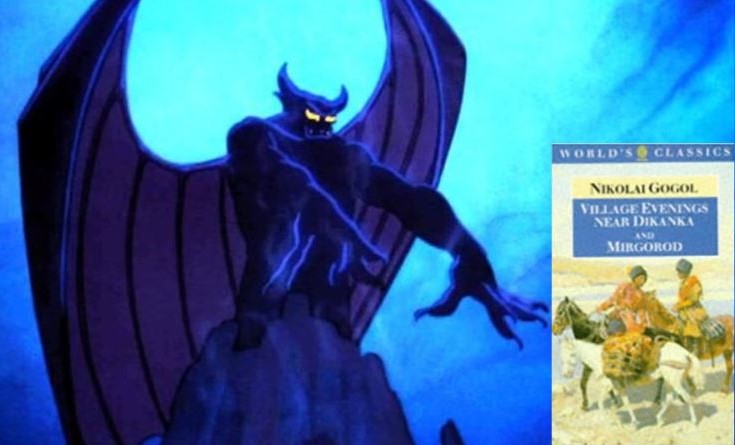
    It wasn’t easy to find an affordable copy of this Oxford paperback (pictured), which has gone out of print. I’ve been fond of these World’s Classics editions since reading Oxford’s “The Count of Monte Cristo,” “The Three Musketeers,” and “Queen Margot,” which were full of helpful notes. (Oxford’s “The Pickwick Papers,” I must say, was much more slovenly notated.) In this instance, there’s not really a lot you need to know that isn’t on the page. I don’t read Russian, it’s true, but the translation “sounds” very well, and it seems idiomatic.

    The Oxford edition also includes the collection “Mirgorod,” which I have yet to tackle. Its most famous tale is “Taras Bulba,” which became the basis for the orchestral rhapsody by Leoš Janáček.

    I should probably also mention that while there is nothing in “Dikanka” that is outright antisemitic, Gogol never misses an opportunity to single out Jews – to be fair, by way of his admittedly rustic characters. And while there is nothing openly derogatory in their treatment, it is evident that they are regarded as outsiders. They are always referred to as “a Jew” or “the Jew.” This is, after all, the world of the Cossacks. But, remarkably, there appears to be no disdain. Certainly, the Poles and the Tatars come in for a lot worse!

    For as entertaining as I found the collection, with its unexpected humor, the experience really underscored how much Mussorgsky, Rimsky, and Tchaikovsky fleshed out Gogol’s narratives with their music. All three composers managed to conjure the author’s poetic flights in a way no libretto possibly could.

    Interestingly, the most famous music connected to the book is “A Night on Bald Mountain,” a comparatively youthful work, written when Mussorgsky was 28 years-old. The composer completed the piece, about a witches’ sabbath on St. John’s Eve, ON St. John’s Eve in 1867. It then went through several versions, as it was inserted into the collaborative opera-ballet “Mlada” and then “Sorochinsky Fair,” inspired by the Gogol story. Sadly, despite his obvious affection for this music, Mussorgsky never heard it performed, in any of its incarnations, during his lifetime.

    Following the composer’s death, however, Rimsky-Korsakov further shaped the material, and arranged the well-known orchestral fantasy, employing as raw material Mussorgsky’s final version, as it appeared in “Sorochinsky Fair.” It is in Rimsky’s revision that it became Mussorgsky’s best-known music – at least until Leopold Stokowski got a hold of it and did his own arrangement for Disney’s “Fantasia.”

    This is a perfect example of just how effective music can be at conjuring a palpable atmosphere of menace, or even terror, as compared to words on a page. There’s not even a Bald Mountain in Gogol’s original, though the supernatural element that looms over the collection as a whole more than justifies Mussorgsky’s artistic license.

    All in all, it’s a book worth getting to know – with the shutters secured and a bucket of horilka at your side. Happy St. John’s Eve!

  • Midsummer Music Bonfires Witches and More

    Midsummer Music Bonfires Witches and More

    Thank the Romans. They’re the ones who marked the summer solstice for June 24 – hence, the discrepancy between the longest day (June 21) and Midsummer. But the Romans liked nothing if not a good party, so why split hairs? Let the good times roll!

    The Church, though fashionably late, was quick to comprehend it would probably be best to divert the stream of paganism rather than attempt to dam(n) everything outright. To this end, June 24 was designated the Feast Day of St. John. This worked out very nicely, since St. Luke implies the birth of John the Baptist took place six months before that of Jesus.

    On the eve of this blessed anniversary, the night of June 23, good Christians celebrate as only reformed pagans can, in the understanding that everyone will be up to fulfill their religious obligations on the morrow.

    This Sunday night on “The Lost Chord,” we’ll have music for St. John’s Eve.

    The eve of St. John is a time for the harvesting of St. John’s Wort, with its miraculous healing powers. It’s a time to seek the fern flower, which can bring good fortune, wealth, and the ability to understand animal speech. It’s a time for the lighting of bonfires against evil spirits, and even dragons, which roam the earth, as the sun again pursues a southerly course. And it’s a time when witches are believed to rendezvous with powerful forces, such as the demon Chernobog, who emerges from the Bald Mountain on St. John’s Eve at the climax of Disney’s “Fantasia.”

    Leaping over a bonfire is seen as a surety of prosperity and good luck. Not to light a bonfire is seen as offering up one’s own house for destruction by fire. The bigger the fire, the further at bay are kept evil spirits. The further the evil spirits, the better the guarantee of a good harvest.

    We’ll have music inspired by some of these Midsummer customs, as we listen to Modest Mussorgsky’s “St. John’s Night,” an earlier, less-familiar incarnation of his popular musical picture “A Night on Bald Mountain,” as heard in his opera, “Sorochinsky Fair.”

    Also featured will be Alfred Schnittke’s impish rondo, “(K)ein Sommernachtstraum.” The root of the title is German for “A Midsummer Night’s Dream,” but the postmodern inclusion of the “K” in parentheses modifies the meaning to “NOT a Midsummer Night’s Dream.” Indeed! Schnittke sets up the listener with a soothing notturno in the style of Mozart or Schubert, but very soon the atmosphere begins to shift.

    Finally, we’ll hear selections from the ballet, “St. John’s Eve,” by the Swedish composer Gunnar de Frumerie. Not surprisingly, after a long, hard winter, the Scandinavian countries are crazy for Midsummer. The allegorical ballet features appearances by John the Baptist, Salome, the Seven Deadly Sins, Angels, and the Devil, all tied up in Swedish Midsummer traditions.

    Leap high, friends, and join me for “Midsummer Night’s Fiends,” this Sunday night at 10:00 EDT, on WWFM – The Classical Network and wwfm.org.

  • Midsummer Bonfires: Music for St. John’s Eve

    Midsummer Bonfires: Music for St. John’s Eve

    Why is it whenever man feels the urge to celebrate, his first impulse is to set things on fire? We see it today in the hot-dogging conflagrations that follow on the heels of championship sports victories. In the ancient world, bonfires were already a mainstay of any festive occasion.

    This Sunday night on “The Lost Chord,” we listen to music for St. John’s Eve. The Feast Day of St. John holds a place on the Christian calendar akin to that of Christmas, in that it coincides with solstice time. Midsummer was originally a pagan festival, which was absorbed by the Church for the observance of John the Baptist’s birth, which St. Luke implies took place six months before that of Jesus.

    Though the actual summer solstice may occur anytime between June 21 and June 25, it was designated that June 24 would be the Feast Day of St. John.

    St. John’s Eve is a time for the harvesting of St. John’s Wort, with its miraculous healing powers. It’s a time to seek the fern flower, which can bring good fortune, wealth, and the ability to understand animal speech. It’s a time for the lighting of bonfires against evil spirits, and even dragons, which roam the earth, as the sun again pursues a southerly course. And it’s a time when witches are believed to rendezvous with powerful forces, such as the demon Chernobog, who emerges from the Bald Mountain on St. John’s Eve at the climax of Disney’s “Fantasia.”

    Leaping over a bonfire was seen as a surety of prosperity and good luck. Not to light a bonfire was seen as offering up one’s own house for destruction by fire. The bigger the fire, the further at bay were kept evil spirits. The further the evil spirits, the better the guarantee of a good harvest.

    We’ll have music inspired by some of these Midsummer customs, as we listen to Modest Mussorgsky’s “St. John’s Night,” an earlier, less-familiar incarnation of his popular musical picture “A Night on Bald Mountain,” as heard in his opera, “Sorochinsky Fair.”

    Also featured will be Alfred Schnittke’s impish rondo, “(K)ein Sommernachtstraum.” The root of the title is German for “A Midsummer Night’s Dream,” but the postmodern inclusion of the “K” in parentheses modifies the meaning to “NOT a Midsummer Night’s Dream.” Indeed! Schnittke sets up the listener with a soothing notturno in the style of Mozart or Schubert, but very soon the atmosphere begins to shift.

    Finally, we’ll hear selections from the ballet, “St. John’s Eve,” by the Swedish composer Gunnar de Frumerie. Not surprisingly, after a long, hard winter, the Scandinavian countries are crazy for Midsummer. The allegorical ballet features appearances by John the Baptist, Salome, the Seven Deadly Sins, Angels, and the Devil, all tied up in Swedish Midsummer traditions.

    I hope you’ll join me for “Midsummer Night’s Fiends,” this Sunday night at 10:00 EDT, on WWFM – The Classical Network and wwfm.org.


    PHOTO: St. John’s Eve celebration in Northern Ireland

  • Chernobog St John’s Eve Disney’s Fantasia

    Chernobog St John’s Eve Disney’s Fantasia

    When the sun sets this evening, June 23, you had better be prepared to deal with Chernobog! That’s right, it’s St. John’s Eve – the eve of the Feast Day of St. John the Baptist.

    “Dracula” fans might be interested to know that none other than Bela Lugosi struck demonic poses for Disney animators for several days as a model for the climactic sequence of “Fantasia.” He would ultimately be replaced by Wilfred Jackson. Still, how cool is that?

    Of course, Leopold Stokowski conducted the Philadelphia Orchestra on the film’s soundtrack. The master of ceremonies, Deems Taylor, sets the scene incorrectly, stating that it occurs on Walpurgis Night (April 30). Chernobog could care less about Walpurgis Night. He’s kickin’ it up for St. John!

    Watch the clip here, and relive your childhood anxiety:

    http://www.cornel1801.com/disney/Fantasia-1940/film8.html

Tag Cloud

Aaron Copland (92) Beethoven (95) Composer (114) Film Music (119) Film Score (143) Film Scores (255) Halloween (94) John Williams (185) KWAX (229) Leonard Bernstein (99) Marlboro Music Festival (125) Movie Music (134) Opera (198) Philadelphia Orchestra (86) Picture Perfect (174) Princeton Symphony Orchestra (106) Radio (87) Ralph Vaughan Williams (85) Ross Amico (244) Roy's Tie-Dye Sci-Fi Corner (290) The Classical Network (101) The Lost Chord (268) Vaughan Williams (102) WPRB (396) WWFM (881)

DON’T MISS A BEAT

Receive a weekly digest every Sunday at noon by signing up here


RECENT POSTS