Tag: Star Trek

  • Star Trek at 60 on “Picture Perfect”

    Star Trek at 60 on “Picture Perfect”

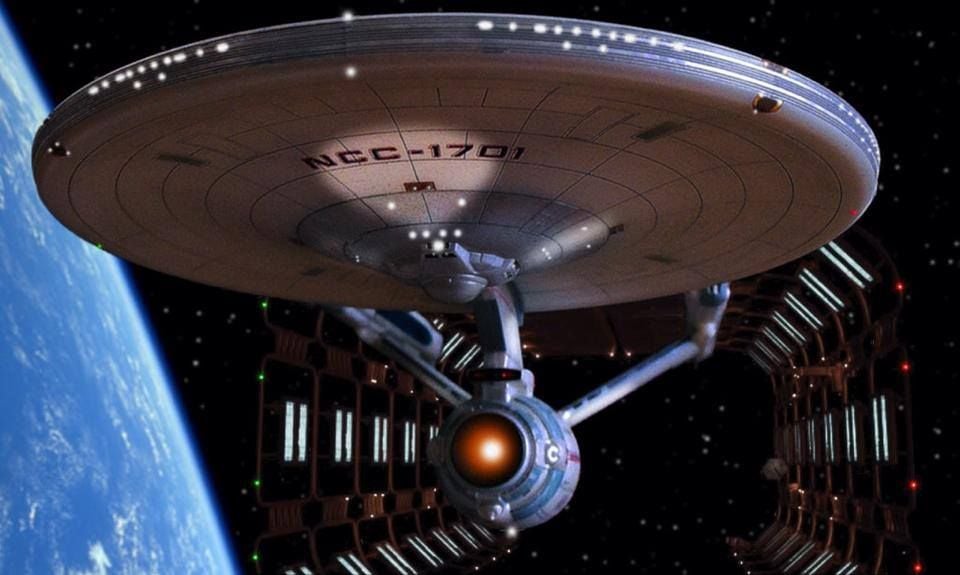
    Space… the final frontier. This week on “Picture Perfect,” beam aboard for some of the best “Star Trek” music in the galaxy, as we mark the 60th anniversary of the first broadcast of the original series on September 8, 1966. We’ll hear enterprising selections from the beloved media franchise.

    In retrospect, it’s hard to conceive of “Star Trek,” the original series (1966-69), staggering toward cancellation after a mere three seasons on NBC, so much a part our shared cultural consciousness it has become. The show’s popularity expanded through syndication. Still, prior to the blockbuster success of “Star Wars,” the only other “Trek” would be an animated series that aired on Saturday morning television from 1973 to 1974.

    In 1977, the one-two box office punch of “Star Wars” and “Close Encounters of the Third Kind” revealed a latent hunger for science fiction that gave “Star Trek” the final boost it needed to reach the big screen.

    “Star Trek: The Motion Picture” (1979), long-awaited, was ambitious to a fault. Its approach seemed especially ponderous next to the souped-up dog fights of a galaxy far, far away. However, there was undeniably a nostalgic satisfaction in seeing the original crew reassembled on the deck of a refurbished Enterprise, and the production values were nothing less than first-rate.

    Robert Wise directed. Wise was involved in the production of any number of classic films, dating back to the 1930s, including “The Day the Earth Stood Still,” “West Side Story,” “The Haunting,” and “The Sound of Music.” He also edited “Citizen Kane.”

    “Star Trek: The Motion Picture” sported state-of-the-art special effects (by Douglas Trumbull no less), and a knock-out music score by Jerry Goldsmith. I remember leaving the theater on the film’s opening night and remarking that the movie was all right, but the music was fantastic.

    There’s a six-minute, music-and-special effects showpiece of a shuttle flying around the drydocked Enterprise that’s a perfect marriage of music and film. It’s like nothing you’re ever likely to encounter in movies today – and more’s the pity.

    The “ST: TMP” theme has always been a fan favorite, but its resurrection, beginning with the launch of the television series “Star Trek: The Next Generation,” cemented its broader familiarity.

    “Star Trek” had always positioned itself as thoughtful science fiction, and in the case of the first film perhaps it tried a mite too hard. “ST: TMP” strove for stately, but what it wound up achieving was stasis. Although a box office success, the film received mixed reviews and performed below industry expectations. However, it still made enough money to justify a sequel.

    “Star Trek II: The Wrath of Khan” (1982) was a belated continuation of an episode from the original series, “Space Seed,” in which a genetically engineered superman is revived from suspended animation and attempts to take over the Enterprise. Khan, of course, was played by Ricardo Montalban, now with gleaming chest and silver mullet – worlds away from his contemporaneous characterization as Mr. Roarke on TV’s “Fantasy Island.”

    The tone of the film proved a refreshing change of pace, playing up the character relationships that made the original series so enjoyable and providing enough action to satisfy audiences attuned to post-“Star Wars” spectacle. Moreover, it cleverly draws on nautical iconography – while “Star Wars” had its dogfights, “Wrath of Khan” deals more in broadsides – and that nautical flavor extends to the film’s brilliant score, by James Horner. The project propelled Horner onto the A-list of film composers.

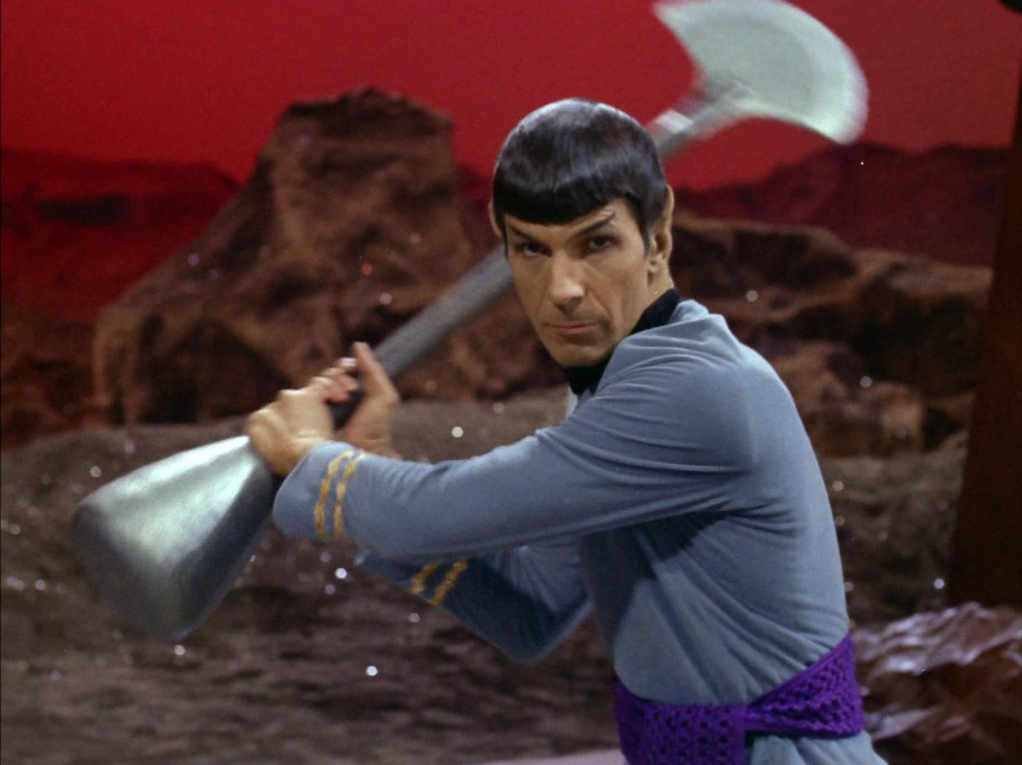
    Another memorable episode of the original series dealt with the usually unflappable Spock losing his cool, as he teeters into pon farr, a period of madness that strikes every seven years during which a Vulcan must mate or die.

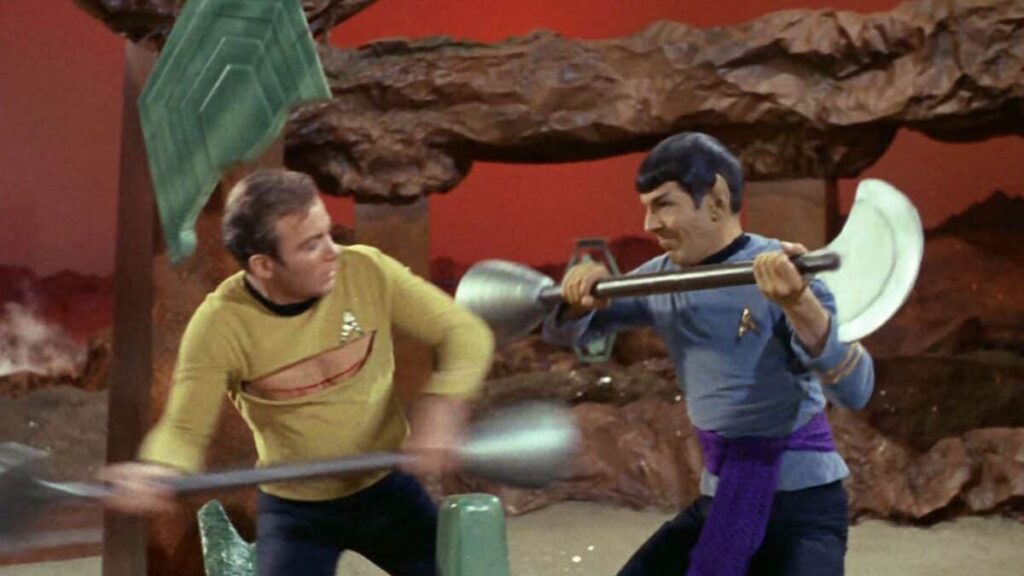
    “Amok Time” (1967) opened the show’s second season. It featured alien-world papier-mâché boulders, oversized Q-tip like weapons, and what is now widely recognized as the “Star Trek fight music.” This music was reused in several subsequent episodes and has since been widely parodied.

    The composer was Gerald Fried, who wrote the music for Stanley Kubrick’s first four films. He also provided most of the score for the landmark television mini-series “Roots.”

    Following the disappointing box office of “Star Trek: Nemesis” in 2002, the film franchise was put on hiatus for the next six-and-a-half years, possibly the result of “Star Trek” fatigue – too many movies and too many television series.

    J.J. Abrams was hired in the hopes of revitalizing “Trek” with a fresh makeover. Abrams’ approach might best be summed up as “Damn the social issues! Damn the philosophical underpinnings! Damn the continuity! Full speed ahead!” The result is undoubtedly entertaining, though very much of our time, with a lot of action at the expense of the ideas and humanity that made earlier incarnations more resonant.

    The “reboot” scored a hit with critics and general audiences, though it remains controversial with fans of the original series. Even the title suggests a new beginning, as the film was titled, simply, “Star Trek” (2009). The story employs an alternative timeline, so that the filmmakers are no longer beholden to more than 40 years’ worth of accrued “Star Trek” lore. It’s the kind of thing that is done all the time in comic books. Whether or not the result is for the best, I leave to you.

    Neither is the music quite as rich as that for some of the earlier installments, though it does generate a fair amount of excitement within the context of the film. The composer is Michael Giacchino.

    I hope you’ll join me for these selections from “Star Trek,” on “Picture Perfect,” music for the movies. The music won’t be the only thing that’s transporting. Set phasers for “fun,” on “Picture Perfect,” music for the movies, now in syndication on KWAX Classical Oregon!

    ———-

    Clip and save the start times for all three of my recorded shows:

    PICTURE PERFECT, the movie music show – Friday at 8:00 PM EDT/5:00 PM PDT

    SWEETNESS AND LIGHT, the light music program – Saturday at 11:00 AM EDT/8:00 AM PDT

    THE LOST CHORD, unusual and neglected rep – Saturday at 7:00 PM EDT/4:00 PM PDT

    Stream them, wherever you are, at the link!

    https://kwax.uoregon.edu/

    ———-

    The first four “Star Trek” movies are back in theaters through September 8, the anniversary of the original series’ debut. Each film is coupled with a classic “Star Trek” episode. If you missed my post about it yesterday, you’ll find more information here:

    https://rossamico.com/2026/09/03/star-trek-at-60-celebrated-on-the-big-screen/

  • “Star Trek” at 60, Celebrated on the Big Screen

    “Star Trek” at 60, Celebrated on the Big Screen

    Before it took root and blossomed into a mega-franchise, “Star Trek” was viewed with skepticism by studio and network executives and wasn’t always treated with the respect it deserved. Now it’s part of the fabric of our pop culture and has been for 60 years.

    The original series was broadcast for the first time beginning on September 8, 1966. To mark the diamond anniversary of its debut, not only will I be playing “Star Trek” music on my radio show “Picture Perfect” tomorrow on KWAX (8:00 p.m. EDT/5:00 p.m. EDT), but the first four theatrical features will actually be screened over the next several days at select AMC, Cinemark, and Regal theaters. These will be coupled with apposite episodes from the original series.

    “Star Trek: The Motion Picture” (1979) will be presented in its director’s cut, preceded by the original series episode “The Changeling.” Both deal with probes of human origin that become sentient with perilous results. (Friday, 9/4)

    “Star Trek II: The Wrath of Khan” (1982) will be preceded by “Space Seed.” Both feature Ricardo Montalban as a genetically engineered superman, one of the Enterprise’s most formidable antagonists. (Saturday, 9/5)

    “Star Trek III: The Search for Spock” (1983) will be preceded by “Amok Time.” Both are tied to the Vulcan time of madness pon farr, during which Spock must mate or die. The television episode spawned the famous “Star Trek” fight music composed by Gerald Fried. (Sunday, 9/6)

    “Star Trek IV: The Voyage Home” (1986) will be preceded by “City on the Edge of Forever,” one of the series’ best episodes. In both, members of the crew of the Enterprise travel back in time. (Monday, 9/7)

    For “Star Trek” die-hards, all four episodes and movies will be screened back-to-back, an all-day affair, ON THE ACTUAL ANNIVERSARY of the show’s first broadcast. So better plan to call in to work now! (Tuesday, 9/8)

    My pick is “Star Trek II,” with its double-dose of Montalban, its James Horner score, the poignant character relationships, and the nautical space battles.

    But I’ve already got my ticket for “Star Trek: The Motion Picture.” I’m one of the few who prefer the theatrical cut. For all its faults, there’s a stateliness – that admittedly teeters on the brink of stagnation – that really allows for a good wallow. I don’t think it’s a great movie by any standard, but it shoots for the stars. Sitting in a theater and experiencing Jerry Goldsmith’s score with Douglas Trumbull’s original effects seems like a good time to me. Highlight: a six-minute sequence of the glorification of the Enterprise at drydock – a heavenly union of image and sound. Also, Ilia’s theme, composed for Peris Khambatta’s character.

    Google is your friend. For showtimes, search the websites of Cinemark, AMC, and Regal. Live long and popcorn!

  • Tom Stoppard and André Previn Find Favour

    Tom Stoppard and André Previn Find Favour

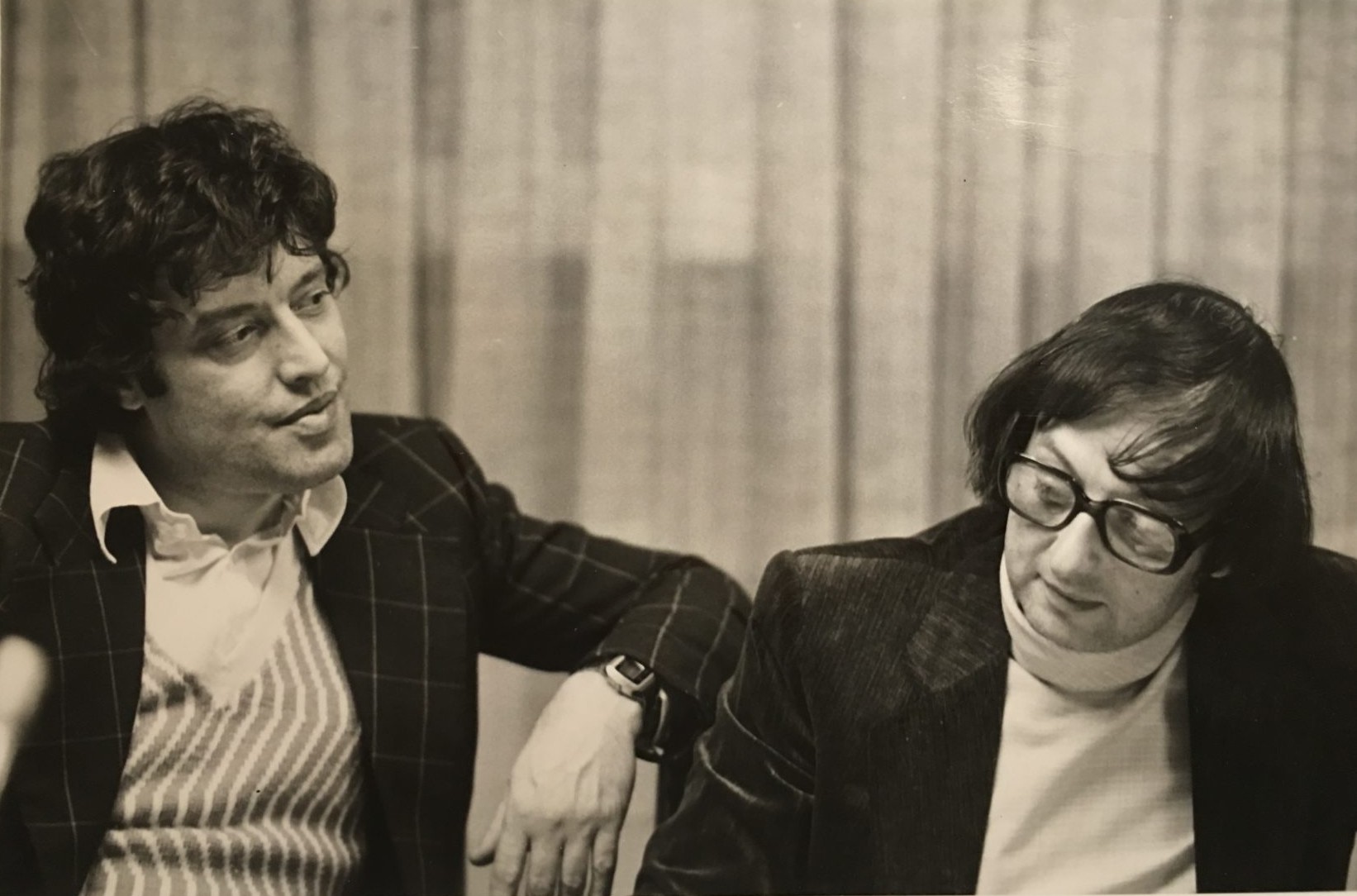
    The playwright Tom Stoppard died yesterday at the age of 88. In 1977, composer-conductor André Previn planted the seed for “Every Good Boy Deserves Favour,” a play for actors and orchestra. The title is derived from a popular mnemonic used in music lessons to help students remember the notes of the five lines of the treble clef (E,G, B, D, F). In the U.S., the phrase is often “Every Good Boy Does Fine.”

    Stoppard’s play, dedicated to Soviet exiles Viktor Fainberg and Vladimir Bukovsky, concerns a political dissident who is held in a psychiatric hospital with a schizophrenic cellmate who believes he has an orchestra at his disposal. In the recent past, the play was dismissed by some as outdated, since the action is tied to a specific time and place. It was still too “contemporary” to see past the shifting political landscape. But the pendulum has swung and the chilling reality that a tyrannical authority can abuse and reorder facts and distort the perception of truth is again very much au courant, sadly. (Then, hasn’t it always been the case with authoritarian regimes?)

    The cost and logistics of employing a full symphony orchestra also work against frequent performances of the play, although the score was subsequently adapted for chamber orchestra. The work runs about an hour in performance. Previn is given co-creator credit in this fascinating document from 1978, with Ian McKellen and Ben Kingsley.

    The play and music were previously recorded with the original cast – McKellen and Patrick Stewart – for commercial release on RCA.

    Stewart would later direct a touring production in 1992, featuring his castmates from “Star Trek: The Next Generation.”

    Previn conducted it in Philadelphia in 2002, in a collaboration between the Wilma Theater and the Philadelphia Orchestra. That production employed the arrangement for chamber orchestra.

    An interesting footnote: At the time of Previn’s death in 2019, he was deep into a commission from the Boston Symphony Orchestra, a monodrama for Renée Fleming inspired by Homer’s “The Odyssey,” which was to have been performed in celebration of the composer’s impending 90th birthday. Stoppard, whom Previn had attempted to woo to the project for years (the “mono” aspect of the drama made him hesitant), was the librettist.

    Among the challenges in figuring out how much of the work had been completed was making sense of Previn’s shuffled, unnumbered pages and disordered sketches. Stoppard’s text, fragments of which Previn included, eased the way. Previn’s longtime editor, David Fetherolf, was able to decipher the composer’s scrawl and fill out his shorthand, so that the premiere of “Penelope” took place as scheduled.

    The project provided closure to a friendship that had spanned 49 years.

    R.I.P. Tom Stoppard.

  • David Frankham’s Hollywood Tales

    David Frankham’s Hollywood Tales

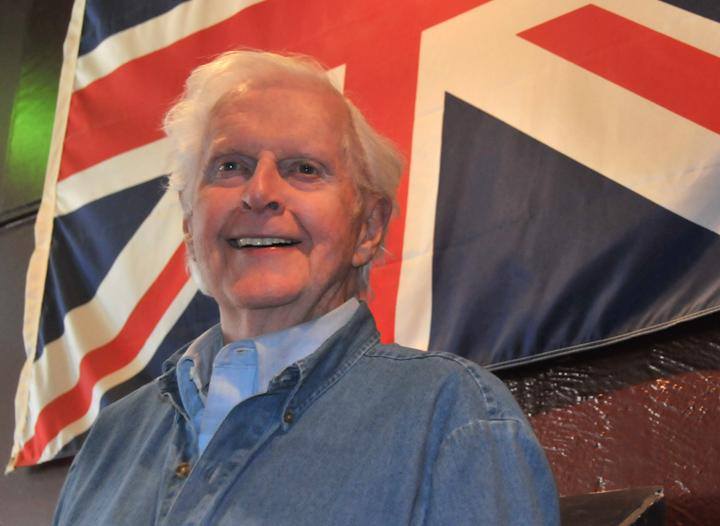
    When you’ve lived for the better part of a century and spent over half your life in the entertainment industry, you get to know a few people. And David Frankham remembers every one of them.

    Roy and I are honored to have hosted the veteran actor for his return to Roy’s Tie-Dye Sci-Fi Corner on Friday, Frankham’s 98th birthday, when once again he lit up the internet with a treasure trove of memories and his extraordinary ebullience.

    In addition to revisiting his experiences on “Star Trek” and “The Outer Limits,” Frankham, who also costarred in the feature films “Return of the Fly,” “Master of the World,” “Tales of Terror,” and “One Hundred and One Dalmations,” shared anecdotes about Vincent Price, Charles Bronson, Basil Rathbone, Walt Disney, Rosemary Clooney, Alec Guinness, Miriam Hopkins, Gladys Cooper, Henry Hull, and many others.

    Frankham was joined by filmmaker Ben Wickey, who was visiting him at his home in Santa Fe, NM. Wickey was on the team of animators responsible for the Academy Award-nominated feature film, “Marcel the Shell with Shoes On” (2021). A big fan of the Vincent Price gothics produced by American International Pictures in the 1960s, Wickey coaxed Frankham into employing his voice talent in a stop-motion adaptation of Nathaniel Hawthorne’s “The House of the Seven Gables” (2018). Not coincidentally, there are plenty of A.I.P. tributes in the film, which also sports a bit of an Edward Gorey/Rankin-Bass vibe. It’s an awful lot of fun. If you have 27 minutes to spare, here it is:

    Frankham’s close friend, Jonathan David Dixon, was also on hand. Dixon voices the role of Mr. Holgrave in the film and provided its pitch-perfect score.

    Finally, not to spoil it for anyone, but toward the end of the show, there was a surprise visit from Mimi Gibson, who costarred with Frankham in “One Hundred and One Dalmations.”

    Frankham’s appearances are always priceless (or, given the source, perhaps Price-full), so do check out the show at the link.

    And if you just can’t get enough, you’ll find another one archived here:

    Of course, there’s plenty more in his memoir, “Which One Was David?”

    Our next livestream will take place on Friday evening at 7:00 EST, when Roy and I will return, our pallid selves, to discuss another classic movie yet to be determined. Keep watching this space. And thank you, David Frankham!

  • Shatner’s Duality Kirk Splits in Classic Trek

    Shatner’s Duality Kirk Splits in Classic Trek

    On the next Roy’s Tie-Dye Sci-Fi Corner, in honor of William Shatner’s return to the Star Trek Original Series Set Tour in Ticonderoga, NY, this weekend, Roy made the command decision that we will discuss the original series episode “The Enemy Within” (1966). This is the one in which a transporter malfunction causes Captain Kirk to be split into two people, one “good,” but indecisive and ineffectual, and the other “evil,” impulsive and irrational. Obviously, it was Evil Roy who handed down this unilateral decision.

    I’m just kidding, of course. I love this stuff, and it is classic “Trek.” Like the character of divided Kirk, its qualities are many-faceted: at the same time ludicrous, thought-provoking, engaging, and fun.

    Shatner is at his histrionic best, underlit and heavy on the eyeliner when evil, and managing to overplay “underplay” when good. But where he really displays his chops is in keeping a straight face while acting alongside a dog in a hairy caterpillar/unicorn onesie.

    Famed horror and sci-fi scribe Richard Matheson (“The Incredible Shrinking Man,” “The Legend of Hell House,” “I am Legend”) mines the old doppelganger theme for this exploration of man’s duality. It also happens to be the first episode, thanks to Leonard Nimoy, in which Spock delivers his signature Vulcan nerve pinch.

    Join us as my will weakens in the presence of forceful Roy. Saurian brandy will be served in the comments section, as it’s revealed that Roy and I are two sides of the same coin, when we livestream on Facebook, YouTube, etc., THIS WEEK AT A SPECIAL TIME, THURSDAY EVENING AT 7:00 EST!

    https://www.facebook.com/roystiedyescificorner

Tag Cloud

Aaron Copland (93) Beethoven (95) Composer (114) Film Music (144) Film Score (143) Film Scores (255) Halloween (94) John Williams (195) KWAX (229) Leonard Bernstein (104) Marlboro Music Festival (125) Movie Music (159) Mozart (90) Opera (212) Philadelphia Orchestra (89) Picture Perfect (174) Princeton Symphony Orchestra (109) Radio (88) Ross Amico (244) Roy's Tie-Dye Sci-Fi Corner (290) The Classical Network (101) The Lost Chord (269) Vaughan Williams (105) WPRB (397) WWFM (881)

DON’T MISS A BEAT

Receive a weekly digest every Sunday at noon by signing up here


RECENT POSTS