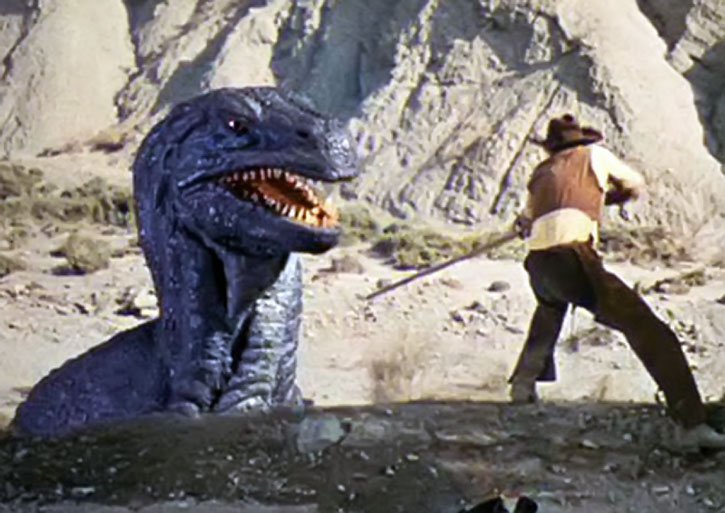
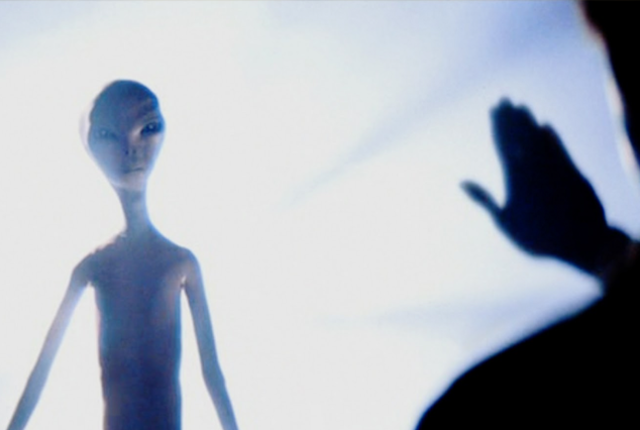
You’re right. The idea of cowboys lassoing an Allosaurus so that they can show it off in their Wild West show is totally preposterous. But not to worry, we’ll rinse the taste out of our mouths with a three-way bull session devoted to a movie about extraterrestrials who fly around in ice cream cones.
That’s right, it’s another Classic Ross Amico double feature!
Join me this Friday evening at 6:00 EDT, for an hour of music from the western scores of Jerome Moross on “Picture Perfect” – including selections from “The Big Country,” “The Proud Rebel,” “The Jayhawkers,” and “The Valley of Gwangi” – on WWFM – The Classical Network and wwfm.org.
Then at 7:00 EDT, Roy Bjellquist and I will be joined by Joe Metz (my cousin, whom I have not seen in about 35 years) for an in-depth discussion about a movie that influenced us all, Steven Spielberg’s UFO blockbuster “Close Encounters of the Third Kind.”
You can bet your mashed potatoes that the hour will not pass without some discussion of music, which permeates the film on multiple levels.
Catch the Facebook live-stream, and by all means, participate in the running commentary. We look forward to reading your thoughts and reactions.
Roy’s Tie-Dye Sci-Fi Corner
Watch us. Watch the skies. When we see you there, we’ll know, truly… we are not alone!
Is “Close Encounters of the Third Kind” the most musical non-musical blockbuster ever made?
I don’t know at what point I recognized Zoltán Kodály’s contribution to “CE3K.” It was certainly not as an 11-year-old boy, which is how old I was at the time I was first spooked and awed by Steven Spielberg’s UFO masterpiece. But somewhere along the way, Kodály took on more significance than simply an exotic-looking name on a chart.
In addition to being one of Hungary’s most respected composers – with his friend, Béla Bartók, at the forefront of the whole Hungarian nationalist movement – Kodály was extremely influential in the field of music education. The hand signals employed by François Truffaut’s Claude Lacombe, when he addresses a conference of UFO scientists and researchers, correspond to specific musical tones. The signals are an integral part of the Kodály method, and they contribute to the film’s memorable climax. Millions who have never heard of Kodály outside the context of “CE3K” will be familiar with the five-signal sequence.
Of course, music imbues just about every aspect of Spielberg’s storytelling. Composer John Williams went through over 300 permutations of the five-notes-to-a-theme before arriving at the now-iconic motive that ties the whole film together. There was no “aha! moment.” It was only after Spielberg learned there were over 130,000 possibilities that they just settled on a sequence they thought would be effective. A significant portion of the score for the last half hour of “CE3K” would be recorded in advance of the actual filming. It’s a rare luxury for composers to have a film cut to their music, as opposed to the other way around, but this is what was done, necessarily, for the film’s climactic encounter.
At the time, Williams’ “CE3K” theme was widely parodied and likely as well recognized as his theme for “Jaws.” His score would be nominated for an Academy Award in 1978. He actually wound up losing to himself, for “Star Wars.” A banner year for John Williams!
Interestingly, the composer tailored a cello solo specifically for Eleanor Aller Slatkin, formerly of the legendary Hollywood String Quartet. Aller was the widow of violinist Felix Slatkin and the mother of conductor Leonard Slatkin. She had been active in Hollywood since the 1940s, introducing Erich Wolfgang Korngold’s Cello Concerto in the film “Deception,” with Bette Davis and Claude Rains. Paul Henreid “played” the concerto onscreen.
French pianist and educator Odette Gartenlaub, a Messiaen pupil and solfège authority who taught at the Paris Conservatory, has a cameo during the climactic extraterrestrial communication scene.
And of course, “When You Wish Upon a Star” is heard on a music box early in the narrative, only to be picked up in Williams’ underscore during the film’s apotheosis. Spielberg said that he relied on the spirit of the song as a kind of guide for the overall feeling he wanted “CE3K” to convey.
“Close Encounters” is a work of great humanity, wonder and hope. Is it any wonder that music would play such an important role? In a story in which so many of the human characters experience frustration in their spoken interactions, running up against all kinds of barriers to effective communication, the key to universal understanding turns out to be music. It is one of the most satisfying and uplifting movies about music ever made. Unusually, it also seems to get everything right.
There were many experienced hands involved in the writing of the film, but in the end it was Spielberg who received the sole screen credit. Somebody really knew their music. I wonder who directed Spielberg to Kodály?
For further reflections on “CE3K,” join Roy Bjellquist and me – with a special appearance by my brilliant cousin, Joseph R. Metz – on the next “Roy’s Tie-Dye Sci-Fi Corner,” to be live-streamed on Facebook this Friday evening at 7:00 EDT.
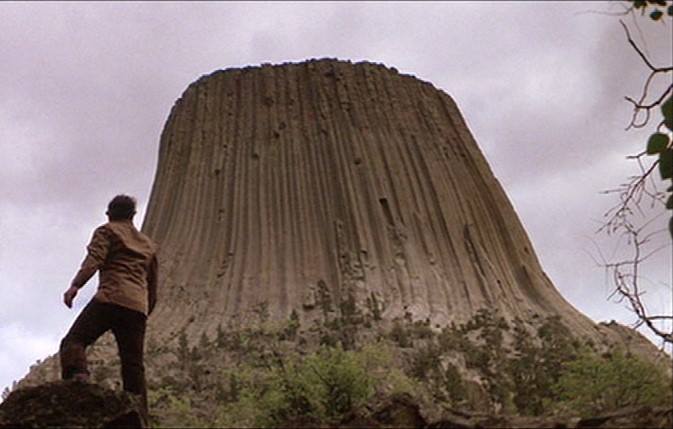
“Close Encounters of the Third Kind” is back in theaters this weekend in a new, digital restoration. In anticipation of the 40th anniversary of the film’s release on November 16th, a unique screening will take place tonight at the base of Devils Tower, the national monument that plays such an important part in the Steven Spielberg classic. Watching “Close Encounters” for the first time was a watershed moment in my movie-going experience. If you’ve only seen it on TV, you have not really seen it. This is a film that definitely deserves to be experienced in a theater. Say what you will about Richard Dreyfuss’ sideburns, for me this will always be one of Spielberg’s best films, with a transcendent score by John Williams. Do yourself a favor, and check your local listings.
Just when you thought it was safe to go back in the water…
The film “Jaws” opened on June 20, 1975 – which means we are barreling down on its 40th anniversary. (Personally, I find that concept much more terrifying than anything portrayed onscreen.)
The blockbuster success of “Jaws” is widely credited with having laid the foundation for the phenomenon which was to become known as the summer movie. This week, we celebrate Steven Spielberg’s game-changer with music from films about underwater threats.
“Beneath the 12-Mile Reef” (1953) stars Robert Wagner and Peter Graves in a Romeo and Juliet story about two families of competing fishermen along the Gulf coast of Florida, one working class and of Greek origin, and the other a family of privileged WASPs. Gilbert Roland is the Greek patriarch who runs afoul of an improbably large octopus. Bernard Herrmann wrote the music. The complete score, characterized by ample harp glissandi for the underwater sequences, has been reissued on Kritzerland Records in a limited edition of 1000 copies.
In “The Sharkfighters” (1956), Victor Mature joins Navy scientists in trying to develop a shark repellent (from octopus ink, actually) in order protect downed pilots at sea. The score, by Jerome Moross, employs an expanded percussion section reflective of the film’s Cuban environs.
A young Henry Mancini was one of three composers to work on “The Creature from the Black Lagoon” (1954). Mancini was teamed with veteran film composer Hans J. Salter and Herman Stein. None of the three are credited on screen – typical of what was considered at the time a low-budget B-movie.
It all culminates in “Jaws” (1975). What can be said about John Williams’ masterful music? It’s right up there with “Psycho” and “The Good, the Bad and the Ugly” in terms of most recognized and most-frequently parodied. Everyone remembers the primal shark theme, but what is sometimes overlooked is that “Jaws” is also one of the great adventure scores, the music effortlessly navigating the choppy waters of suspense, horror, and seafaring swashbuckler. The composer was recognized with a richly-deserved Academy Award.
I hope you’ll join me (on the beach) for “Picture Perfect,” music for the movies, this evening at 6 ET, with a repeat tomorrow morning at 6; or that you’ll listen to it later as a webcast at http://www.wwfm.org.
It’s been announced that John Williams will not be writing the music for Steven Spielberg’s upcoming Cold War thriller, “Bridge of Spies,” scheduled for release on October 18. This is perhaps not surprising, since Williams is committed to score the next “Star Wars” film, slated to open on December 18. The man is, after all, 83 years-old.
However, it is not his age, but rather an unspecified, apparently minor health setback that caused Williams to walk away from the Spielberg project. It is said that the issue is now “corrected.”
Thomas Newman will be stepping in to write the music. It will be only the second Spielberg feature not to be graced by one of Williams’ scores. (The other was “The Color Purple,” released in 1985.) Williams and Spielberg first worked together on “The Sugarland Express,” in 1974.
I confess that this is a personal disappointment, since I was looking forward to two fine film scores this year, which has become a rarity in the Age of Zimmer.
The last film scored by Williams was “The Book Thief,” in 2013. He plans to return for Spielberg’s next project, a film based on Roald Dahl’s novel, “The BFG,” projected for a July 1, 2016 release.