Tag: The Lost Chord

  • Viva Verdi Music of Italian Unification

    Viva Verdi Music of Italian Unification

    “Viva VERDI!” – the cry of Italian patriots on the eve of unification.

    Italy of the 1850s was but a conglomerate of individual states, many of them still under foreign rule. The slogan “Viva VERDI!” was coined in 1859, following the premiere of the composer’s politically sensitive opera “Un ballo in maschera.”

    Verdi’s ongoing troubles with the censors are well-known. It’s a safe bet that when he undertook an opera about a political assassination, he had a pretty good idea what to expect. The name VERDI was taken up by firebrands of the Risorgimento as an acronym for “Vittorio Emanuele, Re D’Italia.” King Vittorio Emanuele II of Piedmont was seen by many as the best hope for a free and united Italy.

    This week on “The Lost Chord,” we’ll refrain for delving too much into Italy’s Second War for Independence, or of Garibaldi’s struggles with the Bourbons. Instead, we’ll enjoy examples of MUSICAL unification – various composers of Italian origin coming together to attempt cohesive works of art.

    There are those who believe the serenata “Andromeda Liberata” may have been composed entirely by Antonio Vivaldi – but perhaps not. The likely impetus for its creation was the return to Rome of one Cardinal Ottobone, who was also a patron of both Arcangelo Corelli and Alessandro Scarlatti.

    The story is that of Perseus and Andromeda. Andromeda has already been rescued from the sea serpent at the start of the piece, which mostly explores the ambiguous feelings of its characters, with a few extraneous love interests tossed into the mix to provide romantic conflict.

    The two-hour entertainment contains in its second part a single aria known definitively to have been composed by Vivaldi. The authorship of the rest remains in doubt. The long-lost manuscript, dating from 1726, was rediscovered as recently as 2002.

    In 1868, Verdi’s great operatic predecessor, the long-retired Gioachino Rossini, died. Rossini had completed his last opera nearly forty years before. Verdi undertook to bring together 12 of his contemporaries, now largely forgotten. The oldest, Carlo Coccia, at age 87, was actually a decade Rossini’s senior!

    Within the year, a collaborative mass was compiled in Rossini’s memory, for which Verdi provided the concluding “Libera me.” In fact, the music looks forward to Verdi’s own masterful Requiem. The completed work doesn’t attain anywhere near the lofty heights of Verdi’s solo run. However, it’s an interesting compendium of contemporary styles, and even the music of lesser talents serves to cast Verdi’s genius in a new light.

    Remarkably, the work lay unperformed in Verdi’s lifetime. Talk about politics! Here was Verdi, a Milanese, trying to kindle some sort of enthusiasm in Bologna (the location of Rossini’s earliest successes), for a project which was to bring together a bunch of compositional dinosaurs, to salute a figure who, for all intents and purposes, had retired from public life some four decades earlier. Bologna at the time was in the process of becoming a stronghold of the musical avant-garde.

    All these factors, along with puzzling stipulations, such as the work being locked away after its first performance, to be trotted out only on special occasions, doomed the project virtually from the start. It remained unheard for another 120 years, resurrected only in 1988.

    I hope you’ll join me for “Viva VERDI!” – Italian unification through music – on “The Lost Chord,” now in syndication on KWAX, the radio station of the University of Oregon!


    Clip and save the start times for all three of my recorded shows:

    PICTURE PERFECT, the movie music show – Friday at 8:00 PM EDT/5:00 PM PDT

    SWEETNESS AND LIGHT, the light music program – Saturday at 11:00 AM EDT/8:00 AM PDT

    THE LOST CHORD, unusual and neglected rep – Saturday at 7:00 PM EDT/4:00 PM PDT

    Stream them, wherever you are, at the link!
    https://kwax.uoregon.edu/

  • Karlowicz & Mlynarski: Polish Romanticism

    Karlowicz & Mlynarski: Polish Romanticism

    This week on “The Lost Chord,” you might say it’s Poland spring. We’ll polish up on our Polish music with works by Mieczyslaw Karlowicz and Emil Mlynarski.

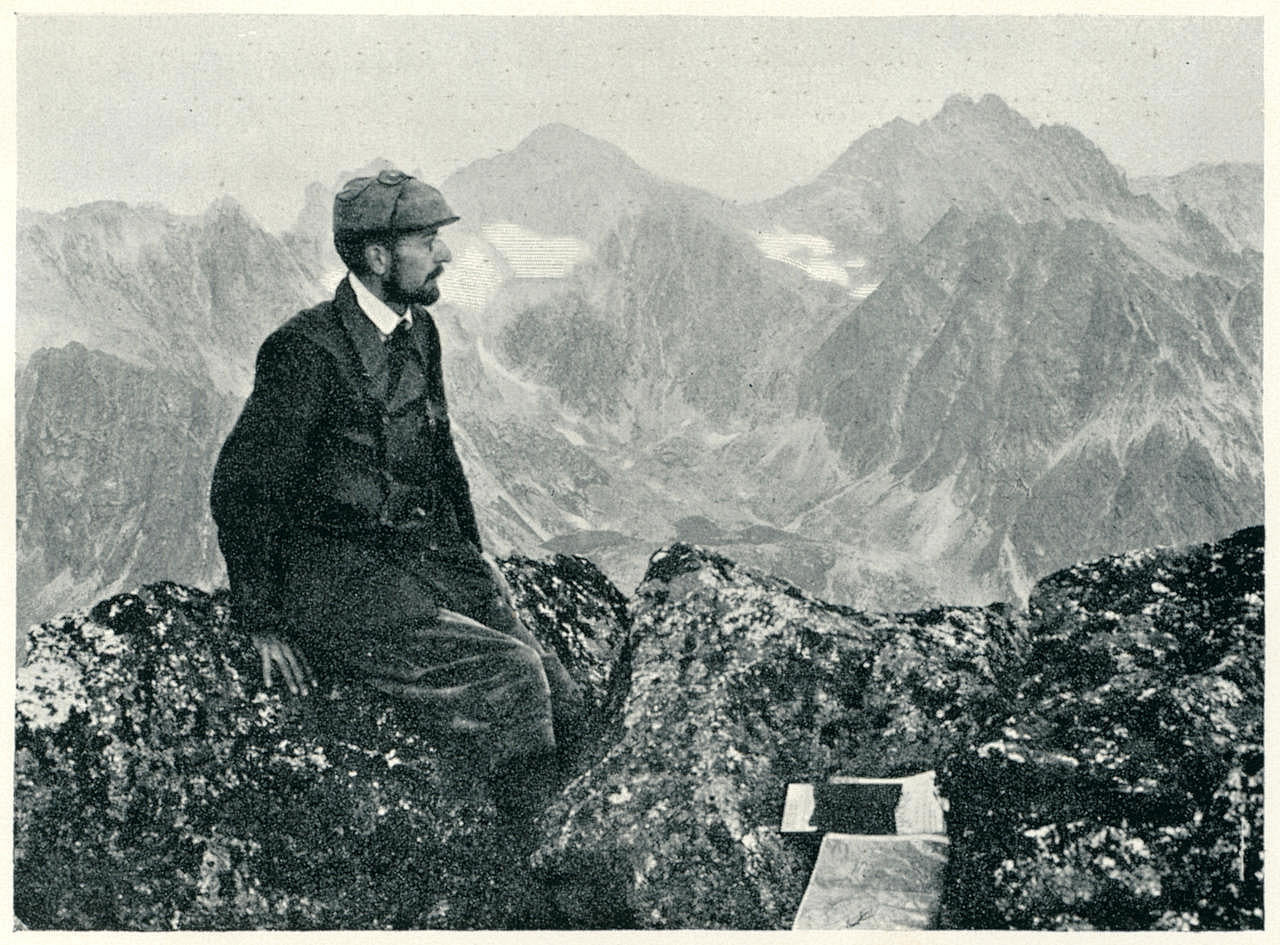
    Karlowicz, by all accounts one of the gloomiest of composers, embraced an outlook and philosophy that might well be described as pessimism leavened with pantheism. In this melancholy world, all love is unfulfilled or doomed, all existence leads to tragedy and destruction. The only place the composer seemed to find solace was in his beloved Tatras. He once noted, “Atop a high mountain, I become one with the surrounding space. I cease to feel individual. I can feel the mighty, everlasting breath of eternal being.”

    It is perhaps a kind of poetic justice that a life spent cultivating suicidal despair, and raising it to a level of high art, would be cut short, when Karlowicz was killed in an avalanche in 1909, aged only 32 years – a most fitting end for an orophile with fatalistic tendencies.

    We’ll hear one of the six symphonic poems upon which Karlowicz’s reputation, in large part, is based. “Stanislaw and Anna Oswiecim,” inspired by a painting of Stanislaw Bergmann, evokes a tale of forbidden love between brother and sister, ending in inevitable tragedy.

    Then it’s romance of different sort, with a violin concerto by Mlynarski. Mlynarski was recognized both at home and abroad as a staunch champion of Polish musical causes. He directed the Warsaw Opera and spearheaded the drive to build Warsaw Philharmonic Hall. He conducted festivals of Polish music in Paris, commissioned Sir Edward Elgar to write “Polonia” for a wartime Polish Relief Concert, and conducted the world premiere of Karol Szymanowski’s opera “King Roger.” He was, in fact, voted Poland’s most popular conductor. (Parenthetically, he also became the father-in-law of Artur Rubinstein.)

    Among his other achievements, he toured with the London Symphony Orchestra, became permanent conductor of the Scottish National Orchestra, shared concerts with Sir Thomas Beecham, and for a time was dean of the Curtis Institute of Music in Philadelphia.

    He was also an outstanding violinist. He studied with Leopold Auer, toured widely, and won a major composition award with his First Violin Concerto.

    Violinist Nigel Kennedy first encountered his music when he was handed a tape of Mlynarski’s Violin Concerto No. 2 by an anonymous Polish fan following a concert. Kennedy went on to make his own recording of the work. I think you’ll agree, it’s a very beautiful discovery.

    It will be a bird’s-eye view as we clear the bar, with an hour of Polish music, on “Pole Vault,” on “The Lost Chord,” now in syndication on KWAX, the radio station of the University of Oregon!


    Clip and save the start times for all three of my recorded shows:

    PICTURE PERFECT, the movie music show – Friday at 8:00 PM EDT/5:00 PM PDT

    SWEETNESS AND LIGHT, the light music program – Saturday at 11:00 AM EDT/8:00 AM PDT

    THE LOST CHORD, unusual and neglected rep – Saturday at 7:00 PM EDT/4:00 PM PDT

    Stream them, wherever you are, at the link!

    https://kwax.uoregon.edu/


    PHOTO: Mieczyslaw Karlowicz, man of destiny

  • Pierre Boulez Provocations in Sound

    Pierre Boulez Provocations in Sound

    Think of Pierre Boulez as a corrective.

    Whether or not you are crazy about Boulez as a composer or a conductor, he certainly had a knack for casting music in a fresh light. No romantic indulgence or fuzzy thinking to be found in his interpretations of Debussy and Ravel. Instead, a kind of neoclassical elegance prevails.

    A similar sense of discipline informs his recordings of the Mahler symphonies (of all things). He transforms what under Leonard Bernstein, for instance, became the ne plus ultra of Romantic excess, into presentiments of the Modern Age – which to some extent actually makes sense. After all, didn’t Mahler himself once declare, “My time will come!”

    As concerns his own music, he actually thought Arnold Schoenberg didn’t take his 12-tone experiments far enough. Boulez was a radical who out-radicaled the radicals. He redrew the boundaries of integral serialism, controlled chance, and electronic music. An aggressive push to the avant-garde earned him a reputation as an enfant terrible.

    Ironically, by the time Boulez died on January 5, 2016, at the age of 90, his brand of dogma had long come to seem old-fashioned, as pluralism and a new acceptance of tonality have come to dominate the contemporary music scene.

    And now, here we are, already poised to mark the centenary of his birth on March 26…

    This week on “The Lost Chord,” we’ll remember Boulez with two of his recordings for voice and somewhat intimate ensembles, imaginatively employed.

    We’ll begin with his keystone composition, “Le Marteau sans maître” (“The Hammer without a Master”), composed between 1953 and 1957. The piece consists of three cycles, instrumental and vocal, after poems by René Char – one surreal and fantastical; another somber and existentialist; and a third romantic and utopian. The individual movements of the cycles are shuffled and integrated. The titles of the poems: “The Furious Craftsman,” “Stately Building and Presentiments,” and “Hangmen of Solitude.”

    There is a further fascination to be found in the work’s instrumentation, which includes a colorful assortment of percussion, and the use of the instruments, which suggests Southeast Asian and African influences.

    The piece was lauded by Igor Stravinsky as “the only significant work of this new age,” and by György Ligeti as “the chief work of the 1950s.” Furthermore, it is surprisingly listenable, with a kind of hypnotic allure.

    We’ll round out the hour with Maurice Ravel’s evocations of a distant land, his “Chansons madécasses” (“Madegascan Songs”), of 1925/1926, on texts of Evariste-Desiréa de Parny.

    Again, there are three of them: “Nahandove,” the name of the narrator’s beloved, the arrival of whom he anticipates on a sticky, languorous night; “Aoua!,” a violent outcry against white imperialism; and “Il est doux” (“How pleasant to lie”), a portrait of a lazy day, passed beneath a palm tree, waiting for the cool of night.

    If anything, Ravel’s songs are even more sparsely scored than Boulez’s, for voice, flute, cello, and piano. Yet the composer manages to convey a certain lushness, or at any rate sensuousness, that boils over into violence as the music skirts atonality.

    I thought it an ideal complement to “Le Marteau sans maître,” with Boulez conducting, of course.

    If there’s one thing Boulez did well it was to force everyone to think – about music, about progress and about the reasons we value the things we hold sacred.

    He once proclaimed, “A civilization that conserves is one that will decay!” Even so, we are very lucky to have his recordings, and music is the healthier for his provocations.

    I hope you’ll join me for “Modern Romance” – Pierre Boulez in poetry and song – on “The Lost Chord,” now in syndication on KWAX, the radio station of the University of Oregon!


    Clip and save the start times for all three of my recorded shows:

    PICTURE PERFECT, the movie music show – Friday at 8:00 PM EDT/5:00 PM PDT

    SWEETNESS AND LIGHT, the light music program – Saturday at 11:00 AM EDT/8:00 AM PDT

    THE LOST CHORD, unusual and neglected rep – Saturday at 7:00 PM EDT/4:00 PM PDT

    Stream them, wherever you are, at the link!
    https://kwax.uoregon.edu/


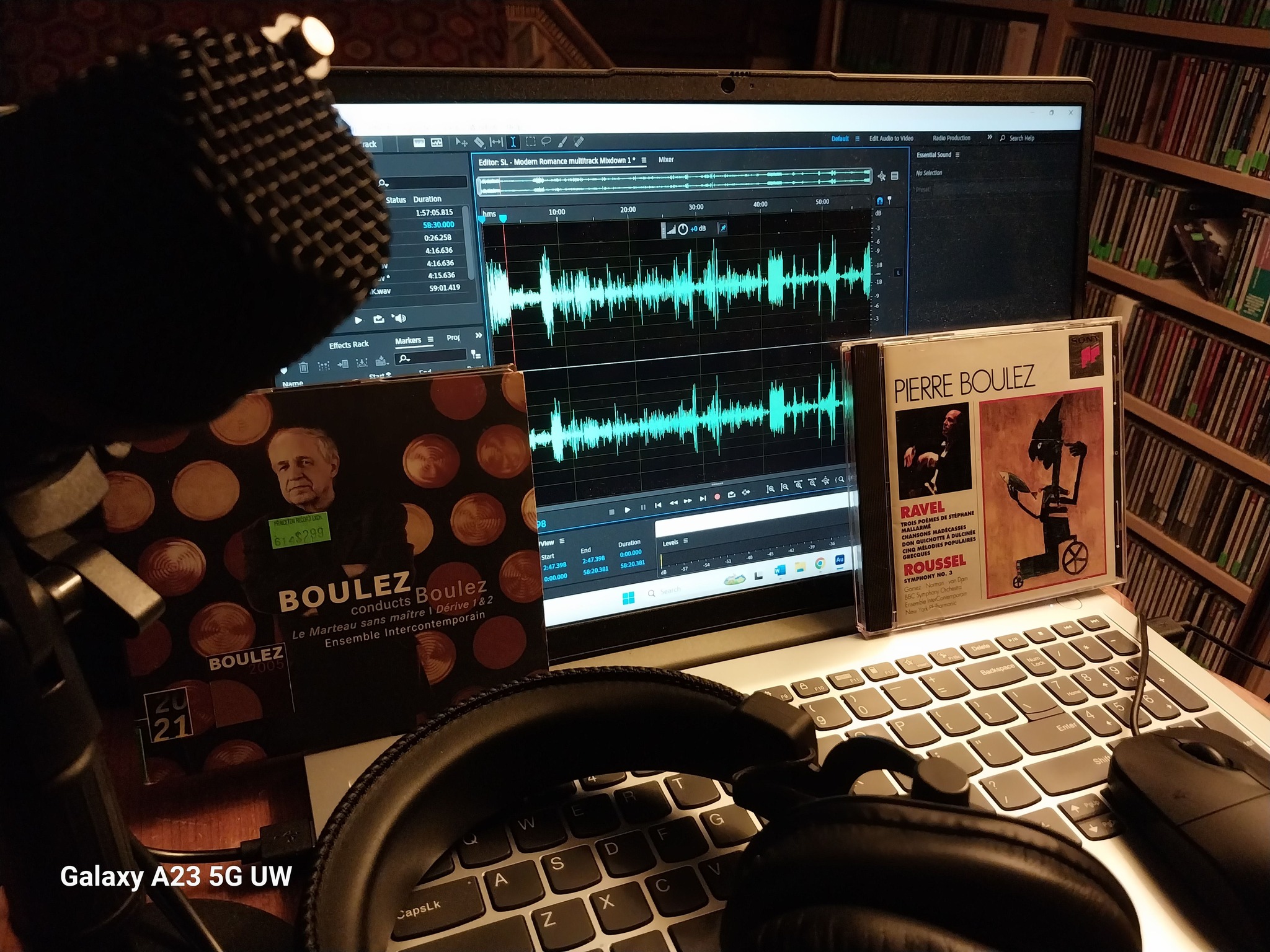
    PHOTO: The Hammer has found a Master

  • Boulez Centenary on The Lost Chord Radio Show

    Boulez Centenary on The Lost Chord Radio Show

    Just finished recording this week’s edition of “The Lost Chord.” To mark the centenary of the birth of Pierre Boulez on March 26, the program juxtaposes two Boulez-conducted song cycles: Boulez’s own “Le Marteau sans maître” (“The Hammer without a Master”) and Ravel’s “Chansons madécasses“ (“Madagascan Songs”). Hear it on KWAX, this Saturday at 7:00 p.m. EDT/4:00 p.m. PDT. Stream it wherever you are at https://kwax.uoregon.edu/

  • Irish Music on The Lost Chord for St Patricks Day

    Irish Music on The Lost Chord for St Patricks Day

    This week on “The Lost Chord,” we anticipate St. Patrick’s Day, with two contrasting works with ties to the Emerald Isle.

    John Kinsella was born in Dublin in 1932. He combined composition with a career in music administration until 1988, when he left his position as Head of Music at RTE, Ireland’s national broadcasting organization.

    As a composer, he was influenced by contemporary trends in the European avant-garde, until 1977. Then, following the completion of his String Quartet No. 3, he wrote nothing for a period of 18 months. He emerged from this self-imposed silence a renewed artist, crafting wholly tonal works of great beauty and integrity. Since then, he has completed eleven symphonies, a second violin concerto, a cello concerto, a fourth string quartet, and various other works.

    Kinsella’s Symphony No. 3 was composed in 1989-1990. The work falls into two substantial movements, framed by a brief Prologue and Epilogue, and separated by an Intermezzo, all of which return to material stated in the symphony’s opening bars. The movements are performed without break.

    Although it is not a programmatic work, the composer dedicated the symphony, with gratitude, to his parents. He intended the piece as a personal expression of certain aspects of the joy of life. Hence, the subtitle, “Joie de vivre.”

    More overtly folk-inflected is “Laments and Dances from the Irish,” after melodies by Irish harper Turlough O’Carolan (1670-1738). Philadelphia-born composer Arnold Black was afflicted with cerebral palsy from birth, resulting in limited mobility on his right side. Yet he managed to become a master of the violin. So successful was he on his instrument that following graduation from the Juilliard School, he was hired as assistant concertmaster of the Baltimore Symphony, and ultimately concertmaster of the National Symphony Orchestra in Washington, DC.

    Black’s “Laments and Dances” was commissioned by the Newman and Oltman Guitar Duo. Michael Newman and Laura Oltman reside along the Delaware River in Warren County, NJ. Together or between them, they have taught or been guitarists-in-residence at the Mannes College of Music in New York City, Princeton University, The College of New Jersey, and Lafayette College in Easton, PA. They are also directors of the Raritan River Music Festival, held in historic venues in Central Jersey throughout the month of May. The duo is joined in this recording by the Turtle Island String Quartet.

    Pour yourself a pint of stout and find your bliss. We laugh and weep along with the Irish, on “Airs from Erin,” on “The Lost Chord,” now in syndication on KWAX, the radio station of the University of Oregon!


    Clip and save the start times for all three of my recorded shows:

    PICTURE PERFECT, the movie music show – Friday at 8:00 PM EDT/5:00 PM PDT

    SWEETNESS AND LIGHT, the light music program – Saturday at 11:00 AM EDT/8:00 AM PDT

    THE LOST CHORD, unusual and neglected rep – Saturday at 7:00 PM EDT/4:00 PM PDT

    Stream them, wherever you are, at the link!

    https://kwax.uoregon.edu/

Tag Cloud

Aaron Copland (94) Beethoven (95) Composer (114) Film Music (148) Film Score (143) Film Scores (255) Halloween (97) John Williams (196) KWAX (232) Leonard Bernstein (105) Marlboro Music Festival (125) Movie Music (163) Mozart (91) Opera (215) Philadelphia Orchestra (90) Picture Perfect (174) Princeton Symphony Orchestra (110) Radio (90) Ross Amico (244) Roy's Tie-Dye Sci-Fi Corner (290) The Classical Network (101) The Lost Chord (269) Vaughan Williams (107) WPRB (397) WWFM (881)

DON’T MISS A BEAT

Receive a weekly digest every Sunday at noon by signing up here


RECENT POSTS