Tag: The Lost Chord

  • Autumn Equinox Rediscovering American Composers

    Autumn Equinox Rediscovering American Composers

    This week on “The Lost Chord,” in anticipation of tomorrow’s Autumn Equinox, lend a little color to your weekend with seasonal evocations by two American composers.

    Henry Hadley (1871-1937) studied at home with George Whitefield Chadwick and in Vienna with Eusebius Mandyczewski. In Europe, he befriended Richard Strauss and conducted the Berlin Philharmonic in his own Symphony No. 3. He was assistant conductor at the Mainz Opera, later music director of the Seattle Symphony, and became the first conductor of the San Francisco Symphony. One of his operas, “Cleopatra’s Night,” was performed at New York’s Metropolitan Opera. He served a stint as assistant conductor of the New York Philharmonic, he founded the National Association of Composers and Conductors, and he was instrumental in establishing the Berkshire Music Festival at Tanglewood. He guest conducted orchestras from Buenos Aires to Tokyo. Why then do so few remember him?

    We’ll dig deep into the leaf pile of music history to revive Hadley’s Symphony No. 2, from 1901, subtitled “The Four Seasons.” The work begins with an evocation of a turbulent winter storm, followed by “Spring,” then “Summer.” The symphony concludes with a melancholy portrait of autumn, enlivened by the appearance of some rollicking hunting horns.

    Toward the end of the hour, we’ll have just enough time for music by Leo Sowerby (1895-1968), sometimes called “the Dean of American Church Music.” Sowerby was awarded the Pulitzer Prize for Music in 1946 for his cantata “Canticle to the Sun.” As antidote to the reflective nature of Hadley’s “Autumn,” we’ll conclude with the exuberant “Comes Autumn Time,” an uplifting work for solo organ.

    I hope you’ll join me for “Well-Seasoned” – American composers of experience celebrate autumn – on “The Lost Chord,” now in syndication on KWAX, the radio station of the University of Oregon!


    Clip and save the start times for all three of my recorded shows:

    PICTURE PERFECT, the movie music show – Friday at 8:00 PM EDT/5:00 PM PDT

    SWEETNESS AND LIGHT, the light music program – ALL NEW! – Saturday at 11:00 AM EDT/8:00 AM PDT

    THE LOST CHORD, unusual and neglected rep – Saturday at 7:00 PM EDT/4:00 PM PDT

    Stream them, wherever you are, at the link!

    https://kwax.uoregon.edu/

  • César Franck and His Belgian Legacy

    César Franck and His Belgian Legacy

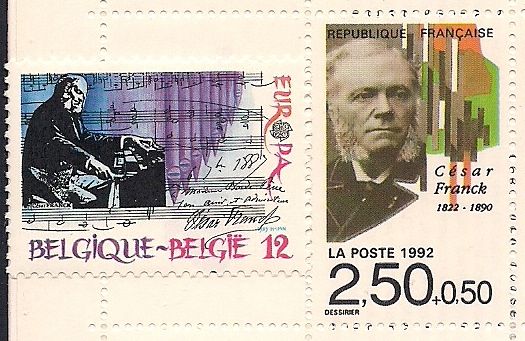
    César Franck was a strangely charismatic outsider. A Belgian abroad, he was required to take French citizenship in order to teach at the Paris Conservatory. A renowned organist, his unexpected genius for composition blossomed late.

    His enduring fame rests on a handful of fairly late works. He managed to reinvigorate the French symphonic and chamber music traditions through his use of “cyclic form,” with themes throughout generated from a single motif. He also embraced the symphonic poem. In these regards he certainly bore the influence of Franz Liszt. In turn, he himself became highly influential among a generation of French and Belgian composers.

    This week on “The Lost Chord,” we’ll examine music by two Belgians who fell under his sway.

    Armand Marsick, born in 1877, trained as a violinist at the Liège Conservatory, before studying abroad in Nancy with Franck enthusiast Guy Ropartz. Then he moved to Paris, where he studied with another Franckian, Vincent d’Indy. His career led him to Athens, and then Bilbao, where he founded a conservatory and an orchestra. He returned to Liège at the age of 50, settling in to teach and direct the concert society there. He died in 1959. The bulk of Marsick’s compositional output, which consisted of some forty works, was written between the ages of 23 and 37. We’ll enjoy a symphonic poem from 1908, titled “La Source.”

    Guillaume Lekeu was born in Verviers in 1870. He studied with Franck in Paris, then, like Marsick, with d’Indy following Franck’s death. Lekeu, unfortunately, is also remarkable for his very short life. He became ill with typhoid fever after consuming contaminated sherbet at a restaurant, and died in 1894, one day after his 24th birthday. Despite his sadly shortened existence, he managed to make important contacts and to write music of considerable promise. At the time of his death, he had already been composing for nine years, from the age of 15. In 1891 he was recipient of a second prize in the celebrated Prix de Rome competition.

    In all, Lekeu composed about 50 works. We’ll hear his Violin Sonata from 1892, written for the great Belgian virtuoso Eugene Ysaye, and his Adagio from 1891, originally composed for quartet and string orchestra. The score to the latter bears an epigraph from a poem by Georges Vanor, “The pale flowers of memory.”

    I hope you’ll join me for music by these Belgian followers of César Franck. That’s “Franckly Belgian,” on “The Lost Chord,” now in syndication on KWAX, the radio station of the University of Oregon!


    Clip and save the start times for all three of my recorded shows:

    PICTURE PERFECT, the movie music show – Friday at 8:00 PM EDT/5:00 PM PDT

    SWEETNESS AND LIGHT, the light music program – ALL NEW! – Saturday at 11:00 AM EDT/8:00 AM PDT

    THE LOST CHORD, unusual and neglected rep – Saturday at 7:00 PM EDT/4:00 PM PDT

    Stream them, wherever you are, at the link!

    https://kwax.uoregon.edu/

  • Labor Day Road Trip American Music

    Labor Day Road Trip American Music

    Labor Day weekend. Road trip!

    This week on “The Lost Chord,” I hope you’ll join me for summer’s last hurrah, as we burn rubber with an hour of quintessentially American music about travel by car.

    Frederick Shepherd Converse’s “Flivver Ten Million” celebrates the Ford Motor Company’s affordable assembly line automobile, from its creation in a Detroit factory to the manifest destiny of America’s roadways.

    John Adams’ “Road Movies” has nothing to do with Bob Hope and Bing Crosby, alas; what it is, however, is a violin sonata written firmly within the American tradition, with a special affinity at its core with Copland’s Violin Sonata.

    Virgil Thomson’s “Filling Station,” written for Leon Kirstein’s Ballet Caravan, may have the distinction of being the only ballet set at a gas station. The work’s success gave Copland the confidence to follow through on a Caravan commission which resulted in “Billy the Kid.”

    Finally, we’ll hear one of Michael Daughtery’s most performed works, the exuberant “Route 66,” inspired by the storied “Main Street of America.”

    Put the pedal to the metal. American composers hit the road for Labor Day, on “The Last Roads of Summer,” on “The Lost Chord, now in syndication on KWAX, the radio station of the University of Oregon!


    Clip and save the start times for all three of my recorded shows:

    PICTURE PERFECT, the movie music show – Friday at 8:00 PM EDT/5:00 PM PDT

    SWEETNESS AND LIGHT, the light music program – ALL NEW! – Saturday at 11:00 AM EDT/8:00 AM PDT

    THE LOST CHORD, unusual and neglected rep – Saturday at 7:00 PM EDT/4:00 PM PDT

    Stream them, wherever you are, at the link!

    https://kwax.uoregon.edu/

  • English Pastoral Piano Music Folk Song Spirit

    English Pastoral Piano Music Folk Song Spirit

    According to a certain school of thought, folk music – music of the land – embodies the spirit of a nation. And no nation’s composers milked that cow quite as soulfully as the English.

    This week on “The Lost Chord,” we’ll have an hour of bucolic reflections for the keyboard of a time lost to technology and industrialization.

    We’ll begin with Gerald Finzi’s “Eclogue” for piano and string orchestra. Originally drafted in the mid-‘20s as the projected slow movement of a piano concerto, the material was later reshaped by the composer, who was content to let it stand on its own. In case you’re not familiar with the term, an eclogue is a short pastoral poem.

    If you find yourself transported by this, I think you will also really enjoy Cyril Rootham’s “Miniature Suite” of 1921. Rootham, better known for his choral music, was a friend of Ralph Vaughan Williams and Gustav Holst. His work at Cambridge University exerted a significant influence over English musical life. Like the “Eclogue,” the “Miniature Suite” is scored for piano and strings.

    In between, I’ll provide a palate cleanser in the form of E.J. Moeran’s “Summer Valley.” Moeran was one of the last composers to really thrive on English folk music. “Summer Valley,” composed for solo piano in 1925, was dedicated to Frederick Delius.

    Finally, we’ll engage in a bit of musical time travel. In addition to the whole folk song perspective, England is justifiably proud of its formal musical past. The legacy of the Tudors was a particular influence on works such as Benjamin Britten’s “Gloriana,” Gordon Jacob’s “William Byrd Suite,” and Vaughan Williams’ “Fantasia on a Theme by Thomas Tallis.”

    In the case Herbert Howells – like Rootham, a composer better recognized for his choral endeavors – he fell under the spell of the clavichord, after he was lent one by one Herbert Lambert, a photographer with a passion for building replicas of early keyboard instruments.

    The fortuitous encounter led to the composition of three suites, written in different periods of Howells’ life, which hark back to the glory days of the “Fitzwilliam Virginal Book.” All three sets are characterized by an inventive blend of Tudor and English folk influences. Each of the individual movements are dedicated to a friend or colleague of the composer. We’ll hear the first set, titled “Lambert’s Clavichord,” written in 1927, which was sanctioned for performance on the modern piano.

    I hope you’ll join me for an hour of musical escapes to the countryside and the golden musical past. That’s “Idyll Thoughts,” pastoral English works for piano, on “The Lost Chord,” now in syndication on KWAX, the radio station of the University of Oregon!


    Clip and save the start times for all three of my recorded shows:

    PICTURE PERFECT, the movie music show – Friday at 8:00 PM EDT/5:00 PM PDT

    SWEETNESS AND LIGHT, the light music program – ALL NEW! – Saturday at 11:00 AM EDT/8:00 AM PDT

    THE LOST CHORD, unusual and neglected rep – Saturday at 7:00 PM EDT/4:00 PM PDT

    Stream them, wherever you are, at the link!

    https://kwax.uoregon.edu/

  • Czech Neoclassical Music on The Lost Chord

    Czech Neoclassical Music on The Lost Chord

    Neoclassicism in music was a reaction against what was perceived as the garish effusiveness and gooey excesses of late Romanticism.

    Contemporary composers, in search of a new lucidity, turned their attention to the 18th century, revisiting its musical processes, though reinterpreting them through a distinctly 20th century prism. Stravinsky was the master, but neoclassicism swept the world.

    This week on “The Lost Chord,” we’ll have three cheery examples of Czech neoclassicism, including works by Ilja Hurník (his “Sonata da Camera”), Iša Krejči (his “Serenade for Orchestra,” conducted by Karel Ančerl) and Bohuslav Martinu (his Concerto for Two Violins and Orchestra).

    These composers – well, Krejči and Martinu, anyway – manage to balance the clarity of the Enlightenment with an unmistakably Czech national sound.

    Hurník’s work is perhaps the purest, in terms of looking back. The term “Sonata da Camera” recalls music of the Baroque and Classical eras, as does the clarity of its instrumentation, involving flute, oboe, cello and harpsichord. Each movement begins as if it were ripped from the pages of history and then gradually squeezed like a lemon, leaving a tangy, contemporary aftertaste.

    All of this music is calculated to lift your spirits. I do hope you’ll join me for “Balanced Czechs,” on “The Lost Chord,” now in syndication on KWAX, the radio station of the University of Oregon!


    Clip and save the start times for all three of my recorded shows:

    PICTURE PERFECT, the movie music show – Friday at 8:00 PM EDT/5:00 PM PDT

    SWEETNESS AND LIGHT, the light music program – ALL NEW! – Saturday at 11:00 AM EDT/8:00 AM PDT

    THE LOST CHORD, unusual and neglected rep – Saturday at 7:00 PM EDT/4:00 PM PDT

    Stream them, wherever you are, at the link!

    https://kwax.uoregon.edu/


    Tightrope walker by Jiří Sliva

Tag Cloud

Aaron Copland (92) Beethoven (95) Composer (114) Film Music (123) Film Score (143) Film Scores (255) Halloween (94) John Williams (187) KWAX (229) Leonard Bernstein (101) Marlboro Music Festival (125) Movie Music (138) Opera (202) Philadelphia Orchestra (89) Picture Perfect (174) Princeton Symphony Orchestra (106) Radio (87) Ralph Vaughan Williams (85) Ross Amico (244) Roy's Tie-Dye Sci-Fi Corner (290) The Classical Network (101) The Lost Chord (268) Vaughan Williams (103) WPRB (396) WWFM (881)

DON’T MISS A BEAT

Receive a weekly digest every Sunday at noon by signing up here


RECENT POSTS