Tag: The Lost Chord

  • Josef Suk’s Summer’s Tale Healing Through Nature

    Josef Suk’s Summer’s Tale Healing Through Nature

    Josef Suk’s 30th year was a tragic one, marked by the deaths of both his young wife, Otilie, and her father, his former teacher, Antonín Dvořák. Not surprisingly, a sense of morbidity colors much of his mature output. The double-loss directly inspired Suk’s “Asrael Symphony,” named for the Angel of Death.

    This week on “The Lost Chord,” for this, his sesquicentennial year (he was born on January 4, 1874), we’ll take a look at “A Summer’s Tale,” the next step in Suk’s emotional rehabilitation. The work is a five-movement symphonic poem, the second of a four-part cycle that contemplates death and the meaning of life. More affirmative than the grim “Asrael,” which is full of pain, loss, and grief, “A Summer’s Tale” explores the healing powers of nature, in a score that at times reflects the epic romanticism of Gustav Mahler and at others the impressionism of Claude Debussy. It was composed over the course of just six weeks in the summer of 1907. Further tinkering took place over the next year-and-a-half. The work received its premiere in January of 1909.

    Suk later described the theme of the piece as “finding a soothing balm in nature.” I hope you’ll join me as we clear a path to “Healing by Nature” – Josef Suk’s “A Summer’s Tale” – on “The Lost Chord,” now in syndication on KWAX, the radio station of the University of Oregon!


    Clip and save the start times for all three of my recorded shows:

    PICTURE PERFECT, the movie music show – Friday at 8:00 PM EDT/5:00 PM PDT

    SWEETNESS AND LIGHT, the light music program – ALL NEW! – Saturday at 11:00 AM EDT/8:00 AM PDT

    THE LOST CHORD, unusual and neglected rep – Saturday at 7:00 PM EDT/4:00 PM PDT

    Stream them, wherever you are, at the link!

    https://kwax.uoregon.edu/
  • Ballets Russes’ Lost English Composers

    Ballets Russes’ Lost English Composers

    Serge Diaghilev, impresario of the Ballets Russes, commissioned some of the most enduring ballet scores of the 20th century, from such composers as Claude Debussy (“Jeux”), Maurice Ravel (“Daphnis and Chloe”), Manuel de Falla (“The Three-Cornered Hat”), and Igor Stravinsky (“The Firebird,” “Petrushka” and “The Rite of Spring”).

    Less well known is the fact that two Englishmen were also approached.

    This week on “The Lost Chord,” we’ll listen to works by Constant Lambert and Lord Berners – both men so diverse in their interests, and possessing such outsized personalities, it isn’t really possible to do justice to either in the time allotted.

    Lambert was a brilliant polymath. In addition to his considerable talents as a composer, he was a conductor, arranger, and writer, as well as the lover of Margot Fonteyn. Alas, alcoholism and workaholism conspired with undiagnosed diabetes to hasten his demise at the age of 45.

    His ballet, “Romeo and Juliet,” presented as a play-within-a-play, turns Shakespeare’s tragedy of star-crossed lovers on its head, with the leads falling hard in a backstage romance with happier results. Lambert would go on to greater things, but the ballet is undeniably an impressive piece of work for a 20 year-old.
    Similarly, Lord Berners’ interests lie all over the place, but his was a much more relaxed character. Unfailingly productive as a composer, a painter, and a writer, nonetheless he never lost sight of the fact that life would be his magnum opus. And Berners lived well.

    Furthermore, his fortune ensured that he would never be taken to task for any of his whimsical behavior. This included having a 140-foot folly tower constructed on his estate (partly to annoy the neighbors) and keeping a horse and a giraffe to invite to his indoor and outdoor tea parties.

    Berners wrote novels, painted portraits (always sure to include a moustache, whether the sitter had one or not), and composed a respectable amount of music, especially for the ballet.

    For the Ballets Russes, he wrote “The Triumph of Neptune,” which became a great favorite of Sir Thomas Beecham. Sacheverell Sitwell provided the scenario, which concerns a sailor who is shipwrecked en route to Fairyland, and George Balanchine supplied the choreography.

    That’s a heady mix of hornpipes and pas de deux. I hope you’ll join me for “England à la Russe,” on “The Lost Chord,” now in syndication on KWAX, the radio station of the University of Oregon!


    Clip and save the start times for all three of my recorded shows:

    PICTURE PERFECT, the movie music show – Friday at 8:00 PM EDT/5:00 PM PDT

    SWEETNESS AND LIGHT, the light music program – ALL NEW! – Saturday at 11:00 AM EDT/8:00 AM PDT

    THE LOST CHORD, unusual and neglected rep – Saturday at 7:00 PM EDT/4:00 PM PDT

    Stream them, wherever you are, at the link!

    https://kwax.uoregon.edu/


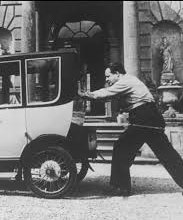
    PHOTOS: Berners, no doubt contemplating the placement of a moustache (right); and Lambert pushing Berners car

  • French Sea Music Beyond Debussy on The Lost Chord

    French Sea Music Beyond Debussy on The Lost Chord

    Claude Debussy wasn’t the only French composer to write music inspired by the sea. This week on “The Lost Chord,” we’ll find refreshment in an hour of “musique de l’eau.”

    Jacques Ibert served as a naval officer during World War I. One of his most frequently performed pieces, “Escales” (“Ports of Call”), conjures impressions of three Mediterranean locales: Palermo, Tunis-Nefti, and Valencia. Considerably less well known is his “Symphonie marine,” composed nine years later, in 1931. Ibert refused to allow the work to be performed in his lifetime, though exactly why is unclear.

    The music actually derives from a film score (for a short film titled “S.O.S. Foch”). Ibert was the first European composer to write music for a talking picture. He certainly wasn’t ashamed of his output for the cinema. In all, he wrote some 30 film scores.

    For whatever reason, the “Symphonie marine” was given its belated premiere shortly after the composer’s death, in 1963, with Charles Munch conducting. We’ll hear the City of Birmingham Symphony Orchestra conducted by Louis Frémaux.

    Joseph-Guy Ropartz (1864-1955) was a student of Théodore Dubois, Jules Massenet, and César Franck. He composed five symphonies, chamber music, and a number of choral works. When his friend, Albéric Magnard, was killed defending his home from German soldiers during the First World War – in retribution Magnard’s house was burned to the ground and his unpublished manuscripts destroyed – Ropartz was able to reconstruct the orchestration of Magnard’s opera, “Guercœur,” from memory, since he had conducted a performance of its third act.

    Ropartz was associated with the Breton Cultural Renaissance and an ardent supporter of Breton regional autonomy. He joined the Breton Regionalist Union in 1898.

    The central movement of his “Prélude, marine et chansons,” composed in 1928 – actually a quintet for flute, violin, viola, cello and harp – is clearly a seascape. The finale is based on an old Breton folk song, “What noise there is upon the earth.” We’ll hear a performance by the Linos Ensemble.

    Another composer with a connection to Brittany was Jean Cras (1879-1932). Cras, who was born and died in Brest, wrote a ravishing opera, “Polyphème” (“Polyphemus”), about a forlorn cyclops, unlucky in love, who wanders off into the sea. Not only was he a productive composer of meltingly lovely music, he was also a career naval officer. And one of distinction. He commanded a torpedo boat in the Adriatic, during the First World War. On one occasion, he sank an enemy submarine, then rescued one of his sailors who had fallen overboard. Clearly he would have written a lot more music if not for the demands of his day job.

    Cras’ “Journal de bord” (“Ship’s Log”) was composed in 1927. Like Debussy’s “La mer,” composed in 1903-05, the work suggests the sea at different times of the day and under various conditions.

    First: Eight to midnight quarter – swell on the open sea, the sky is overcast, clearing at sunset, nothing in sight.

    Second: Midnight to four quarter – beautiful weather, beautiful sea, nothing unusual, moonlight.

    Third: Four to midnight quarter: Land ahoy!

    We’ll hear the Luxembourg Philharmonic Orchestra, conducted by Jean-Francois Antonioli.

    I hope you’ll get yourself a crusty bread, then join me for “Fruits de mer,” a nourishing repast of French music for the sea, this week on “The Lost Chord,” now in syndication on KWAX, the radio station of the University of Oregon!


    Clip and save the start times for all three of my recorded shows:

    PICTURE PERFECT, the movie music show – Friday at 8:00 PM EDT/5:00 PM PDT

    SWEETNESS AND LIGHT, the light music program – ALL NEW! – Saturday at 11:00 AM EDT/8:00 AM PDT

    THE LOST CHORD, unusual and neglected rep – Saturday at 7:00 PM EDT/4:00 PM PDT

    Stream them, wherever you are, at the link!

    https://kwax.uoregon.edu/
  • Armchair Travel Musical Vacation on The Lost Chord

    Armchair Travel Musical Vacation on The Lost Chord

    Armchair travelers, rejoice! This week on “The Lost Chord,” it’s an hour of musical impressions of composers on vacation.

    Tune in for “Postcard Greetings” by Jenö Takács, “Four Breton Sketches” by Anthony Hedges, and “En Vacances” (“On Vacation”) by Deodat de Severac (who was born on this date in 1872).

    No baggage! No fuss!

    Kick back and enjoy the music, on “Leisure Treasures,” on “The Lost Chord,” now in syndication on KWAX, the radio station of the University of Oregon!


    Clip and save the start times for all three of my recorded shows:

    PICTURE PERFECT, the movie music show – Friday at 8:00 PM EDT/5:00 PM PDT

    SWEETNESS AND LIGHT, the light music program – ALL NEW! – Saturday at 11:00 AM EDT/8:00 AM PDT

    THE LOST CHORD, unusual and neglected rep – Saturday at 7:00 PM EDT/4:00 PM PDT

    Stream them, wherever you are, at the link!

    https://kwax.uoregon.edu/
  • KWAX Classical Radio Home of Picture Perfect Sweetness and Light

    KWAX Classical Radio Home of Picture Perfect Sweetness and Light

    I receive a shout-out in this write-up about KWAX from 2013 (at the link). I hasten to emphasize, the article is 11 years old! Still, the station is much the same, even if some of the shows on its roster have changed. It’s rare that classical music hosts are allowed to choose their own music. All the more reason to cherish the station.

    https://northwestreverb.blogspot.com/2013/05/terry-ross-on-kwax-classical-radio.html

    This week’s “Picture Perfect” and “The Lost Chord” are ready to go. I’m in the process of recording my Saturday morning show, “Sweetness and Light,” right now. It’s a celebration of Bastille Day, so yes, lots of French music to come (and some Franz Liszt). The current air times for all three shows are posted below.


    PICTURE PERFECT, the movie music show – Friday at 8:00 PM EDT/5:00 PM PDT

    SWEETNESS AND LIGHT, the light music program – Saturday at 11:00 AM EDT/8:00 AM PDT

    THE LOST CHORD, unusual and neglected rep – Saturday at 7:00 PM EDT/4:00 PM PDT

    Stream them, wherever you are, at the link!

    https://kwax.uoregon.edu/

Tag Cloud

Aaron Copland (92) Beethoven (95) Composer (114) Film Music (123) Film Score (143) Film Scores (255) Halloween (94) John Williams (187) KWAX (229) Leonard Bernstein (101) Marlboro Music Festival (125) Movie Music (138) Opera (202) Philadelphia Orchestra (89) Picture Perfect (174) Princeton Symphony Orchestra (106) Radio (87) Ralph Vaughan Williams (85) Ross Amico (244) Roy's Tie-Dye Sci-Fi Corner (290) The Classical Network (101) The Lost Chord (268) Vaughan Williams (103) WPRB (396) WWFM (881)

DON’T MISS A BEAT

Receive a weekly digest every Sunday at noon by signing up here


RECENT POSTS