Tag: The Lost Chord

  • Thanksgiving Music: Home with Rogers & Copland

    Thanksgiving Music: Home with Rogers & Copland

    With Thanksgiving right around the corner, it’s hardly surprising our thoughts, memories, and desires would be full of home. It’s a good time then to listen to John Fitz Rogers’ “Magna Mysteria.”

    This week on “The Lost Chord,” we’ll hear this 2010 work, which weaves together Latin biblical texts and poetic verse of the 6th century philosopher Boethius, to elevate the idea of home – and the seeking of home – to a metaphorical or spiritual realm. If you have a fondness for the choral music of Morten Lauridsen or Stephen Paulus, I think you’ll really enjoy this, though Rogers is very much his own man. The music is tonal, melodic, and quite lovely.

    Also on the program will be Aaron Copland’s “Letter from Home,” from 1943-44. The work was commissioned by Paul Whiteman for his Radio Hall of Fame Orchestra, and suggests the emotions of an American soldier, as he experiences a bittersweet reprieve, if only for a few moments, while savoring a letter from his family.

    There’s no place like home for the holidays. I hope you’ll join me for “Homebodies,” on “The Lost Chord,” this week on “The Lost Chord,” now in syndication on KWAX, the radio station of the University of Oregon!


    Clip and save the start times for all three of my recorded shows:
    PICTURE PERFECT, the movie music show – Friday at 8:00 PM EST/5:00 PM PST

    SWEETNESS AND LIGHT, the light music program – ALL NEW! – Saturday at 11:00 AM EST/8:00 AM PST

    THE LOST CHORD, unusual and neglected rep – Saturday at 7:00 PM EST/4:00 PM PST

    Stream them, wherever you are, at the link!

    https://kwax.uoregon.edu/

  • Hindemith Birthday KWAX Radio & Bliss Michelson

    Hindemith Birthday KWAX Radio & Bliss Michelson

    I already post too much on Saturdays, since I’m committed to promote my radio shows “Sweetness and Light” and “The Lost Chord,” both of which air today on KWAX (and can be streamed here: kwax.uoregon.edu); but today also marks the birthday of one of the most significant composers of the 20th century. Sometimes I’ll do a search to see what I’ve written about a given anniversary over the past years, and I am frequently awed by my younger self. Who is that guy? I guess once the monomania takes hold, there’s no stopping me. At any rate, I find my observations from 2019 to be interesting and entertaining. I hope you do too. Once you read the post, be sure to scroll down to the comments section to read an amusing anecdote shared by my radio mentor, the late and dearly-missed Bliss Michelson.

    https://www.facebook.com/photo/?fbid=1379019078932045&set=a.279006378933326

    If Bliss’ comment sparks your curiosity to hear Hindy’s Double Bass Sonata, here’s a link to the piece:

    Also, I wonder if this is the Chicago Symphony concert he was referring to?

    Happy birthday, Paul Hindemith.

  • Khachaturian’s Symphony No 2 A Lost Chord Rediscovery

    Khachaturian’s Symphony No 2 A Lost Chord Rediscovery

    Anxious about current events?

    Join me on “The Lost Chord” for Leopold Stokowski’s rarely-heard recording of Aram Khachaturian’s Symphony No. 2.

    Khachaturian composed the work in 1943, the height of World War II, while holed up at a Composers Union retreat with Shostakovich, Prokofiev, Miaskovsky, and Glière. He described the piece as “a requiem of protest against war and violence.” Its nickname, “The Bell,” alludes to a kind of alarm that opens and closes the work. Overall, the tone is one of unshakable resolve in the face of tragedy.

    Stokowski’s recording, long unavailable, was originally issued on United Artists Records in the late 1950s. It reappeared briefly on compact disc, on the EMI label, in 1994, and again in 2009, as part of a 10-disc box set of entrancing Stokowski performances.

    Alas, the master tapes have not weathered the years well, so there are moments of distortion, but the power of the work under Stokowski’s direction transcends any technical limitations.

    To round out the hour, we’ll hear Russian-born pianist Nadia Reisenberg in a selection from her 1947 Carnegie Hall recital, Khachaturian’s most famous piano piece, the “Toccata.” Reisenberg studied at Philadelphia’s Curtis Institute of Music under Josef Hoffman.

    I hope you’ll join me for music by Khachaturian other than the “Sabre Dance.” That’s “Khach as Catch Can,” on “The Lost Chord,” now in syndication on KWAX, the radio station of the University of Oregon.


    Clip and save the start times for all three of my recorded shows:

    PICTURE PERFECT, the movie music show – Friday at 8:00 PM EST/5:00 PM PST

    SWEETNESS AND LIGHT, the light music program – ALL NEW! – Saturday at 11:00 AM EST/8:00 AM PST

    THE LOST CHORD, unusual and neglected rep – Saturday at 7:00 PM EST/4:00 PM PST

    Stream them, wherever you are, at the link!

    https://kwax.uoregon.edu/


    “Sabre Dance” at the Bolshoi, with Khachaturian conducting:

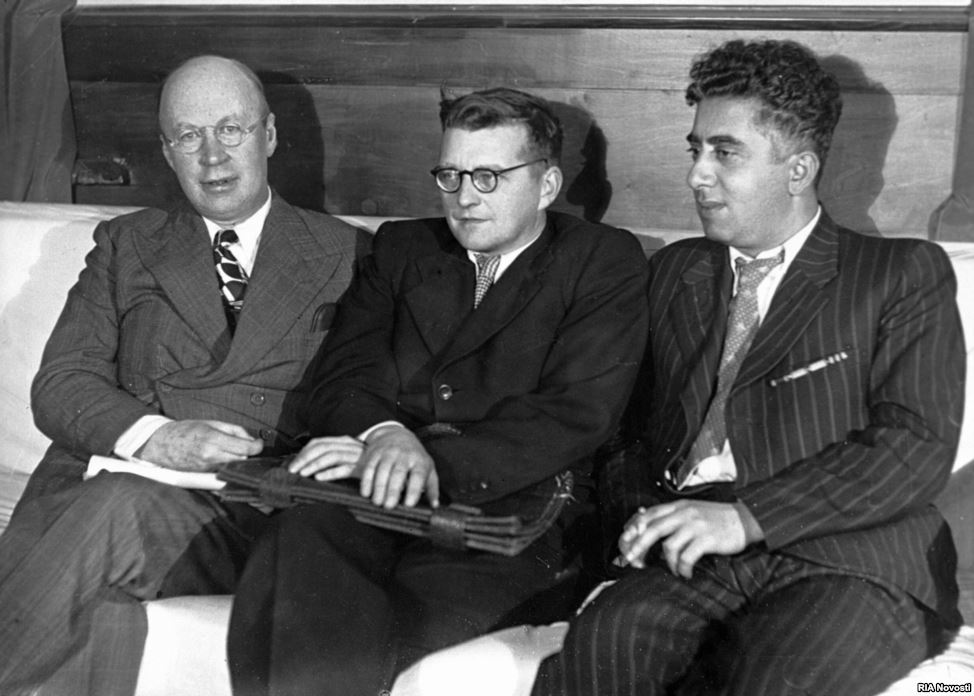
    PHOTO: Troika! (Right to left) Khachaturian with Shostakovich and Prokofiev

  • Ives Bellamann Kings Row A Lost Chord

    Ives Bellamann Kings Row A Lost Chord

    In putting together a special edition of “The Lost Chord” for the 150th anniversary of the birth of Charles Ives, I learn that the first performances of Ives’ “Concord Sonata,” following the work’s publication in 1920, were organized by Henry Bellamann.

    Bellamann, later chairman of the examination board at Juilliard (1924-26) and dean of the Curtis Institute of Music in Philadelphia (1931-32), wrote the bestselling novel “Kings Row.” The book was published in 1940 and adapted into a film by Warner Bros. in 1942.

    I’ve always loved “Kings Row,” the movie, even though it is rather bizarre and over-the-top. Okay, I admit it: I love it BECAUSE of those things. It’s actually a very grim story, anticipating the work of David Lynch, in some respects, as it gradually reveals the dark underbelly of life in a small Midwestern town. A sign on the outskirts advertises it as “a good town… a good clean town… a good town to live in… and a decent place to raise your children.” Of course it’s none of those things. But for as dark as the movie gets, it somehow never loses its sense of optimism. Bellamann’s book, on the other hand, is unrelentingly melancholy and bleak-as-hell. I have to say, it’s a massive downer. Even so, readers adored it. So much so, that Bellamann was spurred to write a sequel (which I have not read), “Parris Mitchell of Kings Row.”

    As you can imagine, the notoriety of “Kings Row” caused quite a stir in Bellamann’s hometown of Fulton, Missouri, and not necessarily because of its success. Rather, a few too many people and institutions recognized themselves in the extremely unflattering narrative. Allegedly the book was banned from the town library, and Bellamann was the target of at least one indignant editorial in the local newspaper.

    “Kings Row” is one of the most subversive films of Hollywood’s golden age. How it managed to get around the Hays Code is anybody’s guess, but I’m putting my money on the music by Erich Wolfgang Korngold, which breathes uplift and hope into what could have been two hours and seven minutes of sustained misery.

    Also, the ending was changed, such an obvious overcompensation, with the climax an almost ludicrous eruption of joy. It’s a neat trick, as somehow, in the film, not only is the wicked in human nature balanced by the good, but the whole is infused with an undercurrent of nostalgia for a passing world. It’s kind of like how people choose to remember “It’s a Wonderful Life,” even though you have to go through hell before you get to heaven.

    Amusingly, from the title, Korngold thought he was being assigned yet another historical adventure (he was Warners’ composer of choice for the Errol Flynn swashbucklers), which is why the theme is so wildly exuberant. By 1942, Korngold could do pomp and braggadocio in his sleep. When he learned of his misunderstanding, he just kept at it. And what a happy accident! The film is so much better – and so much more bearable – than it otherwise would have been. After all, how much madness, suicide, amputation, and incest can one take, especially in the 1940s? It really is quite the sleight of hand.

    FUN FACT: When John Williams came to write the main title for “Star Wars,” “Kings Row” was one of his principal inspirations.

    It was decades earlier that Bellamann reached out to Ives, in preparation for his lectures on the “Concord Sonata.” Bellamann toured the work across the American South, from New Orleans to Spartanburg, South Carolina, providing spoken introductions to each of the four movements, the music itself performed by pianist Lenore Purcell.

    Bellamann would go on to write important articles about Ives, based on his extensive correspondence with the composer. He was the first to report on the influence of Ives’ musically progressive father, George, who was as much ahead of his time as Charles would be, and the composer’s perceptions of his hidebound teacher, Horatio Parker. Bellamann also provided program notes for some early Ives’ performances.

    A graduate of Westminster College in Fulton (no relation to the Princeton institution), Bellamann also studied piano at the University of Denver. He then taught music at several girls’ schools in the South, while in the summers, he traveled to Europe to continue his studies with Charles-Marie Widor and Isador Philipp. Bellamann would hold several prominent administrative and teaching positions in the U.S. In addition to his work at Juilliard and Curtis, he was also a professor of music at Vassar College.

    Since I won’t be talking about him on my Ives show, I figured I’d mention him here. The “Concord Sonata” will be heard in a most unusual form on “Concord and Discord,” an all-new episode of “The Lost Chord,” this Saturday, the eve of Ives’ sesquicentenary, at 4:00 EDT/7:00 PDT, exclusively on KWAX, the radio station of the University of Oregon.

    Stream it wherever you are at the link:

    https://kwax.uoregon.edu/


    CLOCKWISE FROM LEFT: Ives; Bellamann; and 680 pages of pure misery

  • Florent Schmitt Rediscovered Composer

    Florent Schmitt Rediscovered Composer

    Florent Schmitt was one of the most successful French composers of the early 20th century. However, as fashions changed, his characteristically opulent music became marginalized, only to experience something of a revival, in recent years, mostly on recordings.

    This week on “The Lost Chord,” we’ll mark the anniversary of Schmitt’s birth (on September 28, 1870) by sharing selections from his incidental music for a production of Shakespeare’s “Antony and Cleopatra” and his grandiose setting of “Psalm XLVII.”

    Schmitt entered the Paris Conservatory in 1889, where he studied with Gabriel Fauré, Jules Massenet, and Théodore Dubois. He was a winner of the Prix de Rome in 1900. He also befriended Frederick Delius, while Delius was in Paris, and prepared the vocal scores for a number of his operas.

    In addition, Schmitt was a music critic, who attained a degree of notoriety for shouting out his assessments from the audience. He was described by one music publisher as an irresponsible lunatic.

    The later neglect of his music may have been due, in part, to his willingness to go along with the Vichy regime during the Nazi occupation of France. But Schmitt is too fascinating a figure to be dismissed out-of-hand. Stravinsky was an early admirer, remarking that the composer’s “The Tragedy of Salome” gave him greater joy than any other he had heard in a long time. Certain elements of the ballet anticipate analogous experiments in Stravinsky’s own “The Rite of Spring.”

    Indeed, Schmitt’s appetite for overheated decadence and lurid orientalism seems to have been insatiable. There will be nothing on our menu this week but overegged Florentine. I hope you’ll join me for “Schmitt Happens,” on “The Lost Chord,” now in syndication on KWAX, the radio station of the University of Oregon!


    Clip and save the start times for all three of my recorded shows:

    PICTURE PERFECT, the movie music show – Friday at 8:00 PM EDT/5:00 PM PDT

    SWEETNESS AND LIGHT, the light music program – ALL NEW! – Saturday at 11:00 AM EDT/8:00 AM PDT

    THE LOST CHORD, unusual and neglected rep – Saturday at 7:00 PM EDT/4:00 PM PDT

    Stream them, wherever you are, at the link!

    https://kwax.uoregon.edu/


    Exhaustive website devoted to all things Florent Schmitt: florentschmitt.com

Tag Cloud

Aaron Copland (92) Beethoven (95) Composer (114) Film Music (123) Film Score (143) Film Scores (255) Halloween (94) John Williams (187) KWAX (229) Leonard Bernstein (101) Marlboro Music Festival (125) Movie Music (138) Opera (202) Philadelphia Orchestra (89) Picture Perfect (174) Princeton Symphony Orchestra (106) Radio (87) Ralph Vaughan Williams (85) Ross Amico (244) Roy's Tie-Dye Sci-Fi Corner (290) The Classical Network (101) The Lost Chord (268) Vaughan Williams (103) WPRB (396) WWFM (881)

DON’T MISS A BEAT

Receive a weekly digest every Sunday at noon by signing up here


RECENT POSTS