Tag: Tin Pan Alley

  • George M Cohan Broadway’s Yankee Doodle Boy

    George M Cohan Broadway’s Yankee Doodle Boy

    Of course, everyone knows that Broadway luminary George M. Cohan was born on the Fourth of July.

    Except he wasn’t. This was one Yankee Doodle Dandy who was actually born on July 3rd.

    Cohan was born in Providence, Rhode Island, on this date in 1878, but he and his family always maintained he was a Yankee Doodle Boy.

    Cohan was tied to the theater from childhood. He first appeared on stage as a violinist at the age of 8. Later, he became famous for his wisecracks and eccentric dancing.

    He could be quite temperamental in his youth – a trait he apparently tamed – more than once declaring himself “through with the theater.” If he felt particularly ill-used, he was known to walk out on a performance.

    He also became a prolific tin pan alley songsmith, displaying a rare gift. His songs were noted for their clever lyrics and catchy melodies, and a number of them remain immediately recognizable, including “Give My Regards to Broadway,” “It’s a Grand Old Flag,” “Over There,” “Mary is a Grand Old Name,” “Always Leave Them Laughing When You Say Goodbye,” and of course “The Yankee Doodle Boy.”

    But it soon became apparent he was not just a song and dance man. In fact, he became regarded as the most versatile figure in American theater. From 1904 to 1920, with his friend and business partner Sam H. Harris, he produced over 50 Broadway musicals, plays, and revues. He pioneered the “book musical,” with his songs serving a dramatic story. He was also noted for his stirring, flag-waving finales.

    But it wasn’t all about simply pleasing the crowd in his own vehicles. He also earned plaudits for his performance in Eugene O’Neill’s “Ah, Wilderness!”

    Cohan himself was a playwright and also a theater owner. For a time, he and Harris owned Chicago’s Grand Opera House, which in 1912 became known as George M. Cohan’s Grand Opera House. In 1926, it was renamed the Four Cohan’s Theatre. It reverted to the Grand Opera House with its sale to the Shubert family in 1928.

    So many of Cohan’s songs are still so well known, I suppose in part because of the Cagney movie (“Yankee Doodle Dandy,” released in 1942), but also because we used to sing them in school, and heard them at parades, and they’re just good solid tunes from a more innocent age that allowed one to be proud and uncomplicated.

    Cohan did live to see the film, by the way. “My God,” he commented of Cagney’s performance, “what an act to follow.” The Academy thought so too, as Cagney was honored with an Oscar for Best Actor. The film also won the Academy Award for Best Picture.

    Cohan’s obituary in the New York Times described him as perhaps the greatest song and dance man in Broadway history. FDR awarded him the Presidential Medal of Freedom, and Deems Taylor, president of ASCAP and a composer himself, described him as a genius. He died of abdominal cancer in 1942 at the age of 64.

    Cohan wasn’t the only American icon to claim the Fourth of July as his birthdate. Louis Armstrong also celebrated the anniversary of his birth on July 4th. The truth is he didn’t know when he was born, so he and his manager selected Independence Day. What could be more American than that? It wasn’t until the 1980s, well after Armstrong’s death, in 1971, that a researcher discovered Satchmo’s baptismal records and learned that his authentic birthdate was August 4, 1901.

    You know who WAS born on the Fourth of July? ME!

    For the record, if I didn’t know when I was born, I would have chosen Halloween.

    Happy birthday, George M. Cohan!


    Cohan’s obituary in the New York Times

    https://archive.nytimes.com/www.nytimes.com/learning/general/onthisday/bday/0703.html

    Enrico Caruso sings “Over There”

    Cagney and company with “You’re a Grand Old Flag”

    https://www.youtube.com/watch?v=QgdyJX1jaUI

    The film’s trailer

    From a PBS documentary

    George M. Cohan speaks


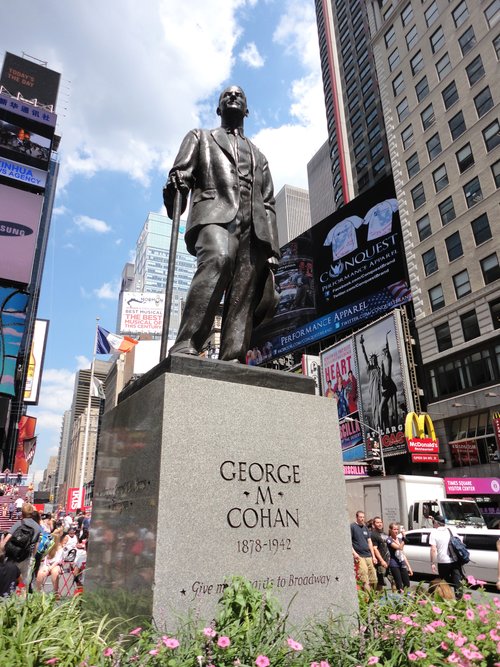
    PHOTO: Cohan statue in Times Square

  • George Gershwin Life in Music Broadway Jazz

    George Gershwin Life in Music Broadway Jazz

    He began his career as a song plugger on New York’s Tin Pan Alley. He was “discovered” by Al Jolson, who gave him his biggest hit. He composed a string of successful stage musicals with lyrics by his brother, Ira.

    Though he had classical training, he was turned away by both Nadia Boulanger and Maurice Ravel, on the grounds that they didn’t want to spoil his natural voice. He played tennis with Arnold Schoenberg, who also refused him lessons. He kept an autographed photo of Alban Berg in his apartment, next to one of Jack Dempsey.

    His musical, “Of Thee I Sing,” was the first to win a Pulitzer Prize. His opera, “Porgy and Bess,” was a failure at its premiere. His songs graced elegant screen comedies of the 1930s. In the concert hall, he was America’s most authentic voice.

    George Gershwin died of a brain tumor in 1937, at the age of 38. Reportedly, his last words were “Fred Astaire.”

    Here are a couple of fascinating documents, set down in 1926, of Fred and Adele Astaire singing with Gershwin at the piano.

    The Astaires headlined two of Gershwin’s Broadway musicals, “Lady Be Good!” (1924) and “Funny Face” (1927). Adele married in 1932 and retired from show business. Fred later starred in the film musicals “Shall We Dance”(1937) and “A Damsel in Distress” (1937), both at least partially scored by Gershwin.

    Gershwin received his only Academy Award nomination for Best Original Song in 1937, for “They Can’t Take That Away from Me,” from “Shall We Dance.” The nomination was posthumous, as Gershwin had died two months after the film’s release.

    The flame that burns twice as bright burns half as long. Happy birthday, George Gershwin.


    PHOTO (left to right): Fred, George and Ira

  • George Gershwin American Original

    George Gershwin American Original

    He began his career as a song plugger on New York’s Tin Pan Alley. He was “discovered” by Al Jolson, who gave him his biggest hit. He composed a string of successful stage musicals with lyrics by his brother, Ira.

    Though he had classical training, he was turned away by both Nadia Boulanger and Maurice Ravel, on the grounds that they didn’t want to spoil his natural voice. He played tennis with Arnold Schoenberg, who also refused him lessons. He kept an autographed photo of Alban Berg in his apartment, next to one of Jack Dempsey.

    His musical, “Of Thee I Sing,” was the first to win a Pulitzer Prize. His opera, “Porgy and Bess,” was a failure at its premiere. His songs graced elegant screen comedies of the 1930s. In the concert hall, he was America’s most authentic voice.

    George Gershwin died of a brain tumor in 1937, at the age of 38. Reportedly, his last words were “Fred Astaire.”

    I invite you to join me this afternoon, as I salute this versatile composer on his birthday anniversary. Gershwin’s music will be among our featured highlights, between 4 and 7 p.m. EDT, on WWFM – The Classical Network and at wwfm.org.

Tag Cloud

Aaron Copland (93) Beethoven (95) Composer (114) Film Music (127) Film Score (143) Film Scores (255) Halloween (94) John Williams (190) KWAX (229) Leonard Bernstein (102) Marlboro Music Festival (125) Movie Music (142) Mozart (87) Opera (205) Philadelphia Orchestra (89) Picture Perfect (174) Princeton Symphony Orchestra (107) Radio (88) Ross Amico (244) Roy's Tie-Dye Sci-Fi Corner (290) The Classical Network (101) The Lost Chord (268) Vaughan Williams (103) WPRB (396) WWFM (881)

DON’T MISS A BEAT

Receive a weekly digest every Sunday at noon by signing up here


RECENT POSTS