I’m up to my ears in housecleaning, digging through stacks of old boxes, exhuming all sorts of interesting concert programs and program guides, theater schedules, and personal writings, documents, and artwork, some of them dating back 40 years. The chain I’ve forged in life!
Leave it to me not to throw anything away…
But more on that in another post.
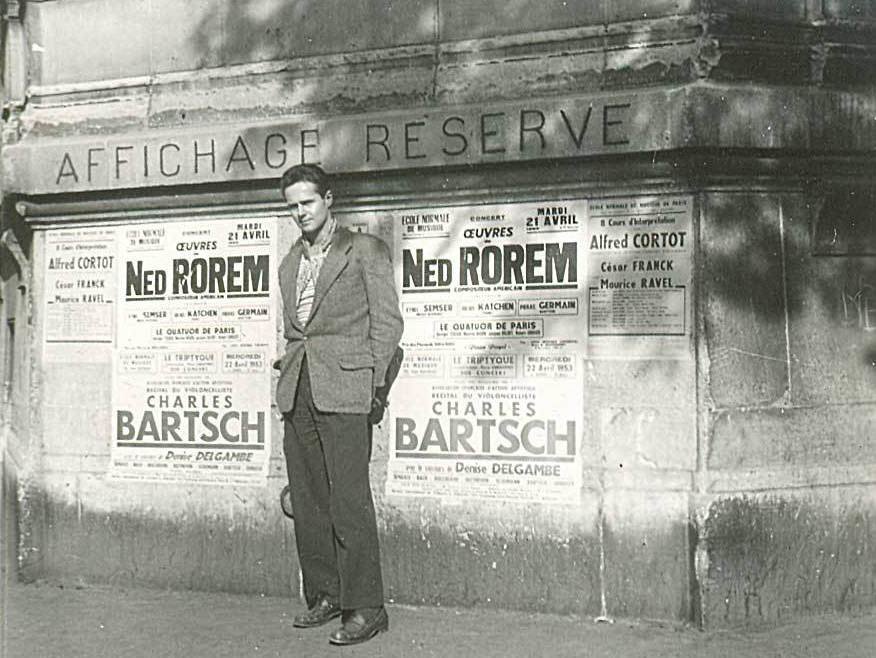
For now, I wanted to quickly acknowledge American composer Ned Rorem, who would have been 100 today. Rorem died last year on November 18.
I hope you’ll pardon me for stacking up a few links from last year.
I apologize if, when writing about Howard Pollock’s Copland biography the other week, I may have come across as a tad immodest, when stating that, because of my lifelong mania for classical music, I was likely to have a more rounded understanding of the material than your average reader. As always, pride comes before the fall, as I’ve since encountered at least one name in the book that was entirely unfamiliar to me.
On the anniversary of the birth of Virgil Thomson, here’s a photo of the composer, left, with his assistant and copyist, Ned Rorem, right. New to me is the figure at center, the composer William Flanagan.
In his day, Thomson was an extraordinarily important figure in American music, both as a composer and as critic at the New York Herald-Tribune. Rorem, who died earlier this month, at the age of 99 (outliving even Thomson, who died at 92), is regarded one of the foremost composers of American art song.
Rorem provided the entry for Flanagan in the “New Grove Dictionary of Music and Musicians.” In his book, “Music and People,” he described his musical style thusly: “Flanagan yearns… for the more easy communicative style that ripened in America nearly twenty years ago [in the 1940s]…. Flanagan’s musical ‘birth’ is of that time, and in growing he has remained faithful to its premise, if not to the specific mannerisms of the period.”
Flanagan wrote a lot of music for the plays of Edward Albee, who was his longtime companion, as well as an opera with Albee after Melville’s “Bartleby the Scrivener.” At the time of his death, at 46, he was planning an artists’ colony in Montauk. This is now the William Flanagan Memorial Creative Persons Center (commonly referred to as “The Barn”), maintained by the Edward F. Albee Foundation.
Flanagan was unusual among composers of his generation in expressing an unqualified and heartfelt enthusiasm for Copland’s music. He was among Copland’s students at Tanglewood in 1947.
From Pollock’s book:
“[A]ccording to Ned Rorem, Copland was, along with Ravel, “the twentieth-century musician closest to his heart.” “You know well that I have always been hopelessly addicted to your music,” Flanagan once wrote to Copland. “But addicted or not, I couldn’t be convinced that there is a composer living who could move ME, at any rate, as you do with the music of the mother’s closing song [in ‘The Tender Land’].” He also defended “Connotations” against the widely circulated “Total gloom descriptions” surrounding the work. In 1962, he described Copland as “the guy whose work has been the most important single influence on one’s way of thinking about the profession he has chosen to occupy his life.” Over the years, Copland regularly offered Flanagan advice and guidance; after Flanagan took his life in 1969, Copland eulogized him at a memorial concert.”
Later in the book, Pollock writes:
“William Flanagan similarly thought that whatever its strengths and weaknesses, the libretto [for ‘The Tender Land’] “falls into its properly subordinate place and the music moves in – a phenomenon that has occurred with many works in the standard operatic repertory. And this music is almost without question the finest composed for an American opera.”
Flanagan managed to resist the dueling gravitational forces of both Stravinsky’s neoclassicism and Schoenberg’s dodecaphony. In common with Rorem, though less prolific, he was best-received as a song composer. His songs “Horror Movie” and “The Upside-Down Man” have been recorded, but so far I have been unable to locate any sound files. In fact, the only one of Flanagan’s pieces I’ve been able to find on the internet is “A Concert Ode” (1951):
Happy birthday, Virgil Thomson; R.I.P., Ned Rorem; and hello, William Flanagan!
The perfect Thanksgiving music? Virgil Thomson’s “Symphony on a Hymn Tune.”
Another seasonal work: the Concertino for Harp, Strings and Percussion, “Autumn” – according to Thomson, actually more of a “portrait of an artist aging.”
A fairly recent production of Thomson’s Susan B. Anthony opera “The Mother of Us All,” on a libretto by Gertrude Stein
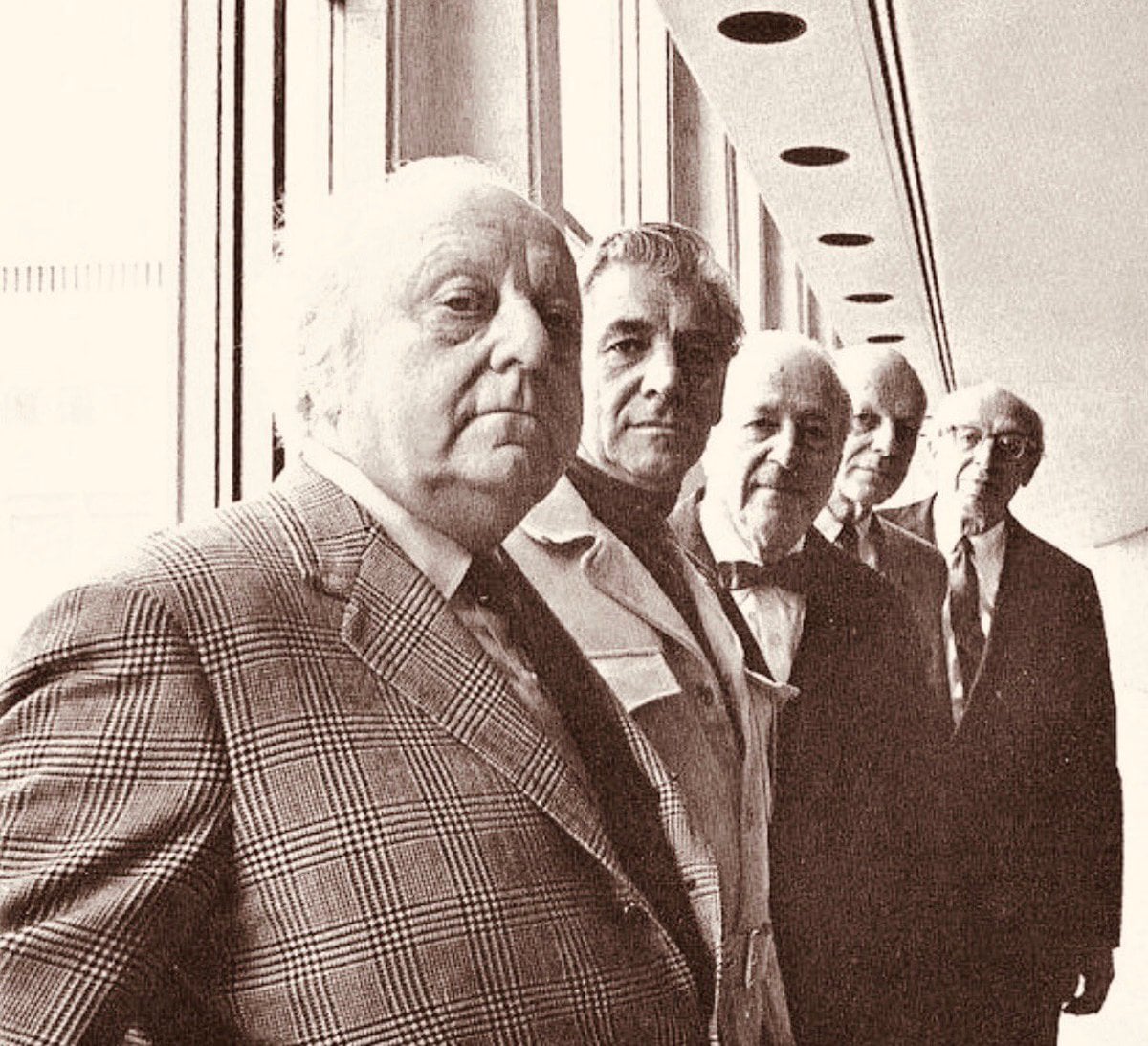
When it falls to America’s great composers to wrest the Tesseract from Thanos, these are the guys Nick Fury assembles. Then Bernstein conducts “West Side Story,” and it is the orchestra that snaps.
Back-to-front, we have Aaron Copland, William Schuman, Walter Piston, Leonard Bernstein, and Virgil Thomson – all of them, with the exception of Lenny, recipients of the Pulitzer Prize for Music. Piston was honored twice.
At the fore, Thomson defies us to take our best shot. His superpower is that he was not only a respected composer, but also a feared critic at the New York Herald-Tribune. This is a man even Thanos would think twice about crossing.
He is especially powerful on this date every seven years or so, during the alignment of his birthday with Thanksgiving.
I understand there are some who remain resistant to his charms. His brand of “faux-naïf” Americana is perhaps not for everyone.
His “Symphony on a Hymn Tune” was composed during his Paris years. Thomson, like Copland and so many others, studied there with Nadia Boulanger. The symphony was inspired by the composer’s memories of his Kansas City boyhood. The “Sunday best” of the church hymns occasionally gets tangled up in a few modernistic burrs – the exchanges between the violin, cello, trombone, and piccolo at the end of the first movement, for instance – but in 1928, it was a landmark in terms of helping to establish a distinctly American idiom. To me, it is perfect Thanksgiving music.
More austere, perhaps, is Thomson’s symphonic poem “Pilgrims and Pioneers” – but just stick around for the fiddle tunes.
Finally, a seasonal work: the Concertino for Harp, Strings and Percussion, “Autumn” – according to Thomson, actually more of a “portrait of an artist ageing.”
And Thomson sure did age. Hard to believe I was already doing radio in his later years.
Happy birthday, Virgil Thomson (1896-1989) – and Happy Thanksgiving!
Check out Thomson on TV!
PHOTO: Just don’t make him angry. You wouldn’t like him when he’s angry. THOMSON SMASH!
A “semi-documentary” is documentary-like, but allows staged or fictional elements, sometimes recreations or reenactments, sometimes flat-out embellishments, often with non-actors playing most of the roles. This week on “Picture Perfect,” enjoy music from four acclaimed examples.
Aaron Copland, one of America’s most respected composers, was more active in film than most people realize. He even won an Academy Award in 1950, for his score to “The Heiress.”
During the World War II, Copland was approached by the Office of War Information to score a brief film about the resettlement of European refugees in a rural Massachusetts town. The film was called “The Cummington Story” (1945). The music is rather interesting in that, having been written at the height of Copland’s “populist” phase, he employs melodies which were later fleshed out into more familiar concert works, such as the Clarinet Concerto and “Down a Country Lane.”
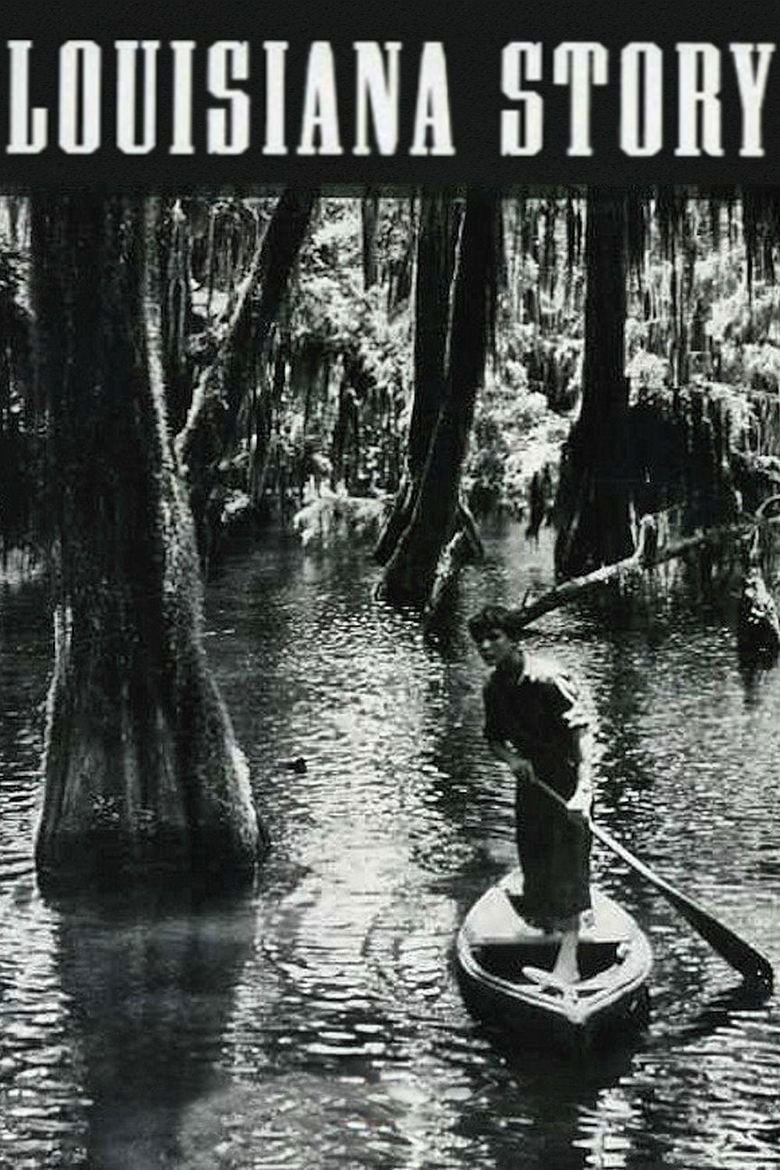
Director Robert Flaherty’s “Louisiana Story” (1948) is often misidentified as a straight documentary. (Flaherty made the first commercially-successfully, feature-length documentary, “Nanook of the North,” in 1922 – itself later revealed to have been more of a docudrama.) However, the plot is entirely fictional, an idealized story of a Cajun family that reaps the rewards of oil drilling that takes place in an inlet behind its house. The film was shot on location in bayou country, using Cajun locals as actors, giving it a certain verisimilitude.
Although it was selected for preservation in the United States film registry by the Library of Congress as being “culturally, historically or aesthetically significant,” and its script was nominated for an Academy Award, “Louisiana Story” acts as a kind of time capsule in its naiveté. Perhaps the most interesting aspect of the entire project is the film’s score, by American composer and revered critic of the New York Herald Tribune, Virgil Thomson. So far, it is the only film score ever to be awarded the Pulitzer Prize for Music.
Like Copland and Thomson, Ulysses Kay is associated more with his works for the concert hall. Nevertheless, he wrote music for numerous television shows and documentaries in the late 1950s and early ‘60s. His first scoring assignment was for an experimental quasi-documentary called “The Quiet One” (1948), a film about an abused African American child and his subsequent coming of age. The film received an Oscar nomination for Best Story and Screenplay, and was listed as one of the ten best movies of the year by the New York Times and the National Board of Review. Kay, a long-time resident of Teaneck, NJ, was a rarity in the world film scoring, a composer of color.
Finally, we’ll turn to Morton Gould and “Windjammer” (1958), the only film ever to be shot in the widescreen “Cinemiracle” format. “Windjammer” depicts the training cruise of a fully-rigged sailing ship, from Oslo, across the Atlantic, to the Caribbean, New York, and back home again. Its dreamy theme music is full of the romance of the high seas.
Artistic truth is based on fact this week. I hope you’ll join me for an hour of selections from semi-documentaries on “Picture Perfect,” music for the movies, this Saturday evening at 6:00 EST, on WWFM – The Classical Network and wwfm.org.
The New York Philharmonic has begun sharing some of its past performances on Facebook. Of particular interest is this rare presentation of Virgil Thomson’s 1947 opera, “The Mother of Us All.” Thomson composed his Susan B. Anthony opera to a libretto by Gertrude Stein.
The new, site-specific staging was a collaboration with The Metropolitan Museum of Art and the Juilliard School, and was performed in February.
The presentation is part of “Project 19,” a multi-season New York Philharmonic initiative that also encompasses commissions by 19 women composers, in honor of the centennial of the 19th Amendment. They claim this the largest women-only commissioning initiative in history.
Virgil Thomson’s “The Mother of Us All” will stream on the Metropolitan Museum Facebook page, tonight at 7 p.m.