It’s the first day of spring – and Palm Sunday, to boot. With March already slipping away, on this week’s edition of WWFM’s “The Lost Chord,” I’ve opted to focus on contributions of two female composers in honor of Women’s History Month. Both were featured on my earlier, WPRB salute.
However, I feel in some way that I could have made a stronger case for Vitězslava Kápralová (1915-1940). While I called her one of the great hopes of Czech music, a figure who undoubtedly would be much better known had she not died of tuberculosis at the age of 25, I opted to play her “Partita for Strings and Piano.” While impressive, the work was written very much under the influence of her teacher and lover, Bohuslav Martinu. Martinu’s fingerprints are all over the piece.
Her String Quartet, on the other hand, was written while she was yet a student at the Prague Conservatory, where her teachers included Vitězslav Novák and Václav Talich. (She studied with Martinu later in Paris.) The work was completed in 1936, when Kápralová was about 21 years-old. In many ways it is a more distinctive and appealing creation. Judge for yourself tonight.
More about Kápralová here, in this article written to mark her centenary in 2015:
Then we’ll have a chance to enjoy a second hearing of Ethel Smyth’s “Serenade in D” – a symphony in all but name – which brought such a positive response when I played it a few weeks ago on WPRB. What I neglected to mention on that occasion was that the piece was Smyth’s first orchestral score, composed in 1890, when she was about 32 years-old.
I did state that the “Serenade” is better than just about anything composed by her contemporary, Sir Hubert Parry, and much more compelling than the symphonies of Sir Charles Villiers Stanford, and I stand by those assessments. It’s a remarkably assured work, and one that deserves to be far better known.
Smyth (later DAME Ethel Smyth, 1858-1944) was one of the most vocal advocates of the women’s suffrage movement in England. She overcame early opposition to a career in music on the part of her father to receive the praise of George Bernard Shaw, who called her Mass “magnificent.”
However, her works were often better-appreciated abroad. Her operas, in particular, were embraced in Germany. One of them, “Der Wald,” was the only opera by a woman composer mounted by New York’s Metropolitan opera for over a century!
Smyth served time in prison for putting out the windows of politicians who opposed a woman’s right to vote. She also wrote for the cause “The March of the Women.” When Sir Thomas Beecham went to visit her in jail, he witnessed her conducting through the bars of her window with a toothbrush as her associates gathered for exercise in the courtyard.
More about Ethyl Smyth here, in this piece put together in connection with a revival of her opera, “The Wreckers,” by the great Leon Botstein:
I hope you’ll join me tonight on “The Lost Chord” for music by these two extraordinary women – “A Woman’s Place is in the Concert Hall” – this Sunday night at 10 ET, with a repeat Wednesday evening at 6; or that you’ll listen to it later as a webcast at wwfm.org.
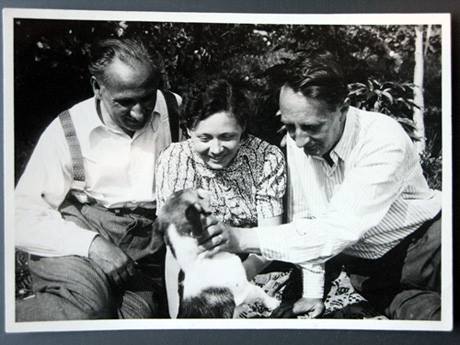
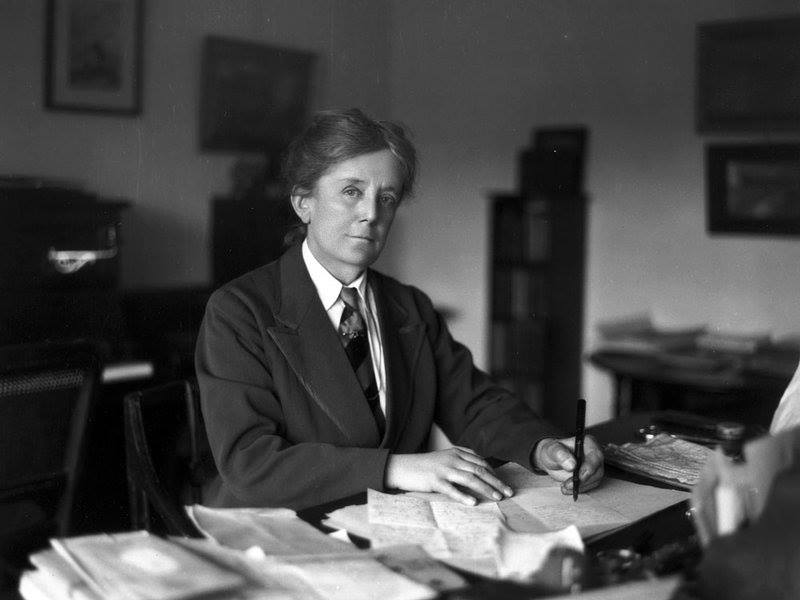
PHOTOS: Ethel Smyth at her desk (top); Vitězslava Kápralová taking up the baton (she studied conducting in Prague with Václav Talich and in Paris with Charles Munch)