December 7, FDR’s “day of infamy.”
On this date in 1941, a Japanese strike force of 353 aircraft laid waste to the United States naval base on Oahu, Hawaii. Thousands of American servicemen and civilians were killed, precipitating the country’s entry into World War II.
Although Europe, Russia, and the Far East were already at war, for the U.S. the attack on Pearl Harbor was an unanticipated catastrophe in peacetime. Days always start early in the service, but 7:48 on 12/7/41, a Sunday, will always be the wake-up call nobody wanted to get.
In past years, I’ve written about American-born composers with connections to those caught in the attacks or who memorialized those who perished in them. This year, I direct your attention to two European refugees who proudly embraced their adopted country in its time of need. Both were Jewish. Both got out of Nazi Germany early, in 1933.
Kurt Weill was denounced by the Nazis not only on racial grounds, but also for his leftist political leanings. After an interlude in Paris, he and his wife, Lotte Lenya, arrived in New York in 1935. There, he reinvented himself, embracing American popular song and stage music and finding success as a composer for Broadway. He became an American citizen in 1943.
Three of Weill’s Walt Whitman songs – “Beat! Beat! Drums!,” “Oh Captain! My Captain!,” and “A Dirge for Two Veterans” – were written in response to the Pearl Harbor attack. He composed a fourth, “Come Up from the Fields, Father,” in 1947. Weill went on to orchestrate the first three of them. Carlos Surinach orchestrated the last, following the composer’s untimely death, three years later, at the age of 50.
Arnold Schoenberg, who was actually Austrian, also left Germany in 1933. When the Nazis banned Jews from the universities, he lost his teaching position at the Prussian Academy of Arts. Furthermore, his music was branded “degenerate.” Schoenberg had actually converted to Lutheranism in 1898; but Nazi anti-Semitism caused him to swing back hard to Judaism, in defiance of Hitler. He became an American citizen in 1941.
In contrast to Weill, Schoenberg found the vulgarity and vacuity of much of American culture frustrating. Yet he was clearly grateful to have been “driven into paradise,” as he described it, where “my head can be erect.”
The attack on Pearl Harbor stirred him to reflect on his indebtedness to his adopted country. Leonard Stein, his assistant at the time, recollected a conversation they had had on December 7, following the bombing, which led him to believe that perhaps Schoenberg’s “Ode to Napoleon” was written in direct response to the event. More broadly, the composer’s setting of the poem by Lord Byron is a thrust in the face of tyranny that culminates in a commitment to the ideal of democracy as personified by George Washington.
Not popular entertainment, perhaps – sprechstimme would be a hard-sell for the masses – but clearly Schoenberg had his heart in the right place.
Weill, “Four Walt Whitman Songs” (orchestrated)
Schoenberg, “Ode to Napoleon”
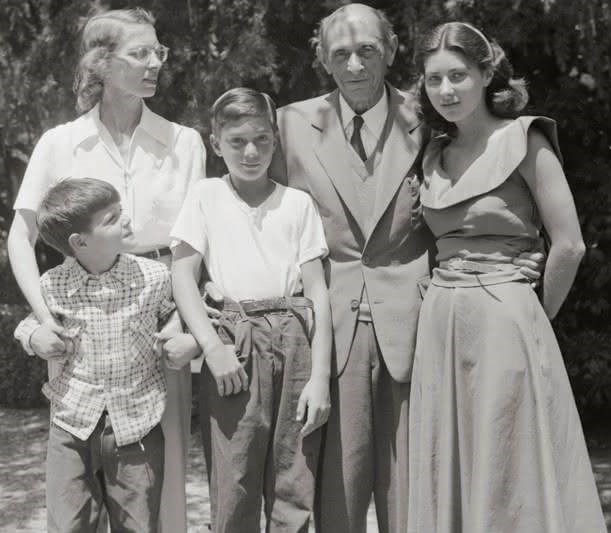
PHOTOS: Schoenberg and family in the 1940s; Weill and Lenya at the piano