Tag: WFLN

  • WFLN Philadelphia Airchecks Jill Pasternak & More

    WFLN Philadelphia Airchecks Jill Pasternak & More

    My recent posts about Jill Pasternak have prompted me to go back and search out a few air checks of WFLN that I’d been able to find online. WFLN served as Philadelphia’s only full-time classical music radio station since 1949. Pasternak, who was hired in 1986, was the one tasked with bidding farewell, before the frequency’s changeover to a contemporary pop format, on September 5, 1997.

    At the link below, you’ll find her in happier times, sitting in for Bill Shedden and hosting “Evening Concert” on August 20, 1989. Jill introduces music by Balakirev, Tchaikovsky, and Rachmaninoff. (The audio cuts off shortly after she announces Rimsky-Korsakov’s “Scheherazade.”)

    On the same page, there’s a sound file of Frank Kastner hosting on October 22, 1989. Kaster was the announcer who signed on the station on March 14, 1949 (his 25th birthday), playing Brahms’ “Academic Festival Overture,” Rachmaninoff’s Piano Concerto No. 2, and Sibelius’ Symphony No. 2 from 78 rpm records. The playlist here consists of Léo Delibes’ “Coppélia” (in progress) and Ralph Vaughan Williams’ Partita for String Orchestra (sadly, cutting off before the end).

    WFLN (Philadelphia) Evening Concert

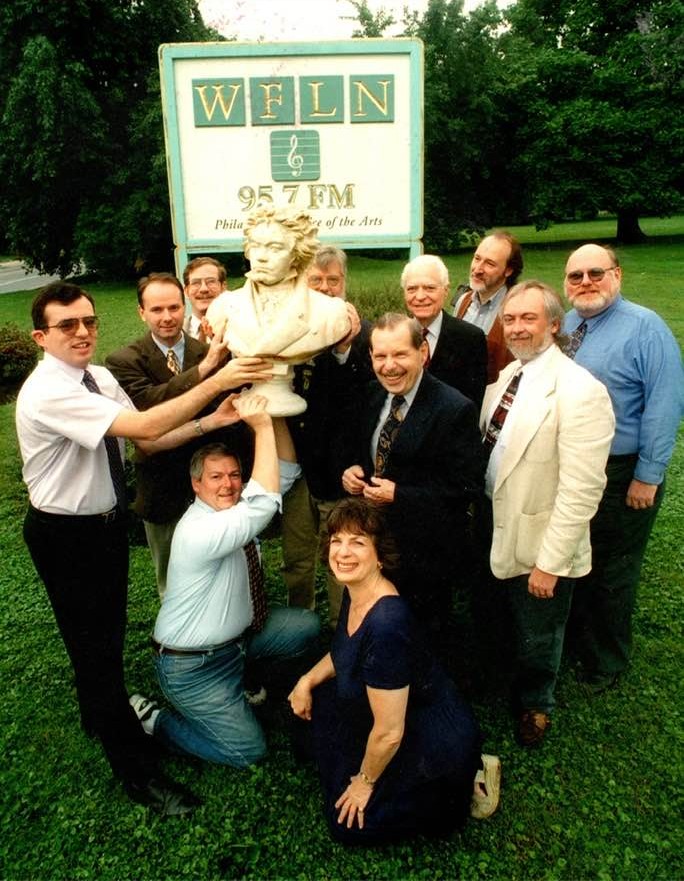
    PHOTO: Representatives of the WFLN crew in 1997, Jill Pasternak kneeling in front. I also recognize Mark Pinto (left), Dave Conant (obscured), Frank Kastner (with mustache), Charles Lee (white hair), Jack Moore (white jacket), Bill Shedden (blue shirt). Anyone know the others?

  • Remembering WFLN Philadelphia’s Lost Classical Station

    Remembering WFLN Philadelphia’s Lost Classical Station

    My post on July 28 about the passing of WRTI radio host Jill Pasternak stimulated some interesting reader comments and a lot of personal memories about Jill’s former employer, the late, great WFLN, Philadelphia’s full-time classical music station for nearly 50 years. I am a nostalgic person by nature, so it’s easy for me to get lost for hours sometimes obsessively googling favorite subjects from the past. WFLN flourished largely in the days before the internet, so every nugget is hard-won and savored to the fullest. I wish there were more out there. But I am always digging.

    Yesterday, David Nethermark Carson left a message on the Pasternak post. He was WFLN’s chief engineer for a time in the 1950s. That reminded me of this blog I stumbled across a few years ago by former WFLN host Gordon Spencer, who also goes way back. It occurs to me, I may never have mentioned it or shared the link. There’s not much to it, only a few entries, but it offers some valued glimpses of the Wild West days of Philadelphia’s now-lamented classical music station. Since WFLN was sold in 1997 (28 years ago???), the sixth largest city in the United States has been without a full-time classical music broadcast outlet.

    WRTI, as Temple University’s former full-time jazz station, now divides its schedule between jazz and classical. Interestingly, I learn from Spencer’s reminiscences that at one time WFLN offered jazz as well.

    Spencer died in 2018 at the age of 84. His entries are prefaced with a remembrance by his wife.

    https://stationbreaks2bygordonspencer.umkc.edu/

  • Remembering Jill Pasternak & WFLN’s Golden Age

    Remembering Jill Pasternak & WFLN’s Golden Age

    Whenever one of the old WFLN roster dies, it makes me horribly nostalgic for the better days of classical radio. Signed on by Frank Kastner in 1949 (the two-hour inaugural program, he told me, included Brahms’ “Academic Festival Overture,” Rachmaninoff’s Piano Concerto No. 2, and Sibelius’ Symphony No. 2), WFLN was Philadelphia’s classical music radio station for nearly 50 years. Over time, Kastner, Henry Varlack, Taylor Green, Bill Shedden, and Ralph Collier all passed into the beyond. Now, I’m sorry to learn, they are joined by Jill Pasternak, who died on Saturday at the age of 91.

    Although I met her several times while working at WRTI, I don’t have any good Jill Pasternak stories. I only really knew her, like most people, as a listener. In house, I followed her at the microphone on a few occasions, as the station transitioned from classical to jazz at 6 p.m. But we really didn’t get to too much chit-chat. I defer to some of her other colleagues for their colorful reminiscences, which you’ll find at one of the links below. I found especially amusing Mark Pinto’s recollection of Jill’s penchant for Michel Legrand’s music for “The Go-Between” and what that led to behind the scenes.

    From time to time, I’ll google WFLN and its hosts to see if I can come up with any fresh information. Last night, I came across a report from 1986 that bore out what I had always heard about the station: WFLN was one of a dwindling number of commercial classical music stations that always turned a profit. (Nowadays, with few exceptions, if you hear classical music on the radio, it is usually from a public or community source.)

    Unfortunately, when the license was sold, that wasn’t good enough. You know how it is. It’s not enough to make money. You have to make a LOT of money. As in, squeeze it for as much as you possibly can.

    What followed is painful to remember, as the new owners gave this longstanding cultural oasis an ultimatum to pull bigger numbers, or else. The strategy? Bust up all those symphonies and concertos into bite-sized pieces to be spoon-fed to the populace. No more complete Brahms symphonies. Certainly no more Bruckner. Just individual movements of old favorites.

    This was especially painful when someone tried to program an excerpt from a piece like Liszt’s Piano Concerto No. 1, which has an innovative structure, intended to be played through without break. On such occasions, the music would stop, jarringly, interrupted like clicking an “off” button in the middle. It did not make for good radio.

    Again, WFLN proved profitable, but I think everyone knew, once the ultimatum had been issued, that its fate was inescapable. The station was merely being put through the motions to demonstrate, “Well, we tried.”

    Finally, on September 5, 1997 (with only 24-hours’ public notice), WFLN’s classical music format was replaced, again jarringly – both from a programming but also an emotional standpoint – with modern “adult contemporary hits,” as WXXM. Reflecting the kind of world we now live in, the “new” station shifted format every few years, in contrast to the anchor WFLN had been. (Its current call letters are WBEN-FM.) The last voice heard before the transition was that of Jill Pasternak, who bid farewell to a half-century of excellence with Fritz Kreisler’s “Schön Rosmarin.” Her humanity was never more evident. Audibly choked-up, she reflected what we all felt. It was loss. You could hear it in her voice. Just like that, five decades had come to an end.

    For months after, there was no classical music programming being broadcast from Philadelphia. Temple University stepped up with an imperfect solution: WRTI, which had built its own following as a 24-hour jazz station, would divide its schedule, with classical music during the daytime hours hosted by a handful of WFLN exiles. Jill was one of these.

    With all respect to WRTI, it never has been a substitute for WFLN. You could turn on 95.7 at any time during the day or night and find the consolation of Haydn or Grieg or Fauré. Now, after 6:00, you’re out of luck. Nearly 30 years later, America’s sixth largest city is still without a full-time classical music station.

    Of course, times have changed, and classical music can be found elsewhere, especially via internet streaming. But that kind of old-school classical music radio, with playlists of complete recordings of great performances, introduced by knowledgeable, friendly-without-being-inane hosts is increasingly rare.

    How many times have I had on a classical music station and been transported by the music, only to be slapped awake at the end of a movement by some vacuous chit-chat. What happened to the rest of the piece? It’s jarring, and very upsetting, and I doubt very much it does anything to build listenership beyond the music-as-wallpaper crowd. I can’t even deal with it as wallpaper. There’s too much talk to be able to use it as background. You can’t even get lost in the fantasy of the music.

    It’s happening all across the country. Increasingly, local hosts are falling away as owners, general managers, and even universities that run these stations find that it’s more economical to drop community-connected voices, who over time have become like family for local listeners, to become, essentially, affiliates for larger, syndicated, satellite-distributed behemoths like Classical 24, a service out of Minnesota that’s now being carried by classical music stations across the U.S., so that as a listener, when you drive for great distances, you jump from frequency to frequency, and it’s the same soul-deadening slop.

    WFLN was as solid as the Rock of Gibraltar. As a kid, I was able to learn the entire standard repertoire by listening to the radio.

    The greatest investment I made in the last several years was that for my internet radio. Yeah, you can get decent speakers and you can stream anything on your computer; but the internet radio allows me to continue to live in a world in which I can turn on a tabletop console and enjoy beautiful music with hosts who are real people who say relevant things without getting bogged down in chat or being so didactic that you start to wonder what kind of station you’re even listening to. In short, classical radio the way it used to be.

    The one thing that shatters the illusion is when I have to step outside the bubble and drive someplace and again I am at the mercy of “local” radio. Of course, there’s a workaround for that too, but I haven’t progressed to the point where I’m plugging in my phone in the car. It’s easier for me just to carry a few CDs.

    I realize this isn’t an awful lot about Jill, but there are some nice remembrances to be gleaned in reading from the WRTI website. (See the links below.) Already, I’d forgotten her warm greeting: “How ARE you today?”

    I keep hoping to uncover more airchecks from WFLN broadcasts from those pre-internet days. If you’ve got any, please consider sharing them. I would love to hear them! Over the years, I’ve only been able to find a few online, and one of them is morning drive-time, not really representative of the rest of the day’s programming.

    It’s astonishing to me that I had the opportunity to actually work with so many of these voices that were unwitting mentors to me over the years. Dave Conant, Bill Shedden, Ralph Collier, Jack Moore, Michael Carter, Jill. I talked to Henry Varlack on the telephone during his air shift in the middle of the night, many, many times. I met Terry Peyton and Taylor Green when I visited the WFLN studios in Roxborough (an hour’s bus-ride from Center City), when I auditioned to get on the air there when I was still in college. I did not succeed, although Dave Conant was very kind, recording my voice as I read copy and offering critiques (“You sound like you’re announcing the races!”) and inviting me to come back and try again. Which I did. Years later, as he neared retirement, I finally did wind up working with him, as an on-call classical host mostly doing overnight jazz at WRTI.

    Jill, a regular presence and a beloved one, retired from WRTI in 2015. I am grateful to her for helping to make life a little more pleasant. She shared a lot of beautiful music and always kept it human.

    R.I.P.


    Bruce Hodges’ obituary on the WRTI website

    https://www.wrti.org/wrti-spotlight/2025-07-27/jill-pasternak-longtime-classical-host-at-wrti-has-died-at-91

    WRTI staff memories of Jill

    https://www.wrti.org/wrti-spotlight/2025-07-27/here-are-our-memories-of-jill-pasternak-what-are-yours

    1986 radio report, affirming the solidity of WFLN’s finances and revenue

    https://www.worldradiohistory.com/Archive-Mediatrix/Mediatrix-Philadelphia-1986.pdf

    Philadelphia Inquirer article on the last gasp of WFLN

    https://www1.udel.edu/nero/Radio/readings/Classical/lastclass.html
  • Classical Christmas Fading Away

    Classical Christmas Fading Away

    I realize I’ve not been churning out with my usual vigor this time of year my characteristically voluminous posts on arcane Christmas lore. By now, I’ve usually written with ample cranberry relish about the Yule Goat, the Yule Lads, the Yule Cat, Saturnalia, (the historic) Saint Nicholas, even Krampus. But I’ve been busy, and anyway I’m just not feeling it this year.

    That said, there’s always time for a good rant. On the birthday of soprano Rita Streich, I elaborate on this reflection from last year, on the dwindling culture of classical music Christmas, as sadly – if not unexpectedly – it still very much applies. And it’s not going to get any better. I will continue to carry old Christmas in my ears and sporadically in my CD player, but the wise should seek it only on the internet, for it is now no more than a dream remembered. You will search for it on American classical radio in vain.

    For much of the time I worked at a certain radio station (for nearly three decades, in fact), it was the rule, for some reason, not to program any Christmas music until after December 16 – Beethoven’s birthday. That has changed, since they laid off all of their sub-managerial local hosts and started piping in most of their content from an independent, presumably more economical service in the Midwest. But for many years, Beethoven was the demarcation for Classical Music Advent to commence. Sure, you don’t want to hammer listeners with a month of brass arrangements of the usual ho ho ho; but for those of us with a little more imagination, who would really like to relax into the repertoire, nine days isn’t a heck of a lot of time.

    Most of the grand and contemplative Christmas works (Franz Liszt’s “Christus,” Berlioz’s “L’enfance du Christ,” Vaughan Williams’ “Hodie,” Saint-Saëns’ “Christmas Oratorio,” Casals’ “El Pessebre,” Charpentier’s “Messe de Minuit,” Respighi’s “Laud to the Nativity,” Schütz’s “Christmas Story”) – basically, those that aren’t “Messiah” – are slipping away, as playlists pander to an increasingly A.D.D. society.

    Over the years it’s been suggested to me that people “don’t like singing.” Or that they might find the religious content exclusionary or off-putting. (Somehow it’s never a consideration when we play Bach.) The squeaky wheel gets the grease, and the wider listenership has been trained to expect little more than consumer-friendly arrangements of the less-demanding carols. This sets a frustrating precedent, but at a time when even Beethoven symphonies are broadcast less and less frequently in their entirety (except perhaps for the shorter ones), what are you going to do?

    Brass renditions of “Rudolph” and “Frosty” are sweetmeats that can give you a lift between meals, but on their own they offer very little sustenance. They are great palate-cleansers, for sure, and they are perfect for a parade or a public tree-lighting or as background for a holiday party, but you don’t necessarily want to down box after box of them.

    I muse on this every year, but especially so around the birthday of Rita Streich (1920-1987), whose crystalline voice I have always admired. If you’re going to do traditional carols, Streich is a paragon of how they really should be done. She sang them most enchantingly. Whenever I programmed one of her carol medleys on December 18, for the duration of the performance, it really felt like Christmas.

    Streich is also the soprano soloist in a recording that has become dearer and dearer to me over the years of Josef Rheinberger’s “The Star of Bethlehem.” Rheinberger (1839-1901), everyone’s favorite composer from Liechtenstein, is likely remembered, if at all, primarily for his organ works. But he was also a distinguished teacher and left an uplifting piano concerto that really should be much better known. How I would love to hear it in concert!

    I used to encounter “The Star of Bethlehem” on the radio every year. Of course, as one of the last of my kind, I myself picked up the standard and bore it proudly, working it into my programs when I still had a regular air shift. Streich’s recording originally appeared on vinyl, on the EMI label. It was reissued on compact disc on Carus. Good luck finding the CD for a reasonable price now that it’s out-of-print and in the talons of the secondhand market. (You’ll have better luck if you own a turntable and aren’t too finicky about condition.) Dietrich Fischer-Dieskau is the baritone and Robert Heger conducts.

    A thousand years of Christmas music, and how much of it is ever played? It all seems to have disappeared so quickly.

    I realize not everyone is Christian, radio stations are not churches, and we are living in an increasingly secularized society, but I assure you my concerns are more musical than they are religious. I join Hector Berlioz, Ralph Vaughan Williams, and others of their like in appreciating the transcendent beauty of so much music for the season, even in cases where the composers themselves may not have been the most devout believers. (Many most certainly were.)

    Somewhere, I’ve got my old program guides for WFLN, Philadelphia’s classical music station for nearly 50 years. While still in its golden era, WFLN filled the airwaves with Christmas music for the entire span of Advent. True “classical” Christmas music. Granted, for a kid (I wasn’t even in my teens at the time I discovered them), it was pretty hardcore, and I was thankful for the occasional lighter interludes like Leopold Mozart’s “A Musical Sleigh-Ride” and Victor Hely-Hutchinson’s “Carol Symphony.” But this music came to characterize the Christmas season for me, other than those times, for the sake of my mother, we would decorate the tree to the Chestnut Brass. I’ll see if I can find one of the December program guides from back in the day and post what I can.

    Watch this space, and happy birthday, Rita Streich!

  • Sibelius Day 3 Paleo Smelly Zone & Classical Radio

    Sibelius Day 3 Paleo Smelly Zone & Classical Radio

    EIGHT DAYS OF SIBELIUS – DAY 3

    As a classical music lover, I watch a lot of videos on YouTube. Frequently they’ll be in foreign languages, so I have to rely on closed captioning. Anyone with any experience with the program knows the system often comes up with some real howlers. The other week, I was watching something about Sibelius, and when someone referred to his incidental music for “Pelleas and Melisande,” closed captioning transliterated it as “Paleo Smelly Zone.” Sure, it sounds disgusting, perhaps even a little unsavory. But that’s what makes it funny. Here’s a link to a performance of the complete piece.

    I used the “Entr’acte” from Sibelius’ incidental music as a signature tune for one of my radio shows, back in the day.

    I’m pretty sure I ripped it off from WFLN, Philadelphia’s classical music station for nearly 50 years, which used it as fill, to “take it up to the top of the hour,” at the conclusion of one of its day parts. As I recall, some of the other works they used as signatures included the third movement of a Concerto for 7 trumpets by Johann Ernst Altenburg, the last movement of Haydn’s Symphony No. 6 “Le matin,” the Gavotte from Fauré’s “Masques et bergamasques,” one of the “Cypresses” for string quartet by Dvořák, and of course, Fauré’s “Pavane,” for the overnight program, “Sleepers Awake.”

    That station taught me everything I know about the standard repertoire. And they did it by playing complete pieces of music, with local hosts pronouncing all the names correctly. It was a commercial outlet (with no ads between midnight and 6), not at all stuffy, but the standards were impeccable. How I miss that level of professionalism in American classical radio!


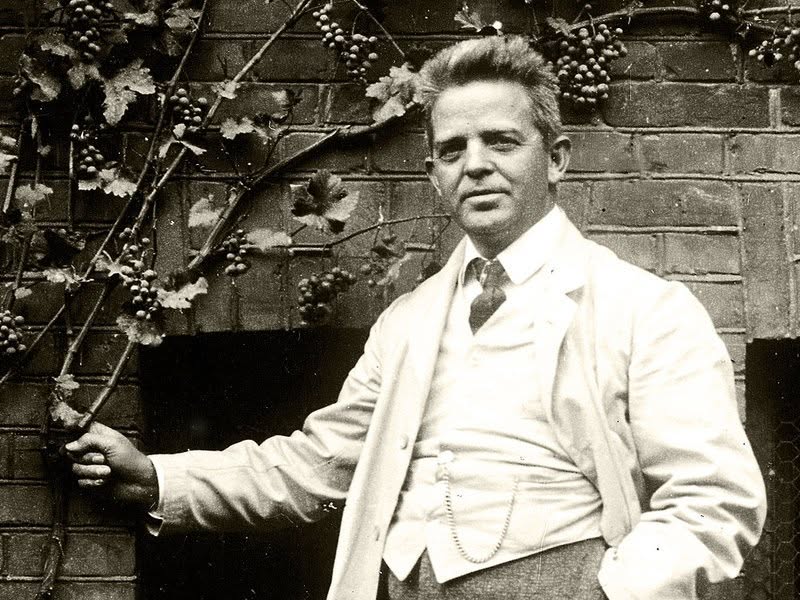
    PHOTO: Sibelius enjoying a rare laugh, with cigar, perhaps to cover up the scent of the “Paleo Smelly Zone”

Tag Cloud

Aaron Copland (92) Beethoven (95) Composer (114) Film Music (119) Film Score (143) Film Scores (255) Halloween (94) John Williams (185) KWAX (229) Leonard Bernstein (99) Marlboro Music Festival (125) Movie Music (134) Opera (198) Philadelphia Orchestra (86) Picture Perfect (174) Princeton Symphony Orchestra (106) Radio (87) Ralph Vaughan Williams (85) Ross Amico (244) Roy's Tie-Dye Sci-Fi Corner (290) The Classical Network (101) The Lost Chord (268) Vaughan Williams (102) WPRB (396) WWFM (881)

DON’T MISS A BEAT

Receive a weekly digest every Sunday at noon by signing up here


RECENT POSTS