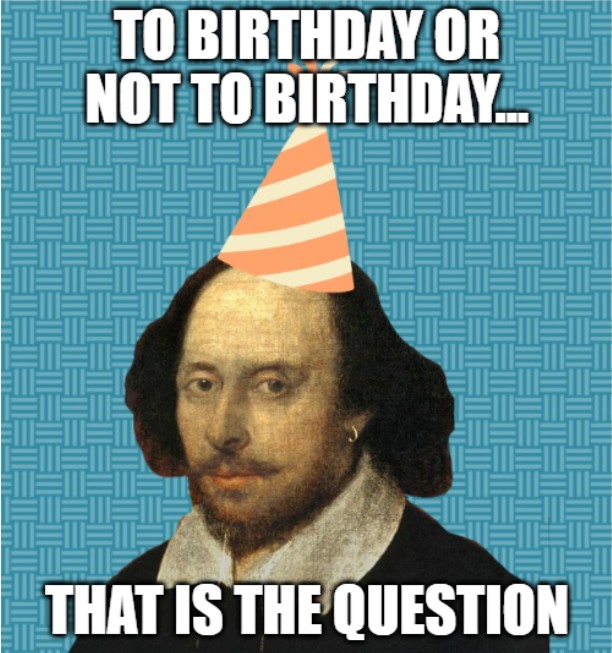
We don’t know exactly when Shakespeare was born. We do know that he was baptized on April 26, 1564. Since he died on April 23, 1616, the urge to keep it tidy has been too difficult to resist: traditionally the Bard’s birthday has been observed on the same date as that of his death. At any rate, we hardly need an excuse to celebrate his plays, which have inspired lots of colorful music.
I hope you’ll join me this morning on “Sweetness and Light” for our annual Shakespeare celebration. We’ll hear a comedy overture inspired by “Hamlet,” of all things, by Geoffrey Bush; a suite compiled from incidental music for “The Winter’s Tale,” “As You Like It,” and “The Tempest,” by Engelbert Humperdinck (composer of “Hansel and Gretel”); a prelude from one of Sir William Walton’s majestic film scores; further works for the stage by Charles Gounod and Erich Wolfgang Korngold; and one of Ralph Vaughan Williams’ loveliest creations, the “Serenade to Music,” inspired by a passage from “The Merchant of Venice.” This is a piece of such aching beauty, it’s said to have brought the notoriously dour Sergei Rachmaninoff, present at the work’s first performance, to tears.
Laughing at “Hamlet” and crying at beauty? Partying is such sweet sorrow! I hope you’ll join me for an hour of great Shakes on “Sweetness and Light,” this Saturday morning at 11:00 EDT/8:00 PDT, exclusively on KWAX Classical Oregon!
Stream it, wherever you are, at the link!
https://kwax.uoregon.edu/
Tag: William Walton
-

All the World’s a Rager, as We Celebrate Shakespeare on “Sweetness and Light”
-

William Walton Rediscovered Lost Works Revealed
Sir William Walton, beloved for his coronation marches and film scores, also wrote operas, symphonies, concertos, chamber music and choral works. As is often the case, posterity has been astonishingly reductive.
This week on “The Lost Chord,” we’ll hear two long-out-of-print recordings of works composed more than three decades apart.
At the time of the premiere of his Symphony No. 2, in 1957, Walton was perceived as a musical throwback. Indeed, despite the fact that it is more tightly argued, the piece has always been regarded as a poor stepsister of the Symphony No. 1, composed in 1935, a work full of grand gestures, written under the spell of Sibelius.
What apparently escaped critics of the day was the subtlety of its craftsmanship. The finale, in particular, is a set of variations based on a twelve-note row, a technique not unlike that employed in the kind of serial composition so much in vogue at the time.
George Szell gave the American premiere of the symphony, with the Cleveland Orchestra, in December of 1960. A few months later, they made the first recording.
Walton was viewed as an enfant terrible, when, more than three decades earlier, he set Edith Sitwell’s poetry as an entertainment, titled “Façade.” The work was first performed publicly in 1923. The premiere was a succès de scandale, with Sitwell herself speaking her poems into a megaphone protruding from the mouth of a painted face by John Piper, Walton conducting an ensemble of six instruments.
The displeasure of performers, audience and critics was evident, with Noel Coward ostentatiously marching out. However, the work quickly caught on, even becoming downright popular in a variety of arrangements. Within a decade, a purely orchestral version was choreographed by Frederick Ashton.
We’re going to be listening to selections from a treasured recording, unavailable in this country for many years, featuring Dame Peggy Ashcroft and Paul Scofield as the reciters. Both were noted Shakespearean actors, who did much of their best work on stage. Ashcroft received an Academy Award for Best Supporting Actress in 1985, for her part in David Lean’s final film, “A Passage to India,” and Scofield was honored with an Academy Award for Best Actor two decades earlier, in 1966, for his performance in “A Man for All Seasons.”
I hope you’ll join me for “Will’s Wonders Never Cease” – rarely heard recordings of the works of William Walton – on “The Lost Chord,” now in syndication on KWAX, the radio station of the University of Oregon!
Clip and save the start times for all three of my recorded shows:
PICTURE PERFECT, the movie music show – Friday at 8:00 PM EDT/5:00 PM PDT
SWEETNESS AND LIGHT, the light music program – Saturday at 11:00 AM EDT/8:00 AM PDT
THE LOST CHORD, unusual and neglected rep – Saturday at 7:00 PM EDT/4:00 PM PDT
Stream them, wherever you are, at the link!
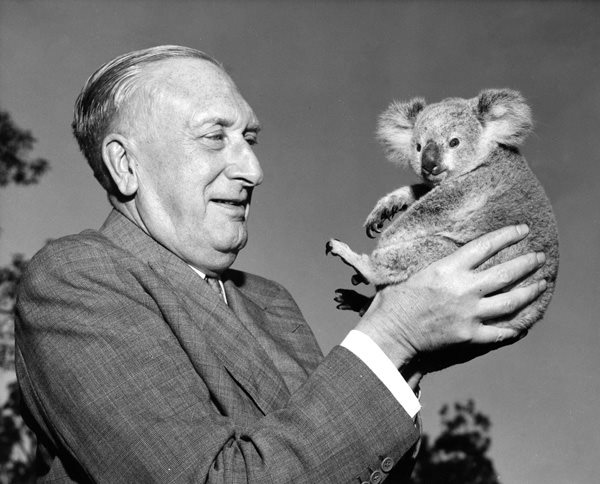
PHOTO: Biggest click-bait image I could find of William Walton (left)
-

Shakespeare Film Music Streaming This Week
Am I am such a tender ass, if my hair do but tickle me, I must scratch?
This week on “Picture Perfect,” we’ll celebrate William Shakespeare, just a few days shy of the anniversary of his birth, on April 23 (observed). Tune in for an hour of music from film adaptations of his comedies. We’ll enjoy selections from “As You Like It” (William Walton), “A Midsummer Night’s Dream” (Korngold), “The Taming of the Shrew” (Nino Rota), and “Much Ado About Nothing” (Patrick Doyle), even as we wryly acknowledge that the course of true love never did run smooth.
What fools these mortals be!
Verily, the wise ones know to stream it, wherever they are, at the link, this Friday evening at 8:00 EDT/5:00 PDT!
-

Shakespeare Birthday Celebration on KWAX
Brush up on your Shakespeare!
We don’t know exactly when Shakespeare was born. We do know that he was baptized on April 26, 1564. Scholars must have found the potential for symmetry irresistible: since he died on April 23, 1616, the Bard’s birthday has traditionally been observed on the same date as his death.
Of course, he’s one of the most influential artists who ever lived. Regardless of what anyone may argue to the contrary, his relevancy will never wane, for as long as humans continue to exist. Who knows, maybe longer. I’ll have to consult Sycorax.
In the meantime, I’ll be doing my small part, in anticipation of the Bard’s birthday anniversary, with three programs of music inspired by his works.
First, on “Picture Perfect” (tonight at 8:00 EDT/5:00 PDT), we’ll have an hour of selections from cinematic adaptations of the comedies, including “As You Like It” (William Walton), “A Midsummer Night’s Dream” (Erich Wolfgang Korngold), “The Taming of the Shrew” (Nino Rota), and “Much Ado About Nothing” (Patrick Doyle).
Then, on “Sweetness and Light” (Saturday morning at 11:00 EDT/8:00 PST), we’ll do our best to charm and to cheer with Shakespearean inspirations by Johan Wagenaar, Sir Arthur Sullivan, Mario Castelnuovo-Tedesco, Felix Mendelssohn (transcribed by Sergei Rachmaninoff), Sir Thomas Morley, and again, Erich Wolfgang Korngold (same composer, different work).
Finally, on “The Lost Chord,” power corrupts, as we juxtapose musical adaptations of “Macbeth,” by William Walton and Sir Arthur Sullivan, with works inspired by Eugene O’Neill’s “The Emperor Jones,” by Louis Gruenberg and Heitor Villa-Lobos, on a program titled “Power Plays” (Saturday at 7:00 p.m. EDT/4:00 p.m. PDT).
If music be the food of love, stream on, on KWAX, the radio station of the University of Oregon!
-

William Walton: Star Wars Inspiration
Today is the 120th anniversary of the birth of Sir William Walton. Walton is perhaps best remembered for his coronation marches and film scores, but he also wrote operas, symphonies, concertos, chamber music, and choral works.
Sadly, these days, we don’t seem to encounter these much in concert anymore, at least in the U.S., which is a great pity, since Walton was an impeccable craftsman and his music often quite inspirational.
Be that as it may, his influence has been felt by just about anyone who’s ever gone to the movies since 1977. That’s the year John Williams married Walton’s heroic sound to George Lucas’ vision of a long time ago, in a galaxy far, far away.
Walton’s concert music may have fallen out of fashion, but Williams would have never become the household name he has without having assimilated his marches, harmonies, and orchestrations. When André Previn first heard Williams conduct his music to “Star Wars,” he could hardly contain his glee, exclaiming, “Why, it’s Willie Walton!”
Hear for yourself…
“Star Wars” throne room – from the one-minute mark, pure Walton:
What Walton cooked up for the Queen in 1953 – there’s a proto-“Star Wars” moment about two minutes in, but do listen to the whole thing:
This is what he composed for her dad in 1937:
For Olivier’s film of “Richard III”
“Belshazzar’s Feast”: “Praise Ye!”
“Belshazzar’s Feast”: “Alleluia”
In 1966, Previn himself laid down what is considered the benchmark recording of Walton’s Symphony No. 1. It’s possible he managed to surpass it with this explosive performance with the London Symphony Orchestra in 1970:
Happy birthday, Sir William Walton!
PHOTO: Walton (right) with Previn, his champion
Tag Cloud
Aaron Copland (92) Beethoven (95) Composer (114) Film Music (120) Film Score (143) Film Scores (255) Halloween (94) John Williams (185) KWAX (229) Leonard Bernstein (100) Marlboro Music Festival (125) Movie Music (135) Opera (198) Philadelphia Orchestra (88) Picture Perfect (174) Princeton Symphony Orchestra (106) Radio (87) Ralph Vaughan Williams (85) Ross Amico (244) Roy's Tie-Dye Sci-Fi Corner (290) The Classical Network (101) The Lost Chord (268) Vaughan Williams (103) WPRB (396) WWFM (881)