Tag: William Walton

  • Walton’s Façade: Scandal to Success

    Walton’s Façade: Scandal to Success

    If Winter leaves you with a long face, imagine what it was like to be Edith Sitwell and William Walton. Both had very long faces indeed.

    It was on this day 100 years ago that Walton’s “Façade” was first performed at Sitwell’s home. An eccentric poet from an eccentric family of artistically-inclined English aristocrats, Sitwell also participated in the work’s first public performance, on June 12, 1923. She declaimed her verses through a megaphone from behind a painted screen to the accompaniment of a seven-piece jazz band.

    Cheekily, Walton set the poems to popular dance-styles of the period, with breakneck allusions to and quotations from other composers. The music is protean in its invention, encompassing paso doble and patter song, waltz, foxtrot, and mazurka. The texts are nonsense, most immediately striking for their rhythmic value – the settings are as much about the abstract SOUND of words as they are about their meaning – but once the listener acclimates, they actually do start to make a kind of sense.

    The June premiere was a succés de scandale, with much pearl-clutching and face-fanning by public and press alike. Needless to say, the work’s notoriety ensured its frequent revival.

    Worlds away from the coronation marches and Shakespeare scores for which Walton would be so well remembered, the music from “Façade” is also among his most popular. It is perhaps even more frequently performed without the texts. The composer arranged two suites for orchestra. In 1931, Frederick Ashton choreographed the piece as a ballet.

    Walton would go on receive a knighthood in 1951. Sitwell would be awarded a damehood in 1954. So it is that yesterday’s eccentricity becomes today’s respectability.

    There must be something to it, if it could make dour Paul Scofield sound like this, in my favorite recording of the work:

    Sitwell and Constant Lambert in the first recording in 1929. Is this the English “Pierrot Lunaire?”

    Selections from Sitwell’s later recording, from 1953, with Peter Pears:

    Having attained respectability, the orchestral suites:

    An interview with Dame Edith Sitwell:

    Walton remembers the Sitwells and the Roaring ‘20s:

    Dame Edith, English eccentric:

    http://thedabbler.co.uk/2011/04/edith-sitwell-and-the-english-eccentrics/

  • Shaw on Screen Film Music from GBS

    Shaw on Screen Film Music from GBS

    Prior to his death in 1950, George Bernard Shaw was granted complete creative control over a number of film adaptations of his stage works. Of course, he was also an astute and entertaining music critic. This week on “Picture Perfect,” enjoy an hour of Shavian delights. We’ll hear selections from scores from the films of GBS.

    It was the ambition of Hungarian producer Gabriel Pascal to create a series of films inspired by Shaw’s plays, beginning with “Pygmalion” in 1938. Shaw was skeptical at first, on account of some inferior adaptations by other hands which had already appeared. However, when he was granted final approval, he agreed. This led to several big screen collaborations. After “Pygmalion” (scored by Arthur Honegger) came “Major Barbara” (1941).

    Wendy Hiller plays the Salvation Army major, who is appalled to take donations from those who have made their fortunes on war and whiskey, and Robert Morley her father, a munitions manufacturer. Rex Harrison is the scholar who tries to persuade her of the benefits of capitalism. (Harrison, of course, would go on to star in the musical version of Shaw’s “Pygmalion,” “My Fair Lady.”)

    William Walton wrote the score. Still a few years shy of his knighthood, he was already one of Britain’s most famous composers.

    “Caesar and Cleopatra” (1945) would be the final Pascal-Shaw collaboration. (Following Shaw’s death, Pascal would film “Androcles and the Lion” in 1953.) Claude Rains and Vivien Leigh were cast in the title roles. Rains made history as the first actor ever to receive a million-dollar salary. The lavish Technicolor production wound up being the most expensive British film ever made, up until that time, and unlike “Pygmalion” and “Major Barbara,” it was not a success.

    Pascal had actually wanted Sergei Prokofiev to write the music, but when that didn’t go anywhere, he offered the assignment to Walton. When Walton turned it down, Arthur Bliss was engaged. Bliss, like Walton, was destined to receive a knighthood. In 1953, he would also be appointed Master of the Queen’s Music.

    Bliss may have been good enough for the Royal Family, but Pascal was evidently not pleased with him from the start. He had been Shaw’s choice, and the playwright encouraged him to eschew any Egyptianisms in his music. Rather, Shaw wanted the score to sound as “Bliss-ful and British” as possible.

    In the end, Pascal’s surliness, in no doubt exacerbated by production setbacks, ran Bliss out. The job was then offered to Benjamin Britten, but Britten wisely declined, acknowledging that his own temperament was a great deal less mild than Bliss’.

    The final cut sports a score by Georges Auric. Both Bliss’ and Auric’s scores have been recorded, so we’ll get to sample from both.

    Finally, we’ll turn to Otto Preminger’s adaptation of “Saint Joan” (1957). Graham Greene worked on the screenplay, produced seven years after Shaw’s death. The film featured a seasoned cast, including Richard Widmark, Anton Walbrook, John Gielgud, Felix Aylmer, and Finlay Currie. However, Jean Seberg, an unknown actress, reportedly selected from a casting call of 18,000 applicants, was widely panned for her alleged inability to carry the film.

    The music was by Mischa Spoliansky, not exactly a household name. Spoliansky was born in Bialystok. He moved with his family to Vienna, then was displaced from Koenigsberg to Berlin during the First World War. With the rise of fascism in Germany, he settled in London in 1933. Some of his songs were written for Paul Robeson, and he provided the complete underscore for the Robeson version of “King Solomon’s Mines,” in 1937. Whatever the film’s perceived faults, the music Spoliansky composed for “Saint Joan” is beautiful and evocative.

    In the classical music world, we’re used to encountering Shaw’s assessments of Wagner and Brahms and Parry and Elgar. One wonders what he would have made of these scores composed for his films.

    Shaw observed, “Most people go to their grave with their music inside them.” Hear some that made it to the big screen this week, on “Picture Perfect,” music for the movies, this Saturday evening at 6:00 EDT, on WWFM – The Classical Network and wwfm.org.


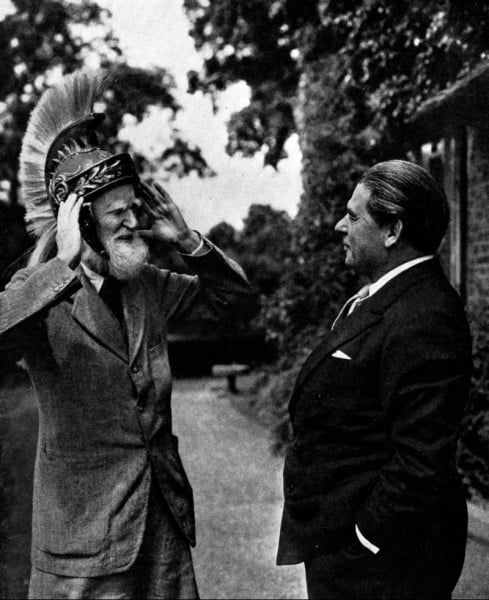
    PHOTO: Shaw models centurion headgear for Pascal

  • Royal Albert Hall Celebrates & Classical Greats

    Royal Albert Hall Celebrates & Classical Greats

    Quite the day for musical Anglophiles!

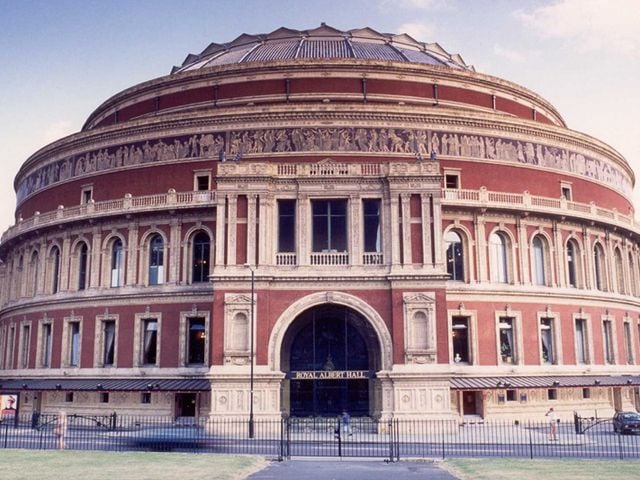
    In addition to it being the birthdays today of Sir William Walton and Sir Richard Rodney Bennet, it’s also the 150th anniversary of the opening of Royal Albert Hall.

    Wagner conducted there. Hitchcock filmed there. Muhammad Ali fought there.

    The hall was opened by Queen Victoria in 1871.

    Of course, at this point, a lot of emphasis is being placed on the popular bands and singers who performed there. I don’t know why, but I have never had the slightest interest in rock music. I continue to scratch my head at the rest of the world.

    Here’s an article on the history of Albert Hall that includes some of its quirkier events (still a little weak on the classical music, which you’d probably expect from the derogatory use of “stuffy” in the first sentence):

    https://www.bbc.com/news/uk-england-london-56428543

    Hate to refer you to the Wikipedia page, but it’s got more information than most:

    https://en.wikipedia.org/wiki/Royal_Albert_Hall

    Footage of Royal Albert Hall in 1967:

    Hitchcock filmed the climax of both versions of “The Man Who Knew Too Much” there, in 1934 and 1956. Bernard Herrmann is seen conducting the orchestra in the 1956 version. Don’t watch the clip if you haven’t seen the film yet and plan to do so!

    Audio of Elgar conducting his “Enigma Variations” there in 1926:

    Vaughan Williams conducting his Symphony No. 5 there in 1952:

  • Rediscovering William Walton’s Genius

    Rediscovering William Walton’s Genius

    Sir William Walton is beloved for his coronation marches and film scores. But posterity has been woefully reductive. He also wrote operas, symphonies, concertos, chamber music, and choral works.

    This Sunday night on “The Lost Chord,” we’ll hear two long-out-of-print recordings of works composed more than three decades apart.

    At the time of the premiere of his Symphony No. 2, in 1957, Walton was perceived as something of a musical throwback. Indeed, despite the fact that it is more tightly argued, the piece has always been regarded as a poor stepsister of the Symphony No. 1, composed in 1935, a work full of grand gestures, written under the spell of Sibelius.

    What apparently escaped critics of the day was the subtlety of its craftsmanship. The finale, in particular, is a set of variations based on a twelve-note row, a technique not unlike that employed in the kind of serial composition so much in vogue at the time.

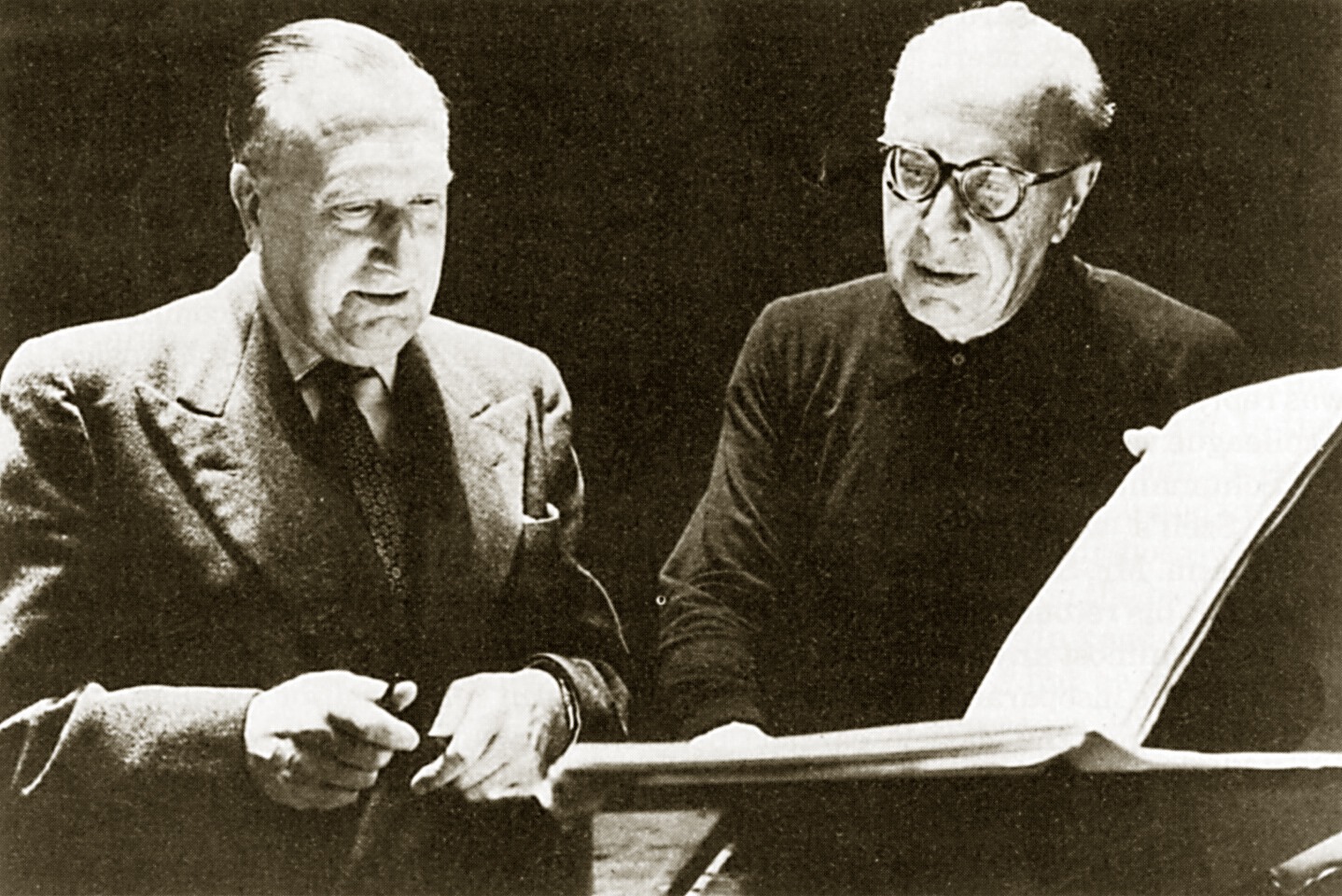
    George Szell (pictured, with the composer) gave the American premiere of the symphony, with the Cleveland Orchestra, in December of 1960. A few months later, they made the first recording.

    More than three decades earlier, Walton was viewed as an enfant terrible, when he set Edith Sitwell’s poetry as an entertainment, titled “Façade.” The work was first performed publicly in 1923. The premiere was a succès de scandale, with Sitwell herself speaking her poems into a megaphone protruding from the mouth of a painted face by John Piper, Walton conducting an ensemble of six instruments.

    The displeasure of performers, audience, and critics was evident, with Noel Coward ostentatiously marching out. However, the work quickly caught on, even becoming downright popular in a variety of arrangements. Within a decade, a purely orchestral version was choreographed by Frederick Ashton.

    We’ll hear selections from a treasured recording, unavailable in this country for many years, featuring Dame Peggy Ashcroft and Paul Scofield as the reciters. Both were noted Shakespearean actors, who did much of their best work on stage. Ashcroft received an Academy Award for Best Supporting Actress in 1985, for her part in David Lean’s final film, “A Passage to India,” and Scofield was honored with an Academy Award for Best Actor two decades earlier, in 1966, for his performance in “A Man for All Seasons.”

    I hope you’ll join me for “Will’s Wonders Never Cease” – rarely heard recordings of the works of William Walton – this Sunday night at 10:00 EDT, on WWFM – The Classical Network and wwfm.org.

  • Shakespeare Inspired Music Today

    Shakespeare Inspired Music Today

    All the world’s a stage, and all the men and women merely players.

    That said, I’ve got but a few hours in which to play music to mark the presumed anniversary today of the birth of the great William Shakespeare.

    We’ll hear works inspired by a number of Shakespeare’s plays, including a “scenario” assembled from William Walton’s magnificent score for Laurence Olivier’s acclaimed film adaptation of “Henry V.” The speaker will be none other than Christopher Plummer.

    Today’s Noontime Concert will serve as prologue, with the Rolston String Quartet coming your way from the Church of the Holy Trinity, Rittenhouse Square, in Center City Philadelphia. The program, presented by Astral Artists, will include works by Mozart (the String Quartet No. 18 in A major, K. 464), Ligeti (the Quartet No. 1, “Metamorphoses nocturnes”), and Beethoven (the Quartet No. 13 in B-flat major, Op. 130).

    … [M]ay we cram
    Within this wooden “O” the very casques
    That did affright the air at Agincourt?
    O, pardon!

    Piece out our imperfections with your thoughts, from 12 to 4 p.m. EDT, on WWFM – The Classical Network and wwfm.org.

Tag Cloud

Aaron Copland (92) Beethoven (95) Composer (114) Film Music (120) Film Score (143) Film Scores (255) Halloween (94) John Williams (185) KWAX (229) Leonard Bernstein (100) Marlboro Music Festival (125) Movie Music (135) Opera (198) Philadelphia Orchestra (88) Picture Perfect (174) Princeton Symphony Orchestra (106) Radio (87) Ralph Vaughan Williams (85) Ross Amico (244) Roy's Tie-Dye Sci-Fi Corner (290) The Classical Network (101) The Lost Chord (268) Vaughan Williams (103) WPRB (396) WWFM (881)

DON’T MISS A BEAT

Receive a weekly digest every Sunday at noon by signing up here


RECENT POSTS