Tag: Wind Ensemble

  • Warren Benson A Centennial Celebration

    Warren Benson A Centennial Celebration

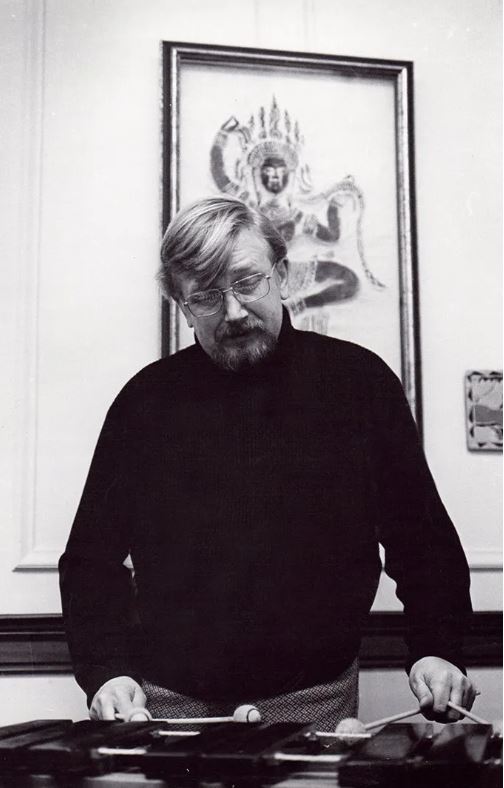
    Bang the drum for Warren Benson. Benson was born in Detroit 100 years ago today.

    At 14, he was playing timpani in the Detroit Symphony Orchestra, working with conductors such as Eugene Ormandy, Fritz Reiner, Eugene Goossens, and Leonard Bernstein while an undergraduate at the University of Michigan.

    He taught in Greece for two years, establishing a bi-lingual music curriculum and organizing the Anatolia College Chorale, the first scholastic co-educational choir in the country. For 14 years, he taught at Ithaca College, organizing the first touring percussion ensemble in the eastern United States. From there, he joined the faculty at the Eastman School of Music in Rochester, NY.

    Benson composed over 100 works. He was especially well-regarded for his song cycles and music for percussion and winds. His most celebrated piece has been “The Leaves Are Falling,” written in the aftermath of the assassination of John F. Kennedy. The piece was inspired by the poem “Herbst” (“Autumn”) by Rainer Maria Rilke.

    Benson died in 2005. Donald Hunsberger, an associate at Eastman, included “The Leaves Are Falling” on a list of essential works for wind ensemble.


    “The Leaves Are Falling”

    Benson discusses it:

    https://irp-cdn.multiscreensite.com/2302eea8/files/uploaded/discussion_w_benson.pdf

    “HERBST” (“AUTUMN”) BY RAINER MARIA RILKE

    Die Blätter fallen, fallen wie von weit,
    als welkten in den Himmeln ferne Gärten;
    sie fallen mit verneinender Gebärde.

    Und in den Nächten fällt die schwere Erde
    aus allen Sternen in die Einsamkeit.

    Wir alle fallen. Diese Hand da fällt.
    Und sieh dir andre an: es ist in allen.

    Und doch ist Einer, welcher dieses Fallen
    unendlich sanft in seinen Händen hält.

    ENGLISH TRANSLATION BY DONALD MACE WILLIAMS:

    Leaves fall, they fall as from a distant place,
    as if far gardens withered in the skies;
    they fall with a denying attitude.

    And in the nighttimes falls the heavy world
    out of all stars into the solitude.

    We all are falling. Falling, here, this hand.
    And look at others: it is in them all.

    Yet there exists One who all of this falling
    forever softly holds within his hands.

  • Explore the Music of Karel Husa

    Explore the Music of Karel Husa

    Who’s afraid of Karel Husa?

    It seems like Husa’s barely left us, and already it is time to mark his centenary.

    A former student of Arthur Honegger and Nadia Boulanger, Husa fled to the United States from his native Czechoslovakia in 1954. He became an American citizen in 1959.

    Ten years later, he became the recipient of the Pulitzer Prize for Music for his String Quartet No. 3. It’s ironic that an artist so highly regarded for his wind music should win the Pulitzer for a string quartet! In 1993, he was also recognized with a Grawemeyer Award for his Cello Concerto. However, it is for his “Music for Prague 1968,” inspired by the Soviet bloc invasion of his homeland, that he is probably best known.

    Husa held a professorship at Cornell University from 1954 to 1992. He was also a lecturer at Ithaca College from 1967 to 1986.

    Performance of his music was banned in Czechoslovakia for over three decades. At the time of his death, in 2016, he was 95 years-old.

    Husa’s mode of expression can come across as a little angsty at times, but I think I’ve managed to come up with a nice cross-section of some of his more accessible works. Click the links below, and fear no Husa!


    Concertino for Piano and Winds

    “Music for Prague 1968”

    Trumpet Concerto

    Five Poems for Wind Quintet, inspired by the composer’s love of birds. As the title suggests, it’s in five movements, so if you want to hear the whole thing, let the playlist run through all five videos.

    Concerto for Percussion and Wind Ensemble

    Interviewed by Bruce Duffie

    http://www.bruceduffie.com/husa.html

  • Enescu’s Delightful “Dixtuor” at Marlboro

    Enescu’s Delightful “Dixtuor” at Marlboro

    George… GEORGE! Do you want your face to stay that way?

    If George Enescu is itching for a fight, it’s nowhere in evidence in his delightful “Dixtuor.” The work – scored for ten wind instruments, as its title suggests – can be heard on this evening’s “Music from Marlboro” broadcast.

    We’ll enjoy a 1978 performance by a “who’s who” of fabulous Marlboro wind players, including flutists Carol Wincenc and Julia Bogorad, oboist Rudolph Vrbsky, English hornist Gerard Reuter, clarinetists David Krakauer and Yehuda Hanani, bassoonists Kim Walker and Alexander Heller, and French hornists David Jolley and Meir Rimon, all under the direction of Marlboro co-founder Marcel Moyse.

    Perhaps Enescu is miffed that Marlboro musicians have elected to play Béla Bartók’s String Quartet No. 4 as the centerpiece of their upcoming tour. The first of this year’s Marlboro tours will take place from November 11 to November 18, with stops within our listening area – in New York City, at Weill Recital Hall in Carnegie Hall, on November 12, and in Philadelphia, at the American Philosophical Society, on November 14, presented by the Philadelphia Chamber Music Society. The tour will also feature two works by Antonín Dvořák: his Piano Trio in F minor, Op. 65, and the Miniatures, Op. 75a. Learn more and find a complete schedule at marlboromusic.org.

    Tonight’s broadcast will open with a 2016 performance of Bartók’s quartet, played by violinists Robyn Bollinger and Soovin Kim, violist Hwayoon Lee, and cellist Tony Rymer.

    It’s understandable that Enescu might be a little jealous. The quartet, composed in Budapest in 1928, when Bartók was in his mid-40s and at the height of his mastery, displays a striking, five movement, “arched” structure, and is full of unusual sonorities – rhythmic sforzandi (notes played with strong, sudden emphasis), passages performed on muted strings, passages performed without vibrato (the rapid oscillation on a sustained tone used for added warmth and expressivity), glissandi (sliding from note to note), and snap pizzicati (plucked strings slapping back against the instruments’ fingerboards).

    By contrast, Enescu’s “Dixtuor,” written in 1906, when the composer was in his mid-20s, is a much more relaxed-sounding work. However, its seemingly laid-back, almost rhapsodic disposition and seductive veneer disguise a carefully thought-out classical structure that makes it a kind of spiritual descendant of the 18th century divertimento. I think you’ll find it the perfect balm for the end of a long work day.

    Who needs anger management, when you’ve got access to great music-making from the legendary Marlboro Music School and Festival? Music hath charms to soothe the savage breast, this Wednesday evening at 6:00 EST, on WWFM – The Classical Network and wwfm.org.

    Marlboro School of Music and Festival: Official Page

Tag Cloud

Aaron Copland (92) Beethoven (95) Composer (114) Film Music (119) Film Score (143) Film Scores (255) Halloween (94) John Williams (185) KWAX (229) Leonard Bernstein (99) Marlboro Music Festival (125) Movie Music (134) Opera (198) Philadelphia Orchestra (86) Picture Perfect (174) Princeton Symphony Orchestra (106) Radio (87) Ralph Vaughan Williams (85) Ross Amico (244) Roy's Tie-Dye Sci-Fi Corner (290) The Classical Network (101) The Lost Chord (268) Vaughan Williams (102) WPRB (396) WWFM (881)

DON’T MISS A BEAT

Receive a weekly digest every Sunday at noon by signing up here


RECENT POSTS