Tag: World War II

  • A Grandfather’s Grit WWII Sacrifice & American Ideals

    A Grandfather’s Grit WWII Sacrifice & American Ideals

    My grandfather clambered out of the Great Depression, subsisting on a diet of raw onions, ketchup sandwiches, and the occasional egg. Despite being diagnosed with a terminal illness, he still did his part to help smash the Axis, serving in the U.S. Army Corps of Engineers, in both the European and Pacific theaters, during World War II. And you know what? He managed to live another half-century, doing whatever he could to keep it together and support his family: chicken farming, carpentry, bus driving, credit managing. This is a man who had dreamed of becoming a doctor and had to drop out of school when he was just getting started, because his medical bills ran him dry.

    He was soft-spoken and modest. If he talked about the war, which was rare, it would be a humorous recollection, like the time one of his Army buddies took a welder to a drum without considering it had once contained gasoline. The drum took off like a rocket, he said, the guy was lucky it didn’t take his head off. Or something crazy, like the time a plane was flying over at night and they heard the engine cut out and suddenly everyone had to dive for cover. At the crash site, the only thing they could find of the pilot was his feet.

    He didn’t say much, but once, when we were alone, when he was in his late 70s, he let something drop that hinted at just how harrowing it could be to live under constant threat of enemy fire, and how, after a time, he just became numb and wound up taking a crazy chance. Afterward, he said he never told anyone about it before. After he died, I shared the story with my mother, and she said she had never known that side of him. Now that she’s gone, I’m probably the one alive who does.

    Back in the day, he served as a Republican committee chairman of his county. He would be appalled to know what the party of Eisenhower has become. How could people in public office be so transparently self-serving and abhorrent, and how can so many voters sanction it? I was 8 years-old when Richard Nixon resigned, and we watched the speech together in his living room. I remember him saying, “Watch this. This is history.” I was just a kid, of course, but the significance was impressed upon me, and as I matured, I noticed that whenever my grandfather had anything to say about politicians, it was generally with an air of disgust.

    50 years on, Watergate wouldn’t have even been a blip. It’s nauseating to consider that all the sacrifices made by my grandfather and his contemporaries, and all the other American soldiers down the generations, may have bought us but a few decades. Is America really going to be driven into the ground by greed and grievance?

    Holidays like Veterans’ Day, Memorial Day, and Armed Forces Day are so important. Not so one can go through the motions of raising a flag, or to fly one off the back of a truck, but to prompt one to step outside oneself and take a moment to reflect and to honor those who put themselves on the line for the preservation of the higher ideals of the United States of America.

    My grandfather was the hero in a family of heart murmurs and flat feet. Of the younger generations, our veterans have all been in-laws (U.S. Army and U.S. Air Force). One suffers from severe PTSD. I remember in my early 20s the creeping dread of the Gulf War, that it would spiral out of control and lead to a reinstatement of the draft. That kind of service isn’t in anybody’s plan. But people like my grandfather understood the necessity and did what they had to do.

    Thank you for your service and your many sacrifices, Pap, wherever you are. And thank you, honorable men and women of the U.S. Armed Forces.

  • Rochberg: D-Day, Music, and Unlikely Heroism

    Rochberg: D-Day, Music, and Unlikely Heroism

    On the 80th anniversary of D-Day, my thoughts turn to American composer George Rochberg, who could write symphonies with the best of them, but was also a man of principle, who had real guts.

    Rochberg, born in Paterson, NJ, in 1918, was for decades a fixture at the University of Pennsylvania, where he chaired the music department until 1968. He continued to teach there until 1983.

    But his big claim to fame – or, in some circles, notoriety – is that he was one of the first composers of his kind to emerge from the strictures of serialism, predominant in academic circles from mid-century, to embrace a new tonality. The shift was brought on, it is said, by the untimely loss of his son, Paul, to a brain tumor in 1964.

    Rochberg felt the musical vocabulary he had been employing inadequate to express his grief and rage. Beginning with his String Quartet No. 3 in 1971, he began to incorporate tonal passages back into his music, much to the dismay of his academic peers. His String Quartet No. 6 of 1978 includes a set of variations on Pachelbel’s “Canon.” Horrors!

    Little did anyone realize at the time that this was the most avant-garde thing Rochberg could have done. He was the unwitting prophet of a new pluralism that went on to become the norm.

    What is perhaps not so well known is that Rochberg’s mettle had been tested well before the petty skirmishes of Ivory Tower politics, when he was thrown into the deep-end of one of the pivotal operations of World War II.

    Rochberg was drafted into the U.S. Army infantry in 1942. A lot of musicians fulfilled their military service by composing marches or playing in military bands. Many were never even shipped overseas. While Rochberg did have his share of musical assignments, he saw real action as part of George S. Patton’s Third Army during its perilous breakout from Normandy following D-Day in 1944.

    Amy Lynn Wlodarski writes about it in her book, “George Rochberg, American Composer: Personal Trauma and Artistic Creativity” (University of Rochester Press, 2019):

    “Nearly fifty years later, he could still vividly recall the ‘look of fear’ on the faces of the soldiers who had been wounded in the initial onslaught: ‘Walking away from the plane that had just landed on an airstrip on Omaha Beach… and seeing the wounded, walking and on stretchers, going to the same plane that had just taken us from England. The look in their eyes, a look I’d never seen before that day. Almost an animal look; glistening fear, anxiety, uncertainty radiating from their eyes.’ Upon arrival, his division was immediately dispatched to help with the second stage of the invasion, which involved breaking through the hedgerows in northern France, a deafening assault that required explosive charges to dislodge the thick, thorny bushes of the French countryside. The fatigue from constant marching and physical work was overwhelming despite nearly a full year of basic training: ‘I remember being dog-tired [at] night. Apparently I [once] slept through some minor bombing by German reconnaissance planes.’”

    Mangled feet were par for the course, but Rochberg himself wound up taking a bullet, the first of several substantial injuries he would receive in combat. His doctors remarked that if it had been the First World War, it would have cost him a leg.

    The accepted narrative is that the composer’s later grief over the death of his son motivated his drift toward a more communicative means of expression in his music. But Rochberg was always at heart a humanist, and already during the war, twenty years earlier, his worldview and aesthetic outlook were beginning to coalesce, as when he came to regard the destruction he witnessed at the town of Saint-Lô, where the Allies faced off against the Second SS Panzer Division of the German Army, as “a metaphor for the precarious state of Western culture.”

    Rochberg, of course, was not the only artist to think this way. The war left its indelible mark on all the arts. In music, especially, its devastation and sorrow were reflected in the creations of composers on all sides, as demonstrated in Jeremy Eichler’s recent, excellent book, “Time’s Echo: The Second World War, the Holocaust, and the Music of Remembrance” (Knopf, 2023).

    The varied experiences of Richard Strauss, Arnold Schoenberg, Dmitri Shostakovich, and Benjamin Britten are examined at some length. None of them actually “saw action,” although Shostakovich was present during the siege of Leningrad and Britten performed on site for survivors of Bergen-Belsen. Rochberg is not part of the narrative.

    Rochberg drafted a number of musical sketches during the European campaign. These later became the basis for his Symphony No. 6, completed in 1986. The work is tonal, yet harmonically extremely loose. I don’t believe it has even been recorded for commercial release. The linked performance is conducted by Raymond Leppard, which is interesting, since Leppard was regarded for so long as a Baroque specialist. But of course his repertoire was much broader than that, and he conducted a number of first performances of works by contemporary composers.

    There’s another recording on YouTube, taken from a concert with Leppard conducting the Saint Louis Symphony, but the sound isn’t as good. So we’ll stick with this one, with Leppard’s own orchestra, the Indianapolis Symphony, the orchestra he directed from 1987 to 2001.

    What’s with the video’s moon imagery is anyone’s guess.

    Rochberg died in Bryn Mawr, outside Philadelphia, in 2005. He left more than 100 works, including six symphonies, seven string quartets, and an opera, “The Confidence Man,” after Melville. At the time of his death, he was 86-years-old.

    His service is remembered, as is that of everyone who made the push through on D-Day possible, so that the free world could achieve victory over fascism.


    Symphony No. 2 (1955-1956), serial but, contrary to the composer’s later concerns, still emotionally expressive

    Pachelbel Variations from the String Quartet No. 6 (1978)

    Opening of the “Transcendental Variations” (1971-1972, the third movement of Rochberg’s String Quartet No. 3, transcribed for string orchestra in 1975)


    PHOTO: Wlodarski and the cover of her book, with Rochberg in uniform

  • Pearl Harbor Remembrance & Reflections

    Pearl Harbor Remembrance & Reflections

    The years, they do fly by. It astonishes me how quickly important anniversaries make their laps. I don’t know if it’s because I’ve been doing this for nine years or because I’m now in my late 50s and time really does speed up when you’re older. Not OLD, mind you – for as nice as it would be to pass the days in a rocking chair on the front porch, I’m not collecting my Social Security benefits quite yet – but older.

    Furthermore, I have to say, increasingly I am a little intimidated to go back and look at my past posts. For Krampus, for St. Nicholas, and now for Pearl Harbor Day, I sincerely don’t know how I could improve on what I wrote last year, or even the year before. It is daunting to be in competition with oneself!

    Especially so, since I’ve been under the weather this week, and it’s difficult to do anything, so I hope you will excuse me for deferring to the more able-bodied Classic Ross Amico of yore for this day that has lived in infamy, as I do take it seriously, even as I puzzle over what has happened to my country in recent decades.

    Now is not the time to go too much into it, since the entire point is for me not to overextend myself in my weakened state, but it’s sad that we do not honor the countless Americans who sacrificed so much, both in the service and at home, by walking the walk. “Thank you for your service” is all well and good, but how about earning it by being civil to our neighbors, not treating domestic affairs like they’re a wrestling match, not glorifying violence, bullying, and vengeance, upholding fair-play, extending a helping hand, and doing our best to leave a positive imprint on our communities? We, as citizens of the United States, carry the seeds of our own salvation or destruction. Do we really want to be the ones to accomplish what the Axis could not?

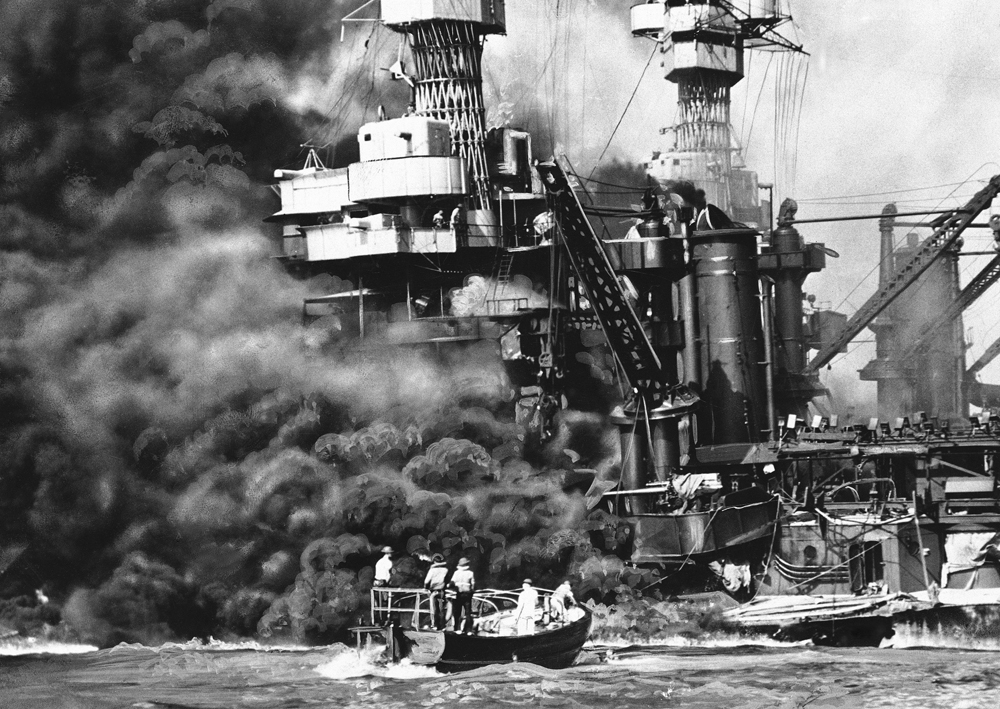
    On December 7, 1941, a surprise strike by the Imperial Japanese Navy on the U.S. naval base at Pearl Harbor resulted in 2,403 American deaths, 1,178 wounded, and the United States’ entry into World War II. Sailors, soldiers, airmen, marines, and civilians were among the casualties.

    Here is last year’s remembrance of composer John Duffy, who served in the U.S. Navy and had family at Pearl Harbor:

    And, from two years ago, my reflections on American Christmas in 1941:

    Hopefully, next year I will have the strength, the focus, the fire, and the time to pound out another mini-masterpiece. For today, I’m still getting over a flu and I’ve got a deadline looming.

    Dona nobis pacem. Peace on earth, goodwill toward men.

  • Romeo Cascarino Blades of Grass Memorial Day

    Romeo Cascarino Blades of Grass Memorial Day

    Philadelphia composer Romeo Cascarino (1922-2002), who served in the U.S. Army during World War II, composed a plaintive elegy, “Blades of Grass,” in 1945. He expressed a preference, on several occasions, that Carl Sandburg’s poem, “Grass,” be read before performances of the work. Sandburg’s poem was written in 1918, in response to “The Great War.”

    Alas, how little the world changed in 27 years. Alas, how little it has changed today.

    On Memorial Day, let us honor those who made the ultimate sacrifice by committing to being more conscious of living with compassion, regarding others with respect, striving for peaceful resolutions, and when conflict is unavoidable, acquitting ourselves with honor, humility, and mercy.

    These are ideals we may not always live up to, but who are we, if we don’t try to be better?


    Pile the bodies high at Austerlitz and Waterloo.
    Shovel them under and let me work—
    I am the grass; I cover all.

    And pile them high at Gettysburg
    And pile them high at Ypres and Verdun.
    Shovel them under and let me work.
    Two years, ten years, and passengers ask the conductor:
    What place is this?
    Where are we now?

    I am the grass.
    Let me work.

  • Still’s “In Memoriam” & Black Soldiers’ Sacrifice

    Still’s “In Memoriam” & Black Soldiers’ Sacrifice

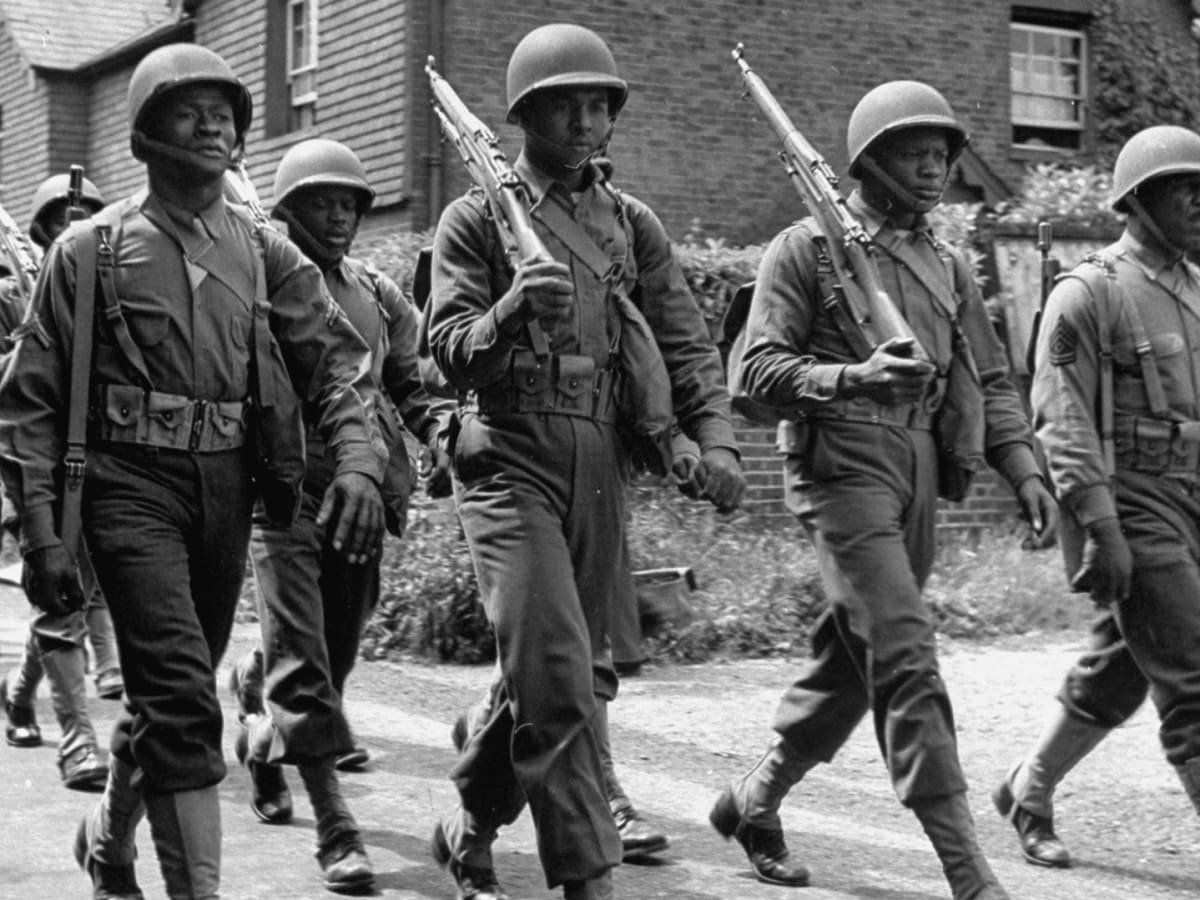
    In common with many American composers, William Grant Still turned to patriotic themes during World War II. Only in his case, there is an added poignancy in his choice of subject matter, “In Memoriam, The Colored Soldiers Who Died for Democracy” (1943), since the black soldiers to whom the work is dedicated not only fought in segregated units, but also experienced inequality at home.

    By nature, Still was not a political person, but because of the simple fact of his skin color, the association of race – of what it meant to live in and serve a country that wasn’t always fair to its minorities – is inescapable. The piece is about democracy and war, but the subtext, whether or not the composer intended it as such, is one of racial inequality, even for those who served with honor and gave everything for this country.

    Still himself served in the U.S. Navy during World War I.

    George Szell and the Cleveland Orchestra perform “In Memoriam, The Colored Soldiers Who Died for Democracy” in Kyiv in 1965:

    Charles Ives was inspired by the Memorial to Colonel Robert Gould Shaw and the 54th Massachusetts Infantry Regiment, one of the earliest African American units in the American Civil War, when he composed “Saint-Gaudens on Boston Common,” the first movement of his “Three Places in New England” (1915). The 54th was also the subject of the film “Glory.”

Tag Cloud

Aaron Copland (92) Beethoven (95) Composer (114) Film Music (120) Film Score (143) Film Scores (255) Halloween (94) John Williams (185) KWAX (229) Leonard Bernstein (100) Marlboro Music Festival (125) Movie Music (135) Opera (198) Philadelphia Orchestra (88) Picture Perfect (174) Princeton Symphony Orchestra (106) Radio (87) Ralph Vaughan Williams (85) Ross Amico (244) Roy's Tie-Dye Sci-Fi Corner (290) The Classical Network (101) The Lost Chord (268) Vaughan Williams (103) WPRB (396) WWFM (881)

DON’T MISS A BEAT

Receive a weekly digest every Sunday at noon by signing up here


RECENT POSTS