Tag: World War II

  • Pearl Harbor Christmas 1941 Anxious Holiday

    Pearl Harbor Christmas 1941 Anxious Holiday

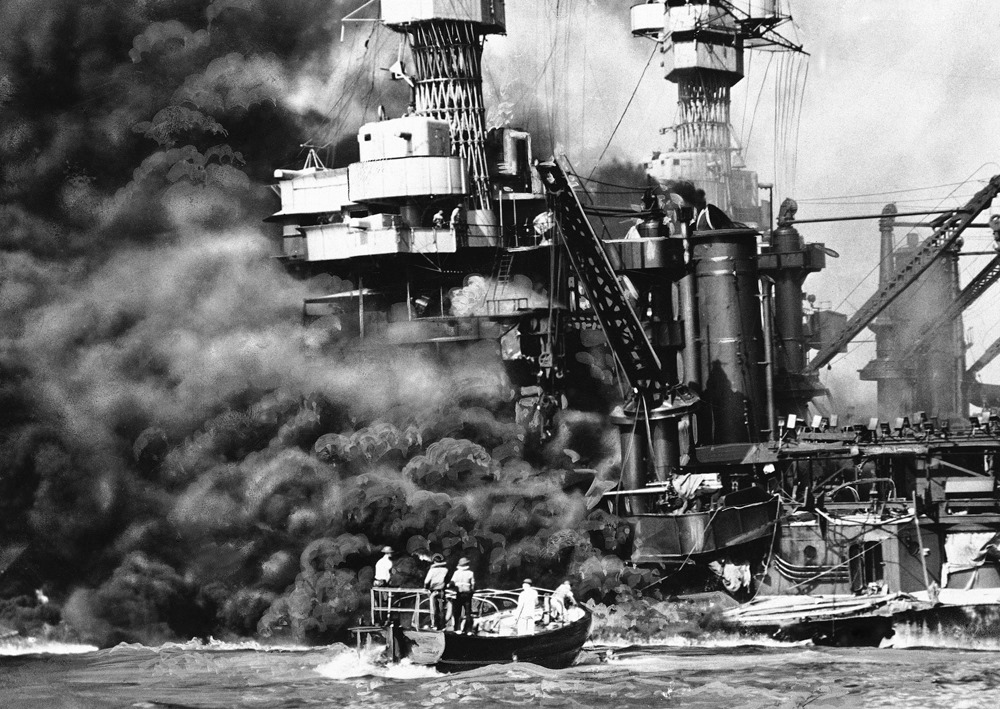
    I was reflecting this morning that the events of December 7, 1941, would have made Christmas an anxious time for millions of Americans.

    It was on this date 80 years ago that the Imperial Japanese Navy launched a surprise strike on the United States naval base at Pearl Harbor, precipitating the U.S.’ entry into World War II. Sailors, soldiers, airmen, marines, and civilians were caught in the attack. In all, 2,403 Americans were killed and 1,178 wounded.

    A stunning blow, by any measure. Yet, from what I gather, though surely shadows must have flitted across the consciousness of any rational celebrant that year, Christmas in the U.S. proceeded pretty much as it always had.

    Of course, it wouldn’t be long before the war turned everyone’s lives upside down. There was the need to organize, train, and outfit an enormous influx of civilians into the armed forces. Means of production would be adapted to meet the necessities of defense. For those who remained at home, there would be restrictions on many facets of American life. It would be a time of enormous personal sacrifice, and of course concern for loved ones deployed around the globe.

    It’s hardly conceivable today, when so many Americans are affronted by the slightest suggestion that there is a world outside of themselves, that our citizenry would be up to such a challenge. Not when people become apoplectic if they have to wear a mask or endure a Columbus Day parade. I shudder to think what would be the reaction when the butter, bacon, and sugar disappeared.

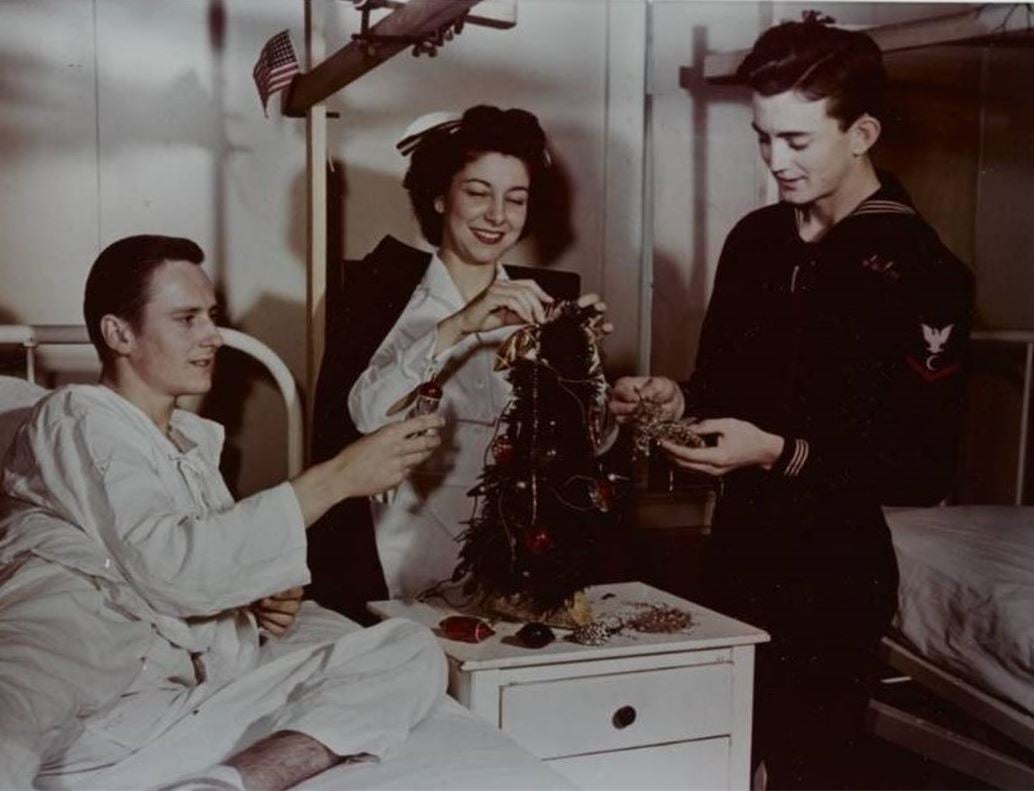
    Christmas 1942 was really the era’s first “wartime Christmas.” In 1941, aside from any psychological discomfort, there were few deprivations for Americans. Gas rationing would begin in December 1942, and a 35 mph “Victory Speed Limit” imposed. By 1943, metal would disappear from kids’ toys and copper from pennies. In the coming years, fathers, sons, and brothers would be in short supply, as they spent Christmas abroad with Uncle Sam.

    Wartime Christmas was not merry for all, by any means. During the conflict, some of our fighting men were lucky enough to get turkey. Others were fortunate to get an apple or even a potato. All would have been thankful for their lives.

    Here’s an interesting article on American Christmases during World War II. I never realized that the nylon shortage was because the material was needed to make parachutes. I guess the dream was kept alive through pin-ups. At least Artur Rodzinski’s recording of the “1812 Overture” was selling well.

    https://www.militarytimes.com/news/your-military/2018/12/18/christmas-in-wartime/

    It’s not difficult to understand why wartime favorites like “White Christmas” and “I’ll Be Home for Christmas” were embraced in their poignancy. While family celebrations would continue during those lean years, for most servicemen, attendance would be only in their dreams.


    Newsreel of Pearl Harbor devastation

    FDR’s declaration of war

    “I’ll Be Home for Christmas”

    Rodzinski’s “1812”

  • Germaine Tailleferre in Philadelphia

    Germaine Tailleferre in Philadelphia

    I find it fascinating that Germaine Tailleferre waited out World War II in Philadelphia. And yet I can never seem to find out very much about what she did while in exile.

    Tailleferre was the only female member of Les Six, that loose collective of composers that rose to prominence in Paris in the late ‘teens and 1920s, under the guidance of Jean Cocteau. Her famous colleagues included Francis Poulenc, Darius Milhaud, Arthur Honegger, and Georges Auric. Louis Durey, a hard-line communist who went on to set poems by Ho-Chi Minh and Mao Zedong, is the one nobody remembers. (I wonder why.)

    Tailleferre was strong-willed from the beginning. Her birth name was Taillefesse, but she changed it to spite her father, since the old man opposed her musical studies. However, she took piano lessons with her mother and was admitted into the Paris Conservatory. It was there that she met the rest of The Six and that the prizes began to pile up. She also earned the friendship and received the support of Maurice Ravel.

    In 1925, she married Ralph Barton, the American caricaturist, and moved to New York. Two years later, the couple returned to France, then divorced. Her career thrived in the 1920s and ‘30s. With the outbreak of World War II, however, she beat it back to the United States, leaving most of her scores at her home in Grasse, and, as I said, passed the war years in Philadelphia.

    After the war, she again returned to France, where she resumed her career. As she got older, her pieces tended to be shorter, as she suffered from arthritis. She also wrote a lot for children and young pianists. She composed virtually right up until the time of her death in 1983, when she was 91 years-old. She wrote so much, in fact, that a lot of the music of her later years has never been published, and fresh discoveries from her output are being recorded all the time.

    Happy birthday, Germaine Tailleferre! If anyone has any information about her activities in Philadelphia, I would be very curious to know.


    The Concertino for Harp and Orchestra (1927):

    The lovely and wistful “Arabesque” for clarinet and piano (1972):

    https://www.youtube.com/watch?v=i0E8tUzQezA See Less

    The Concerto for Piano and Orchestra (1924). The piece was given its U.S. premiere – in the presence of the composer – by Alfred Cortot and the Philadelphia Orchestra, conducted Leopold Stokowski.

  • Remembering Pearl Harbor & Seeking Unity

    Remembering Pearl Harbor & Seeking Unity

    Perhaps if we reflected more on all we’ve been through as a country, and the trials of our forebears, we would be more inclined to honor their sacrifices with less division, more public mindedness, and a little kindness.

    It was on this date in 1941 that the Imperial Japanese Navy launched a surprise military strike against the United States naval base at Pearl Harbor, awakening Yamamoto’s “sleeping giant” and precipitating the U.S.’s entry into World War II. Ultimately, that probably turned out to be a good thing, but tell that to the 2,403 Americans killed and the 1,178 wounded. Sailors, soldiers, airmen, marines, and civilians were caught in the attack.

    In 1991, American composer John Duffy was commissioned by the U.S. government to mark the 50th anniversary of the strike. The result was “A Time for Remembrance: A Peace Cantata.” Duffy dedicated the work to the memory of the victims of Pearl Harbor. Among them were the composer’s sister, brother, and cousin. The texts are taken from a poem by Rupert Brooke, a speech by Franklin Delano Roosevelt, an African American spiritual, and actual letters written by sailors aboard the USS Arizona.

    James Earl Jones is the narrator on the only recording of the piece, with the Milwaukee Symphony Orchestra conducted by Zdenek Macal, which I am very sorry to see has not been posted online, though you’ll find a few audio clips when you click on the link. The relevant files are titled “The Dead,” “Letters Home,” “I Want to Die Easy,” “An End to War,” and “Blow out you bugles, over the rich Dead.”

    http://www.johnduffy.com/freedomworks.html

    Grant us peace – internationally and at home.

  • LBJ Saved Leinsdorf A Musical Rescue

    LBJ Saved Leinsdorf A Musical Rescue

    It was recently brought to my attention that we have Lyndon Johnson to thank for Erich Leinsdorf.

    In 1938, Leinsdorf was 26 years-old and conducting at the Metropolitan Opera, when his visa expired. This was very bad timing indeed. Of course, Leinsdorf had been working hard to build a career in New York. But to really put things in perspective, the Anschluss had just taken place in March. For Leinsdorf, an Austrian Jew, to travel back to Vienna would have been the beginning of the end.

    He immediately applied for a six month extension, but grew increasingly uneasy as he received no response. Fortunately, a couple of American friends with good connections were able to hook him up with Johnson, who was then but a young congressman of 30 himself. It was Johnson’s idea to have Leinsdorf leave the country but to reenter through Cuba as an immigrant. He did everything to smooth his path. Leinsdorf followed Johnson’s instructions and before long he was back in the U.S. to declare his intention to become a citizen.

    The two men remained friendly for decades. Leinsdorf even supported Johnson’s run for the Senate. Later, however, when he disagreed with some of Johnson’s policies, he didn’t hesitate to let him know. The following was Johnson’s response to Leinsdorf’s criticisms: “Your letter makes me proud that I could have a hand in making a new citizen, who would so well use his citizenship.” Would that this story could play out that way today!

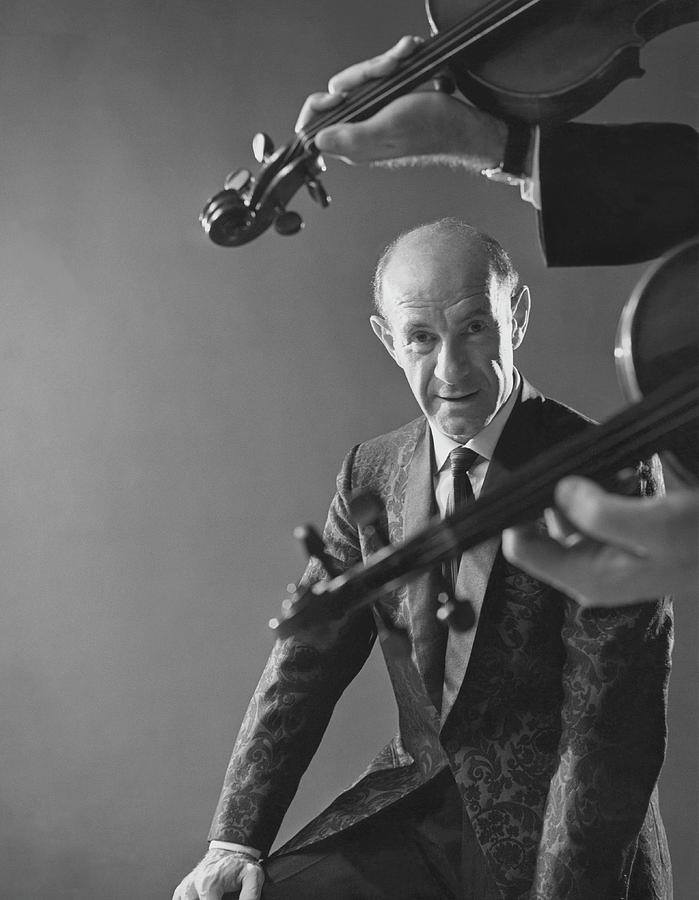
    Leinsdorf may have had the good fortune to escape Hitler, but in 1962 he had the bad luck to land one of the most prominent conducting posts in the United States – music director of the Boston Symphony Orchestra – in the wake of the great Charles Munch. Not only was Leinsdorf unprepared to handle the politics of the organization – in a ceaseless battle against musicians and administration, his outspokenness didn’t earn him many friends – he also came in for a sound drubbing from the critical establishment, which found many of his performances to be just meh.

    As someone who saw Leinsdorf conduct often in Philadelphia during his twilight years, I couldn’t disagree more. As a guest conductor, Leinsdorf brought plenty of interesting music and assembled it into satisfying programs. What’s more, unburdened by the pressures of being boss, he turned in some pretty good performances and actually seemed to enjoy himself.

    This afternoon, I’ll celebrate Leinsdorf on the anniversary of his birth with some of his better recordings, which I’ll shuffle into the mix between 4 and 7 p.m. EST, on WWFM – The Classical Network and wwfm.org.


    On November 22, 1963, Leinsdorf found himself in the unenviable position of breaking the news of President Kennedy’s assassination from the stage of Boston’s Symphony Hall and over WGBH radio. He then conducted the funeral march from Beethoven’s “Eroica” Symphony in JFK’s honor. It’s especially moving to hear the audience’s reaction in those days before cell phones. Remember also that the musicians were in the process of digesting the news themselves, as the replacement scores had only just been distributed.

  • Ida Haendel: Violinist, Chelm Survivor

    Ida Haendel: Violinist, Chelm Survivor

    Earlier this week, I posted about the “Sages of Chelm,” in connection with a piece of music bearing that name by Matthew H. Fields. In Yiddish lore, the citizens of Chelm, Poland, were notorious for their batty solutions to everyday problems. This Chelm is a kind of never-never land that charms with its inevitably ironic punchlines.

    There is nothing light-hearted, however, about the real-life fate of the citizens of Chelm, who were liquidated during World War II. Most of the 18,000 Jews living there were murdered by the Nazis.

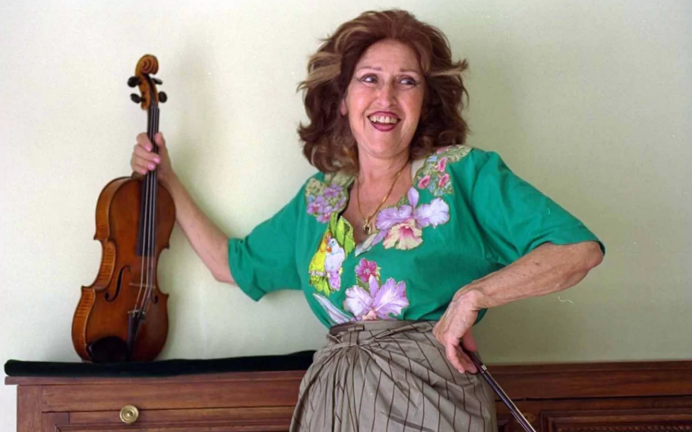
    The violinist Ida Haendel was born in Chelm on this date in 1928, only a decade before the death marches and extermination camps were implemented. To say that Haendel was a gifted prodigy is an understatement. She won the Warsaw Conservatory’s Gold Medal and first Huberman Prize in 1933, at the age of five, for her performance of the Beethoven Violin Concerto. At seven, she was competing against David Oistrakh and Ginette Neveu, about twenty years her senior, to become a laureate of the first Henryk Wieniawski Violin Competition. Soon, she was studying in Paris with legendary pedagogues Carl Flesch and George Enescu.

    During WWII she employed her talent to help boost the morale of British and American troops and factory workers. In 1937, she made her first appearance at the Proms. She went on to perform at the Proms no less than 68 times.

    Internationally, she played with many of the great conductors, drawing particular acclaim for a recording of the Sibelius Concerto. Sibelius personally wrote her to say, “I congratulate you on the great success, but most of all I congratulate myself, that my concerto has found an interpreter of your rare standard.” In all, her recordings span some 70 years.

    In 2006, she played before Pope Benedict XVI at the former concentration camp of Auschwitz-Birkenau. The organizers suggested that she play something Jewish. Instead, she chose Handel’s prayer from the “Dettingen Te Deum.” The work was arranged by her teacher, Carl Flesch.

    Haendel was extremely fortunate in that her talent allowed her to escape the fate of so many of her townspeople. Today, she is 90 years-old. Happy birthday, Ida Haendel.

    More about Ida Haendel:

    http://www.interlude.hk/front/great-women-artists-shaped-music-vi-ida-haendel/

Tag Cloud

Aaron Copland (92) Beethoven (95) Composer (114) Film Music (120) Film Score (143) Film Scores (255) Halloween (94) John Williams (185) KWAX (229) Leonard Bernstein (100) Marlboro Music Festival (125) Movie Music (135) Opera (198) Philadelphia Orchestra (88) Picture Perfect (174) Princeton Symphony Orchestra (106) Radio (87) Ralph Vaughan Williams (85) Ross Amico (244) Roy's Tie-Dye Sci-Fi Corner (290) The Classical Network (101) The Lost Chord (268) Vaughan Williams (103) WPRB (396) WWFM (881)

DON’T MISS A BEAT

Receive a weekly digest every Sunday at noon by signing up here


RECENT POSTS