Oh, Ralph, you’re such the contrarian. You wrote that embodiment of English pastoralism, “The Lark Ascending,” in response to the War to End All Wars. Then in peacetime, in the early 1930s, you composed your most turbulent symphony, the Symphony No. 4. Some say that already you sensed the impending cataclysm of World War II. Then when the war finally hit, you turned around and wrote your most serene symphony.
On this date in 1943, you unveiled your Symphony No. 5. Queen’s Hall lay in ruins from German bombs, so you conducted the London Philharmonic at Royal Albert Hall. Perhaps unexpectedly, the audience that day found itself awash in hope and optimism. In place of the seemingly obligatory bluster of a “wartime symphony,” there was a sense of affirmation in a musical celebration of humanity and tradition. London may be rocked by air raids today, but England, the country and its people, would endure.
You had already long been flirting with your pet project, the opera “The Pilgrim’s Progress,” for decades. The symphony shares the same sense of faith and optimism in the face of seemingly implacable adversity. The audience emerged into the sunlight on that summer afternoon feeling refreshed and ready to face the future.
The Symphony No. 5 (dedicated, by the way, to Jean Sibelius):
December 7, 1941. A date that has lived in infamy.
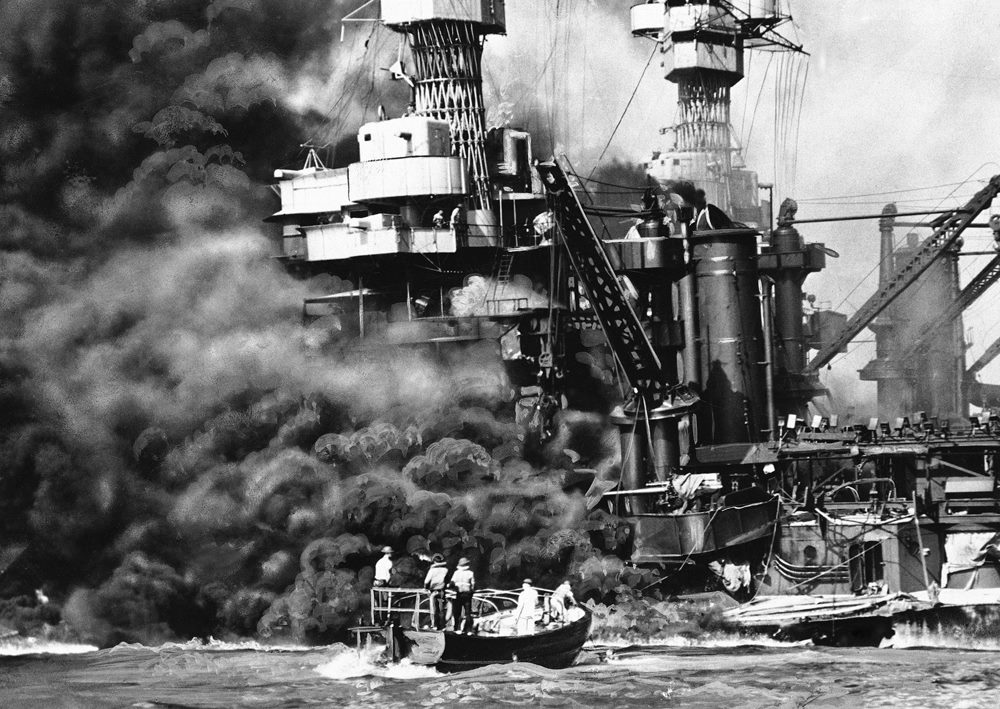
75 years ago today, the Imperial Japanese Navy launched a surprise military strike against the United States navy base at Pearl Harbor, awakening Yamamoto’s “sleeping giant” and precipitating the U.S. entry into World War II. Ultimately, that probably turned out to be a good thing, but tell that to the 2,403 Americans who were killed and the 1,178 who were wounded. Sailors, soldiers, airmen, marines and civilians were caught in the attack.
In 1991, American composer John Duffy was commissioned by the U.S. government to mark the 50th anniversary of the strike. The result was “A Time for Remembrance: A Peace Cantata.” Duffy dedicated the work to the memory of the victims of Pearl Harbor. Among them were the composer’s sister, brother and cousin. The texts are taken from a poem by Rupert Brooke, a speech by Franklin Delano Roosevelt, an African American spiritual, and actual letters written by sailors aboard the USS Arizona.
We remember this afternoon, and we’ll honor a few birthday anniversaries along the way, from 4 to 7:00 EST, on WWFM – The Classical Network and at wwfm.org.
I find it fascinating that Germaine Tailleferre waited out World War II in Philadelphia. And yet I can never seem to find out very much about what she did while in exile.
Tailleferre was the only female member of Les Six, that loose collective of composers who rose to prominence in Paris in the late ‘teens and 1920s, under the guiding hand of Jean Cocteau. Her famous peers included Francis Poulenc, Darius Milhaud, Arthur Honegger, and Georges Auric. Louis Durey, a hard-line communist who went on to set poems by Ho-Chi Minh and Mao Zedong, is the one nobody remembers. (I wonder why.)
Tailleferre was strong-willed from the beginning. Her birth name was Taillefesse, but she changed it to spite her father, since the old man opposed her musical studies. However, she took piano lessons with her mother and was admitted to the Paris Conservatory. It was there that she met her future colleagues and that the prizes began to pile up. She also earned the friendship and received the support of Maurice Ravel.
In 1925, she married Ralph Barton, an American caricaturist, and moved to New York. Two years later, the couple returned to France, then divorced. Her career thrived in the 1920s and ‘30s. With the outbreak of World War II, however, she beat it back to the United States, leaving most of her scores at her home in Grasse, and, as I said, passed the war years in Philadelphia.
After the war, she again returned to France, where she resumed her career. As she got older, her pieces tended to be shorter, as she suffered from arthritis. She also wrote a lot for children and young pianists. She composed virtually right up until the time of her death in 1983, when she was 91 years-old. She wrote so much, in fact, that a lot of the music of her later years has never been published, and fresh discoveries from her output are being recorded all the time.
Happy birthday, Germaine Tailleferre! If anyone has any information on her activities in Philadelphia, I would be most curious to know.
The Concertino for Harp and Orchestra:
The lovely and wistful “Arabesque” for clarinet and piano:
It’s Veterans Day. Nearly a century ago, in May 1915, Canadian military doctor Maj. John M. McCrae composed the poem “In Flanders Fields,” after treating victims of a German chemical attack in Belgium. It captured the imagination of millions so that red poppies became a widely recognized symbol of Veterans Day.
In Flanders fields the poppies blow
Between the crosses, row on row,
That mark our place; and in the sky
The larks, still bravely singing, fly
Scarce heard amid the guns below.
We are the Dead. Short days ago
We lived, felt dawn, saw sunset glow,
Loved and were loved, and now we lie
In Flanders fields.
Take up our quarrel with the foe:
To you from failing hands we throw
The torch; be yours to hold it high.
If ye break faith with us who die
We shall not sleep, though poppies grow
In Flanders fields.
The text became the basis for the second of “Three War Songs,” by Charles Ives:
On a lighter note, here’s Ives himself singing the third, “They Are There!”
My grandfather served in World War II. He was an engineer, a sergeant, who was involved in construction and demolition. Among other things, he and his men built and blew up bridges. My uncles had medical conditions that kept them out of Vietnam. I feel very fortunate never to have had to experience modern warfare. I can’t imagine what my grandfather had to endure. He didn’t have people shooting at him all the time, but the war was no picnic, and though he had lots of funny stories, he had some close calls and did some desperate things. There are things about the war he never talked about. Some he revealed to me only toward the end of his life.
He died in 1996. At his viewing, it was mostly family, until the door opened and in walked a stranger, an old man in uniform. He had come to say farewell to his sergeant and friend, someone he had not seen for 50 years. Those of us who weren’t there, in Europe, in the Pacific, can only imagine what it was like. A simple night’s sleep could be interrupted at anytime. Of course, you couldn’t smoke, because the glowing tip of a cigarette was as good as a target.
One night, a German plane malfunctioned. Everyone heard the engine sputter, but there was no moon, and there was nothing to do but scramble blindly for shelter. My grandfather took refuge under a jeep. After the explosion, the men went to look for the body. All they found were the pilot’s feet.
In the Pacific, they had to transport nitroglycerin over some rough terrain. I gather from one of his murkier stories that someone took a shot at them.
The flag that was draped over my grandfather’s coffin was displayed on our mantle until my mother passed. It is now in the possession of my aunt.
I think of my grandfather often. I wonder what it was like to leave a young wife behind to risk everything in Europe, only to be sent to the Pacific. He talked about waves so powerful, they would dent the hull of a ship. After the war, he saw to it that all of his men found a way home. There was no organization, so everyone had to hitch rides with cargo or whatever they could get. But in the end, he did make it back.
From his image, captured in black and white photographs of the time, everyone remarks how much I look like my grandfather. The similarity ends there.