Tag: WWFM

  • Lost Chord’s Persian Sunset WWFM

    Lost Chord’s Persian Sunset WWFM

    You might say I’m on a Seemorgh diet. I see ‘Morgh, and I play it!

    This Sunday night that all comes to an end, as last week I received notice that, after 20 years, “The Lost Chord” will be “sunsetting” on WWFM.

    I hope you’ll join me for a final go ‘round, with an hour of Persian polyphonic music – that is to say, music by Persian (or Iranian) composers, based on native folk and classical melodies, but tailored specifically to western instruments.

    We’ll hear two works by Behzad Ranjbaran, recorded in 1994 for the Delos label. I had heard Ranjbaran’s lyrical Piano Concerto at a concert of the Philadelphia Orchestra some years ago, but it did not prepare me for the beauty and opulence of his “Persian Trilogy.”

    Ranjbaran, born in Tehran in 1955, is currently on the faculty of the Juilliard School. Many of his works are influenced by Persian culture and literature. The “Persian Trilogy” was inspired by the “Shahnameh,” the national epic of 11th century poet Ferdowsi.

    We’ll hear two of the three pieces, including “Seven Passages,” about the hero Rostam, who undergoes seven trials along the path to rescue the Persian king Kavus; and “Seemorgh,” about the mythical bird (“seemorgh” is Persian for “phoenix”) that raises the abandoned hero Zaal, who is able to summon her in times of crisis.

    Ranjbaran proves himself a master orchestrator. If you enjoy the music of Rimsky-Korsakov, Debussy, Paul Dukas, or Ottorino Respighi, I think you’ll really enjoy his “Persian Trilogy.”

    We’ll also hear music by Reza Vali, born in Ghazvin in 1952. Vali, currently on the faculty of Carnegie Mellon University, has been called “the Iranian Béla Bartók” for his ability to successfully meld native folk elements with established western classical forms. His “Folk Song (Set No. 9)” is composed for the combination of flute and cello. The flutist switches between various instruments of the flute family, and the cellist plays tuned crystal glass and tom-toms. As you’ll hear, the musicians are also required at various points to sing and whistle.

    It may be sunset, but we’ll keep looking to the sunrise for new possibilities. For now, it’s the last flight of the phoenix for “The Lost Chord.” I hope you’ll join me for “Roses of Persia,” a bouquet of Persian polyphonic music, this Sunday night at 10:00 EDT, on WWFM – The Classical Network and wwfm.org.

  • Conan & Barbarian Film Scores: A Final WWFM Tribute

    Conan & Barbarian Film Scores: A Final WWFM Tribute

    “Crom… I have never prayed to you before. I have no tongue for it. No one, not even you, will remember if we were good men or bad. Why we fought, or why we died. Valor pleases you, Crom, so grant me one request: grant me an hour of barbarian music!”

    Ten days ago, I received notice that, after a 13-year run, “Picture Perfect” will be “sunsetting” on WWFM. Not much notice, and tonight’s show was already scheduled. But I must say, if the series has to end, it may as well go out in a blaze of glory.

    There are those, I’m sure, who would deny themselves the guilty pleasures of viewing these silly, cheesy, violent films, all of which were inspired by the writings of pulp master Robert E. Howard. Howard created the warrior Conan in 1932. The character became the center of a series of lucrative stories first published in “Weird Tales” magazine.

    It would be a half century before Conan made the leap to the big screen, under the direction of John Milius. “Conan the Barbarian” (1982) propelled Arnold Schwarzenegger, already a legend in the field of bodybuilding, to international superstardom. While “Conan” isn’t exactly “Citizen Kane,” it does have its pleasures. The intensity of the violence can be a little disturbing, but the ponderous tone is a blast. “Conan” is a film that takes itself just seriously enough to make it occasionally hilarious.

    Another thing “Conan” has going for it is the fact that it was made on a blockbuster budget. The first-rate production values extend to the music by Basil Poledouris, who employs a full symphony orchestra to impressive ends. In fact, the “Conan” score was one of the strongest of the decade. It’s amazing that anyone would find so much inspiration in such a mediocre film, but Poledouris’ music intersperses Borodin-style Central Asia lyricism with brawny, thrilling action music.

    Sadly, the sequel, “Conan the Destroyer,” betrays signs of penny-pinching, so that it often winds up feeling like a direct-to-video effort. Poledouris was forced to make do with a smaller orchestra, which sounds a bit too much like a television ensemble. Still, he gave it his all, and there’s something to be said for the fact that it is an original score, rather than a mere retread of the original.

    Another one of Howard’s creations, Kull of Atlantis, was given the big screen treatment as “Kull the Conqueror” (1997). Kevin Sorbo, TV’s Hercules, plays the title role. The composer, Joel Goldsmith (son of Jerry Goldsmith), was asked to incorporate heavy metal riffs into his orchestral underscore. I haven’t actually seen this one, but for some reason I don’t feel like I’m missing anything.

    The astoundingly prolific Ennio Morricone – with more than 500 motion picture and television scores to his name – had an uncanny knack for spinning garbage into gold. His music for “Red Sonja” (1985) lends the film an aura of ‘80s cheese ball fun, perhaps more so than it deserves. This is the film that introduced Brigitte Nielsen as the chain-mailed barbarian beauty. Schwarzenegger appears in the supporting role of Lord Kalidor.

    “Make the music loud, Crom! Drive my enemies before me and drown the lamentations of their women.”

    “Picture Perfect” gallops off into the sunset with movies inspired by the writings of Robert E. Howard, this Saturday evening at 6:00 EDT, on WWFM – The Classical Network and wwfm.org.


    PHOTO: Classic Ross Amico, after 28 minutes of music from “Conan the Barbarian”

  • Odyssey on the Radio This Sunday

    Odyssey on the Radio This Sunday

    I’d be the first to admit that some of my shows have been more like groundouts to first. But this one is a guaranteed Homer.

    This Sunday night on “The Lost Chord,” tune in for an hour of high adventure and satisfied bloodlust, as we listen to musical evocations of “The Odyssey.”

    We’ll hear Ernst Boehe’s symphonic poem “Departure and Shipwreck,” from his cycle “From Odysseus’ Voyages” (1903-05), and Benjamin Britten’s radio play “The Rescue of Penelope” (1943), narrated by Dame Janet Baker.

    Odysseus, of course, is one of the heroes of the Trojan War, waylaid time and again, on his homeward journey, by Poseidon and the frailties of his own men. It takes him ten years to make his way back to Ithaca. When he gets there, he finds his wife beset by boorish suitors all vying for her hand and his throne.

    What happens next pushes all the same buttons that are still pushed whenever Sylvester Stallone or Arnold Schwarzenegger apply the camouflage, strap on the bandoliers, and sheathe the big knives. Along the way, there’s also some meaningful father-son bonding. Leave it to Homer, who always knew how to lend a little class to the classics.

    Zing goes the string of Odysseus’ bow! Just as Grandma rendered in needlepoint, there’s no place like “Home Sweet Homer,” this Sunday night at 10:00 EDT, on WWFM – The Classical Network and at wwfm.org.

  • Armchair Travel Through Film Scores

    Armchair Travel Through Film Scores

    This week on “Picture Perfect,” settle in for a little armchair traveling as, musically, we follow the English abroad.

    We’ll hear selections from “Enchanted April” (Richard Rodney Bennett), “A Passage to India” (Maurice Jarre), “The Best Exotic Marigold Hotel” (Thomas Newman), and “Around the World in 80 Days” (Victor Young).

    Bennett, quite the accomplished concert composer (and occasional torch song singer), supplies a sensitive score for the 1991 Merchant/Ivory adaptation of Elizabeth von Arnim’s novel about four English ladies who spend an idyllic month at an Italian villa.

    Jarre received his third Academy Award for his music to David Lean’s final film, a 1984 adaptation of E.M. Forster’s novel of repression and racial tension in colonial India.

    Newman incorporates traditional Indian elements into his score for “The Best Exotic Marigold Hotel,” the 2012 surprise hit about English pensioners reinventing themselves in retirement in Jaipur.

    And Young won his only Oscar (alas, posthumously bestowed) for “Around the World in 80 Days,” the star-studded, light-as-a-feather, though admittedly charming mega-winner at the 1956 Academy Awards. It takes longer to watch the movie than it does to read Jules Verne’s novel – though it does provide a rare opportunity to see Ronald Colman in color.

    No need to pack your valise for Picture Perfect,” music for the movies, this Saturday evening at 6:00 EDT, on WWFM – The Classical Network and wwfm.org.
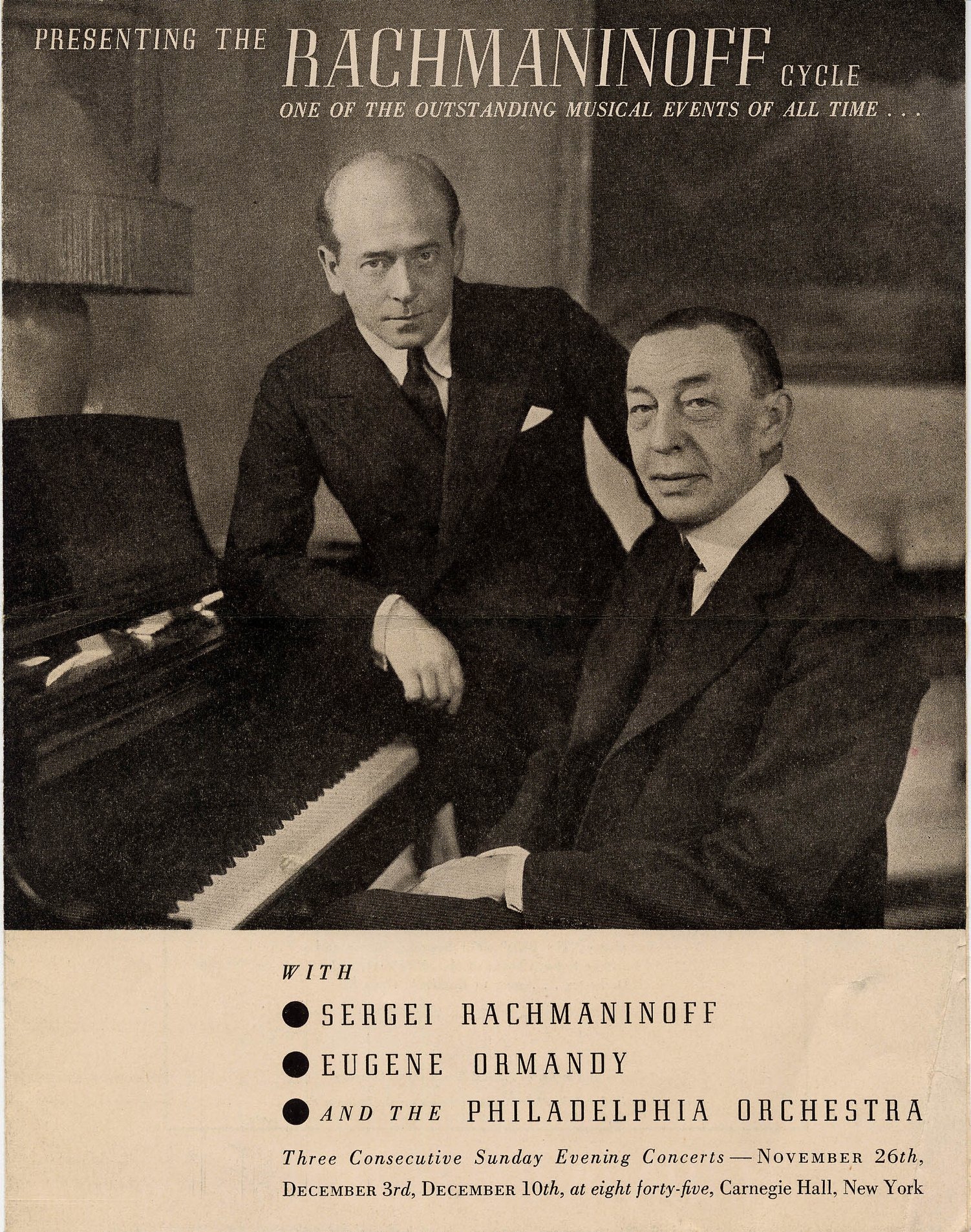

    PHOTO: There’s no balloon in Verne’s original, but as long as there’s champagne, who cares?

  • Rachmaninoff at 150 Anniversary Celebration

    Rachmaninoff at 150 Anniversary Celebration

    Sergei Rachmaninoff may have been born on April 1, but he was nobody’s fool. Frequently derided by critics, he knew just what the public wanted – good tunes and heart-on-the-sleeve emotion! His Piano Concertos Nos. 2 & 3, the “Rhapsody on a Theme of Paganini,” the Symphony No. 2, the “Vocalise,” and more solo piano works than I care to list, including the Prelude in C-sharp minor – so ubiquitous the composer himself came to hate it – have never been out of the active repertoire.

    Rachmaninoff has been my focus on “The Lost Chord” several times over the years – I devoted a show to his friendship with Nikolai Medtner and another to his achievements as a recitalist – but the program most easily referenced is the one that aired this past Sunday on WWFM – The Classical Network.

    For Rachmaninoff’s 150th birthday, enjoy an hour of vintage recordings of his music, including one of the composer playing his own “Symphonic Dances,” on the piano of Eugene Ormandy, in 1940. Also, Ormandy introduces – and conducts – the Philadelphia Orchestra in a memorial performance of “Isle of the Dead,” given only days after Rachmaninoff’s death in 1943. The hour concludes with a literal party piece, as Rachmaninoff tosses off the folk song “Bublichki,” or “Bagels,” in 1942.

    The recordings are taken from a 3-CD boxed set on the Marston Records label. Get a piece of the Rach! Enjoy the webcast by following the link and clicking on “listen.”

    https://www.wwfm.org/show/the-lost-chord-with-ross-amico/2023-03-24/the-lost-chord-march-26-rach-of-ages

    Happy 150, Sergei Rachmaninoff!

Tag Cloud

Aaron Copland (92) Beethoven (94) Composer (114) Conductor (84) Film Music (106) Film Score (143) Film Scores (255) Halloween (94) John Williams (179) KWAX (227) Leonard Bernstein (98) Marlboro Music Festival (125) Movie Music (121) Mozart (84) Opera (194) Picture Perfect (174) Princeton Symphony Orchestra (102) Radio (86) Ross Amico (244) Roy's Tie-Dye Sci-Fi Corner (290) The Classical Network (101) The Lost Chord (268) Vaughan Williams (97) WPRB (396) WWFM (881)

DON’T MISS A BEAT

Receive a weekly digest every Sunday at noon by signing up here


RECENT POSTS